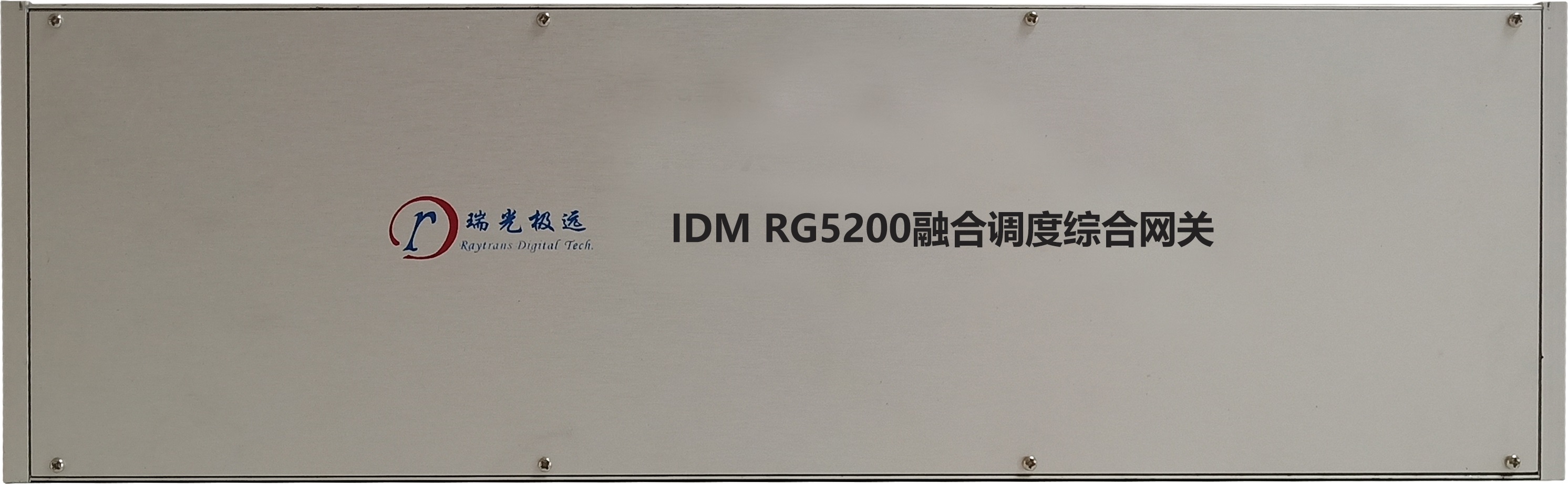
IDM RG2000 Series ROIP Wireless Trunking Intercom Gateway Series Products
Enables interconnection between radio stations and PSTN public switched telephone networks, supporting analog conventional, digital conventional, analog trunking, digital trunking, shortwave and other types of radios, supporting various types of standard telephone exchanges, and supporting active dialing from radio stations.
Gallery
Enables interconnection between radio stations and PSTN public switched telephone networks, supporting analog conventional, digital conventional, analog trunking, digital trunking, shortwave and other types of radios, supporting various types of standard telephone exchanges, and supporting active dialing from radio stations.
Function Introduction:
Trunking intercom has a long development history, and most user organizations already have comprehensive wireless network coverage. There are numerous industries and organizations currently using it, and compatibility with existing equipment must be considered during expansion. The drawback is the single communication method, with emphasis on trunking intercom.
The Trunking Intercom Gateway is a powerful voice access device that facilitates the integration of trunking intercom systems with telephone systems. Users can conveniently call radios via telephone, and can also use radios to make phone calls. The system supports traditional PSTN telephone lines and SIP-based VoIP telephone lines, making deployment and usage convenient with plug-and-play capability. Combined with years of experience in the multi-party voice field, the voice algorithms developed ensure call quality superior to similar products currently on the market.
The Trunking Intercom Gateway adopts a carrier-grade product design scheme with powerful networking and voice processing capabilities. It utilizes microcomputer chip technology and electronic switching technology, with each channel control being independent, providing sensitive switching of audio signals in and out. It supports simultaneous access of 2 channels, 4 channels (1U equipment), and 48 channels (3U equipment) of intercom. It uses DB9 connectors, with 6U equipment configured with RJ45 connectors, and comes with professional radio control cables.
The Trunking Intercom Gateway is flexible and simple to deploy, ready for use with simple wiring. It supports PSTN, SIP, and is compatible with multiple models of handheld radios and transceivers. Standard 19-inch rack mounting ensures safety and reliability.
The equipment supports ordinary telephone and IP interfaces (built-in IAD), and can connect to PBX subscriber lines, telecom bureau subscriber lines, analog subscriber gateway IAD and other devices. It also supports SIP applications of major companies' IP-PBX, softswitch, and SIP servers. It can seamlessly integrate with various command and dispatch systems.
IDM MCC is a next-generation dispatch communication system based on IP networks, comprehensively meeting users' intelligent command & dispatch communication needs in terms of management, usage, deployment, and maintenance. Due to its short development history, IDM MCC focuses more on transmission, access, and interconnection of heterogeneous networks, with applications on wired networks being less extensive in wireless network communications compared to trunking systems;
By integrating and interconnecting IDM MCC multimedia dispatch with wireless trunking through the gateway, the advantages of both systems can be fully utilized, forming a command & dispatch communication system that combines wired and wireless, has wide coverage, rich communication methods, flexible and convenient usage, and simple management and maintenance, meeting users' needs for upgrading from traditional communications to intelligent communications while protecting users' original investments.
The Trunking Gateway enables trunking interconnection, including traditional trunking intercom systems such as analog trunking, TETRA, GOTA, and new IP network intercom voice gateway devices. It can connect professional PTT systems and traditional trunking systems (iDEN, TETRA, GOTA, analog intercom, etc.), trunking systems of different frequency bands, and achieve interconnection between digital trunking and analog trunking systems, with no restrictions on regions or number of trunking groups, enabling cross-band and cross-network communication, with flexible networking methods and simple engineering implementation.
Through the intercom gateway, mutual calling can be achieved nationwide or globally via mobile phones, telephones, and any traditional voice intercom system. Through the trunking intercom voice gateway, mobile phone intercom systems, digital trunking systems (such as TETRA, GOTA), analog trunking systems, and conventional frequency band radio intercom can be easily connected to CDMA, GPRS, WIFI, business private networks, LANs, and the Internet, achieving long-distance wireless intercom communication integration.
The main problems it solves are real-time performance and error-free transmission of PTT signals, thereby solving the challenge of transmission distance constrained by transmit power, antenna sensitivity, and other factors in radio transmission. It not only achieves the goal of ultra-long-distance relay-free interconnection, but can also form low-power distributed intercom signal coverage systems. Through IP networks, low-power ultra-long-distance cross-regional radio signal interconnection is accomplished. Typical applications include cross-city and cross-province public security wireless command & dispatch, wireless communication between north and south divisions of large enterprises, and unified wireless command & dispatch for large-scale mining areas. In short-distance applications, RoIP technology can accomplish low-power community radio signal coverage through LANs, revolutionizing the traditional high-power repeater station radio signal coverage solutions.
- Application Environments:
Widely used in public security, armed police, fire protection, military, civil air defense, industrial and mining enterprises, forestry, petroleum, electric power, government, public safety, transportation, large enterprises and institutions, hotels, property management, security, etc., achieving rapid response for emergency handling and converged communication of multiple communication methods.
Intercom signal networking coverage for subway stations of metro companies
Intercom system networking coverage for various regions of oil fields and mines
Large-scale intercom system networking coverage for forest fire prevention
Long-distance signal extension for railway tunnels
Unified command & dispatch for various sports venues during large events
Highway radio signal extension
Unified dispatch for various branches of logistics companies
Intercom system coverage for large commercial buildings, shopping malls, and underground parking lots
Intercom system coverage for large property residential communities, buildings, and underground parking lots
Cross-regional patrol for public security joint defense, urban management, etc.
Construction sites for high-speed rail and highways
- Application Modes:
Remote interconnection;
Heterogeneous network interconnection, wired networks, wireless and trunking networks, mobile communication networks GSM/CDMA, IP networks;
Interconnection of different standard trunking systems, digital trunking, analog trunking;
Can be used as trunking repeater or translator station.
- Features:
Support for multiple types of radios
Support for standard PSTN telephone exchanges
Voice delay adjustment
Active dialing from radio stations
Forced disconnection
Software parameter configuration
External wired intercom terminal handset, speaker
Does not change radio usage methods
Unparalleled noise cancellation technology
Multiple dialing and number reception rule configurations
Multi-channel telephone (SIP, PSTN) access processing capability
Adaptive VOX (voice activation) with adjustable sensitivity
Adjustable input and output volume
COR, PTT valid signals user-configurable
- Specifications
· VoIP Protocol Support: SIP
· Audio Input: Unbalanced 600 ohms, -26dBm to +12dBm level; 100Hz to 1500Hz
· Audio Output: Unbalanced 600 ohms, -26dBm to +12dBm level, 100Hz to 1500Hz
· Voice Codecs: G.711A, G.711μ, G.729, G.723, GSM610, iLBC, Speex, etc.
· DTMF: RFC~2833, InBand
· Programming Control: HTTP, Serial Port
· Network Interface: 10/100M, RJ45
· Number of Ports: 2/4/8
· Radio: DB~9 Female
- Configuration:
Web user management interface
Supports English and Simplified Chinese
HTTP online upgrade
Configuration file backup and restore
Diagnostic tools: ping, tracer, DNS lookup, SIP route tracing
Comprehensive alarms and event logging
- Principles:
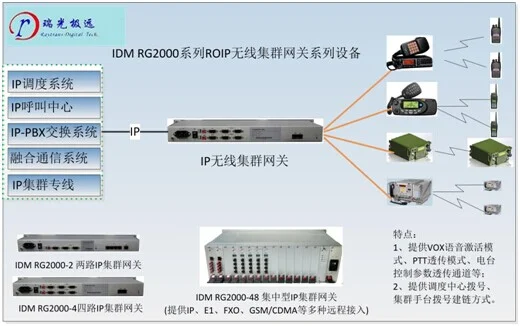
The wireless trunking gateway interconnects the dispatch system with the wireless system, achieving interoperability between wired and wireless networks;
The IP side of the wireless trunking gateway connects to the IP network via the Ethernet port, registering to the dispatch system as a dispatch system terminal;
The wireless side serves as a terminal of the wireless trunking system, connecting to the wireless trunking system through radio relay circuits;
For wireless trunking and SIP networks, the wireless trunking gateway acts as a terminal with its own independent broadcast channel and extension number;
The trunking gateway can register as a terminal to the SIP Server of the NGN network;
Wireless trunking can call a terminal telephone number of the trunking gateway via PTT key or DTMF dialing, and can also correspond to an intercom group and conference group;
Wired telephone calls to the trunking gateway number can connect to trunking intercom devices on the same frequency band as the trunking gateway;
Different standard trunking systems can achieve intercom interoperability through the trunking gateway;
Supports wired and wireless hybrid multi-level talk-right preemption;
During use, one trunking gateway corresponds to one wireless channel, allowing same-channel intercom systems to be connected to the IP communication system;
Various standards of digital trunking and analog trunking can be connected to the IP communication system;
Through other conversion gateways, wireless trunking can interoperate with fixed telephones, wired intercom, GSM/CDMA and other terminals;
Equipped with 350M trunking interface, 800M trunking interface, VHF conventional communication interface, UHF conventional communication interface, TETRA interface.
- Supported Standards:
Radio Specifications
Radio RX Input: Balanced Hi-Z; accepts signals from -30 to +11 dBm, 10 to 3600 Hz
Radio Unsquelch Detection: Hardwired COR input line, DSP-based VOX or VMR
Radio TX Audio Output: Unbalanced Lo-Z; adjustable from -30 to +11 dBm, 10 to 3350Hz
Radio Transmit Control: Open drain PTT signal; with max sink current of 100 mA, max open circuit voltage of 60 VDC
Network Specifications
RFC 3261: SIP: Session Initiation Protocol
RFC 2976: The SIP INFO Method
RFC 3515: The Session Initiation Protocol (SIP) Refer Method
RFC 2327: SDP: Session Description Protocol
RFC 3264: An offer/answer model with Session Description Protocol (SDP)
RFC 1889: RTP: A transport protocol for real-time applications
RFC 1890: RTP protocol for audio and video conferences with minimal control
SIP Support Vocoders: GSM and G711u