IDM MINI PCM Multiplexer
One device with E1 electrical port, 155M optical port dual uplink, voice, data, Ethernet, and same-unit aggregation
IDM MINI PCM multiplexer, applied in the product showcase field, communication/transmission/dispatch equipment for industry customers (to be further detailed subject to the manufacturer's technical documentation)
What Is a 155M Optical Port PCM Multiplexer
The IDM-MINI 155M optical port PCM multiplexer is an independent-structure integrated service access device developed by Beijing Ruiguang Jiyuan Digital Technology Co., Ltd. It integrates two uplink channels — an E1 electrical port and a 155M optical port — in the same unit, multiplexing voice, data and Ethernet services into a single digital stream that is sent over one of the channels, and is aimed at the communication, transmission and dispatching edge access of customers in electric power distribution, rail transit, military private network and other industries. As a 155M optical port PCM multiplexer for private network edge use, the unit's interfaces comply with standards such as ITU-T G.703 and IEEE802.3, and the site's dispatch telephone, telecontrol data and office network are aggregated on one PCM equipment.
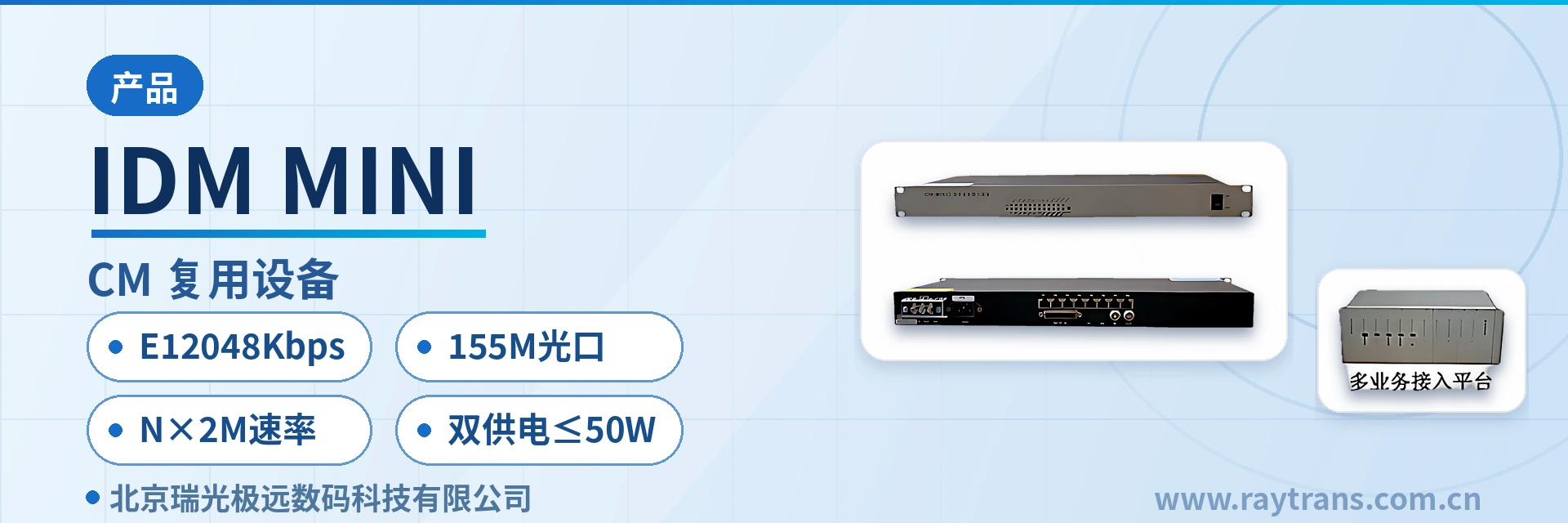
Key specifications at a glance: E1 2048Kbps · 155M optical port · N×2M rate · dual power supply ≤50W · 155M/155M single-mode FC · 8+1 channels of voice and data
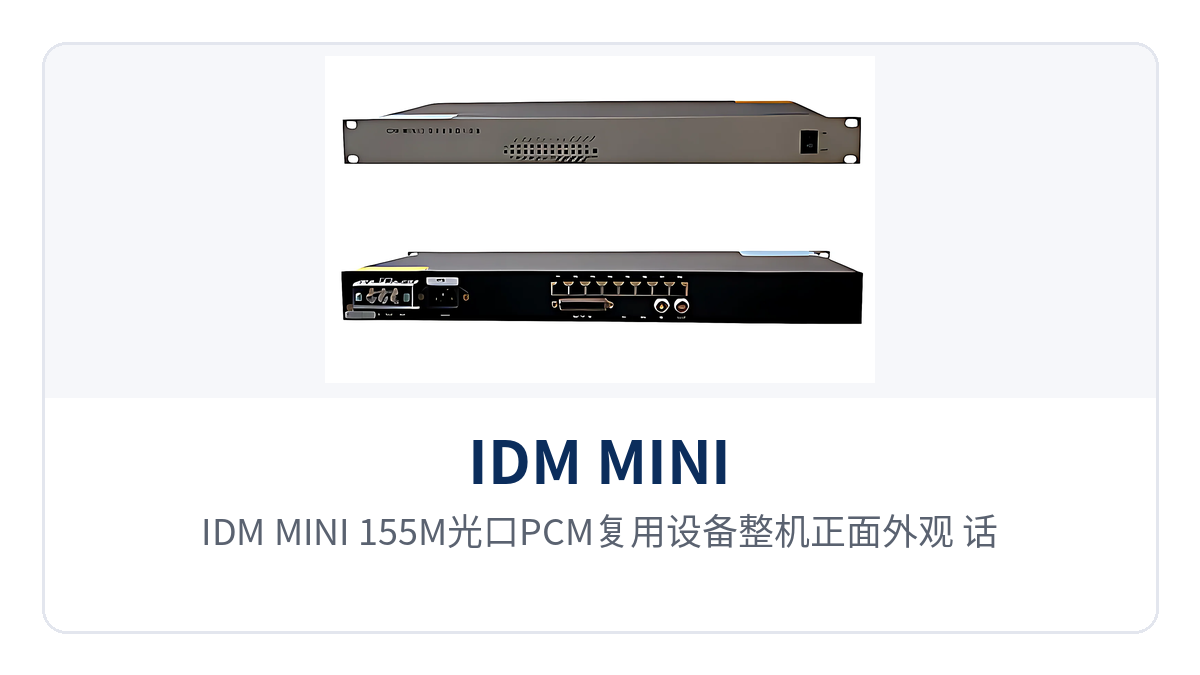
Figure 1: Front view of the IDM-MINI 155M optical port PCM multiplexer, showing voice channel interfaces, indicator LEDs and the independent-structure enclosure
A 155M optical port PCM multiplexer refers to an access device that uses a 155M-rate optical interface as the uplink channel and packages multiple 64K services for transmission in time division multiplexing mode. The IDM-MINI is exactly this form of product: the user side accesses telephone voice channels, V.24/V.35 data and RJ-45 Ethernet interfaces, and the device internally converts these signals uniformly into the 2048Kbps E1 data stream specified by ITU-T G.703, which is then sent out through the E1 electrical port or the FC optical interface. One PCM equipment replaces the single-service transmission devices originally installed separately by service type, and the number of devices and cable usage on the site side decrease accordingly.
The distinguishing point lies in the different capacity specifications of the two channels. The E1 channel is a standard 2048Kbps bundle with HDB3 line coding and 75Ω/120Ω impedance, and voice and data services share this bundle of bandwidth; the 155M optical port channel has symmetrical receive/transmit rates and, with single-mode (multi-mode optional) optical fiber, can provide full N×2.048Mbps (N≤50) Ethernet transparent transmission. Which channel to choose depends on whether E1 digital trunk resources already exist on site and whether self-owned optical cables are available.
Which Services One Device Can Access Simultaneously
The service access capacity of the IDM-MINI 155M optical port PCM multiplexer covers four types — voice, low-speed data, synchronous data and Ethernet — and is configured according to the on-site service list. The function items and descriptions are shown in the table below, and the specific interface card configuration is subject to the manufacturer's technical documentation and commercial confirmation.
Function | Description |
|---|---|
Voice service access | Provides 8 channels of 64K voice channel access, with an audio range of 300Hz to 3400Hz, A-law compression encoding per ITU G.711, and a loop current of 25mA per channel, used for dispatch telephone and inter-station communication |
Low-speed data access | The V.24 interface has a transmission rate of asynchronous ≤9600bps and synchronous 64Kbps, with electrical characteristics compliant with the CCITT V.28 protocol, carrying low-speed asynchronous data or single-time-slot synchronous data |
Synchronous data access | The V.35 interface uses the RJ-45 form, with electrical characteristics compliant with ITU-T V.35 recommendations, a transmission rate of n×64Kbps (n=0 to 31), and a terminal interface compliant with ISO2593 |
Ethernet access | Provides an RJ-45 Ethernet interface with a transmission rate of N×2.048Mbps (N≤50), standard protocol support for IEEE802.3, and an operating mode of full/half duplex/adaptive |
E1 channel transmission | The E1 interface has a bit rate of 2048Kbps and HDB3 line coding, standard protocol support for ITU-T G.703, an impedance of 75Ω/120Ω, and a PCM30/31 frame structure |
Optical fiber channel transmission | The optical interface has receive/transmit rates of 155M/155M, an interface type of FC (SC and others can be customized), a fiber mode of single-mode (multi-mode optional), and receive/transmit wavelengths of 1310nm/1550nm |
Power supply mode | Supports two power supply inputs, AC220V/DC-48V, with an overall power consumption of ≤50W, suitable for mains-powered equipment rooms and DC power supply sites |
Key Specifications
The key specifications of the IDM-MINI 155M optical port PCM multiplexer cover four parts — optical interface, E1 interface, Ethernet and data interface, and power supply — listed item by item in the tables below, and the parameters are subject to the manufacturer's product documentation and factory testing.
Optical Interface Parameters
Item | Parameter/Specification | Description/Applicable Conditions |
|---|---|---|
Interface type | FC (SC and others can be customized) | Optical connector form, customizable according to the equipment room patch cord conditions |
Fiber mode | Single-mode (multi-mode optional) | Selected according to line fiber core conditions |
Receive/transmit rate | 155M/155M | Symmetrical 155M optical rate for receive and transmit |
Receive/transmit wavelength | 1310nm/1550nm | Two wavelengths selectable |
Transmit optical power | -3 to -11dBm | Typical range on the transmit side, subject to actual measurement with an optical power meter |
Receiver sensitivity | Better than -36dBm | Used to calculate the link loss margin |
Transmission distance | 20Km | Rated distance under single-mode conditions, extendable with optional long-distance optical modules |
E1 Interface Parameters
Item | Parameter/Specification | Description/Applicable Conditions |
|---|---|---|
Bit rate | 2048Kbps | Standard E1 line rate |
Line coding | HDB3 | Line coding compliant with ITU-T G.703 |
Standard protocol | Supports ITU-T G.703 | Standard followed by the E1 interface |
Impedance | 75Ω/120Ω | 75 Ω coaxial or 120 Ω balanced interface form |
Frame structure | PCM30/31 | Primary group frame structure |
Signaling | Channel-associated signaling | Line and voice channel status transmitted along with the voice channel time slot |
Ethernet and Data Interface Parameters
Item | Parameter/Specification | Description/Applicable Conditions |
|---|---|---|
Ethernet interface type | RJ-45 | Standard Ethernet interface form |
Ethernet transmission rate | N×2.048Mbps (N≤50) | Bandwidth configured in 2.048Mbps steps |
Ethernet standard protocol | Supports IEEE802.3 | Standard followed by the Ethernet interface |
Ethernet operating mode | Adaptive half-duplex/full-duplex | Operating mode automatically negotiated with the opposite-end equipment |
V.24 transmission rate | Asynchronous ≤9600bps; synchronous 64Kbps | Low-speed asynchronous data or single-time-slot synchronous data |
V.24 electrical characteristics | Compliant with CCITT V.28 | Standard V.24 level interface |
V.35 interface type | RJ-45 | Interface form |
V.35 electrical characteristics | Compliant with ITU-T V.35 | Electrical characteristics compliant with ITU-T V.35 |
V.35 transmission rate | n×64Kbps (n=0~31) | Occupies 0~31 64K time slots as required by services |
V.35 terminal interface | Compliant with ISO2593 | Interfaces with a standard V.35 connector |
Power Supply Parameters
Item | Parameter/Specification | Description/Applicable Conditions |
|---|---|---|
Power supply mode | AC220V/DC-48V | Two power supply inputs: AC 220 V and DC -48 V |
Overall power consumption | ≤50W | Upper limit of overall power consumption including service interface cards |
Operating temperature | 0℃~40℃ | Equipment room and temperature-controlled cabinet environments |
Relative humidity | ≤90% (non-condensing) | Normal operation under non-condensing conditions |
Dimensions | 495×307×47(mm) | Length×Depth×Height, independent-structure unit |
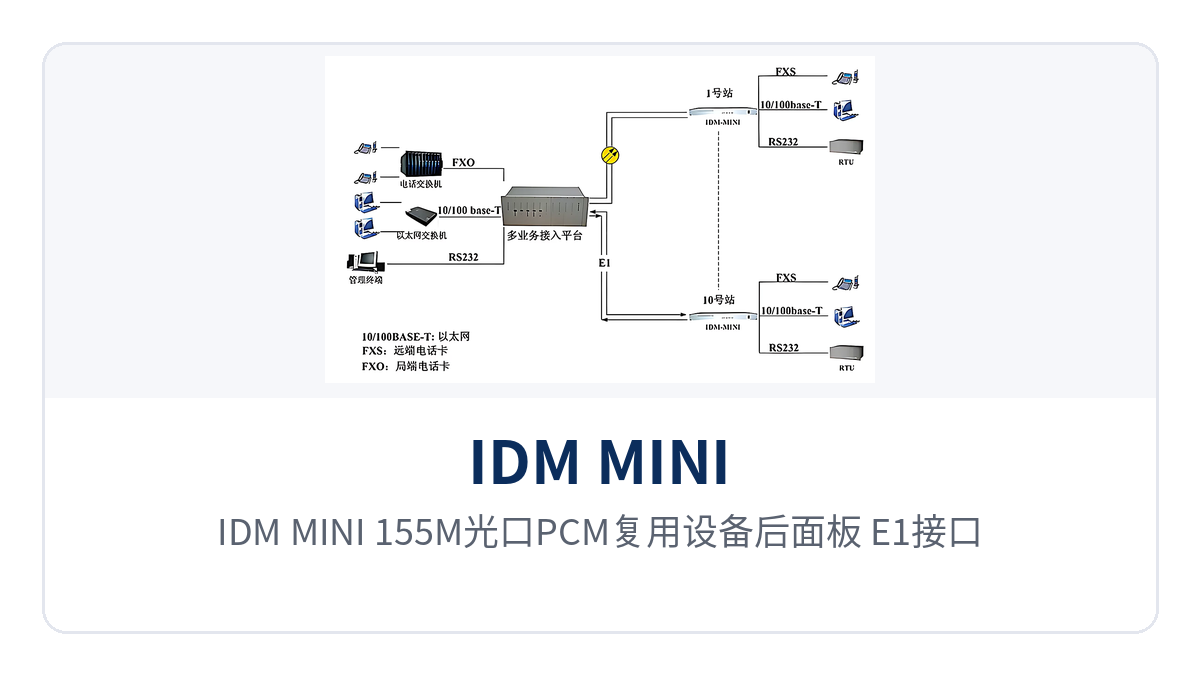
Figure 2: Rear panel of the IDM-MINI 155M optical port PCM multiplexer, close-up of the E1 interface, FC optical port and AC/DC power terminals
How the 155M optical port PCM multiplexer multiplexes voice, data and Ethernet into a single E1 channel
How are voice, data, and Ethernet multiplexed into a single E1 channel? The answer is that all service types are first split into uniform 64K time slots and then transmitted in sequence over the same channel. An E1 channel has a bit rate of 2048Kbps and a PCM30/31 frame structure, and is transmitted using the HDB3 line coding specified in ITU-T G.703, with 30 time slots carrying services and channel-associated signaling (CAS) passed along with the voice time slots.
The IDM-MINI 155M optical port PCM multiplexer allocates time slots for each service type within the unit: one voice channel occupies one 64K time slot, V.24 and V.35 data occupy corresponding time slots according to their respective rates, and Ethernet services are configured in N×2.048Mbps (N≤50) bandwidth rate steps. After multiple service types reach the opposite end site without interfering with one another, the opposite end device restores them to their original interfaces according to the same time slot allocation. As a mature PCM equipment, this model plays the role of common-channel multiplexing of voice, data, and Ethernet in the integrated service access device series.
How to Choose Between an E1 Channel and an Optical Port Channel
How to choose between an E1 channel and an optical port channel depends on which transmission resource already exists between the sites. For sites that already have a 2M dedicated line, microwave, or DDN channel, E1 channel access extends the interface working distance without laying new optical cables; for sites that already have their own optical cables, optical port channel access provides a 155M optical rate and 20Km single-mode coverage, with more room for Ethernet bandwidth configuration.
Both uplink channels are built-in capabilities of the IDM-MINI 155M optical port PCM multiplexer, with E1 transmission and optical transmission selectable, so that the same model covers both types of site conditions with unified spare parts and maintenance practices. The differences between the two channel types are compared item by item in the table below.
Comparison Dimension | E1 Channel Access | Optical Port Channel Access |
|---|---|---|
Channel Source | Existing 2M dedicated line, microwave, DDN channel | Site-owned optical cable |
Interface Form | 75Ω/120Ω E1 interface, HDB3 line coding, compliant with ITU-T G.703 | FC optical interface (SC and others customizable), single-mode (multi-mode optional) |
Transmission Rate | 2048Kbps | 155M/155M symmetric receive/transmit |
Service Bandwidth | Voice, data, and Ethernet share 2048Kbps | Ethernet bandwidth configurable at N×2.048Mbps (N≤50) |
Application | Equipment rooms and sites with existing E1 resources that need extended interface distance | Trackside and field sites with their own optical cables that need long-distance coverage |
How Far Can a PCM Multiplexer Transmit
How far a PCM multiplexer can transmit depends on which channel is used. Over the optical port channel, the IDM-MINI 155M optical port PCM multiplexer has a rated transmission distance of 20Km under single-mode conditions, with a transmit optical power of -3 to -11dBm and a receiver sensitivity better than -36dBm; the difference between the two is the available loss margin of the link, and a long-distance optical module can be optionally installed when a greater distance is required.
Over the E1 channel, the transmission distance is determined by the coverage of the connected 2M dedicated line, microwave, or DDN transmission system; the device side is responsible for converting services into an E1 data stream and does not change the coverage capability of the existing transmission system. Whether the link can reach the rated distance is determined by calculating the loss margin from the transmit optical power and receiver sensitivity, subject to actual measurement with an optical power meter. As an optical multiplexer manufacturer, Raytrans always treats link margin calculation as a mandatory item in factory testing during the design of optical multiplexing equipment.
Differentiated Value: E1 2048Kbps · 155M Optical Port · N×2M Rate · Dual Power Supply ≤50W
The differentiated value of the IDM-MINI 155M optical port PCM multiplexer centers on four points: selectable E1 channel and 155M optical port dual channels, common-channel multiplexing of 8+1 channels of voice and data with Ethernet, and dual power supply adapting to different site power conditions. The correspondence between each selling point and the value for industry customers is shown in the table below.
Differentiated Selling Point | Specific Capability | Value for Industry Customers |
|---|---|---|
2048Kbps/HDB3 line coding, E1 channel compliant with ITU-T G.703, suited to private network dispatch | E1 interface bit rate 2048Kbps, HDB3 line coding, 75Ω/120Ω impedance, PCM30/31 frame structure | The E1 channel can be directly connected to existing 2M transmission equipment in electric power distribution networks, rail transit, and military private networks, carrying dispatch telephone and telecontrol data over the same bundle |
155M/155M receive/transmit, 1310/1550nm wavelength, single-mode FC interface with multi-mode optional | Symmetric optical interface receive/transmit rate, FC connector with SC and others customizable, single-mode with multi-mode optional | A pair of optical fibers brings remote site services back, and a matching interface can be selected for different fiber core conditions |
N×2.048Mbps (N≤50) Ethernet transmission, IEEE802.3 full/half duplex adaptive | RJ-45 Ethernet interface bandwidth configured in 2.048Mbps rate steps, with operating mode auto-negotiated with the opposite end device | Site office networks, video, and collected data require no additional bridge and are carried away over the multiplexed channel |
Dual power supply ≤50W | Power supply mode supports AC220V/DC-48V, overall power consumption ≤50W | Mains-powered equipment rooms and DC-powered sites use the same model, with unified spare parts and maintenance practices |
Typical Application Scenarios
Electric Power Distribution: Dispatch Telephone and Data Backhaul from Substation to Distribution Terminal
Between substations, switching stations, and distribution terminals in electric power distribution networks, there are both dispatch telephones and automation information and in-station data. The IDM-MINI 155M optical port PCM multiplexer accesses 8 channels of voice and data interfaces at the station end, multiplexes voice and telecontrol data, and backhauls them over the E1 channel to the distribution network dispatch center, where the central-side device restores and connects them to the existing switching and transmission systems. The E1 interface has a bit rate of 2048Kbps and HDB3 line coding and complies with ITU-T G.703, allowing direct connection to existing 2M transmission equipment in the electric power private network; when the site has its own optical cable, the optical port channel can be used instead, and a pair of fiber cores covers an inter-station distance within 20Km. Power supply supports AC220V/DC-48V, so the distribution network dispatch private network can transmit stably under both mains power and DC conditions, a typical deployment form of government private network optical fiber communication solutions and energy industry private networks.
Rail Transit: Voice and Monitoring Data over One Channel at Trackside Sites
Between stations, depots, and trackside sites in rail transit, there are official telephones, low-speed monitoring data, and office networks. The IDM-MINI 155M optical port PCM multiplexer is placed at a trackside site, multiplexes in-station telephone voice channels, V.24/V.35 data, and Ethernet services, and backhauls them over one E1 channel or a pair of fiber cores to the station communications equipment room, occupying only one channel at the site side. The 155M optical port is equipped with full/half duplex adaptive Ethernet interfaces, automatically negotiating the operating mode when connecting to the station's existing switching and video equipment; the optical cable link is immune to trackside electrical interference, and the independent-structure unit can be directly installed in the in-station communications cabinet.
Military Private Network: High-Capacity Multiplexing and Flexible Networking at Mission Sites
Between command posts, duty posts, and emergency communications vehicles in military private networks, services are mainly internal telephones, low-speed data, and office networks, and there is often no dedicated maintenance personnel on site. The IDM-MINI 155M optical port PCM multiplexer provides N×2.048Mbps (N≤50) Ethernet channels and 8 channels of voice in one unit, with more than 20 types of service interface cards selected according to the mission list; the military private network can be flexibly networked as required, meeting the requirements of military emergency communications vehicle solutions for rapid deployment and multi-service convergence. The device supports AC220V and DC-48V dual power supply, with overall power consumption ≤50W, an operating temperature of 0℃~40℃, and a relative humidity ≤90% (non-condensing), suitable for deployment in temperature-controlled vehicle-mounted cabinets and fixed equipment rooms.
Conclusion
The Raytrans IDM-MINI 155M optical port PCM multiplexer is an independent-structure unit that multiplexes voice channels, V.24/V.35 data, and Ethernet services into one E1 channel or 155M optical port channel. The E1 interface has a bit rate of 2048Kbps and HDB3 line coding and complies with ITU-T G.703. The optical interface has a receive/transmit rate of 155M/155M and is single-mode with multi-mode optional. The Ethernet bandwidth is adjustable in N×2.048Mbps (N≤50) rate steps. Power supply supports AC220V/DC-48V, and the overall power consumption is ≤50W.
For edge access in electric power distribution networks, rail transit, and military private networks, when selecting this 155M optical port PCM multiplexer, first confirm the number of voice channels, data interface type, and Ethernet bandwidth rate step according to the site service list, then check the uplink channel conditions and power supply mode to complete configuration confirmation.