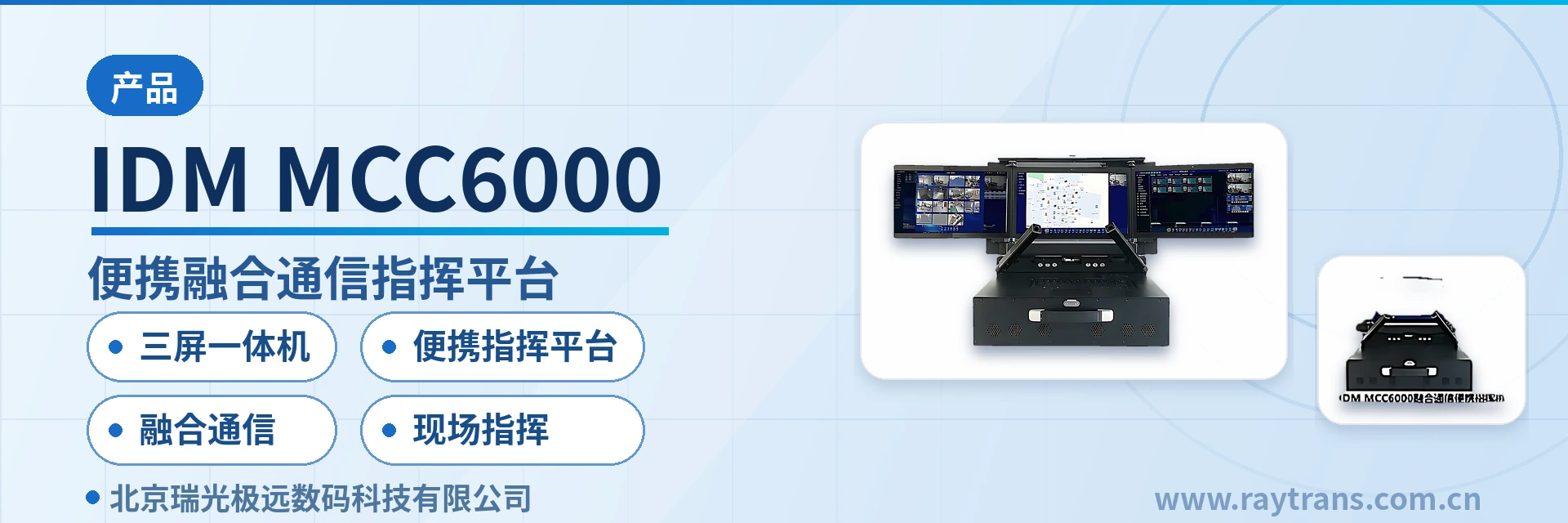
IDM MCC6000 Portable Converged Communication Command Platform
One Host with Three Screens, Dispatch Out of the Box; Set Up a Command Post On Site Without Mains Power or a Public Network
The IDM MCC6000 portable converged communication command platform adopts a three-screen all-in-one design and suits scenarios such as emergency command, enterprise emergency management, government emergency command, on-site firefighting command, on-site forest firefighting command, on-site security for large events, video training and command, and UAV flight control command.
IDM MCC6000 three-screen portable converged communication command platform is an integrated portable converged communication command device developed by Beijing Ruiguang Jiyuan Digital Technology Co., Ltd. It adopts an integrated three-screen all-in-one design that packs three fold-out monitoring screens, multi-standard communication access and command and dispatch software into a single portable chassis, and is used in scenarios such as emergency management, on-site firefighting command, security for large events and unmanned aerial vehicle (UAV) flight control command, where a command post needs to be set up on site. Disaster rescue and major event support sites often have neither a fixed equipment room nor a stable, usable public network; once on site and with the screens unfolded, the IDM MCC6000 three-screen portable converged communication command platform can take on on-site emergency command and dispatch tasks, bringing on-site networking, command and dispatch, and front-and-rear coordinated handling capability directly to the front line, and providing emergency communications with rapidly deployable portable converged communication command platform support.
Key specifications at a glance: three 15.6-inch fold-out monitoring screens · IP65 ingress protection rating · 30AH lithium iron phosphate battery · liquid cooling plus forced air cooling hybrid heat dissipation · 14th Gen i9 processor + RTX 4090 graphics card · 4 SDH optical ports (2.5G/622M/155M) · 8 groups of 4-party video conferencing
What kind of device is the three-screen portable converged communication command platform?
The three-screen portable converged communication command platform is a category of on-site emergency communications command equipment that concentrates display, communication and dispatch functions in a single portable chassis; the IDM MCC6000 three-screen portable converged communication command platform is a representative model: the unit adopts a one-host, three-screen architecture and is equipped with three 15.6-inch fold-out monitoring screens, so that multiple video feeds can be presented simultaneously once the chassis is opened, which is why it is also called a three-screen all-in-one unit.
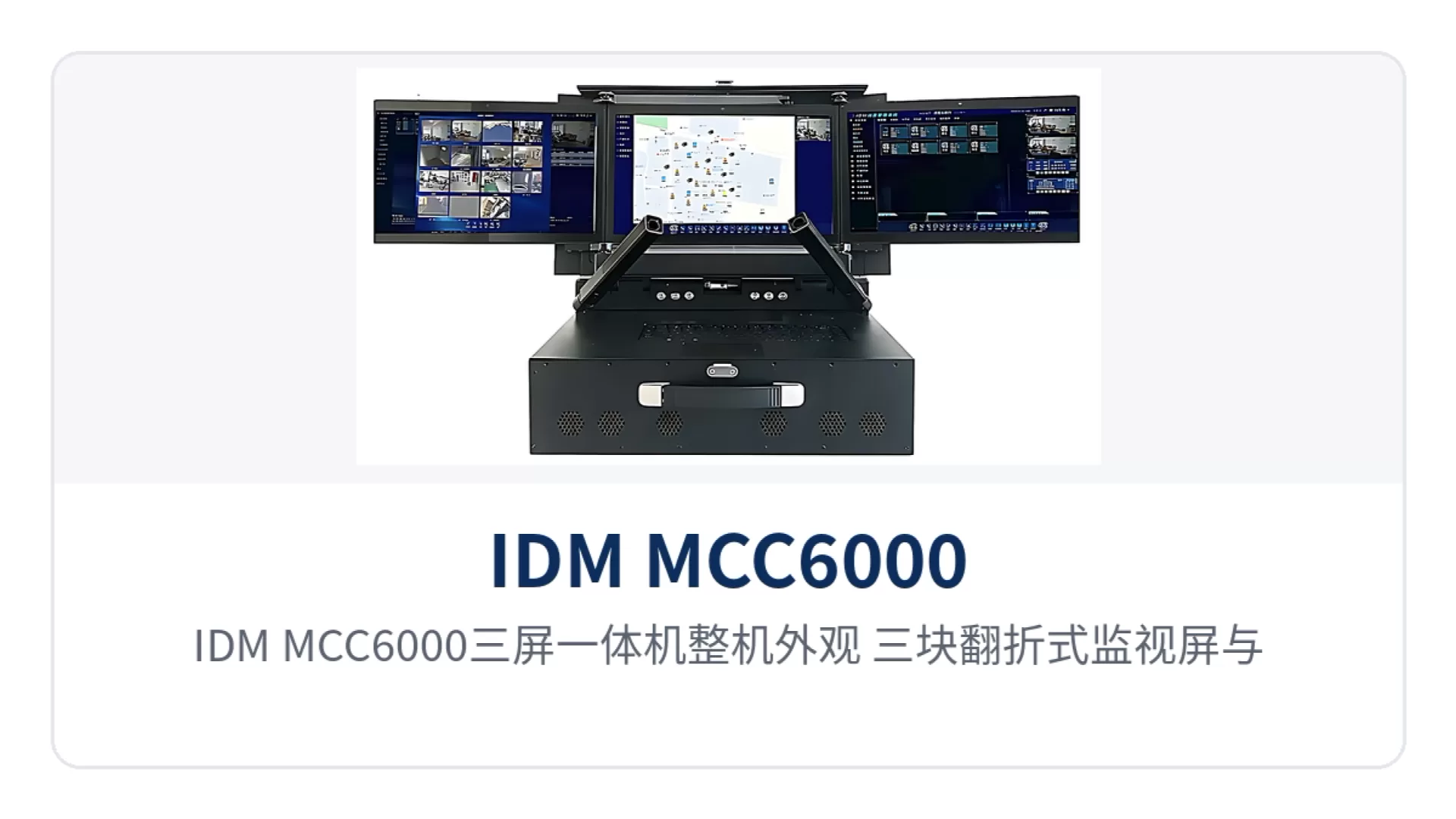
Figure 1: Overall appearance of the IDM MCC6000 three-screen all-in-one unit — three fold-out monitoring screens and the portable chassis
The three fold-out screens are used according to the division of command tasks, carrying video surveillance, video consultation and command output images respectively, and working with the dispatch console software to present the GIS map and visualized data. On the same device, a dispatcher can watch on-site video, organize multi-party consultation and issue dispatch orders at the same time. The computing module integrated in the chassis, formed by a 14th Gen i9 processor and an RTX 4090 graphics card, can run large models such as Deepseek and QWQ 32B, providing computing power for high definition (HD) video conferencing and visualized command and dispatch software.
Portability and field adaptability are carried jointly by the chassis, heat dissipation and power supply design: the IDM MCC6000 has an ingress protection (IP) rating of IP65, uses liquid cooling plus forced air cooling hybrid heat dissipation, and has a built-in 30AH lithium iron phosphate battery with power management capability, so it can continue to carry out on-site emergency command and dispatch operations in field and vehicle-mounted environments without a fixed equipment room or mains power.
Key specifications
The key specifications of the IDM MCC6000 cover display, protection, power supply, computing and communication interfaces; the table below is used to check them item by item against the on-site conditions of the project during selection.
Item | Parameter/Specification | Description/Applicable Conditions |
|---|---|---|
Unit form | Portable all-in-one chassis, one host with three screens | For rapid deployment in scenarios such as emergency management, on-site firefighting command and security for large events |
Display screen | Three 15.6-inch fold-out monitoring screens | Carry video surveillance, video consultation and command output images respectively; can present GIS and visualized data |
Ingress protection rating | IP65 | Suits outdoor, field and vehicle-mounted environments |
Heat dissipation | Liquid cooling plus forced air cooling hybrid heat dissipation | Supports high-load, long-duration continuous operation |
Power supply | Built-in 30AH lithium iron phosphate battery | Powers the unit where mains power is unavailable; includes power management |
Computing platform | 14th Gen i9 processor, RTX 4090 graphics card | Can run large models such as Deepseek and QWQ 32B; supports high definition (HD) video conferencing and visualized command and dispatch software |
Optical interface | 4 SDH optical ports | Supports multiple rates including 2.5G, 622M and 155M |
Concurrent online services | 20 concurrent online services | Concurrency capacity for local switching and dispatch services |
Video conferencing | 8 groups of 4-party video conferencing | Multi-party consultation capability |
Streaming media protocols | RTMP and RTSP streaming services | On-site audio and video transmission and access |
Video output | HDMI integrated video output | Outputs the display content organized on the dispatch console to an external large display |
Unit dimensions and weight | Not yet recorded in the knowledge base | Subject to the manufacturer's technical documentation and commercial confirmation |
The display, protection, power supply and computing configuration in the table enables the IDM MCC6000 both to serve as the display and dispatching core of an on-site command post and to keep running where there is no mains power and no fixed equipment room, with little engineering installation work and low dependence on the environment.
What on-site problems do the three-screen all-in-one integrated design and the portable architecture solve?
The conclusion first: the three-screen all-in-one integrated design packs display, communication and dispatch into a single chassis, solving the problems of a command post that cannot be set up, cannot see and cannot connect during on-site emergency command and dispatch; the portable architecture then moves the whole set of command capabilities from a fixed equipment room to the field front line. The correspondence between the three design features and the on-site problems is shown in the table below.
Design feature | On-site problem solved | Supporting capability |
|---|---|---|
Integrated three-screen all-in-one design, ready to use out of the box on site | No display, dispatch console or equipment room on site, and temporary setup takes a long time | The three 15.6-inch fold-out screens and the main unit are delivered as one unit; unfold them on arrival to display, with no separate display or desktop dispatch console required |
Portable architecture suited to field emergency command scenarios | Equipment is difficult to move, with limited power supply in field, mountainous and vehicle-mounted environments | The integrated portable chassis, combined with IP65 protection, liquid cooling plus forced air cooling and a 30AH lithium iron phosphate battery, can run without mains power or a fixed equipment room |
Command platform oriented to UAV flight control | UAV video transmission, man-pack and on-site video each on their own screen, forcing the commander to switch back and forth | Front ends such as UAV video, deployable surveillance camera and man-pack devices access the same dispatch console, with on-site images and the GIS situation presented on the three onboard screens |
Ready to use out of the box specifically means that the screens, host, power supply and dispatch software are installed in the same chassis at the factory, so there is no need to reserve space and wiring on site for a display, a dispatch host and a UPS separately; for relocation, the unit is carried as a whole rather than dismantled and reassembled device by device. Field emergency command sites have two further adaptations: first, the IP65 ingress protection rating and liquid cooling plus forced air cooling hybrid heat dissipation give the equipment more assurance of long working hours in sand and dust, rain and high temperature environments; second, the 30AH lithium iron phosphate battery lets the IDM MCC6000 power on in a camp without a generator or mains power. How it adapts to UAV flight control command is discussed separately in "Typical application scenarios" below.
Which communication networks can the portable command platform access?
Which communication networks a portable command platform can access directly determines how well an emergency communications site can connect and how much it can transmit back. The IDM MCC6000 concentrates access methods such as optical fiber, mobile public network and private network, ad-hoc network, satellite communication (SATCOM) and wired broadband in a single device, so that the site can choose links for networking according to available conditions, with multiple links providing mutual backup.
Access mode | Capability description |
|---|---|
Optical fiber transmission | 4 SDH optical ports supporting 2.5G, 622M and 155M rates, for wired interconnection with the terrestrial service network and the command center |
4G/5G public network and private network | Backhaul via carrier networks or a self-built private network, providing high-speed channels with low latency |
Wireless Mesh ad-hoc network | Builds a communication network where there is no infrastructure, with self-organizing and self-healing capability |
Satellite communication (SATCOM) | Maintains communication with the rear in remote areas or where there is no terrestrial network coverage |
WiFi HaLow | Long-distance wireless broadband access with low power consumption, suited to large-area coverage scenarios |
Regional broadband wireless | On-site regional broadband wireless access, enhancing communication flexibility and reliability |
Field wire broadband | Bandwidth up to 10Mbps, suited to wired access in complex terrain |
The practical value of multi-network access is connectivity that survives a network outage: when the public network is normal, 4G/5G and optical fiber backhaul are used in preference; in the event of public network interruption or when its coverage is unavailable, the platform can switch over to a wireless Mesh ad-hoc network, satellite communication, field wire broadband and other means to keep the on-site emergency communications command link uninterrupted as far as possible.
Which terminals and services can converged communication command dispatch?
The value of converged communication command lies in enabling intercommunication among communication terminals of different standards and different organizations on the same dispatch console. The IDM MCC6000 supports wireless intercom system convergence and access of audio and video conference endpoints, and provides local switching, conference consultation and Internet of Things (IoT) information access capability; the function list is given in the table below.
Function | Description |
|---|---|
Wireless intercom system access | Supports converged interconnection of 130 MHz commercial trunking, 350MHz public security trunking (PDT), 370MHz emergency management trunking (PDT), 400MHz commercial trunking, analog/digital conventional (DMR) and high frequency (HF) systems via a dedicated gateway for interfacing |
On-site terminal access | Can connect various communication terminals such as trunking intercom, mobile man-pack device, deployable surveillance camera, UAV video and video consultation |
Audio terminal access | Supports ordinary telephones, IP phones, handheld device app, network broadcast and network intercom |
Gateway capability | Provides radio gateway, trunking gateway and SMS gateway |
Video conference endpoint access | Supports handheld device app, PC camera, PC screen or window, GB28181 camera and ONVIF camera |
Local switching capability | Provides an E1 digital trunk interface, supports SS7 signaling and PRI signaling, and supports 20 concurrent online services |
Conference and consultation capability | Supports 8 groups of 4-party video conferencing and RTMP and RTSP streaming services |
IoT terminal access | Supports local IoT terminal access and is compatible with the IoT information provided by audio and audio/video terminals |
Large display output capability | Through the HDMI integrated video output interface, outputs the display content organized on the dispatch console to an external large display |
From the service perspective, trunking intercom, public address (PA), telephony, video conferencing and on-site video transmission are interconnected within the same platform; without switching among multiple devices, the commander can complete voice dispatching, video consultation and terminal management, and the platform is compatible with the existing video surveillance, video conferencing, central control, alarm, public address and IoT monitoring systems of each organization.
How is on-site emergency command communication set up quickly?
The key to setting up on-site emergency command communication quickly is to form a command post that can see, call and connect as soon as possible after arrival. The IDM MCC6000 compresses the setup steps with its portable unit design: once the integrated chassis arrives, the three fold-out screens can be unfolded, with no cabinet installation or dedicated equipment room required, and the unit is carried as a whole when relocating, meeting the rapid deployment requirements of emergency management, on-site firefighting command and security for large events, and providing a product showcase that is ready to use out of the box for emergency communications and on-site emergency command and dispatch.
At the power supply and protection level, the IDM MCC6000 has a built-in 30AH lithium iron phosphate battery with efficient power management, so it can be powered on and run on site without mains power; its IP65 ingress protection rating, combined with liquid cooling plus forced air cooling hybrid heat dissipation, gives the equipment more assurance of long working hours in field and vehicle-mounted environments. At the communication networking level, the site can choose access by optical fiber, 4G/5G public network or private network, wireless Mesh ad-hoc network, satellite communication, field wire broadband and other means according to available conditions: where there is a terrestrial network, the service network is accessed in preference, and in the event of network interruption or when coverage is unavailable, the ad-hoc network and satellite links take over, ensuring that emergency communications links are not interrupted.
At the terminal access layer, the IDM MCC6000 supports access of devices such as trunking intercom, mobile man-pack device, deployable surveillance camera, UAV video and video consultation, so the commander can organize on-site forces on the same dispatch console and, by interconnecting with the terrestrial service network, achieve coordinated handling between the front and rear command centers. As a portable converged communication command platform, it integrates converged communication, command and dispatch, converged dispatching and dispatch console capabilities in one, meeting the operational requirements of on-site emergency command and dispatch for a converged communication command and dispatch system.
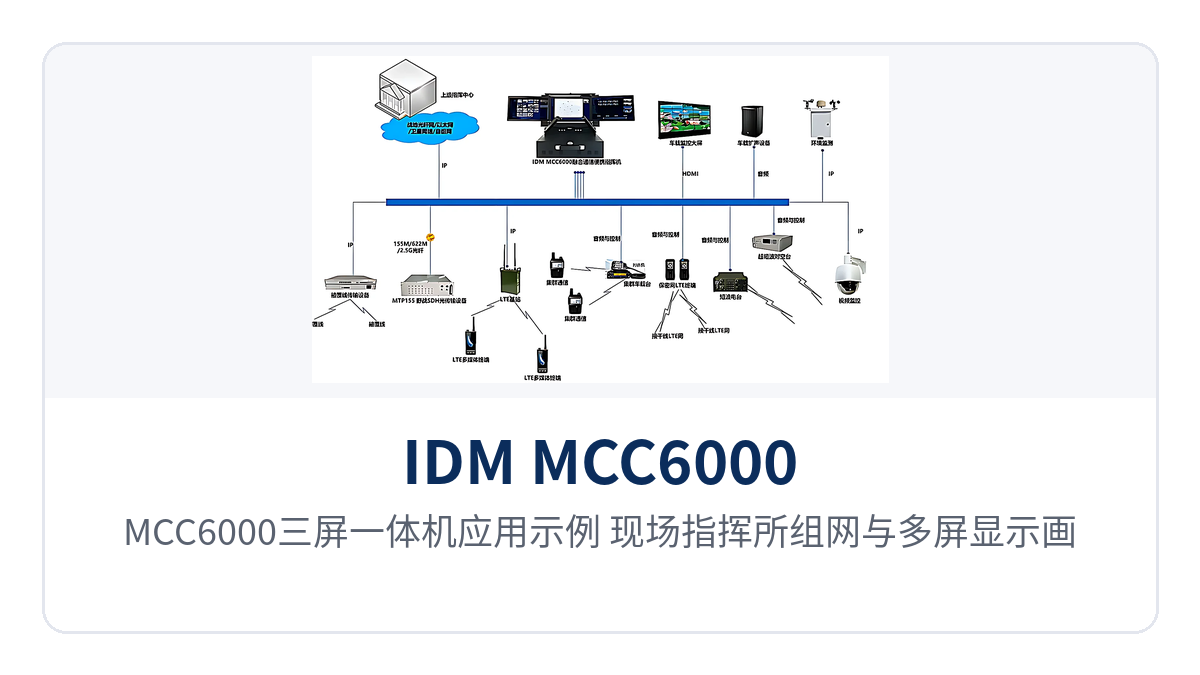
Figure 2: Application example of the MCC6000 three-screen all-in-one unit — on-site command post networking and multi-screen display images
Typical application scenarios
Emergency management and government and enterprise emergency command
Government departments and enterprise emergency management departments face multi-department, multi-team simultaneous on-site handling of an incident. The IDM MCC6000 three-screen portable converged communication command platform can quickly establish a temporary command post on site, restore communications through optical fiber, 4G/5G private networks, wireless Mesh ad-hoc network and satellite, and access trunking intercom, man-pack, deployable surveillance camera and UAV video; the three screens simultaneously display on-site images and the GIS situation, on which basis the commander dispatches rescue teams, checks handling progress and stays coordinated with the rear command center, making it suitable for emergency communications assurance in government emergency command and enterprise emergency management scenarios.
On-site firefighting and forest firefighting command
The on-site communication environment at a fire scene is poor and the terrain is complex, and there is usually no usable public network or mains power. The built-in 30AH lithium iron phosphate battery of the IDM MCC6000 supports power-on without mains power, and its IP65 protection and liquid cooling plus forced air cooling hybrid heat dissipation suit field environments with smoke and dust and high temperatures; it can access firefighting trunking intercom, man-pack video transmission and UAV video, presenting fire scene images, water sources and force deployment on the three onboard screens; for forest firefighting, where the firefighting line is long and there are scattered sites, the IDM MCC6000 can link the sites into one through the wireless Mesh ad-hoc network and satellite links, allowing the on-site commander to conduct unified intercom and issue orders, fully leveraging the role of converged dispatching in on-site emergency command and dispatch.
On-site security for large events
Security for large events such as sports events, concerts and exhibitions requires temporarily linking video surveillance, alarm, public address and intercom systems into one. The IDM MCC6000 can access front ends such as surveillance cameras, man-pack devices and deployable surveillance cameras, and is compatible with the existing video surveillance and conference systems of the organizer; through the three-screen integrated interface, the dispatcher can view spectator areas, entrances and exits, and passage images at the same time and direct security forces to handle situations by site, reducing the coordination delay caused by multiple systems running independently, and letting the converged communication command and dispatch system run efficiently at the security site.
UAV flight control command
UAV flight control command requires video transmission, command and communication links to be in place at the same time. The IDM MCC6000 three-screen portable converged communication command platform can access UAV video and aerial video transmission, presenting the UAV image, the GIS situation and the dispatch operating interface on split screens, so that the commander can issue orders to ground forces while seeing the aerial perspective; the IDM MCC6000 provides UAV video backhaul to the on-site command post and the rear command center through a 4G/5G private network, a wireless Mesh ad-hoc network or satellite link. The specific link and remote control access methods of various UAV types are not yet recorded in the knowledge base; please refer to the manufacturer's technical documentation and commercial confirmation. UAV video, man-pack and deployable surveillance camera images are managed on the same dispatch console, making it suitable for occasions where aerial reconnaissance and ground handling need to proceed in parallel.
Selection and deployment recommendations
When selecting a three-screen portable converged communication command platform, it is recommended to check three things item by item: the match between the communication methods available on site (optical fiber, 4G/5G public network or private network, satellite, ad-hoc network, field wire) and the access capacity of the IDM MCC6000; whether the terminal types and numbers to be connected (trunking intercom, man-pack, deployable surveillance camera, UAV video, GB28181 camera, IoT terminal) are within the supported range of the platform; and whether the number of channels for video conferencing and the concurrent online service capacity meet the actual command scale. As a professional command and dispatch system manufacturer, Raytrans can provide product showcase and selection support ranging from military emergency communications vehicle solutions to portable converged communication command platforms.
During deployment, use the platform as the display, communication and dispatching core of the on-site command post: first connect the available links (optical fiber or a 4G/5G private network in preference), then access front ends such as intercom, man-pack and UAV video as required, and output to an external large display via HDMI when centralized viewing is needed. The IDM MCC6000 three-screen portable converged communication command platform is ready to use out of the box on site with the integrated three-screen all-in-one design, adapts to field emergency command with its portable architecture, and can serve as an on-site platform option oriented to UAV flight control command; for engineering parameters such as unit dimensions, weight and power supply endurance, and for commercial prices, please refer to the manufacturer's technical documentation and commercial confirmation.
Design feature | On-site problem solved | Supporting capability |
|---|---|---|
Integrated three-screen all-in-one design, ready to use out of the box on site | No display, dispatch console or equipment room on site, and temporary setup takes a long time | The three 15.6-inch fold-out screens and the main unit are delivered as one unit; unfold them on arrival to display, with no separate display or desktop dispatch console required |
Portable architecture suited to field emergency command scenarios | Equipment is difficult to move, with limited power supply in field, mountainous and vehicle-mounted environments | The integrated portable chassis, combined with IP65 protection, liquid cooling plus forced air cooling and a 30AH lithium iron phosphate battery, can run without mains power or a fixed equipment room |
Command platform oriented to UAV flight control | UAV video transmission, man-pack and on-site video each on their own screen, forcing the commander to switch back and forth | Front ends such as UAV video, deployable surveillance camera and man-pack devices access the same dispatch console, with on-site images and the GIS situation presented on the three onboard screens |
Ready to use out of the box specifically means that the screens, host, power supply and dispatch software are installed in the same chassis at the factory, so there is no need to reserve space and wiring on site for a display, a dispatch host and a UPS separately; for relocation, the unit is carried as a whole rather than dismantled and reassembled device by device. Field emergency command sites have two further adaptations: first, the IP65 ingress protection rating and liquid cooling plus forced air cooling hybrid heat dissipation give the equipment more assurance of long working hours in sand and dust, rain and high temperature environments; second, the 30AH lithium iron phosphate battery lets the IDM MCC6000 be powered on in a camp without a generator or mains power. How it adapts to UAV flight control command is discussed separately in "Typical application scenarios" below.
Which communication networks can the portable command platform access?
Which communication networks a portable command platform can access directly determines how well an emergency communications site can connect and how much it can transmit back. The IDM MCC6000 concentrates access methods such as optical fiber, mobile public network and private network, ad-hoc network, satellite communication (SATCOM) and wired broadband in a single device, so that the site can choose links for networking according to available conditions, with multiple links providing mutual backup.
Access mode | Capability description |
|---|---|
Optical fiber transmission | 4 SDH optical ports supporting 2.5G, 622M and 155M rates, for wired interconnection with the terrestrial service network and the command center |
4G/5G public network and private network | Backhaul via carrier networks or a self-built private network, providing high-speed channels with low latency |
Wireless Mesh ad-hoc network | Builds a communication network where there is no infrastructure, with self-organizing and self-healing capability |
Satellite communication (SATCOM) | Maintains communication with the rear in remote areas or where there is no terrestrial network coverage |
WiFi HaLow | Long-distance wireless broadband access with low power consumption, suited to large-area coverage scenarios |
Regional broadband wireless | On-site regional broadband wireless access, enhancing communication flexibility and reliability |
Field wire broadband | Bandwidth up to 10Mbps, suited to wired access in complex terrain |
The practical value of multi-network access is connectivity that survives a network outage: when the public network is normal, 4G/5G and optical fiber backhaul are used in preference; in the event of public network interruption or when its coverage is unavailable, the platform can switch over to a wireless Mesh ad-hoc network, satellite communication, field wire broadband and other means to keep the on-site emergency communications command link uninterrupted as far as possible.
Which terminals and services can converged communication command dispatch?
The value of converged communication command lies in enabling intercommunication among communication terminals of different standards and different organizations on the same dispatch console. The IDM MCC6000 supports wireless intercom system convergence and access of audio and video conference endpoints, and provides local switching, conference consultation and Internet of Things (IoT) information access capability; the function list is given in the table below.
Function | Description |
|---|---|
Wireless intercom system access | Supports converged interconnection of 130 MHz commercial trunking, 350MHz public security trunking (PDT), 370MHz emergency management trunking (PDT), 400MHz commercial trunking, analog/digital conventional (DMR) and high frequency (HF) systems via a dedicated gateway for interfacing |
On-site terminal access | Can connect various communication terminals such as trunking intercom, mobile man-pack device, deployable surveillance camera, UAV video and video consultation |
Audio terminal access | Supports ordinary telephones, IP phones, handheld device app, network broadcast and network intercom |
Gateway capability | Provides radio gateway, trunking gateway and SMS gateway |
Video conference endpoint access | Supports handheld device app, PC camera, PC screen or window, GB28181 camera and ONVIF camera |
Local switching capability | Provides an E1 digital trunk interface, supports SS7 signaling and PRI signaling, and supports 20 concurrent online services |
Conference and consultation capability | Supports 8 groups of 4-party video conferencing and RTMP and RTSP streaming services |
IoT terminal access | Supports local IoT terminal access and is compatible with the IoT information provided by audio and audio/video terminals |
Large display output capability | Through the HDMI integrated video output interface, outputs the display content organized on the dispatch console to an external large display |
From the service perspective, trunking intercom, public address (PA), telephony, video conferencing and on-site video transmission are interconnected within the same platform; without switching among multiple devices, the commander can complete voice dispatching, video consultation and terminal management, and the platform is compatible with the existing video surveillance, video conferencing, central control, alarm, public address and IoT monitoring systems of each organization.
How is on-site emergency command communication set up quickly?
The key to setting up on-site emergency command communication quickly is to form an on-site command post that can see, call and connect as soon as possible after arrival. The IDM MCC6000 compresses the setup steps with its portable unit design: once the integrated chassis arrives, the three fold-out screens can be unfolded, with no cabinet installation or dedicated equipment room required, and the unit is carried as a whole when relocating, meeting the rapid deployment requirements of emergency management, on-site firefighting command and security for large events, and providing a product showcase that is ready to use out of the box for emergency communications and on-site emergency command and dispatch.
At the power supply and protection level, the IDM MCC6000 has a built-in 30AH lithium iron phosphate battery with efficient power management, so it can be powered on and run on site without mains power; the IP65 ingress protection rating, combined with liquid cooling plus forced air cooling hybrid heat dissipation, gives the equipment more assurance of long working hours in field and vehicle-mounted environments. At the communication networking level, the site can choose access by optical fiber, 4G/5G public network or private network, wireless Mesh ad-hoc network, satellite communication, field wire broadband and other means according to available conditions: where there is a terrestrial network, the service network is accessed in preference, and in the event of network interruption or when coverage is unavailable, the ad-hoc network and satellite links take over, ensuring that emergency communications links are not interrupted.
At the terminal access level, the IDM MCC6000 supports access of devices such as trunking intercom, mobile man-pack device, deployable surveillance camera, UAV video and video consultation, so the commander can organize on-site forces on the same dispatch console and, by interconnecting with the terrestrial service network, achieve coordinated handling between the front and rear command centers. As a portable converged communication command platform, it integrates converged communication, command and dispatch, converged dispatching and dispatch console capabilities in one, meeting the operational requirements of on-site emergency command and dispatch for a converged communication command and dispatch system.
Figure 2: Application example of the MCC6000 three-screen all-in-one unit — on-site command post networking and multi-screen display images
Typical application scenarios
Emergency management and government and enterprise emergency command
Government departments and enterprise emergency management departments face multi-department, multi-team simultaneous on-site handling of an incident. The IDM MCC6000 three-screen portable converged communication command platform can quickly establish a temporary command post on site, restore communications through optical fiber, 4G/5G private networks, wireless Mesh ad-hoc network and satellite, and access trunking intercom, man-pack, deployable surveillance camera and UAV video; the three screens simultaneously display on-site images and the GIS situation, on which basis the commander dispatches rescue teams, checks handling progress and stays coordinated with the rear command center, making it suitable for emergency communications assurance in government emergency command and enterprise emergency management scenarios.
On-site firefighting and forest firefighting command
The on-site communication environment at a fire scene is poor and the terrain is complex, and there is usually no usable public network or mains power. The built-in 30AH lithium iron phosphate battery of the IDM MCC6000 supports power-on without mains power, and its IP65 protection and liquid cooling plus forced air cooling hybrid heat dissipation suit field environments with smoke and dust and high temperatures; it can access firefighting trunking intercom, man-pack video transmission and UAV video, presenting fire scene images, water sources and force deployment on the three onboard screens; for forest firefighting, where the firefighting line is long and the sites are dispersed, the IDM MCC6000 can link the sites into one through the wireless Mesh ad-hoc network and satellite links, allowing the on-site commander to conduct unified intercom and issue orders, fully leveraging the role of converged dispatching in on-site emergency command and dispatch.
On-site security for large events
Security for large events such as sports events, concerts and exhibitions requires temporarily linking video surveillance, alarm, public address and intercom systems into one. The IDM MCC6000 can access front ends such as surveillance cameras, man-pack devices and deployable surveillance cameras, and is compatible with the existing video surveillance and conference systems of the organizer; through the three-screen integrated interface, the dispatcher can view spectator areas, entrances and exits, and passages at the same time and direct security forces to handle situations by site, reducing the coordination delay caused by multiple systems running independently, and letting the converged communication command and dispatch system run efficiently at the security site.
UAV flight control command
UAV flight control command requires video transmission, command and communication links to be in place at the same time. The IDM MCC6000 three-screen portable converged communication command platform can access UAV video and aerial video transmission, presenting the UAV image, the GIS situation and the dispatch operating interface on split screens, so that the commander can issue orders to ground forces while seeing the aerial perspective; the IDM MCC6000 provides UAV video backhaul to the on-site command post and the rear command center through a 4G/5G private network, a wireless Mesh ad-hoc network or satellite link. The specific link and remote control access methods of various UAV types are not yet recorded in the knowledge base; please refer to the manufacturer's technical documentation and commercial confirmation. UAV video, man-pack and deployable surveillance camera images are managed on the same dispatch console, making it suitable for occasions where aerial reconnaissance and ground handling need to proceed in parallel.
Selection and deployment recommendations
When selecting a three-screen portable converged communication command platform, it is recommended to check three things item by item: the match between the communication methods available on site (optical fiber, 4G/5G public network or private network, satellite, ad-hoc network, field wire) and the access capacity of the IDM MCC6000; whether the types and numbers of terminals to be connected (trunking intercom, man-pack, deployable surveillance camera, UAV video, GB28181 camera, IoT terminal) are within the supported range of the platform; and whether the number of video conferencing channels and the concurrent online service capacity meet the actual command scale. As a professional command and dispatch system manufacturer, Raytrans can provide product showcase and selection support ranging from military emergency communications vehicle solutions to portable converged communication command platforms.
During deployment, use the platform as the display, communication and dispatching core of the on-site command post: first connect the available links (optical fiber or a 4G/5G private network in preference), then access front ends such as intercom, man-pack and UAV video as required, and output to an external large display via HDMI when centralized viewing is needed. The IDM MCC6000 three-screen portable converged communication command platform is ready to use out of the box on site through its integrated three-screen all-in-one design, adapts to field emergency command with its portable architecture, and can serve as an on-site platform option oriented to UAV flight control command; for engineering parameters such as unit dimensions, weight and power supply endurance, and for commercial prices, please refer to the manufacturer's technical documentation and commercial confirmation.