
Untitled Product
title: "IDM MCC560 Converged Communication | Command and Dispatch | Converged Communication Command and Dispatch System | Converged Dispatching | Raytrans"
articleTitle: IDM MCC560 Multi-mode Converged Communication Terminal
slug: idm-mcc560
tags:
- "Converged Communication Terminal"
- "Multi-mode Communication Terminal"
- "Ad-hoc Network Communication"
- "Emergency Command and Dispatch"
- "Inspection Communication"
keywords: "IP Access Terminal,Product Showcase,Converged Communication,Command and Dispatch,Converged Communication Command and Dispatch System,Converged Dispatching,Raytrans,Command and Dispatch System Manufacturer,Military Emergency Communications Vehicle Solution,Mesh Ad-hoc Network,Emergency Communication Terminal"
brief: "The IDM MCC560 multi-mode link auto-switching converged communication terminal is an IP access terminal developed by Beijing Ruiguang Jiyuan Digital Technology Co., Ltd. As a multi-mode converged communication terminal, it integrates 4G LTE, WiFi/BT, digital trunking intercom, WiFi HALOW and Mesh ad-hoc network communication methods into one portable unit, enabling real-time transmission of voice, video, text, images and data in on-site scenarios with no public network coverage, weak signals or high confidentiality requirements…"
coverAlt: "IDM MCC560 Converged Communication | Command and Dispatch | Converged Communication Command and Dispatch System | Converged Dispatching | Raytrans Main Product Image"
publishDate: "2026-10-18"
cover: /images/uploads/1792252912694_batch_banner_1792252933242.webp
faq: - "ptt-group-intercom-im-read-receipt-dispatch-scenarios"
- "field-network-terminal-registration-no-voice-troubleshooting-maintenance"
- "three-screen-portable-fusion-communication-command-platform-selection"
- "sip-webrtc-dual-channel-interworking-scenarios"
- "fiber-field-wire-halow-uav-relay-auto-link-switching"
model: "Primary and backup link 50ms automatic switchover, centerless Mesh ad-hoc network, still connected during network outage"
category: IP接入终端
specs:
Features: "Multi-mode converged communication: supports 4G, WiFi, digital trunking intercom, LoRa, infrared and other links, integrated in one unit with on-demand switching; Intelligent networking capability: features Mesh ad-hoc networking, enabling audio and video intercommunication even in centerless, server-free environments; AI-assisted operation: integrates speech recognition, speech synthesis and AI video recognition, supporting voice reporting, intelligent recording and command control; Strong endurance and strong protection: built-in 10000mAh large-capacity battery, IP68 protection and high-brightness touchscreen, adapting to harsh outdoor environments; built-in voice assistant, video recognition, multilingual translation and other functions improve on-site work efficiency and lower the operating threshold; can connect to various sensors, dispatch systems and IoT devices, and supports seamless integration with IDM series and other manufacturers' systems; supports offline maps, ad-hoc network communication, AI voice reporting and direct sensor connection, enabling inspection and automatic data acquisition in uninhabited areas; on-site communication is chaotic and multiple systems cannot interoperate; command and dispatch lacks visualized support; multi-mode convergence, one-touch PTT emergency call, split-screen display (map + video + data), supporting multi-party conferencing and real-time video backhaul; supports end-to-end (E2E) encryption, automatic link switchover, remote device management and log auditing, ensuring communication security and command continuity; one unit integrates multiple communication modes, supporting group intercom, offline voice commands and IP68 protection, adapting to sand and dust, rain and other environments; Not just an intercom, but your mobile command center."
Performance Specifications: "-Full-scenario audio and video dispatching: supports point-to-point call, multi-party conferencing, instant messaging and PDT trunking intercom, compatible with various dispatch systems; Flexible expansion: provides mini PCIe, RJ45 connector, Type-C and other interfaces, and can be expanded with 5G, satellite, SDR Mesh and other modules; built-in LoRa/NB-IoT interfaces support sensor data acquisition and linked device control, realizing integrated "communication + monitoring""
description: "The IDM MCC560 multi-mode converged communication terminal is an intelligent portable terminal that integrates multiple communication modes, designed for efficient collaboration and reliable communication in complex environments. It combines 4G LTE, WiFi/BT, digital trunking intercom, WiFi HALOW, Mesh ad-hoc network and other communication methods, supports real-time transmission of voice, video, text, images and data, and is suitable for operation scenarios with no public network coverage, weak signals or high confidentiality requirements, making it an ideal choice for industry mobile communication and intelligent scheduling. Converged communication terminal, multi-mode converged communication terminal, multi-mode communication terminal, ad-hoc"
The IDM MCC560 multi-mode link auto-switching converged communication terminal is an IP access terminal developed by Beijing Ruiguang Jiyuan Digital Technology Co., Ltd. As a multi-mode converged communication terminal, it integrates 4G LTE, WiFi/BT, digital trunking intercom, WiFi HALOW, and Mesh ad-hoc network communication methods into a single portable unit, providing real-time voice, video, text, image, and data transmission for sites with no public network, weak signals, or high confidentiality requirements, and meeting the diverse needs of converged communication and emergency communication terminal scenarios.
Key Specifications at a Glance: 4G LTE/WiFi/digital trunking intercom/WiFi HALOW/Mesh multi-link · 50ms link switchover · centerless Mesh · 10000mAh battery · IP68 protection · high-brightness touchscreen visible in sunlight
What kind of device is the multi-mode link auto-switching converged communication terminal?
The IDM MCC560 multi-mode link auto-switching converged communication terminal is an on-site IP access terminal that packs multiple communication links and audio and video dispatching capabilities into a single portable enclosure, supporting point-to-point calls, multi-party conferencing, instant messaging, and PDT trunking intercom. The unit uses a high-brightness touchscreen as its operating interface, has a built-in 10000mAh large-capacity battery, offers IP68 protection capability, and can be carried by individual soldiers or deployed vehicle-mounted; once powered on, links can be enabled as needed to establish connectivity, making it suitable for on-site access in converged communication and command and dispatch scenarios.
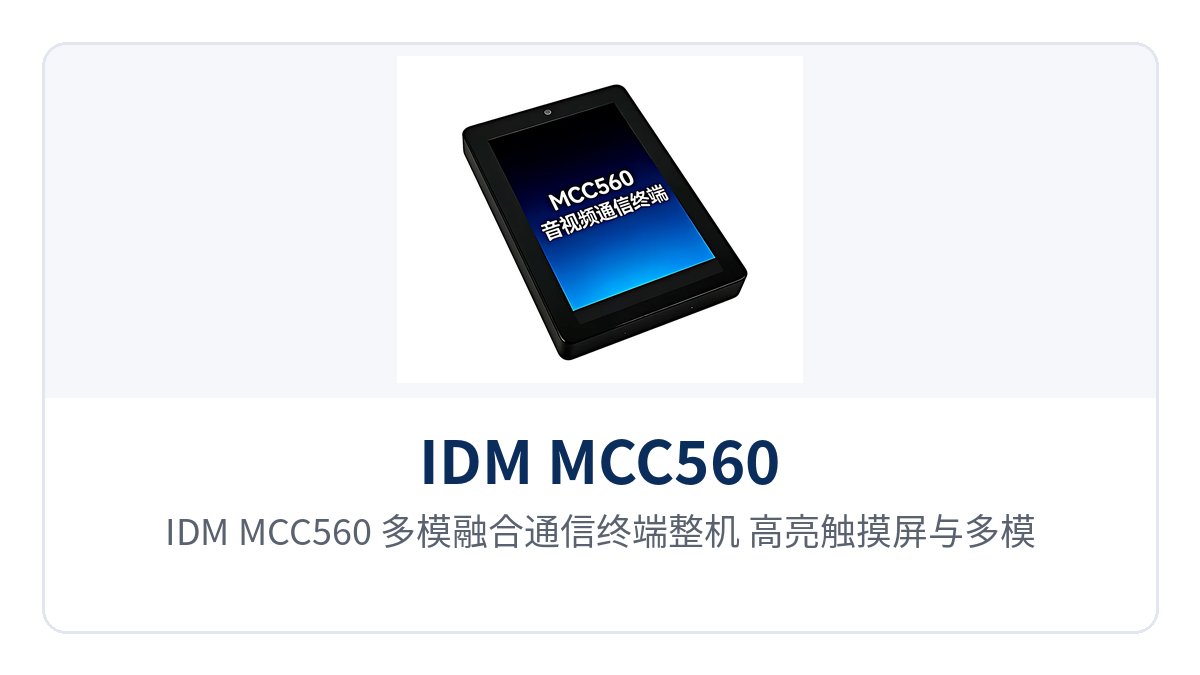
Figure 1: IDM MCC560 multi-mode converged communication terminal unit, high-brightness touchscreen and multi-mode communication antennas
Key Specifications
The table below lists the links, switchover, endurance, protection, and expansion interfaces most often asked about on site, and can be used directly for product showcase, selection comparison, and bid document preparation; the unit dimensions, weight, and price are not given in the product documentation and must be confirmed with the manufacturer and through commercial confirmation according to the ordering configuration.
| Item | Parameter/Specification | Description/Applicable Conditions |
|---|---|---|
| Communication method | 4G LTE, WiFi/BT, digital trunking intercom, WiFi HALOW, Mesh ad-hoc network | Integrated in one unit, enabled or superimposed according to on-site coverage conditions |
| Expansion links | LoRa, infrared; 5G, satellite, SDR Mesh via expansion interface | IoT data acquisition, short-range remote control, and cross-regional backhaul |
| Link switchover | Automatic switchover between primary and backup links within 50ms | Voice, video, and data services continue transmission over the backup link |
| Ad-hoc network | Centerless Mesh ad-hoc network, independent of base stations and servers | Networking in network-free environments enables group audio and video intercommunication |
| Battery | Built-in 10000mAh large-capacity battery | Supports long-duration operation in outdoor and emergency sites |
| Ingress protection (IP) rating | IP68 | Drop and shock resistance, adapts to rain, snow, sand and dust, and other outdoor environments |
| Display and operation | High-brightness touchscreen, visible in sunlight | Screen readable under strong light, supports touch operation and split-screen |
| Split-screen layout | Map + video + data on the same screen | Commanders view the situation and video pictures on one screen |
| Expansion interface | mini PCIe, RJ45, Type-C | External modules, wired network, and commissioning and maintenance |
| IoT interface | LoRa/NB-IoT interface | Sensor data acquisition and linked device control |
| Security and management | End-to-end (E2E) encryption, remote device management, log auditing | Communication confidentiality, unified device status management, and record traceability |
| Unit dimensions, weight, and price | not yet recorded in the knowledge base | Subject to the manufacturer's technical documentation and commercial confirmation |
How is 50ms primary/backup link switchover implemented?
50ms link switchover means the terminal maintains both primary and backup links at the same time; when primary link quality degrades to unusable or is completely interrupted, services are transferred to the backup link within 50ms to continue transmission, and calls and video pictures typically show no noticeable pause. The switchover is performed automatically by the terminal, and on-site personnel do not need to redial or change frequencies, making it suitable for converged dispatching occasions with high requirements for communication continuity, such as emergency rescue and tactical command.
50ms is the switchover specification stated in the product documentation; actual recovery performance depends on on-site signal conditions, service load, and the selected link combination. The link combination must be set before enabling, for example setting 4G LTE as primary and digital trunking intercom or WiFi as backup, then adjusting priorities according to on-site coverage; for project acceptance, it is recommended to confirm based on on-site measured results.
How does centerless Mesh network, and can terminals intercommunicate without a base station?
Centerless Mesh means terminals do not depend on base stations, servers, or public networks; after powering on, they discover neighbors on their own and form a mesh network, in which any two terminals can reach each other, and voice, video, and data are shared within the network. When a node or a link is interrupted, services automatically reroute through the remaining nodes, and the network has self-organizing and self-healing capabilities; no infrastructure needs to be deployed on site in advance, making it a common networking approach in military emergency communications vehicle solutions.
In tunnels, basements, mountainous and forest areas, and other sites without public network coverage, teams can enable group audio and video communication simply by powering on the terminals, without carrying servers or temporarily setting up relay stations. Mesh ad-hoc network coverage varies with the number of terminals present and the terrain; when cross-regional backhaul is needed, 5G, satellite, or SDR Mesh modules can be added through the mini PCIe, RJ45, and Type-C interfaces.
Which communication links can one terminal access?
The terminal concentrates public network, private network, ad-hoc network, and IoT links in a single unit; on site, a single link can be selected or links can be superimposed according to coverage conditions, avoiding communication interruption caused by the failure of a single link. The table below lists access capacity and applicable conditions by link type, facilitating trade-offs according to on-site conditions.
| Communication link | Access capacity | Applicable conditions |
|---|---|---|
| 4G LTE | Mobile public network voice, video, and data services | Areas with cellular network coverage; can serve as the primary link |
| WiFi/BT | Wireless local area network (WLAN) access, temporary on-site networking, and local interconnection | Sites with wireless access points or requiring local device interconnection |
| WiFi HALOW | Wireless access for long-range and penetration scenarios | Absence of public network and need for longer-distance wireless backhaul |
| Digital trunking intercom | Access to digital trunking links, supporting PDT trunking intercom | Interworking with existing trunking intercom systems and unified command |
| Mesh ad-hoc network | Automatic formation of mesh links without a center or server | Tunnels, mountainous areas, basements, and other sites without infrastructure |
| LoRa | Low-power wide-area IoT link | Sensor data acquisition and low-speed long-distance backhaul |
| NB-IoT | Narrowband IoT link | Data reporting for meter and monitoring terminals |
| Infrared | Short-range infrared communication | Short-range remote control and data exchange |
| Expansion modules | 5G, satellite, SDR Mesh via mini PCIe, RJ45, Type-C | Absence of public network, need for cross-regional backhaul, or temporary networking enhancement |
What are the core functions?
The functions cover link access, ad-hoc networking, audio and video dispatching, AI assistance, endurance and protection, expansion, and security; the table below lists specific capabilities and corresponding descriptions by function item, facilitating item-by-item comparison of tender parameters, preparation of configuration lists, and on-site requirement confirmation.
| Function | Description |
|---|---|
| Multi-mode converged communication | Supports 4G LTE, WiFi, digital trunking intercom, LoRa, infrared, and other links, integrated in one unit and switched as needed |
| Multi-mode link automatic switchover | Automatic switchover between primary and backup links within 50ms, with continuous transmission of voice, video, and data services |
| Centerless Mesh networking | Automatically forms a Mesh network in network-free and server-free environments, enabling group audio and video communication and data sharing |
| Full-scenario audio and video dispatching | Supports point-to-point calls, multi-party conferencing, instant messaging, and PDT trunking intercom, compatible with various converged communication command and dispatch systems |
| AI-assisted operation | Integrates speech recognition, speech synthesis, and AI video recognition, supporting voice reporting, intelligent recording, and command control |
| On-site operation assistance | Supports offline maps, one-touch PTT emergency calls, and split-screen display (map/video/data) |
| Strong endurance and protection | Built-in 10000mAh large-capacity battery, IP68 protection, and high-brightness touchscreen, adapting to harsh outdoor environments |
| Flexible expansion | Provides mini PCIe, RJ45, and Type-C interfaces, expandable with 5G, satellite, and SDR Mesh modules |
| Open convergence | Can connect to sensors, dispatch systems, and IoT devices, and integrate with existing systems |
| Security and management | Supports end-to-end (E2E) encryption, remote device management, and log auditing |
| IoT linkage | Built-in LoRa/NB-IoT interface, supporting sensor data acquisition and linked device control |
| Multilingual assistance | Built-in multilingual translation, facilitating cross-regional and cross-team collaborative operations |
As an on-site emergency communication terminal for converged communication command and dispatch systems, the terminal can interconnect with platforms from command and dispatch system manufacturers (such as Raytrans) and be incorporated into a unified converged dispatching system, making it suitable for application scenarios such as military emergency communications vehicle solutions that have high requirements for Mesh ad-hoc networking and command and dispatch capabilities.
How to select an emergency inspection communication terminal?
Selection starts with whether usable networks exist on site: in areas with 4G coverage, use 4G LTE as the primary link and WiFi for local interconnection; in uninhabited areas with no public network at all, rely mainly on Mesh ad-hoc networking, and add satellite or 5G modules when cross-regional backhaul is needed. As an IP access terminal, the device must also have multi-link aggregation and automatic switchover capabilities to support subsequent converged communication and command and dispatch services.
Next, check the interconnection method with existing systems and confirm operation intensity and protection requirements; on site, the following four items are generally confirmed one by one to avoid discovering interface protocol or ingress protection (IP) rating mismatches only after the equipment arrives, causing secondary procurement and schedule delays; when conditions permit, bring a sample unit to the site for a live test.
- Link combination: how many usable networks exist on site, how primary and backup are arranged, and whether services can continue after switchover
- System interconnection: whether the interfaces and protocols of existing digital trunking intercom, dispatch systems, and sensors match, and whether they can be incorporated into the existing converged communication command and dispatch system
- Operation intensity: whether shift duration matches battery capacity, and whether spare batteries or vehicle-mounted power supply are needed
- Environmental conditions: whether rain, snow, sand and dust, drops, and temperature differences are within the IP68 and unit protection design range
During deployment, first set the primary and backup links by priority and verify whether services recover within 50ms after the primary link is disconnected; then configure AI speech recognition and voice reporting according to the on-site language, and confirm end-to-end (E2E) encryption, remote device management, and log auditing policies with the management department before enabling. If the project involves batch distribution of emergency communication terminals or military emergency communications vehicle solutions, it is recommended that a command and dispatch system manufacturer with converged dispatching experience provide commissioning support; Raytrans can assist with on-site surveys and product showcase demonstrations.
Typical Application Scenarios
In these three industries, the terminal does the same thing: reconnecting voice, video, and data on site where no public network is available or the public network is unstable. The three industries face different coverage conditions and working methods, and their link priorities and operational focus also differ; below, the combination methods, operating methods, and deployment conditions are described by industry.
Power, Oil, and Mining Inspection
Uninhabited areas, long-distance pipelines, and mining areas often have no usable public network coverage. After inspection teams bring the terminals into the site, a Mesh network is automatically formed, teams maintain group voice and video communication, and tracks are viewed together with offline maps; the built-in LoRa/NB-IoT interface can directly connect to on-site sensors and acquire and backhaul device status locally, while AI voice reporting lets inspection personnel record defects by voice, reducing manual recording steps. Acquired data can be backhauled through converged communication channels to the rear command and dispatch center, achieving a closed loop between inspection and converged dispatching.
Emergency Rescue and Firefighting
Disaster sites often have neither a public network nor a fixed power source, and multiple teams use equipment of different formats, making it difficult to aggregate on-site information. The terminal integrates 4G LTE, WiFi, and digital trunking intercom into unified command in multi-mode, one-touch PTT emergency calls quickly summon on-site forces, and split-screen display puts maps, video, and data on the same screen; the 10000mAh battery and IP68 protection support long working hours, and primary and backup link switchover keeps calls continuous. In the military emergency communications vehicle solution, such emergency communication terminals can serve as external extension nodes of the vehicle and coordinate networking with the vehicle-mounted converged communication command and dispatch system.
Public Security and Border Defense Duty
Mobile duty imposes high requirements on communication confidentiality and device management. The terminal supports end-to-end (E2E) encryption and, together with primary and backup link switchover, keeps audio and video continuous; remote device management and log auditing let the command center keep track of terminal presence and usage records; in border and forest area sections without public network coverage, it can switch to a Mesh ad-hoc network to form intra-team communication, or introduce satellite and SDR Mesh links through expansion interfaces to fill coverage gaps, and uniformly orchestrate service forces through the converged dispatching platform.
Conclusion
As a multi-mode link automatic switchover converged communication terminal, the IDM MCC560 accesses on-site services via 4G LTE, WiFi, digital trunking intercom, WiFi HALOW, and Mesh ad-hoc network, and handles network outage and weak signal environments with 50ms link switchover, centerless Mesh, a 10000mAh battery, and IP68 protection, making it suitable for electric power, oil, and mining inspection, emergency rescue and firefighting, and public security and border defense duty. As a command and dispatch system manufacturer deeply engaged in converged communication command and dispatch systems and the converged dispatching field, Raytrans can provide complete support for IP access terminal selection, product showcase, and implementation of the military emergency communications vehicle solution.