
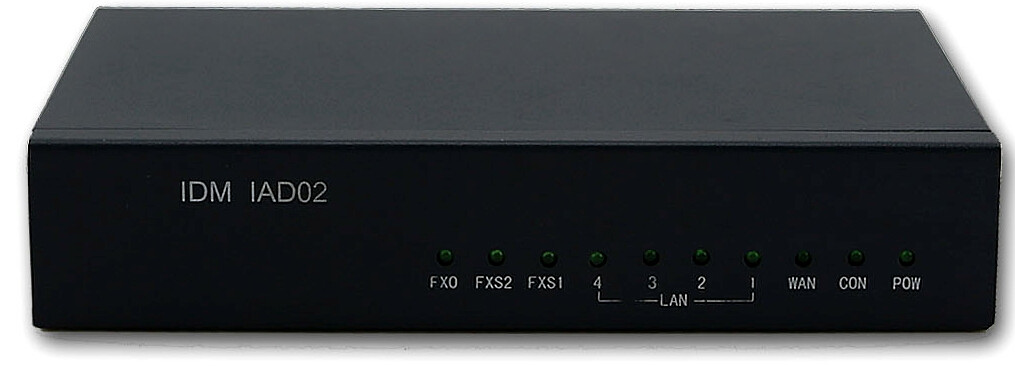
IDM IAD02
IDM IAD02
The IDM IAD02 is an integrated access gateway that transmits two analog telephone lines to an IP network. It uses the standard SIP protocol and can interconnect with standard SIP softswitch systems, providing VoIP/FoIP solutions for carriers, enterprises, and residential community users.
The IDM IAD02 is an integrated access gateway that transmits two analog telephone lines to an IP network. It uses the standard SIP protocol and can interconnect with standard SIP softswitch systems, providing VoIP/FoIP solutions for carriers, enterprises, and residential community users.
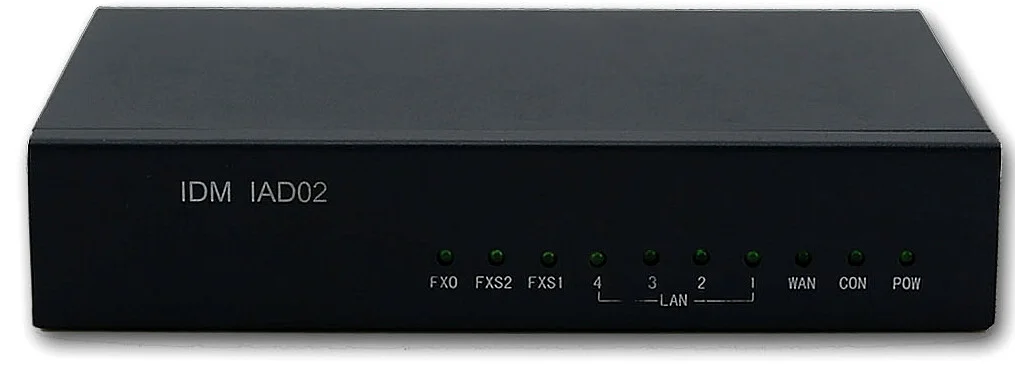
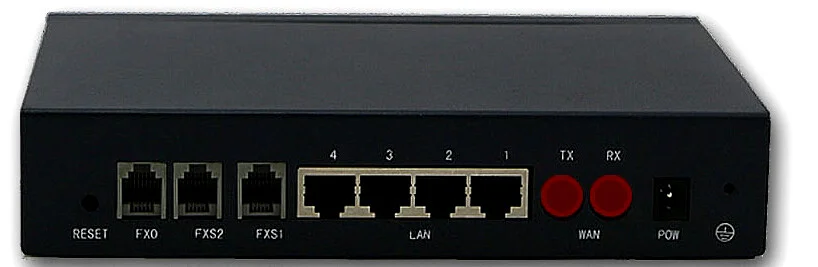
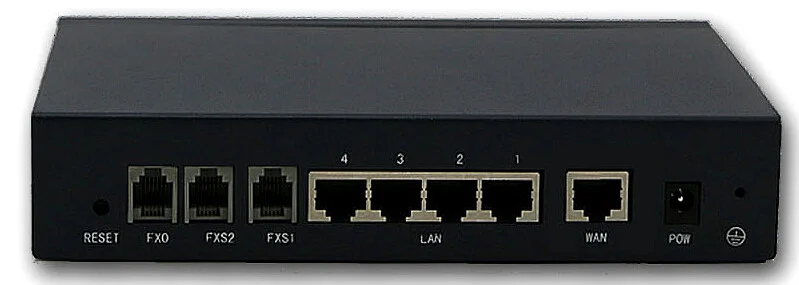
**Front Panel Image** **Optical Ethernet Access** **Electrical Ethernet Access**
I. Device Configuration:
Provides 1 WAN port and 4 LAN ports. The WAN port supports electrical (RJ45) and optical (FC) interfaces. In optical interface mode, it can interoperate with 100M media converters;
Provides 2 analog telephone interfaces (FXS) and 1 escape interface (FXO). The first telephone dials "0" to connect to the PSTN telephone (or the PSTN connection method can be configured via network management). During power failure, the first telephone is connected to the PSTN network.
II. Functional Description:
Supports the standard SIP protocol, supports dual-server registration settings, and supports dual backup of the call control center, enabling fast switching during network failures to ensure uninterrupted normal service;
Supports VLAN partitioning, supports 802.1q and 802.1p protocols, and can set service priority and VLAN tags for voice data streams, greatly enhancing service protection capability;
The system supports VPN (PPTP & L2TP);
The system registers to the server through the WAN port and can be accessed for configuration through both the WAN and LAN ports;
Supports T.38 real-time fax;
Supports multiple ITU-T codec standards such as G.711, G.729A, G.723.1, and supports dynamic jitter buffer management, echo cancellation (meeting ITU-T G.168/165 standards), packet loss compensation technology, Voice Activity Detection (VAD), and Comfort Noise Generation (CNG). It can be placed directly behind an ADSL Modem and automatically runs the PPPoE protocol to activate the enterprise internet interface, with automatic redial after PPPoE disconnection;
Supports DHCP and DNS client protocols, and supports automatic IP address acquisition;
Even if the upstream internet interface is interrupted, the IDM IAD02 device can still make internal calls and can dial in/out through the traditional PSTN network to ensure normal telephone service;
Supports WEB network management.
III. Dimensions and Weight
Length × Depth × Height: 190mm × 120mm × 40mm
IV. Operating Environment
Power Input: AC220V Power Consumption: 4W Operating Temperature: 0℃~45℃
Storage Temperature: -20℃~80℃ Humidity: 10%-90% non-condensing.
V. Application Examples:
Figure 1 Access to SIP Protocol IP Network (Electrical Port Type)
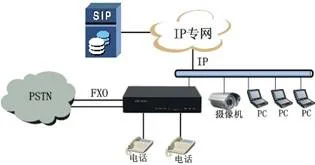
The device can also register directly to a SIP server via the IP network to expand IP telephony for existing systems. Meanwhile, the device supports analog trunk interfaces and can connect to traditional PSTN networks, adapting to complex network environments.
Figure 2 Used with Optical Ethernet Switch (6U) (Optical Port Type)
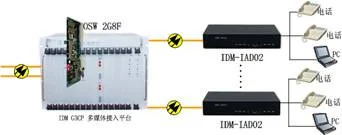
Using our company's high-capacity optical Ethernet switching device IDM MSAP-G3CP as the core switching center, which provides SIP registration services and softswitch functions, it directly connects to multiple remote IAD02 devices through Ethernet optical interfaces, enabling IP telephony and Ethernet data service access applications.
Figure 3 Used with Optical Ethernet Switch (1U) (Optical Port Type)
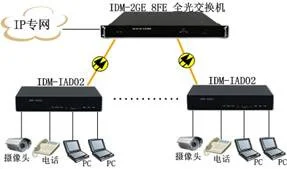
Using our company's small-capacity optical Ethernet switching device IDM 2GE8FE as the core switching center, which provides SIP registration services and softswitch functions, it directly connects to multiple remote IAD02 devices through Ethernet optical interfaces, enabling IP telephony and Ethernet data service access applications.
Figure 4 Used with Media Converters
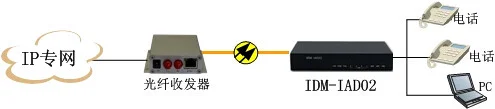
In locations with relatively long transmission distances, the device can be cascaded directly through optical ports with media converters and other equipment to meet IP telephony access applications in some edge networks.
FAQs
What is the working principle and function of a media converter?
The rapid advancement of informatization has led to growing demand for multimedia communications such as data, voice…
View answerWhat Is the Definition of Communication?
Communication: the exchange and transmission of information between people, or between people and nature…
View answerWhat is an E1 line? What are the core knowledge points?
E1 Basics Frame Structure of the E1 Channel In an E1 channel, 8 bits form one timeslot (TS)…
View answerPQC-Based FreeSWITCH and PJSIP Quantum-Resistant Communication System Upgrade Solution
The PQC-Based FreeSWITCH and PJSIP Quantum-Resistant Communication System Upgrade Solution transforms FreeSWITCH and…
View answerFortifying VoIP Communication with Quantum-Safe Defense | FreeSWITCH Softswitch Quantum-Safe Communication Mode Analysis, Selection, and Implementation Path
With the rapid iteration of quantum computing technology, traditional cryptographic algorithms such as RSA and ECC face…
View answer