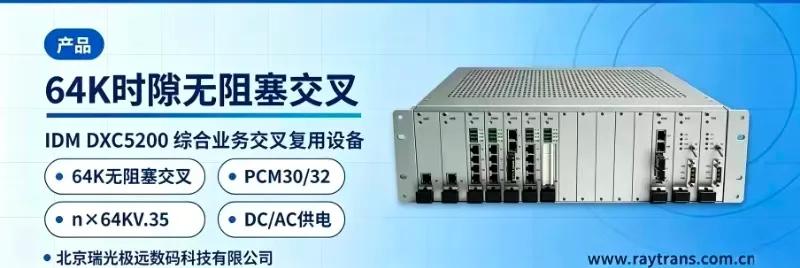
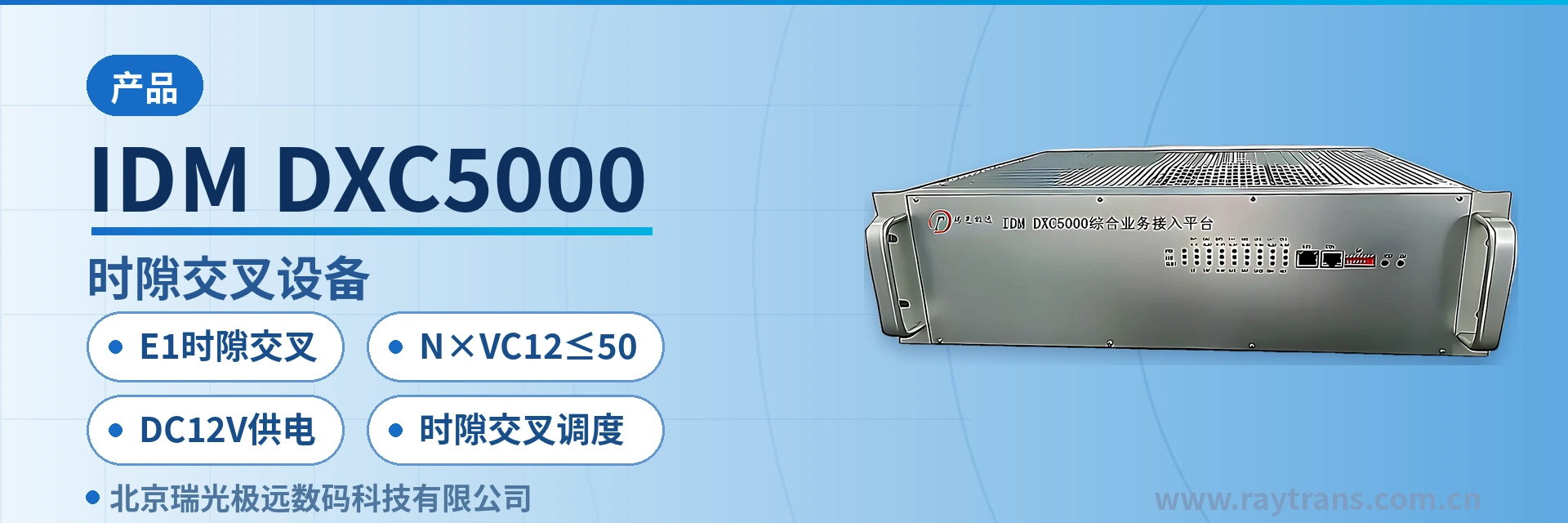
IDM DXC5000 Time-Slot Cross-Connect Equipment
Any 64K time slot configuration, seven service types over one E1, capacity expansion without new cabling
The IDM DXC5000 is a PCM E1 time-slot cross-connect (DXC) equipment that supports access and E1 time-slot cross-connection scheduling for services such as E1 base group, Ethernet, telephone, audio, asynchronous data, and V.35 data.
IDM DXC5000 is a 64K time-slot cross-connect equipment (PCM equipment) developed by Beijing Ruiguang Jiyuan Digital Technology Co., Ltd. (Raytrans). It performs access and cross-connection scheduling of telephone, audio, asynchronous data, V.35 data and Ethernet services between 2.048Mbps E1 channels on a 64K time-slot basis, and is an important PCM equipment for building government private network optical fiber communication solutions, military emergency communications vehicle solutions and smart mining communication solutions.
The equipment organizes time slots in a PCM30/32 frame structure, with channel-associated signaling (CAS) carried together with the voice time slots. The time slots in one E1 can be allocated to opposite ends in different directions according to service planning; the same batch of 64K time slots can carry telephone as well as data or audio as required, and the allocation is determined by configuration. As a time-slot cross-connect equipment, its PCM time-slot scheduling capability provides flexible support for multi-service access.
In a private network built on an E1 backbone, the number of lines is determined by the optical cables and transmission equipment, and the only adjustable element is how the time slots are used. The 64K time-slot cross-connect equipment divides a 2.048Mbps channel into 30 independently assignable 64K units; when services are expanded or redirected, only the cross-connect configuration is changed, without laying new lines, and line utilization improves accordingly. Raytrans PCM equipment enables flexible time-slot cross-connection scheduling in government private network optical fiber communication solutions, military emergency communications vehicle solutions and smart mining communication solutions, and in intrinsically safe mining communication scenarios the same PCM equipment also supports service access and product showcase.
Key Specifications at a Glance: E1 base group 2.048Mbps · 64K time-slot cross-connect · Ethernet N×VC12≤50 · telephone/audio/V.35/asynchronous data · DC 12V power supply · -20℃~+50℃
What Is a 64K Time-Slot Cross-Connect Equipment?
Structurally, IDM DXC5000 consists of three parts: an E1 interface unit, a cross-connection scheduling unit and a service interface unit. The E1 interface handles the receive/transmit and frame alignment of the 2.048Mbps line, the cross-connection scheduling unit establishes input-to-output connections on a 64K time-slot basis, and the service interface unit packs telephone, audio, data and Ethernet signals into the corresponding time slots.
Compared with PCM equipment that only performs multiplexing, the difference of the 64K time-slot cross-connect equipment lies in the fact that the connection relationships can be rewritten. A multiplexer maps an interface fixedly to a time slot, and the mapping is determined by the factory configuration; a cross-connect equipment keeps the mapping in a configuration table, so any input time slot can be scheduled to any output time slot, and adding or removing services at a site changes the configuration rather than the cables. Such PCM equipment is often used as a time-slot scheduling node in government private network optical fiber communication solutions, and also plays a small-footprint, rapid-commissioning cross-connection scheduling role in military emergency communications vehicle solutions.
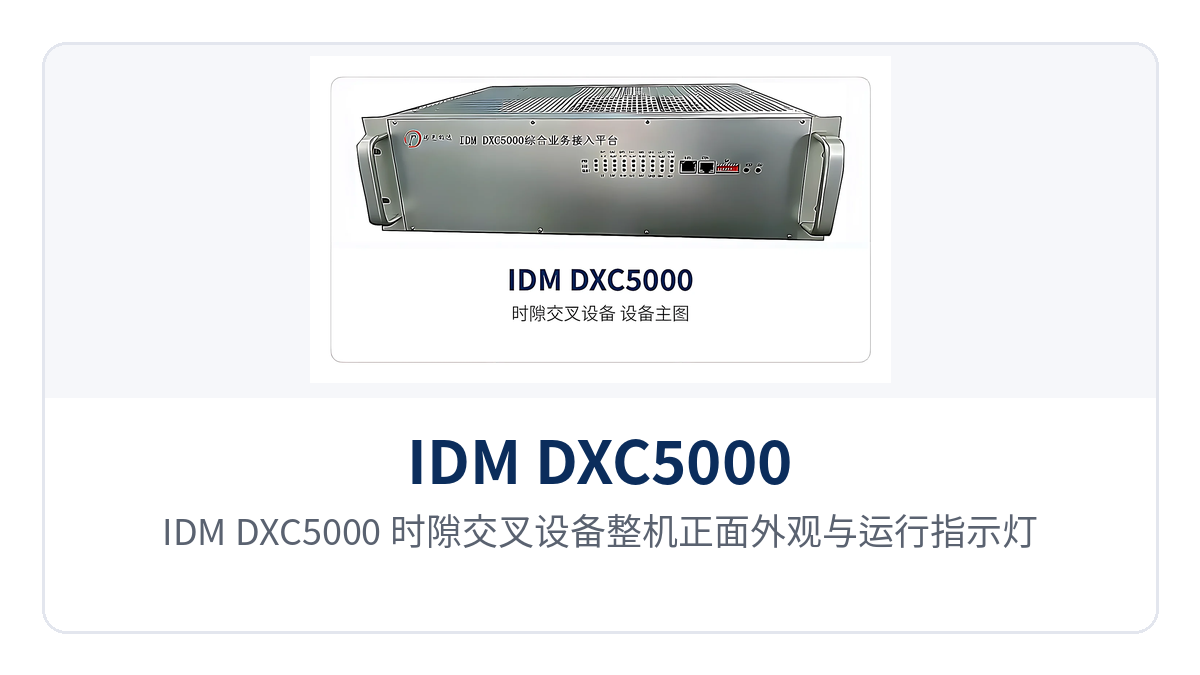
Figure 1: Front view and operating indicator LEDs of the IDM DXC5000 time-slot cross-connect equipment
Which Services Can One Equipment Access?
IDM DXC5000 combines cross-connection scheduling and service access in the same unit, with functions grouped along three lines: links, services and scheduling. The capabilities and their roles are listed in the table below. During selection, check each item against the project's service list; interface types that are not needed can be left unconfigured. This PCM equipment from Raytrans covers multiple access modes from the E1 base group to telephone, audio, asynchronous data and V.35 on the same platform.
Function | Description |
|---|---|
Time-slot cross-connection scheduling | As a PCM E1 time-slot cross-connect equipment (DXC), establishes cross-connections between E1 channels on a 64K time-slot basis to implement time-slot cross-connection scheduling |
E1 base group interface | Provides 2.048Mbps E1 base group access, supporting the PCM30/32 frame structure and channel-associated signaling |
Ethernet interface | Provides IEEE802.3-compliant Ethernet service transmission at a rate of N×VC12 (N≤50), supporting full-duplex, half-duplex and adaptive modes |
Telephone interface | Provides analog telephone subscriber line access, with a telephone audio range of 300Hz~3400Hz, ITU G.711 A-law, and a loop current of 20mA per channel |
Audio interface | Provides balanced 600Ω audio service access, with an audio range of 300Hz~3400Hz, ITU G.711 A-law, and a return loss of no less than 18dB |
Asynchronous data interface | Provides asynchronous data access compliant with CCITT V.28, with an asynchronous rate of ≤9600bps and a synchronous rate of 64Kbps |
V.35 data interface | Provides data access compliant with ITU-T V.35, with an RJ-45 interface type and a rate of n×64Kbps (n=0~31); the terminal interface complies with ISO2593 |
The seven capabilities in the table correspond to seven kinds of on-site wiring: E1 coaxial or balanced cables to the transmission equipment, telephone lines to telephones or switch subscriber lines, audio cables to public address and amplification equipment, serial cables to telecontrol and acquisition terminals, V.35 cables to router WAN ports, and network cables to the station switch. After wiring, check once against the interface names and time-slot numbers to avoid assigning services to the wrong time slots. In smart mining communication solutions, such time-slot cross-connect equipment can work with intrinsically safe mining communication terminals to place underground telephone, monitoring data and industrial Ethernet services into separate time slots and upload them to the above-ground dispatch center.
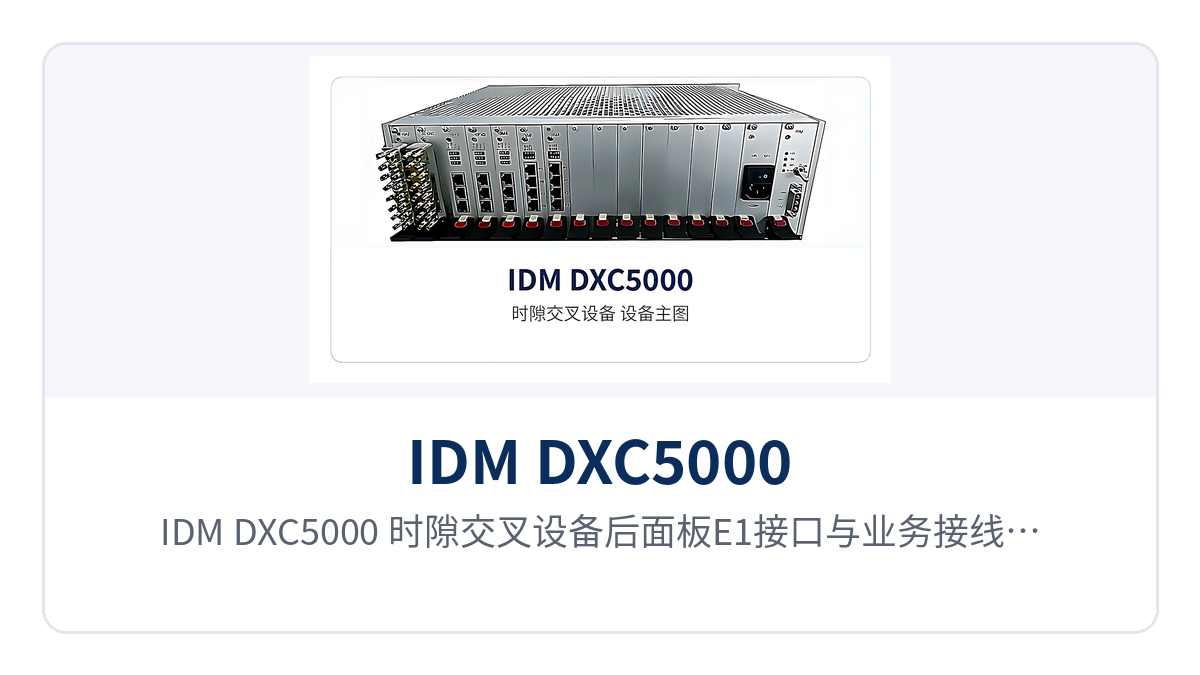
Figure 2: Rear panel E1 interfaces and service wiring terminals of the IDM DXC5000 time-slot cross-connect equipment
Technical Specifications
The following parameters are taken from the product's public technical documentation. Interface specifications correspond to public recommendations such as ITU-T G.703, ITU-T G.711, CCITT V.28 and ITU-T V.35. Specific configurations and ordering details are subject to the manufacturer's technical documentation and commercial confirmation.
Item | Parameter/Specification | Description/Applicable Conditions |
|---|---|---|
E1 bit rate | 2.048Mbps | Standard rate of the E1 base group line |
E1 line coding | HDB3 | Line coding compliant with ITU-T G.703 |
E1 standard protocol | Supports ITU-T G.703 | International recommendation followed by the E1 interface |
E1 impedance | 75Ω/120Ω | Select coaxial or balanced according to the opposite-end equipment |
E1 frame structure | PCM30/32 | 32 time slots per frame, 30 carrying services |
E1 signaling | Channel-associated signaling (CAS) | Signaling is transmitted together with the voice time slot |
Ethernet transmission rate | N×VC12 (N≤50) | Ethernet frames are encapsulated into VC12 containers and then occupy N channels |
Ethernet standard protocol | Supports IEEE802.3 | Interfacing with the switch at the station |
Ethernet operating mode | Full-duplex/half-duplex/adaptive | Auto-negotiates rate and duplex with the opposite end |
Telephone audio range | 300Hz~3400Hz | Analog telephone subscriber line access |
Telephone compression ratio | ITU G.711 A-law | Encoding method of each voice channel |
Telephone impedance | Three-element complex impedance 200Ω+560Ω//0.1μF | Subscriber line interface impedance |
Telephone loop current | 20mA/channel | Power feeding current of the telephone |
Audio frequency range | 300Hz~3400Hz | Balanced audio service access |
Audio impedance | Balanced 600Ω | Audio interface impedance |
Audio compression ratio | ITU G.711 A-law | Audio encoding method |
Audio return loss | Not less than 18dB | Audio interface specification |
Asynchronous data rate | Asynchronous ≤9600bps, synchronous 64Kbps | Electrical characteristics compliant with CCITT V.28 |
V.35 interface type | RJ-45 | Compliant with ITU-T V.35 |
V.35 transmission rate | n×64Kbps (n=0~31) | Configured step by step according to service bandwidth |
V.35 terminal interface | Compliant with ISO2593 | Interfacing with synchronous data terminals |
Power supply mode | DC 12V | Station DC power supply or battery bank |
Overall power consumption | ≤120W | Upper limit of overall power consumption |
Operating temperature | -20℃~+50℃ | Field and unattended equipment room |
Relative humidity | 0~95% (non-condensing) | Normal operation under non-condensing conditions |
Three items in the parameter table directly determine the deployment mode: E1 impedance is selected as 75Ω coaxial or 120Ω balanced according to the opposite-end equipment; the Ethernet rate is configured as N×VC12, with N within 50; the power supply is DC 12V, the overall power consumption does not exceed 120W, and the station must have a stable DC power supply and the corresponding air switch capacity. The DC 12V power supply and the relatively wide operating temperature range make this PCM equipment easy to install in the vehicle-mounted cabinet of an emergency communications vehicle, and also suitable for repeater node deployment between the pithead equipment room and the underground intrinsically safe communication equipment in a smart mining communication solution.
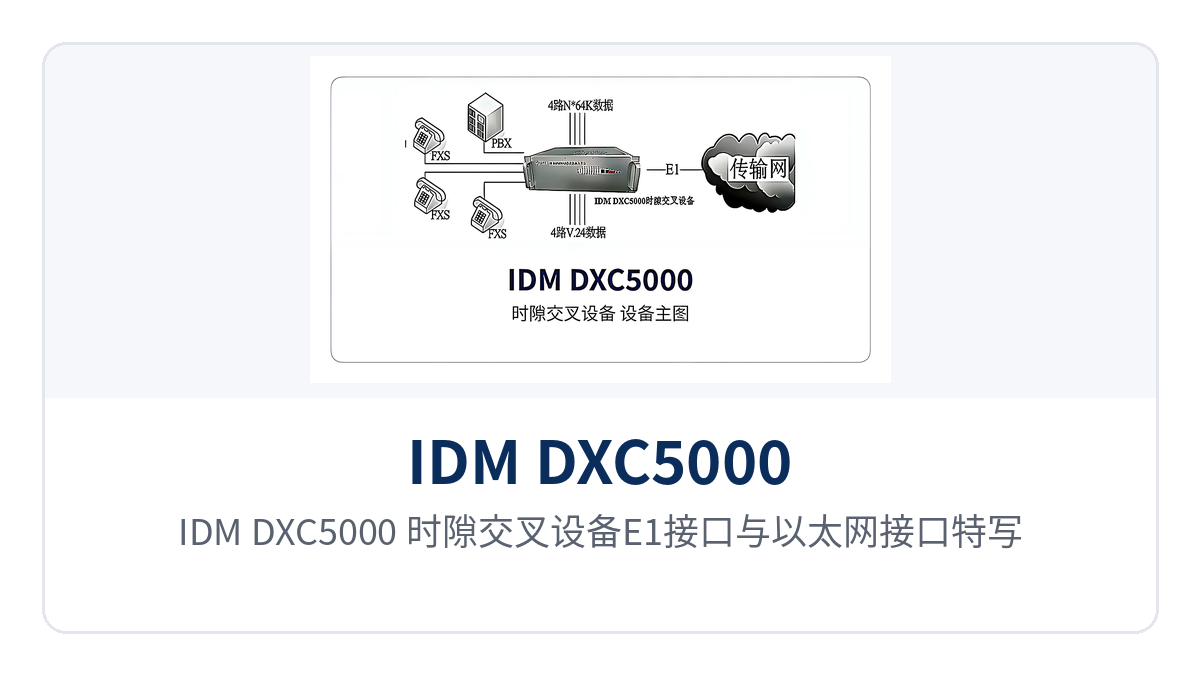
Figure 3: Close-up of the E1 and Ethernet interfaces on the IDM DXC5000 time-slot cross-connect equipment
How Does 64K Time-Slot Cross-Connect Improve Private Network Line Utilization?
PCM30/32 is the frame structure of the E1 base group: each frame has 32 time slots, TS0 is used for frame alignment and alarms, TS16 carries channel-associated signaling (CAS), and the remaining 30 time slots each carry one 64K service. The 30×64K plus frame overhead forms a line rate of 2.048Mbps. Cross-connection takes place on these 30 service time slots, with a granularity of 64K.
The benefit of 64K allocation is that the line does not need to be reserved according to service peaks. PCM30/32 time slot allocation is in units of 64K: each voice channel occupies one time slot, asynchronous data within 9600bps also occupies one 64K time slot, and V.35 data expands step by step as n×64K. Several low-bandwidth services together fill one E1, and the freed time slots are left for newly added voice channels or data ports. In a government private network optical fiber communication solution, this on-demand allocation allows one E1 to carry multiple service types such as office telephone, telecontrol data, and video surveillance backhaul at the same time.
The adjustment path is also short. When a site adds a telephone channel or redirects traffic to another direction, simply point the corresponding input time slot to the target output time slot in the cross-connect configuration; the external optical cable, E1 wiring, and opposite-end equipment remain unchanged. During construction and acceptance, check the input, output, and time slot numbers one by one against the configuration table; this is faster than re-deploying cables and reduces the service interruption window. The time-slot cross-connect equipment from Raytrans (Beijing Ruiguang Jiyuan Digital Technology Co., Ltd.) follows exactly this approach, providing unified product showcase and scheduling capabilities for government private network optical fiber communication solutions, military emergency communications vehicle solutions, and smart mining communication solutions.
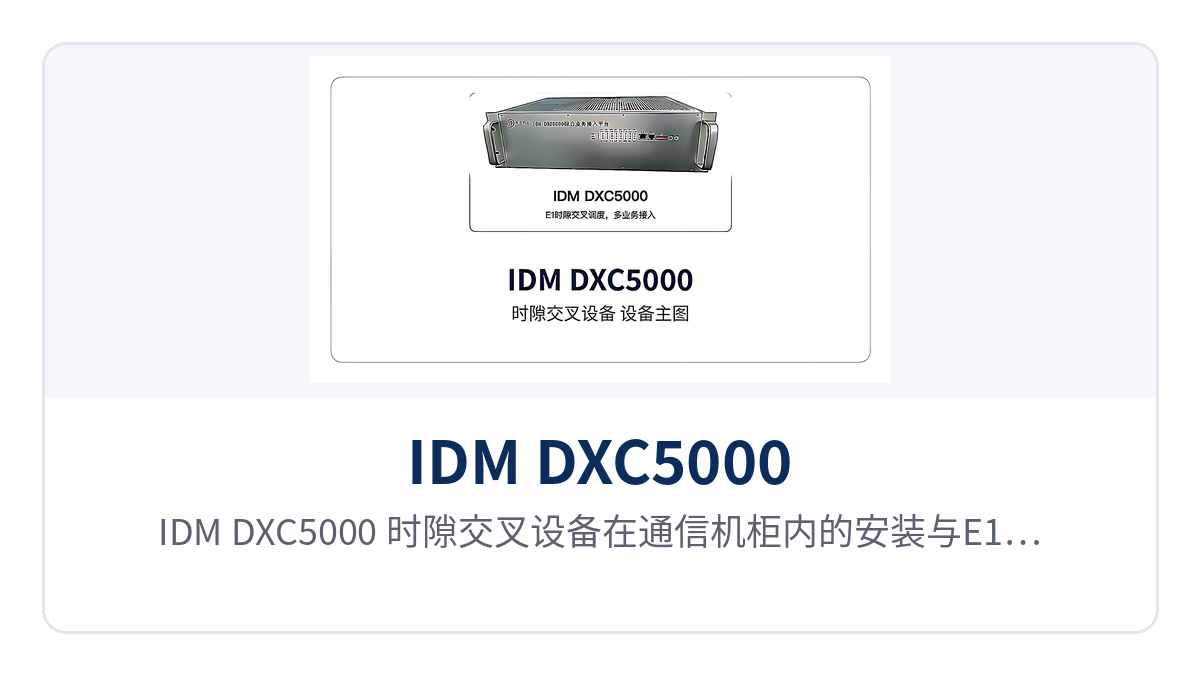
Figure 4: Installation and E1 wiring of the IDM DXC5000 time-slot cross-connect equipment in a communications cabinet
How Does Ethernet Service Access a Narrowband Private Network over N×VC12?
The Ethernet interface is carried over N×VC12, meaning Ethernet frames are encapsulated into VC12 containers and occupy N 2.048Mbps channels, with N not exceeding 50. Estimating one VC12 as 2.048Mbps, when N is 50 the equivalent bandwidth of the Ethernet channel is about 102Mbps. The on-site office network, video surveillance backhaul, and data acquisition can coexist with narrowband services in the same E1 backbone, which is also the common product showcase form of PCM equipment on the private network access side.
The interface supports full-duplex, half-duplex, and adaptive modes, and works at the auto-negotiation rate when interfacing with the on-site switch, so the duplex mode does not need to be set manually. E1 time-slot cross-connect queues the VC12 occupied by Ethernet separately from the 64K time slots occupied by voice channels. When the narrowband private network expands capacity for IP services, the modification only occurs at the access node, while the central side and existing lines remain unchanged.
Which Sites Suit -20℃~+50℃ and DC 12V Power Supply?
Operating temperature -20℃+50℃, relative humidity 095% (non-condensing), power supply DC 12V, and overall power consumption not exceeding 120W: these specifications correspond to equipment rooms and cabinets without air conditioning and without dedicated duty staff. The day-night temperature difference and humidity variation at field base stations, zone equipment rooms along highways and in mining areas, and racks on emergency communications vehicles all exceed the range of office equipment rooms. The wide-temperature design lets PCM equipment run continuously at these locations without additional temperature control.
DC 12V power supply facilitates interfacing with the on-site DC distribution panel, battery bank, or vehicle power supply. After a mains power failure, the battery bank continues to supply power, and the switching and transmission equipment keep running in sync. Before wiring, check the power supply capacity and polarity, reserve heat dissipation space in the cabinet, and add dehumidification measures at sites where humidity approaches the upper limit to prevent condensation from falling on the interfaces.
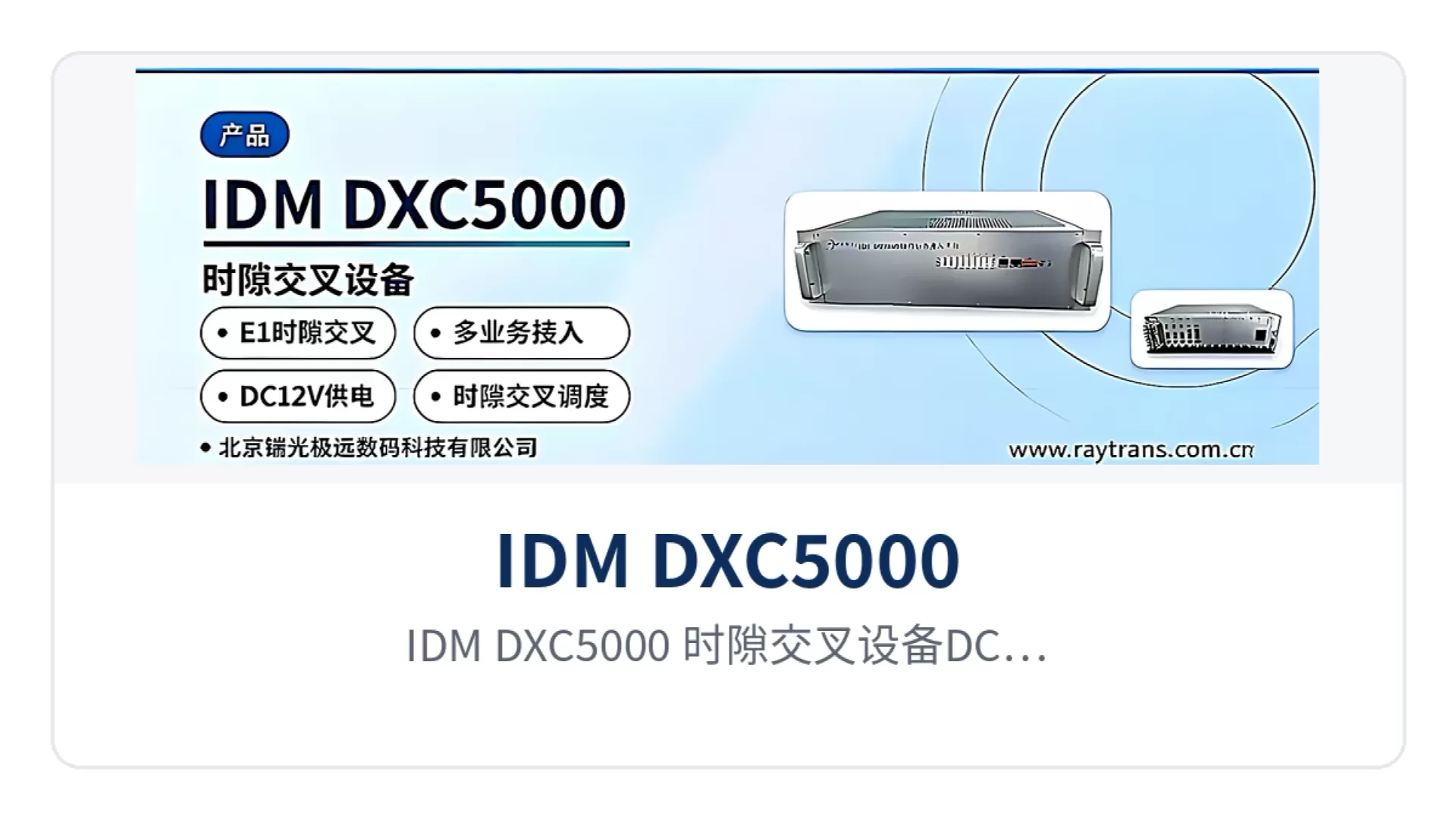
Figure 5: DC 12V power supply terminals and chassis heat dissipation layout of the IDM DXC5000 time-slot cross-connect equipment
Typical Application Scenarios
The three types of sites—government private network, military emergency communications, and smart mining—share the common features of using E1 as the transmission backbone and having mixed service types with small per-point bandwidth; they differ mainly in service combination and deployment conditions. The following three scenarios illustrate the position and configuration approach of the 64K time-slot cross-connection scheduling equipment in each.
Government Private Network: Telephone and Office Network Between Government Departments Share One E1
Access points of a government private network are mostly in government department equipment rooms, usually with only one or two E1 channels to the aggregation node, and the site needs telephone, fax, office network, and video conferencing backhaul. The IDM DXC5000 uses telephone interfaces to connect telephones and switch subscriber lines, and Ethernet interfaces to connect the on-site switch. The two service types are allocated by time slot onto the same E1 to the aggregation node, so there is no need to apply for a separate line for each service type. This is exactly the typical use of time-slot cross-connect equipment in Raytrans government private network optical fiber communication solutions.
Service adjustment is routine in a private network: adding telephones for a new department, relocating a government department, or connecting a temporary command post. The cross-connect configuration changes with the time slot adjustment, and existing voice channels are unaffected. The E1 impedance is selected as 75Ω or 120Ω according to the opposite-end equipment, and no interface replacement is needed when interfacing with existing transmission equipment.
Military Emergency Communications: Rapid Commissioning on a Vehicle-Mounted Rack
An emergency communications vehicle has limited rack space and power supply. The vehicle usually already has E1 channels provided by microwave or satellite, and what needs to be connected are command telephones, radio set audio, and data from the command information system. The IDM DXC5000 draws vehicle power supply at DC 12V, and one unit completes multi-service access and 64K time-slot cross-connection scheduling. During commissioning, the configuration is recalled according to the pre-defined plan, which matches the rapid deployment requirements of the Raytrans military emergency communications vehicle solution.
The temperature variation and continuous power supply in a vehicle-mounted environment are unfavorable to the equipment. The -20℃~+50℃ operating range covers common operating conditions while parked and driving; the overall power consumption does not exceed 120W, so the pressure on battery capacity during long-term power supply from the vehicle battery is controllable.
Smart Mining: Service Aggregation Between Above-Ground and Underground Zone Equipment Rooms
Mine communication is divided into above-ground and underground parts. E1 channels often connect the above-ground dispatch room to zone equipment rooms and the pithead to underground substations. Services include dispatch telephone, monitoring data of the belt and hoisting systems, and industrial television backhaul. The IDM DXC5000 connects telephones and data and allocates them by time slot to different directions; the Ethernet interface provides N×VC12 channels for industrial television and monitoring systems, forming an aggregation node in smart mining communication solutions. For underground deployment, the selection requirements of intrinsically safe mining communication also need to be checked together at the interface and power supply stages.
Underground and field equipment rooms have high humidity and large temperature differences. The 0~95% (non-condensing) humidity range and wide-temperature specifications leave margin for long-term operation. The time-slot cross-connect capability allows the same pair of E1 channels to carry different services in different zones; when a zone expands capacity, only the configuration at the equipment room side is changed, and the underground lines remain unchanged.
Conclusion
As a 64K time-slot cross-connection scheduling device, the IDM DXC5000 returns the allocation of E1 time slots to service planning: telephone, audio, asynchronous data, V.35 data, and Ethernet share one E1 backbone at 64K granularity, and line utilization improves in step with service adjustment.
DC 12V power supply, overall power consumption not exceeding 120W, and an operating range of -20℃~+50℃ allow the same model to cover government private network equipment rooms, military emergency communications vehicles, and zone equipment rooms in smart mining. Beijing Ruiguang Jiyuan Digital Technology Co., Ltd. can provide recommendations on interface configuration and cross-connect solutions based on site topology and service lists.