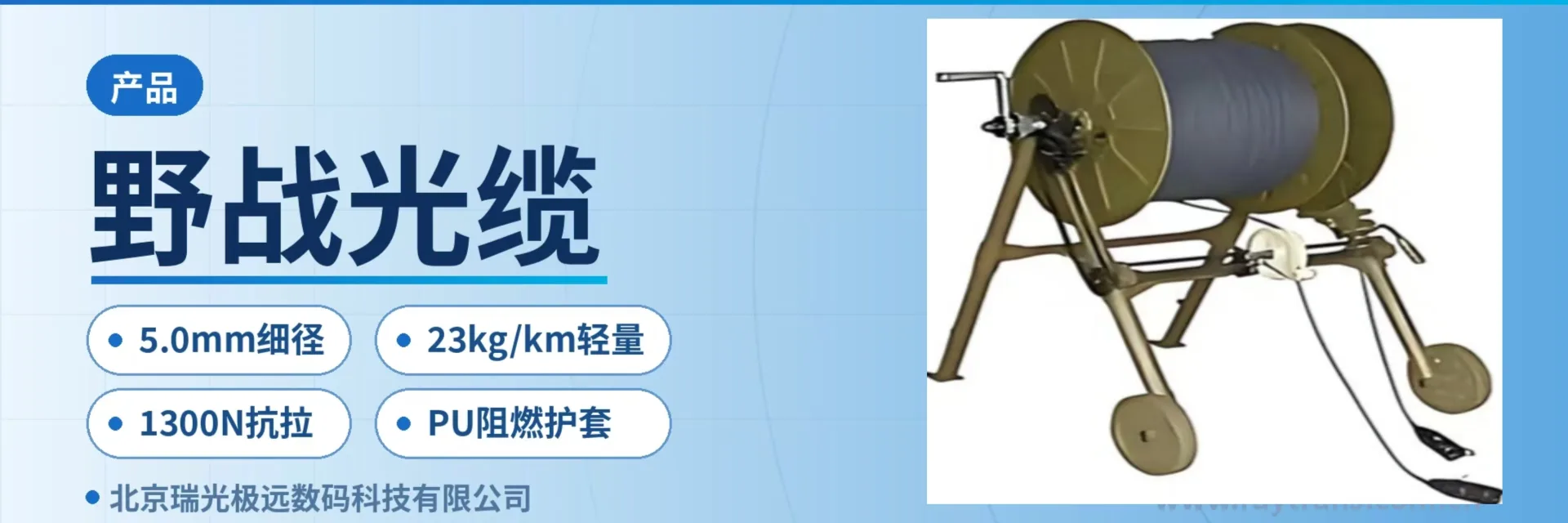
Field Optical Cable
5.0mm slim diameter, 23kg/km single-person carry, 1300N aramid tensile strength
Product applications: cabling in military field communication systems and weapon equipment control systems. Data acquisition and communication for oilfields, mining operations, live TV broadcasting, and emergency repair of telecommunications. Particularly suitable for scenarios requiring manual quick cabling.
What Kind of Equipment Is a Field Optical Cable?
A field optical cable is an optical cable designed for field and complex environments that can be rapidly deployed or repeatedly paid out and taken up manually. Developed by Beijing Ruiguang Jiyuan Digital Technology Co., Ltd. (Raytrans), it is used for cabling in military field communication systems, weapon and equipment control systems, and data acquisition and communication applications such as oilfields, mining operations, live TV broadcasting, and emergency repair of telecommunications, and is also a commonly used cabling material in emergency communications assurance.
Key Specifications at a Glance: 1–6 cores customizable · 2-core and 4-core outer diameter 5.0mm · weight 23kg per kilometer · tensile strength 1300N · crush resistance 10001100N/100mm · allowable bending radius 5055mm · PU flame-retardant sheath
The key indicator for measuring the performance of this type of cable is the strength-to-weight ratio, that is, how much force can be borne per unit weight. Taking the 2-core version as an example, with an outer diameter of 5.0mm, a weight of 23kg per kilometer, a tensile strength of 1300N, and a crush resistance of 1000N/100mm, one operator can drag and deploy it along a temporary route without difficulty, and no auxiliary tools are needed to coil it up.
Why Can a Field Optical Cable Achieve Such a High Strength-to-Weight Ratio?
The high strength-to-weight ratio comes from the materials and the stranding structure, not simply from thickening the sheath. The optical fiber is a high-strength fatigue-resistant type, and the coating layer and secondary covering form a composite structure that absorbs mechanical and environmental stress, resulting in low additional attenuation of the cable; small-pitch SZ stranding combined with single-strand helical stranding of aramid reinforcing fibers gives the cable a large tensile strain window.
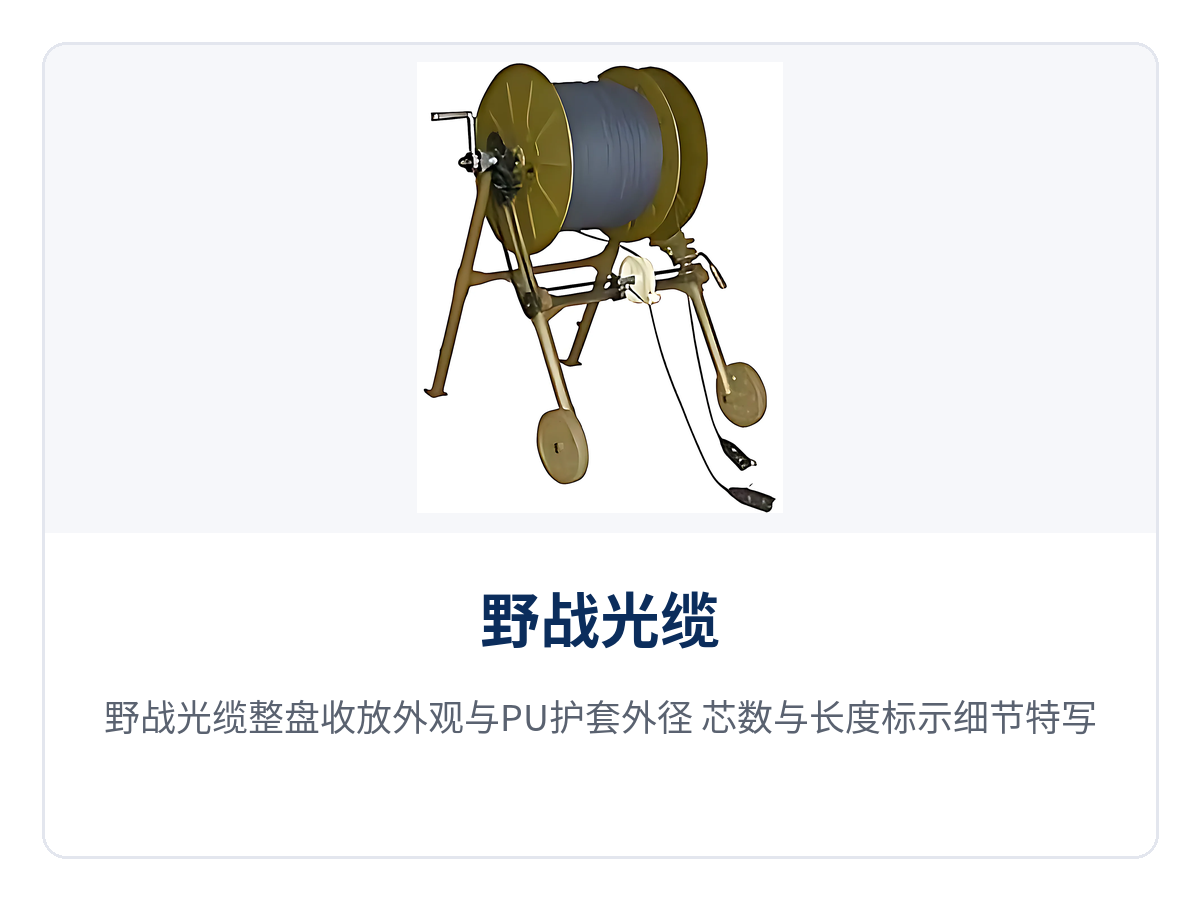
Figure 1: Close-up of the full-reel payout appearance of the field optical cable and details of the PU sheath outer diameter, core count, and length marking
The 1300N tensile strength is borne by the aramid reinforcing fibers, and the optical fiber itself is not directly subjected to tension, which is why a tensile field optical cable is not pulled apart when dragged through brush and ditches. The pulling point is fixed to the sheath and strength members, and only then does the tensile strain window truly take effect; if the pulling force is applied to the optical fiber, fiber breakage often occurs at this step, which has nothing to do with the carrying capacity of the cable itself.
What Core Counts and Specifications Does a Field Optical Cable Support?
The core count of a field optical cable is customizable from 1 to 6 cores, with 2-core, 4-core, and 6-core being the three commonly used options, and the outer diameter and weight differ slightly with the core count. The table below lists the function items at the structure and material level one by one; when ordering, write the required function items into the technical clauses, and there is also a unified basis for on-site verification.
Function | Description |
|---|---|
High-strength fatigue-resistant optical fiber | Ensures reliability and service life under harsh field conditions, maintaining transmission performance after repeated payout and take-up |
Composite structure of coating layer and secondary covering | Absorbs mechanical and environmental stress, resulting in low additional attenuation of the cable |
Small-pitch SZ stranding and single-strand helical aramid stranding | Aramid reinforcing fibers bear the tensile force, providing the cable with a large tensile strain window |
Round compact sheath structure | Round cross-section and small volume, suitable for repeated payout and coiling |
Flame-retardant PU elastomer sheath | High oxygen index and good flame retardancy, oil and chemical corrosion resistance, tear resistance, and low-temperature flexibility |
TIA/EIA-598-B color-coded tight-buffered coating | Each core is distinguished by standard color coding, facilitating path assignment and termination |
Product information and length marking on the outer sheath | Product information and remaining length can be read directly on site and verified before deployment |
Quick mating connectors pre-installed at both ends | Pre-installed as required by the user, plug-and-play termination on site |
1–6 cores customizable | Core count customized as required to match different service capacities |
Item | Parameter/Specification | Description/Applicable Conditions |
|---|---|---|
Optical cable cores | 2-core, 4-core, 6-core; 1–6 cores customizable | Selected according to service capacity and redundancy margin |
Cable outer diameter | 2-core 5.0mm, 4-core 5.0mm, 6-core 5.5mm | Round sheath, small coiling diameter |
Cable weight | 2-core 23kg/km, 4-core 23kg/km, 6-core 28kg/km | Lightweight, easy to carry and deploy manually |
Tensile strength | 1300N (same for 2-core, 4-core, and 6-core) | Borne by aramid reinforcing fibers |
Crush resistance | 1000N/100mm for 2-core and 4-core, 1100N/100mm for 6-core | Withstands vehicle rolling and soil cover pressure |
Allowable bending radius | 50mm for 2-core and 4-core, 55mm for 6-core | Control bending according to this during deployment and take-up |
Optical fiber type | High-strength fatigue-resistant optical fiber | Tight-buffered coating colored according to TIA/EIA-598-B |
Sheath material | Flame-retardant high-strength, high-toughness polyurethane (PU) elastomer | Flame-retardant, oil and chemical corrosion resistant, low-temperature flexible |
Transmission wavelength and attenuation | Not yet recorded in the knowledge base | To be verified according to the selected optical fiber specification and the manufacturer's technical documentation |
The 2-core and 4-core versions share the same 5.0mm outer diameter and the same 23kg/km weight; the 6-core version has a 5.5mm outer diameter and a weight of 28kg/km, with crush resistance increased to 1100N/100mm, while the tensile strength remains 1300N across all three options. When selecting a lightweight field optical cable by core count, first allow redundancy according to the number of service channels, then verify the bending radius and connector type.
Where Are the Differentiated Capabilities of a Field Optical Cable Reflected?
The differentiated capabilities of a field optical cable can be grouped into four items: lightweight, tensile resistance, sheath durability, and customizability, each corresponding to a specific problem in field operations: a full reel too heavy to carry, fear of pulling it apart when dragging, the sheath hardening and cracking under oil contamination and low temperatures, and core count and connector type not matching the site. The table below maps the four capabilities to user value one by one, making it easier to make trade-offs according to on-site conditions.
Differentiation Point | Value to Users |
|---|---|
5.0mm slim diameter, 23kg/km lightweight | 2-core and 4-core versions share a 5.0mm outer diameter and 23kg per kilometer, so one person can carry a whole reel and deploy it along a temporary route, saving effort in manual quick deployment |
1300N tensile strength | Tensile force is borne by aramid reinforcing fibers, so pulling through shrubs and ditches will not break the cable, and the tensile strain window remains effective after repeated deployment and recovery |
PU flame-retardant sheath | The flame-retardant polyurethane elastomer has a high oxygen index, resists oil and chemical corrosion, tear resistance and low-temperature flexibility, and suits repeated deployment and recovery in oilfields and mining areas |
1–6 cores customizable, connectors pre-installed at both ends | The number of cores is selected according to service volume, and quick mating connectors can be pre-installed at both ends for plug-and-play on-site termination |
Among the four capabilities, lightweight and tensile strength determine whether the link can be laid out manually, while the sheath determines how long a reel of cable can withstand repeated deployment and recovery. For quick deployment, field optical cable on temporary routes values the first three items more; for long-term laying in oily and low-temperature environments, the sheath and terminations should be checked together before ordering.
Why Is PU-Sheathed Field Optical Cable Suited to Repeated Deployment and Recovery?
The outer sheath of PU-sheathed field optical cable uses a flame-retardant high-strength, high-toughness polyurethane elastomer, and this sheath determines how many deployment and recovery cycles a reel of cable can withstand. The PU material has a high oxygen index and good flame retardancy, and also resists oil and chemical corrosion, with tear resistance, strong elasticity, good stress buffering, wear and pressure resistance, and retained low-temperature flexibility.
For operations that deploy and recover multiple times a day, the sheath's wear resistance and stress buffering matter more than simply making it thicker. The PU sheath disperses stress during dragging, reeling and vehicle compression, preventing moisture ingress after the sheath cracks; oil, dust and chemical media common at oilfields and mining sites also do not easily attack its surface.
Flame retardant: high oxygen index, not prone to sustained burning under open flame
Oil and chemical corrosion resistance: oil and media at oilfields and mining sites do not easily attack the sheath
Tear resistance and wear resistance: the sheath does not easily crack after dragging, reeling and vehicle crushing
Low-temperature flexibility: the sheath does not harden in low-temperature environments and does not easily break during deployment and recovery
Stress buffering: disperses stress during bending and compression to protect the internal optical fiber
How Is Field Optical Cable Deployed Quickly by Hand?
The prerequisite for quick deployment is a clear load path: tensile force is borne by the aramid reinforcing fibers and the sheath, and the optical fiber itself should not be directly pulled. The following six steps cover the whole process from verification and payout to tension control, cable recovery and optical continuity testing, and can be completed on site without professional instruments.
Verify before deployment: read the product information and length marking on the outer sheath, confirm the number of cores, length and connector type at both ends, and start payout only after they match the route design.
Pay out the route: pull manually along the line, keep the cable run rounded, and avoid kinks, hard bends and stepping on the cable; control the bending radius by core count, no less than 50mm for 2-core and 4-core, and no less than 55mm for 6-core.
Control tension: dragging tension must not exceed 1300N; clear any snag before pulling again, and do not use vehicle traction to replace manual judgment.
Termination and assignment: distinguish cores by TIA/EIA-598-B color code, and directly mate the two ends with pre-installed quick connectors; if not pre-installed, use splicing or on-site termination processes.
Recover and coil: coil in the same direction, without reverse folding or heavy objects on top, and after recovery check the sheath for abrasion marks and the end faces for contamination.
Optical continuity check: after connecting both ends, measure link loss with a light source and an optical power meter, compare it with the budgeted value, and deliver for use only after confirmation.
The step that most often goes wrong in this process is tension control: broken cores are mostly not caused by insufficient cable tensile strength, but by dragging that applies tension directly to the optical fiber. Fix the pulling point on the sheath and strength members so the aramid fibers take the load evenly, and only then does the tensile strain window of the tensile field optical cable truly take effect.
Where Is Field Optical Cable Used?
Field optical cable applications concentrate on three types of sites: military field communications and equipment control, data acquisition at energy sites such as oilfields and mining, and temporary links for emergency repair and live TV broadcasting. What these three types of sites share is that no pre-laid conduit is available, so the cable can only be deployed quickly by hand along a temporary route. For occasions that need to quickly build a product showcase link, field optical cable can likewise visually demonstrate the flexibility of emergency communications deployment.
Military Field Communications and Weapon Equipment Control Systems
Cabling for military field communication systems uses exactly these repeatedly deployable temporary links, and connections among command posts, forward positions and equipment control units are often laid once and recovered within hours or days. With 2-core and 4-core versions at a 5.0mm outer diameter and 23kg/km weight, a single communications soldier can carry one reel and deploy it along a position, and the 1300N tensile strength covers pulling through shrubs and across ditches. Such links are also a common end extension in military emergency communications vehicle solutions, and together with vehicle-mounted equipment they can quickly connect command nodes.
Weapon equipment control systems require link stability more than bandwidth. Field optical cable uses high-strength fatigue-resistant optical fiber and a composite coating structure, with low additional attenuation, and still maintains transmission performance after repeated deployment and recovery; the round compact sheath has a small coiling radius and suits mobile deployment with equipment vehicles.
Data Acquisition in Oilfield and Mining Operations
Data acquisition points at oilfields and mining sites are scattered among well sites, mine roadways and work faces, and links must be relocated as operations advance. Lightweight field optical cable weighs only 23kg per kilometer, so two people can carry a whole reel when relocating; the PU sheath resists oil and chemical corrosion, and oil at well sites and dust in mining areas do not easily attack the sheath surface. In the overall architecture of a smart mining communication solution, such field optical cable can serve as a supplementary link between mining work faces and temporary monitoring points in mine roadways, and work with intrinsically safe mining communication equipment to meet data backhaul needs at mobile work faces.
Temporary links in mining areas and well sites are often crushed by vehicles and covered by materials. The round sheath with 1000N/100mm crush resistance disperses stress across the full cross-section when compressed, so the sheath does not rupture and the optical fiber is not squeezed, ensuring signal continuity for data acquisition.
Telecom Emergency Repair and Live TV Broadcasting
The time window for telecom emergency repair is usually measured in hours, and the cable must be laid directly from the equipment room or repair vehicle to the point of failure. Quick-deployment field optical cable allows core count to be selected according to repair service volume, and with quick mating connectors pre-installed at both ends, on-site termination is plug-and-play, eliminating the wait for temporary splicing. Emergency backup links in government private network optical fiber communication solutions can likewise be built quickly with such cable, providing a temporary detour channel when the trunk optical cable is interrupted.
Live TV broadcasting requires stable signals and laying that does not disturb the site. The tight-buffered coating uses TIA/EIA-598-B color coding, so multi-core links are clearly assigned; the round sheath structure makes it easy to relocate repeatedly between the outside broadcast van and camera positions without affecting the production rhythm.
How to Select and Order Field Optical Cable?
Field optical cable selection can be ordered once three items are fixed: number of cores, length and termination type, while the on-site environment determines the choice of sheath and accessories. The number of cores is first calculated from the number of service channels plus redundancy margin, the length is specified as the actual route length plus deployment and recovery allowance, and finished cables can be pre-installed with quick mating connectors at both ends. As a professional media converter manufacturer, Raytrans can provide selection recommendations and matching optical transmission equipment based on the customer's on-site conditions, ensuring both ends of the link match.
Number of cores: 1–6 cores customizable, with 2-core, 4-core and 6-core as the three common options
Termination: quick mating connectors can be pre-installed, or only the cable body can be ordered for termination by the installer
Length: route length plus deployment and recovery allowance, with length marking printed on the outer sheath for easy verification
Color code: tight-buffered coating distinguishes cores according to the TIA/EIA-598-B standard color code
Environment: for oily, chemical and low-temperature environments, select according to the material capabilities of the PU sheath
Conclusion
Field optical cable combines high-strength fatigue-resistant optical fiber, an aramid-reinforced structure and a PU flame-retardant sheath, carrying 1300N tensile strength in a lightweight 2-core 5.0mm, 23kg-per-kilometer format, so field links can be deployed quickly by hand and recovered repeatedly. The solution experience Raytrans has accumulated in emergency communications and private network communication can provide reference for temporary link selection in military emergency communications vehicle solutions, smart mining communication solutions and government private network optical fiber communication solutions.
With configuration fixed by number of cores, length and termination type, field optical cable can form links quickly on temporary routes and also be laid long-term in oily, low-temperature and frequently relocated environments. For links requiring pre-installed connectors or multi-core customization, simply state the on-site conditions and route length together to complete the selection.