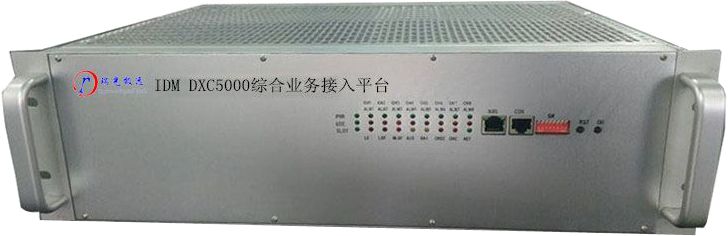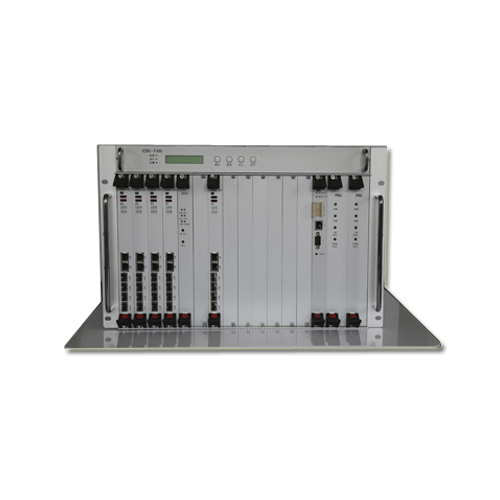
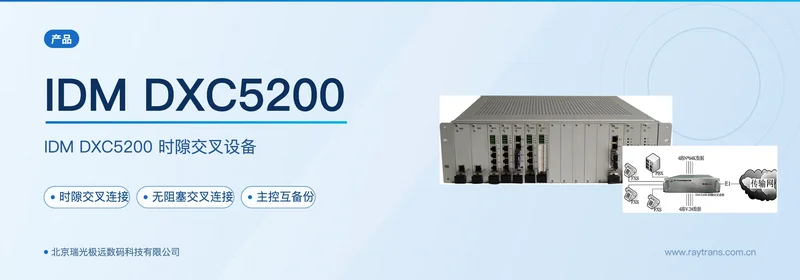
IDM DXC5200, Timeslot Cross-Connect Device, E1 Interface, PCM30/32 Frame Structure, HDB3 Line Code
The IDM DXC5200 timeslot cross-connect device supports the ITU-T G.703 standard, PCM30/32 frame structure, and HDB3 line code. It provides E1 interfaces, audio interfaces, and data interfaces (V.35/RS232), supports channel associated signaling, and is suitable for timeslot cross-connect applications.
The IDM DXC5200 timeslot cross-connect device is a cross-connect device based on E1 transmission developed by Beijing Ruiguang Jiyuan Digital Technology Co., Ltd. It is used to perform 64K timeslot cross-connect and scheduling of voice and data services between 2.048Mbps E1 channels. This E1 timeslot cross-connect device complies with the ITU-T G.703 standard, adopts the PCM30/32 frame structure and HDB3 line code, provides E1 interfaces, audio interfaces, and V.35, RS232 data interfaces, supports channel associated signaling, and is suitable for timeslot cross-connect applications in private and public networks.
What is a Timeslot Cross-Connect Device
A timeslot cross-connect device is a communication device that uses the 64K timeslot as the minimum scheduling unit and performs on-demand cross-connect and service allocation between E1 digital channels. It is a key node for circuit scheduling and switching in PCM primary group networks. The IDM DXC5200 timeslot cross-connect device completes connections between user terminal equipment, or between user terminal equipment and the public switched telephone network, through 2M transmission media, incorporating dispersed voice and data services into E1 channels for unified transmission. Network expansion or service adjustments only require modifying the cross-connect configuration without changing the transmission lines.
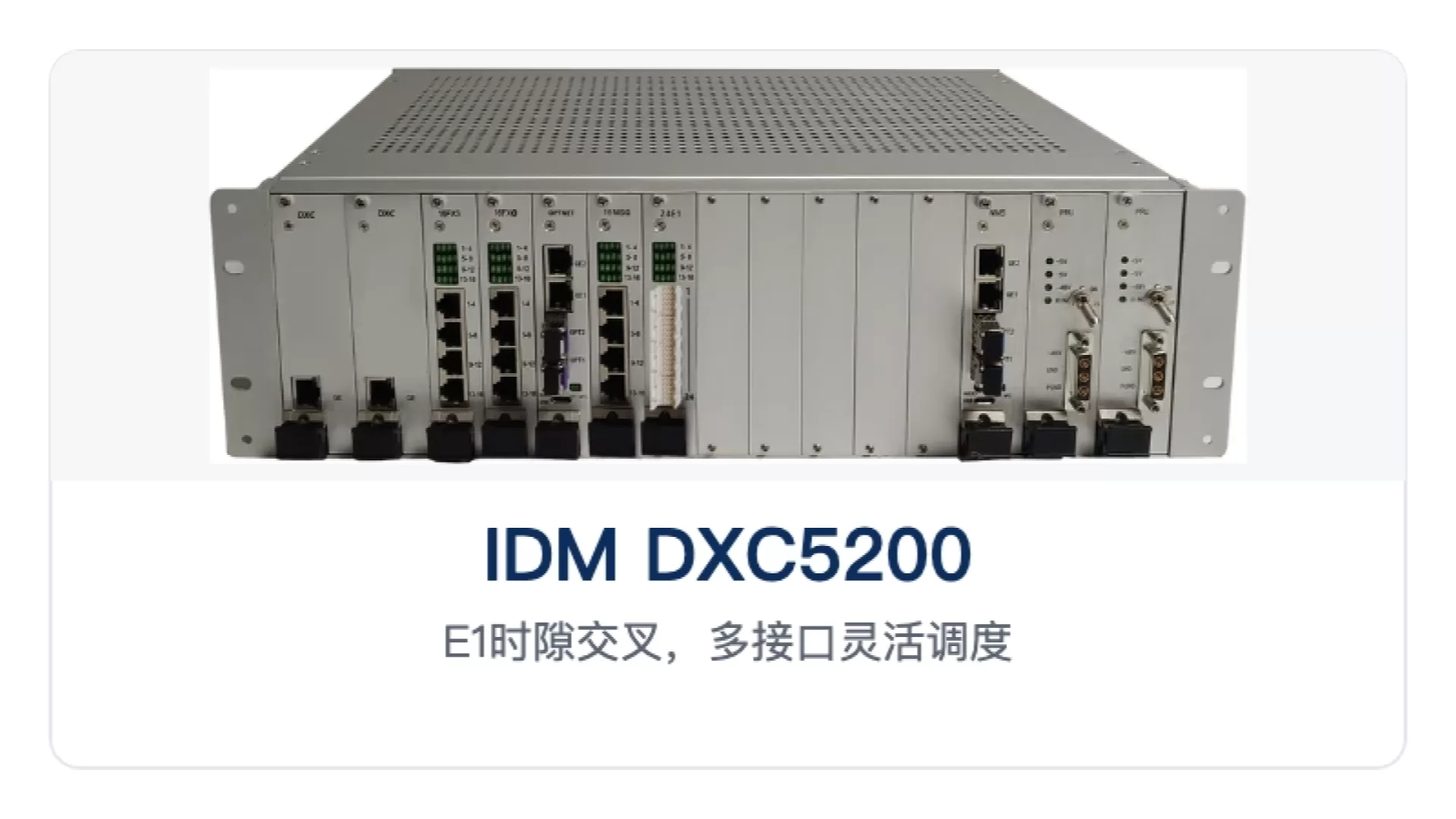
The IDM DXC5200 timeslot cross-connect device adopts the PCM30/32 frame structure. Each E1 can carry 30 64K service timeslots. Combined with channel associated signaling and multiple interface types, it provides flexible and transparent timeslot-level scheduling capability for circuit-type services such as telephony and low-speed data without altering the existing PCM switching network structure.
Core Capabilities of the IDM DXC5200 Timeslot Cross-Connect Device
The IDM DXC5200 timeslot cross-connect device integrates timeslot cross-connect, non-blocking cross-connect, redundant main control units, channel associated signaling support, and multiple interface types into a single unit. The main functions are listed in the table below.
| Function | Description |
|---|---|
| Timeslot Cross-Connect | Performs 64K timeslot-level cross-connect between E1 channels, scheduling voice and data services to designated channels and timeslots as required |
| Non-blocking Cross-Connect | The cross-connect matrix has sufficient internal resources; any input timeslot can be scheduled to any output timeslot, and service adjustments are not hindered by internal conflicts |
| Redundant Main Control Units | Main control units back up each other; when the active main control fails, the standby main control takes over to ensure stable cross-connect configuration |
| Channel Associated Signaling Support | Compatible with channel associated signaling in the PCM30/32 frame structure; telephone status is transmitted synchronously with the voice channel, facilitating interconnection with existing PCM telephone networks |
| Multiple Interface Types Support | Provides E1 interfaces, audio interfaces, and V.35, RS232 data interfaces; voice and data services can be mixed on the same device |
How Timeslot Cross-Connect is Implemented
The cross-connect of the IDM DXC5200 timeslot cross-connect device is based on the PCM30/32 frame structure. PCM30/32 is a common frame format for the E1 primary group. Each frame contains 32 timeslots, of which 30 timeslots carry voice or data services, timeslot TS0 is used for frame synchronization and alarms, and timeslot TS16 is used for channel associated signaling. Voice signals are compressed and expanded according to ITU G.711 A-law and placed into the corresponding timeslot at 64Kbps, conforming to the established arrangement of the PCM30/32 frame structure.
The E1 interface of the IDM DXC5200 timeslot cross-connect device uses a 2.048Mbps line rate and HDB3 line code, complies with the ITU-T G.703 standard, and can operate in either 75Ω coaxial or 120Ω balanced impedance modes. Cross-connect is performed at the 64K timeslot granularity: service timeslots in any E1 can be cross-connected to designated timeslots in another E1. Audio, V.35, and other service timeslots are also included in the same scheduling matrix, thereby upgrading point-to-point PCM voice channels into a flexibly allocatable cross-connect network.
What Interfaces Does the DXC5200 Support
The IDM DXC5200 timeslot cross-connect device provides E1 interfaces, audio interfaces, and data interfaces (V.35, RS232) by service type. The main parameters of each interface are listed in the table below.
| Item | Parameter/Specification | Description/Applicable Condition |
|---|---|---|
| E1 Interface Line Rate | 2.048Mbps | E1 line standard rate |
| E1 Line Code | HDB3 | Compliant with ITU-T G.703 standard |
| E1 Interface Impedance | 75Ω/120Ω | 75Ω coaxial or 120Ω balanced interface |
| E1 Frame Structure | PCM30/32 | 32 timeslots per frame, 30 timeslots carry services |
| E1 Signaling Mode | Channel Associated Signaling | Channel associated signaling transmits line and voice channel status in timeslot TS16 |
| Audio Frequency Range | 300Hz~3400Hz | Analog audio voice channel frequency band |
| Voice Compression Method | ITU G.711 A-law | Voice encoded at 64Kbps A-law |
| Audio Interface Impedance (Balanced Interface) | Balanced 600Ω | Balanced audio line connection |
| Audio Return Loss | ≥18dB | Balanced 600Ω interface specification |
| Audio Interface Impedance (Compound Impedance) | Three-element compound impedance 200Ω+560Ω//0.1μF | Analog switch-side audio connection |
| Audio Loop Current | 20mA/channel | Loop current specification required for audio voice channel operation |
| V.35 Interface Type | RJ-45 | Electrical characteristics comply with ITU-T V.35 recommendation |
| V.35 Transmission Rate | n×64Kbps (n=0~31) | Occupies 1~31 64K timeslots as required by service |
| V.35 Terminal Interface | Compliant with ISO2593 | Connects to standard V.35 connectors |
| RS232 Transmission Rate | Async ≤9600bps; Sync 64Kbps | Low-speed async or single-timeslot sync data |
| RS232 Electrical Characteristics | Compliant with CCITT V.28 | Standard RS232 level interface |
| Power Supply | DC/AC | DC or AC power supply optional |
| Power Consumption | ≤150W | Maximum power consumption of the unit |
| Operating Temperature | -20°C~+50°C | Suitable for general equipment rooms and outdoor cabinets |
| Relative Humidity | 0~95% (non-condensing) | Normal operation under non-condensing conditions |
Typical Application Scenarios
The IDM DXC5200 timeslot cross-connect device is suitable for applications that use E1 as the transmission medium and require centralized scheduling of voice and data services. Common deployments include circuit aggregation between central offices and remote sites, telephony service interconnection between multiple PCM devices, and same-network transmission of mixed audio, V.35, and RS232 services.
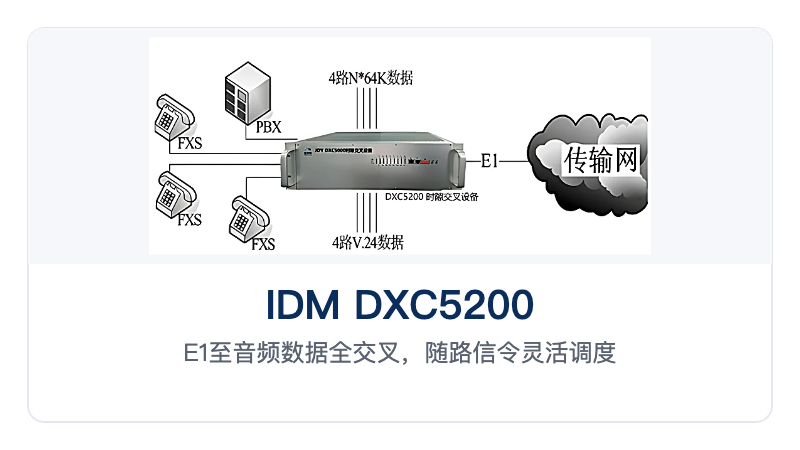
Telephony Service Aggregation between Central Office and Remote Sites
In private telephone networks, remote sites typically need to send multiple audio voice channels to the central office switching equipment. The IDM DXC5200 timeslot cross-connect device cross-connects voice from remote audio interfaces to the uplink E1 channel in 64K timeslot form, and the central-side device restores the E1 to switch interfaces, achieving centralized aggregation and unified scheduling of telephony services.
Service Interconnection between Multiple PCM Systems
When PCM devices of different batches and configurations exist in the network, the IDM DXC5200 timeslot cross-connect device can serve as a common cross-connect node, centrally connecting the E1 channels of each PCM system. Through timeslot-level cross-connect, service timeslots of one system are connected to corresponding timeslots of another system. Combined with channel associated signaling transmission, cross-system telephones can call each other without the need for dedicated direct channels between each pair of PCM devices.
Mixed Access of Voice and V.35, RS232 Data
The IDM DXC5200 timeslot cross-connect device supports carrying audio, V.35, and RS232 services in the same cross-connect matrix. The V.35 interface occupies multiple timeslots at n×64Kbps (n=0~31) to carry high-speed synchronous data, the RS232 interface carries asynchronous low-speed data, and voice occupies standard 64K voice channel timeslots. Multiple services share E1 bandwidth for unified transmission, saving line resources.
Frequently Asked Questions (FAQ)
What Applications is the IDM DXC5200 Timeslot Cross-Connect Device Used For
The IDM DXC5200 (hyphenated form IDM-DXC5200 is the same model) timeslot cross-connect device is used to perform 64K timeslot cross-connect and service scheduling between E1 channels. Typical applications include cross-system interconnection of PCM telephony services, voice aggregation between central offices and remote sites, and mixed transmission of V.35, RS232 data, and audio services in private and public network environments requiring flexible allocation of circuit-type services.
What is the Role of Channel Associated Signaling for Telephony Services
Channel associated signaling occupies timeslot TS16 in the PCM30/32 frame structure, transmitting telephone status such as off-hook, on-hook, ringing, and dialing along with the voice channel. The IDM DXC5200 timeslot cross-connect device supports channel associated signaling, so no additional signaling channel is required when interconnecting with existing PCM telephone networks, and telephony services can transparently pass through the cross-connect node.
What are the Power Supply and Operating Environment Requirements
The IDM DXC5200 timeslot cross-connect device supports both DC and AC power supply, with total power consumption ≤150W, operating temperature range of -20°C~+50°C, and relative humidity of 0~95% (non-condensing). Sites without mains power or requiring DC power can select DC power supply and configure the corresponding power source according to on-site conditions.
Selection and Deployment Recommendations
When selecting the IDM DXC5200 timeslot cross-connect device, first determine the number of E1 channels requiring cross-connect scheduling, the number of audio channels, and the number of V.35 and RS232 data channels, and plan timeslot occupancy and interface configuration accordingly. Select 75Ω coaxial or 120Ω balanced impedance for E1 interfaces based on the peer line type. The IDM DXC5200 timeslot cross-connect device supports channel associated signaling and can directly interconnect with existing PCM networks using the PCM30/32 frame structure. During deployment, it is recommended to perform timeslot cross-connect and signaling joint commissioning on site before putting services into operation. No differentiated selling point information is currently available in the database; it is recommended to confirm with the manufacturer based on specific project requirements. For complete configuration and networking solutions, please contact Beijing Ruiguang Jiyuan Digital Technology Co., Ltd., and the manufacturer will provide selection and commissioning support based on the actual network topology.
FAQs
What is the working principle of Pulse Code Modulation (PCM)?
Working Principle Pulse Code Modulation is the process of converting a time-continuous…
View answerPCM30 Working Principle: What Is PCM30/32
PCM30 Equipment Working Principle The 30-channel PCM equipment refers to equipment that provides 30 user interfaces and…
View answerWhat are the common problems of PCM equipment in enterprise applications?
At present, PCM equipment has become basically ubiquitous in enterprise network applications.
View answerWhat is E1? How to Use E1
What is E1 The European 30-channel pulse code modulation PCM is abbreviated as E1, with a rate of 2.048Mbit/s.
View answerFrame Structure of 30/32-Channel PCM Primary Group
A communication system consists of transmitting equipment, receiving equipment, and transmission equipment.
View answer