
Features of MSTP-based Multi-service Optical Terminal SDH Equipment
The SDH transmission system has a unified frame structure internationally, with standard digital transmission rates and…
The SDH transmission system has a unified frame structure internationally, with standard digital transmission rates and standard optical interfaces, enabling interoperability of network management systems. It therefore offers excellent horizontal compatibility, is fully compatible with existing PDH, and accommodates various new service signals, forming a globally unified digital transmission standard that improves network reliability.
In SDH access systems, code streams of different levels are arranged in a highly regular pattern within the payload area of the frame structure, and the payload is synchronized with the network. Using software, high-speed signals can be directly dropped and inserted into low-speed tributary signals in a single step, achieving one-step multiplexing. This overcomes the process of step-by-step demultiplexing and re-multiplexing of all high-speed signals required by the PDH plesiochronous multiplexing method. By greatly simplifying DXC and reducing back-to-back interface multiplexing equipment, it improves the transparency of service transmission in the network.
With the adoption of advanced Add-Drop Multiplexers (ADM) and Digital Cross-Connects (DXC), the network's self-healing and reconfiguration capabilities are extremely powerful, resulting in high survivability. Since 5% of the signal overhead bits are allocated in the SDH frame structure, its network management functionality is exceptionally robust and can be unified into a network management system, playing a positive role in network automation, intelligence, channel utilization, and reducing network maintenance costs while enhancing survivability.
With multiple network topologies, SDH-based networks are highly flexible. They enhance network monitoring, operation management, and automatic configuration capabilities, optimize network performance, and make network operation flexible, secure, and reliable, providing comprehensive and diverse network functions.
SDH possesses both transmission and switching capabilities. Its series of equipment can be freely combined through functional blocks to implement networks at different levels and with various topologies, offering great flexibility.
SDH is not exclusive to any particular transmission medium; it can be used over twisted pair and coaxial cable, but fiber optics are required for high data rate transmission. This characteristic indicates that SDH is suitable for both backbone channels and branch channels. For example, China's national and provincial cable television backbone networks use SDH, and it is also compatible with Hybrid Fiber-Coax (HFC) networks.
From the perspective of the OSI model, SDH belongs to the physical layer at the lowest level, with no strict restrictions on the upper layers, making it convenient to adopt various network technologies over SDH and support ATM or IP transmission.
SDH is strictly synchronized, ensuring stable and reliable network operation with minimal bit errors, and facilitating multiplexing and adjustment.
Standardized open optical interfaces enable horizontal compatibility over basic optical cable sections, reducing networking costs.
Raytrans SDH equipment is an optoelectronic integrated transmission device based on MSTP and PCM technologies, integrating MSTP transmission and PCM multi-service access functions. It meets the demands of users for fiber transmission and access of both broadband and narrowband services, and utilizes SDH ring network protection to provide more reliable communication protection. It can directly connect remote telephones, computers, cameras, and other terminals, and can be extended via optical ports at the remote end to connect PDH optical terminals, optical modems, and multi-service optical terminals, adapting to various network topologies. Contact: 18710178699 Xu Fei
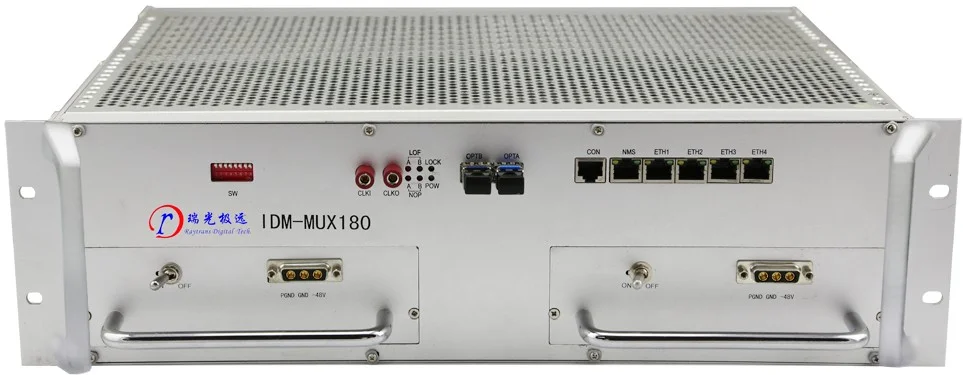
Raytrans SDH Equipment - Schematic Diagram
FAQs
What Is the Definition of Communication?
Communication: the exchange and transmission of information between people, or between people and nature…
View answerWhat is the working principle and function of a media converter?
The rapid advancement of informatization has led to growing demand for multimedia communications such as data, voice…
View answerWhat is the difference between an Optical Terminal and a Media Converter?
Optical Terminal is a device that converts multiple E1 (a data transmission standard for trunk lines…
View answerPCM30 Working Principle: What Is PCM30/32
PCM30 Equipment Working Principle The 30-channel PCM equipment refers to equipment that provides 30 user interfaces and…
View answerWhat is E1? How to Use E1
What is E1 The European 30-channel pulse code modulation PCM is abbreviated as E1, with a rate of 2.048Mbit/s.
View answer