
Public Security Emergency Command & Dispatch System
The Public Security Emergency Command & Dispatch System is a joint action system that enables public security…
The Public Security Emergency Command & Dispatch System is a joint action system that enables public security, firefighting, and other relevant departments to handle special, sudden, and emergency urban incidents and provide social emergency rescue services to the public. It builds a comprehensive emergency early warning and response "safety net" for the city, improving the emergency response mechanism of governments at all levels for sudden public emergencies (such as epidemics, major crimes, and disaster accidents). It enables unified command and coordination across regions, departments, police districts, and police types, with rapid response, unified emergency action, and joint operations, truly realizing coordinated social services and effectively responding to sudden public incidents, safeguarding the health and safety of the people. It is a necessity for modern urban management and an important part of e-government construction.
Police alarm reception and handling;
Emergency Command & Dispatch;
Big data early warning and pre-plan management;
Public safety management;
Case and incident handling;
Comprehensive information release (police alerts, publicity, education, etc.);
Police work management (scheduling, check-in, location, movement tracking, etc.)
The Public Security Emergency Command & Dispatch Platform utilizes modern information technology, GIS geographic information system technology, intelligent sensing technology, grid-based technology, fiber/wireless communication technology, and big data processing technology to achieve multi-faceted resource integration, data sharing, and comprehensive application, meeting the needs of public security emergency Command & Dispatch for rapid data collection and scientific data processing, efficient interconnection and interoperability, fast and accurate command decision-making, and scientific collaborative management.
GIS geographic information maps provide intuitive query of various data and intuitive Command & Dispatch;
The emergency Command & Dispatch platform software interconnects with mobile APPs, WeChat official accounts, law enforcement terminals, dispatch terminals, IoT terminals, and other parties;
Collection, management, and sharing of basic data on people, events, places, objects, situations, and organizations;
Big data computing guides analysis, assessment, and dispatch;
Grid-based management system enables refined management;
Mobile APP terminal for police work management, receiving audio/video Command & Dispatch;
IoT terminals automatically collect and analyze various data, with analysis results scientifically guiding Command & Dispatch;
The Command & Dispatch system supports multiple dispatch networks including IP, HF/VHF, GSM/CDMA, and wireless trunking;
Multiple dispatch methods: text/image, voice, and video.


GIS Geographic Information System
Displays relevant data on people, places, events, objects, situations, and organizations intuitively through electronic maps.
Integrates functions of data collection, storage, management, query, computation, analysis, display, and description.
Example of alarm location application: location methods include area positioning, road positioning, intersection positioning, building positioning, house number positioning, mobile phone positioning, and more; functions during incident response include GPS vehicle calling, shortest path analysis, GPS vehicle search, green wave support, and video browsing.


Population Control Based on the Basic Database:
Basic personnel database:
Identity, address, social relationships, real-time location, and other information. Collects basic information such as ID cards, photos, employment, and social relationships of (floating) populations in urban villages, villages, communities, hotels, and other areas.
Person-household association:
Association of property owners with housing information, tenants with housing information, and property owners with tenant information, enabling person-based location of residence andresidence.
Feature recognition database:
Deploys video surveillance in key locations such as hospitals, schools, and entertainment venues, and collects facial and other feature data. Patrol officers perform person-to-certificate verification on suspicious individuals and confirm identity through networked systems.
Intelligent video analysis:
In densely populated areas such as hospitals, schools, entertainment venues, and street-front shops, intelligent analysis of video surveillance promptly alerts on abnormal situations such as crowd gathering and fights.
Smart patrol:
Real-time collection of on-site location information and on-site video footage by patrol and law enforcement personnel, and monitoring of whether patrol routes deviate from prescribed routes.
Based on the GIS geographic information system and big database, the jurisdiction is divided into several public security governance grids, with grid management stations established respectively, and grid administrators and grid clerks assigned.

The focus of social governance is placed on grassroots grids, facilitating the entry, viewing, management, and statistics of various information within the grid;
Relying on grid administrators/clerks for patrol inspections, updating basic data and dynamic data in real time through mobile APPs;
Standardized incident handling workflows enable multi-department collaborative handling of public incidents;
Through big data analysis, timely early warnings/forecasts are issued.


Grid officer APP:
System login, issue reporting, task management, issue verification, historical records, daily reminders, information collection, map browsing, data synchronization, system settings, user help, personnel check-in, application security;
Supervisor APP:
Grid officer management, supervision and assessment, statistical analysis
Leadership APP:
System login, task management, historical records, public opinion decision-making, daily reminders, map browsing, data synchronization, system settings, user help, application security;
Public APP:
Incident reporting, progress inquiry, issue expediting, reward methods, usage guide, common phone numbers
Smart patrol broadly includes an electronic simulated patrol system composed of video surveillance, electronic fencing, IoT, and more.
Patrol data is transmitted to the command center in real time, different attention content is reminded based on different incidents and locations, patrol personnel parameters (trajectory, steps, speed) are automatically recorded, patrol area content (major category, minor category, incident or hazard description, handling methods, location-tagged image records) is recorded in real time, and patrol data is transmitted back to the server over the private network for big data analysis, etc.
The system adopts intelligent scheduling, automatically checking whether patrol personnel follow required times and routes, and detecting missed patrols, skipped patrols, lateness, early arrival, wrong order, etc. Queries and statistics can be performed by time period, route, patrol point, and patrol personnel.
(1) Group prevention and control. Conduct voluntary self-inspection of social fire hazards. The public can promptly report fire hazards and dangers through WeChat official accounts, mobile APPs, SMS links, etc. This enables early detection, early identification, and early handling of fire hazards.
(2) Fire violation reporting. The public can scan QR codes or use WeChat mini-programs to monitor the operational status of nearby fire protection equipment and facilities in real time. They can also promptly report fire violations and fire hazards through the platform and track the handling progress.
(3) Fire safety publicity. Fire training, fire safety knowledge, fire cases, policies and regulations, etc.
(4) One-touch help/alarm.
Big Data Processing Results Guide Decision-Making
Supported by basic data on people, places, events, objects, situations, and organizations, and through the integration of maps, video images, and analysis in multiple forms, real-time monitoring and Command & Dispatch of urban management are achieved, providing auxiliary decision-making support for leaders at all levels.

Call Center

The call center receives alarms, suggestions, and complaints from the public. Leaders can grasp the on-site situation in real time through the platform and conduct Command & Dispatch of the scene.
The call center is a communication system that receives incoming calls from unknown populations or makes outgoing calls to people outside the system.
It has functions such as call queuing, automatic call distribution, user profile database generation, and user service process tracking.
It is used to automatically transfer public calls to responsible personnel such as precinct officers/grid officers based on the user database.
It is used to automatically or manually call or notify the public of relevant service information or government affairs disclosure. Another means of government affairs disclosure is SMS notification.
Another source of call center information is realized through the voice function of the APP.
Rapidly locate the call position, roads, buildings, and surrounding video signals, automatically assign the nearest officer/grid officer and the optimal response route, and quickly dispatch drones for reconnaissance and confirmation.
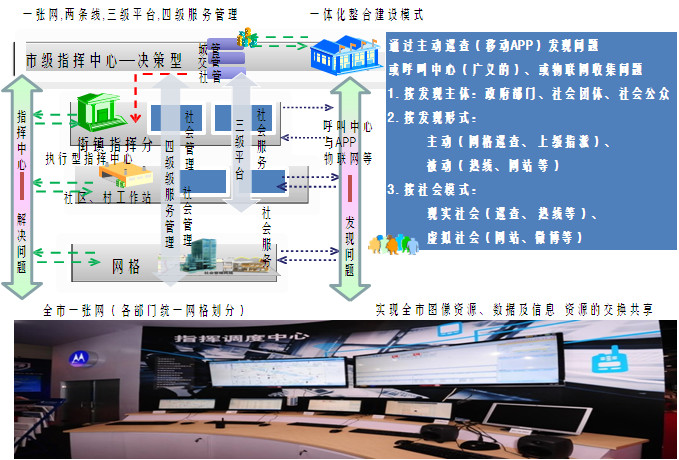
Command & Dispatch Center
The Command & Dispatch system is a system for rapid communication and management of known personnel within the system through various communication means. It has functions such as forced release, barge-in, monitoring, transfer, recording, broadcast, multicast, and roll call.
The intelligent dispatch system is associated with the GIS geographic information system and surveillance video, and also has database query functions for dispatched personnel.
Dispatch systems can also be interconnected hierarchically.
Emergency command means include fixed-line phones, mobile phones, emergency public address broadcasting, trunked radio intercom networks, WiFi APP intercom networks, and set-top box video broadcast announcements.


Features:
SDH, encrypted integrated services PSDH, HF and VHF radio stations, wireless trunking;
Fiber optic networks, HF/VHF radio stations, wireless trunking, E1 networks, IP networks, GSM/CDMA networks;
No.1 signaling, No.7 signaling, PRI signaling, SIP signaling;
Integrated services including wired telephony, wireless intercom, video surveillance, and video calling;
Multi-party conference mode, ordinary telephone intercom mode, PTT terminal intercom mode, broadcast mode;
External connectivity: PCM equipment, PABX, SIP servers, HF/VHF radio stations, IP phone gateways, magneto phone gateways, 3G access gateways, dispatch consoles, cascading;
Rack-mount and vehicle-mounted portable configurations;
Dual optical port protection mechanism, ring network protection mechanism.


Big Data Analysis


City Supervision and Command Platform: Unified Supervision, Tiered Prevention and Control
Through the big data system, data on key units, facilities, police resource information, etc. is collected to implement unified remote supervision; based on intuitive map-based visualization, dynamic supervision and guidance of key units and potential hazards is achieved, and through tiered prevention and control, a basis is provided for law enforcement supervision, prevention and control, and other work.
View Details
Through the big data platform, leaders at all levels, supervisors, and rescue command personnel can access and manage the status of key social fire safety units on an integrated portal. The key unit database can store and query fire safety review drawings and fire acceptance records of key units at any time.

GIS Geographic Information System Application


Social Basic Information Management
Main Functional Modules
Community Basic Information Management Module
Community Public Sentiment and Opinion Management Module
Community Service and Affairs Management Module
Organization and Team Module
Actual Housing Module
Actual Population Module
Address Database Management Module
Key Personnel Module
Key Youth Module
New Economic and Social Organization Module
Public Security Module
Conflict and Dispute Investigation and Mediation Module
Railway and Line Protection Module
Campus and Surrounding Safety Module
Community Affairs Management Module
Message Center Module
Soft Phone Functional Interface
Automatic Registration
Number Registration
Upon incoming call, the phone information entry interface is automatically invoked, allowing agent staff to record the call content in the information entry interface and forward it to the corresponding processing unit or department. Meanwhile, the system automatically generates and displays/saves entry forms, dates, times, serial numbers, caller numbers, and other information.
Social Governance Knowledge Base
Intelligent Response
Intelligent Matching of Historical Experience
Quick Query
Knowledge Base Submission
Knowledge Base Review
For event types with knowledge base reserves, the knowledge base is automatically displayed when an event occurs, prompting operators with handling methods and precautions, and using a Q&A approach to determine the elements required for evaluating such events;
That is, based on factors such as the current event's location and category, corresponding historical records are retrieved from the historical event database to provide reference for operators handling complaint calls;
For issues frequently reported by citizens, each handling department can submit them to the social governance center through the system. The governance center reviews the knowledge base content submitted by each handling department, and only content that passes the review is entered into the database; otherwise, it is not adopted.
Issue Registration and Record Retrieval
Intelligent speech recognition technology is applied to the 12345 hotline to build an intelligent, user-friendly, and highly efficient "self-service speech-to-text conversion system," applying intelligent speech technology to user-system interaction and converting user requests into the required text format for work order content in real time.
Intelligent Speech-to-Text Conversion
Multimedia Command and Dispatch


Supervision and Urging System: To maximize the effectiveness of the system platform in handling affairs, the platform has established a "completion within time limit" supervision and assessment mechanism, i.e., time-limit assessments are set for both "signing and receiving" and "processing" of affairs, with red card warnings for overdue unprocessed events and yellow card reminders for events approaching their deadline.

FAQs
What Is the Definition of Communication?
Communication: the exchange and transmission of information between people, or between people and nature…
View answerWhat is the working principle and function of a telephone switch?
Telephone Switch Principle In fact, the basic principle of a telephone switch is quite simple…
View answerWhat is a trunk line? What are its advantages and disadvantages?
A trunk line: a telephone line that connects a user's private branch exchange (PBX)…
View answer