
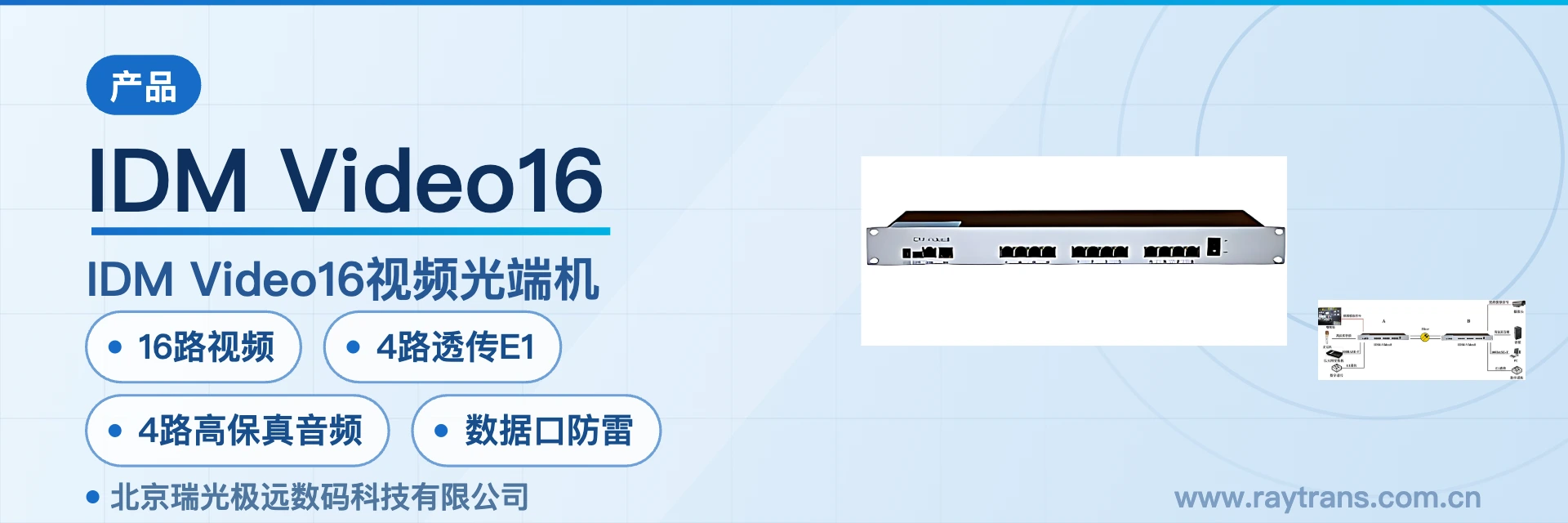
IDM-Video16 Video Optical Multiplexer: 16 Video Channels with 4 E1 and Audio Transparently Transmitted over the Same Fiber, Eliminating a Pair of Converters
The IDM-Video16 digital video optical multiplexer uses an optical fiber transmission medium and advanced digital video optical fiber transmission technology to complete the transmission of 16 video service channels, while at the same time implementing the transmission of RS232 and RS485 data. It adopts all-digital uncompressed technology and can support the high-quality transmission of any high-resolution moving or still image. The IDM-Video8, IDM-Video4, IDM-Video2 and IDM-Video1 digital video optical multiplexers can support the transmission of 8, 4, 2 and 1 video service channels respectively, and the other functions are the same as those of the IDM-Video16.
The IDM-Video16 video optical multiplexer is a digital video optical multiplexer developed by Beijing Ruiguang Jiyuan Digital Technology Co., Ltd. It completes the transmission of 16 video service channels over the optical fiber transmission medium and at the same time implements the transmission of RS232 and RS485 data, and is deployed as a pair between the surveillance sites and the surveillance center. As a mature multi-service optical multiplexer product, the IDM-Video16 video optical multiplexer adopts all-digital uncompressed technology and can support the high-quality transmission of high-resolution moving and still images; it is suitable for concentrating the multiple video, data, audio and E1 services of distributed sites and delivering them to the equipment room at the remote end, and is widely used in scenarios such as government private network optical fiber communication solutions and military emergency communications vehicle solutions. The IDM-Video8, IDM-Video4, IDM-Video2 and IDM-Video1 digital video optical multiplexers support the transmission of 8, 4, 2 and 1 video service channels respectively, and the other functions are the same as those of the IDM-Video16 video optical multiplexer. As a professional optical multiplexer manufacturer, Ruiguang Jiyuan (Raytrans) continuously provides reliable optical multiplexer products and solutions for users in all industries.
Key Specifications at a Glance: 16 video channels in a single optical direction · 4-channel transparent E1 · 4-channel high-fidelity audio · RS232/RS422/RS485 data interfaces configurable by the user · all-digital uncompressed · compatible with PAL/NTSC/SECAM formats
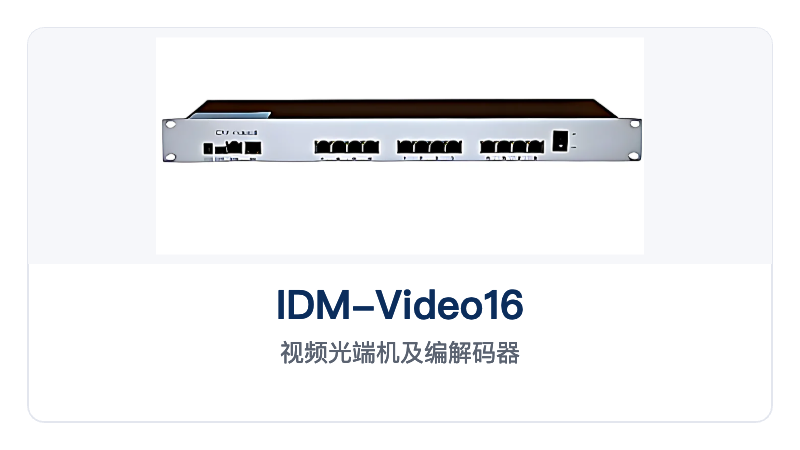
Figure 1: IDM-Video16 Digital Video Optical Multiplexer main unit appearance and close-up of the video ports, data ports and optical fiber interfaces
All-Digital Uncompressed Transmission: How 16 Video Channels Are Sent over the Optical Fiber without Loss
All-digital uncompressed transmission means that after the video signal is digitized inside the IDM-Video16 video optical multiplexer it is sent directly onto the optical fiber as a digital stream, with no compression encoding at any point along the link, and the peer end restores it as the original picture data. This approach brings three direct benefits: first, there is no loss of detail caused by compression, and high-resolution moving images and still images can both be fully preserved; second, the encoding and decoding stages are eliminated, so the link introduces no additional latency, making it suitable for latency-sensitive occasions such as video conferencing and remote teaching; third, digital transmission naturally avoids the intermodulation interference problem of analog FM, PM and AM optical multiplexers. The IDM-Video16 digital video optical multiplexer can therefore support all-digital uncompressed transmission of PAL, NTSC and SECAM video formats.
What Service Interfaces Does the IDM-Video16 16-Channel Video Optical Multiplexer Provide?
The service interfaces of the IDM-Video16 video optical multiplexer are completed under the factory configuration, so on site it is only necessary to connect the cables according to the port markings, with no additional electrical or optical adjustment required for the IDM-Video16 video optical multiplexer. The table below lists the main functions of this product model and their purposes.
| Function | Description |
|---|---|
| 16-channel audio and video transmission in a single optical direction | Carries 16 video service channels unidirectionally over one optical fiber, with 4-channel high-fidelity audio superimposed |
| 4 transparent E1 channels | Provides 4 E1 transparent transmission channels to carry existing E1 services and transmit them over the same fiber as the video |
| 4-channel high-fidelity audio | Transmits 4 audio channels over the same fiber as the video channels, for intercom, monitoring or conference sound reinforcement |
| All-digital uncompressed transmission | Video goes onto the optical fiber in an all-digital uncompressed manner, compatible with PAL, NTSC and SECAM video formats |
| High-resolution image support | The uncompressed link supports the high-quality transmission of high-resolution moving and still images |
| Free from electromagnetic and radio frequency interference | Optical fiber transmission is immune to electromagnetic interference (EMI), radio frequency (RF) interference (RFI) and common-ground loop interference |
| Free from the intermodulation interference of analog optical multiplexers | There is no intermodulation interference problem such as that of analog FM, PM and AM optical multiplexers |
| User-configurable data interfaces | Supports RS232, RS422, RS485 and other data interfaces, and the interface type can be configured by the user |
| Lightning protection design for the data port | The data port features a lightning protection design, adapting to the lightning surge environment of outdoor surveillance sites |
Technical Specifications of the IDM-Video16 Video Optical Multiplexer
The transmission capability of the IDM-Video16 video optical multiplexer follows the figures given in the product documentation: 16 video channels in a single optical direction, 4-channel transparent E1, 4-channel high-fidelity audio and configurable data interfaces. Indicators in the optical interface, power supply and structural categories are not yet recorded in the knowledge base, and the related engineering parameters are subject to the manufacturer's technical documentation.
Video Channel Parameters
| Item | Parameter/Specification | Description/Applicable Conditions |
|---|---|---|
| Number of video channels | 16 in a single optical direction | The number of video service channels carried over the same optical fiber |
| Transmission mode | All-digital uncompressed | The video is not compression-encoded but sent directly onto the optical fiber as a digital stream |
| Video format | PAL, NTSC, SECAM | Compatible with the video signals of cameras in these three formats |
| Image support capability | High-resolution moving and still images | Uncompressed link, which introduces no loss of encoding detail |
| Video interface type, level, signal-to-noise ratio (SNR) and other indicators | Not yet recorded in the knowledge base | Subject to the manufacturer's technical documentation |
Audio and E1 Channel Parameters
| Item | Parameter/Specification | Description/Applicable Conditions |
|---|---|---|
| Number of audio channels | 4-channel high-fidelity audio | Transmitted over the same fiber as the 16 video channels |
| E1 channels | 4-channel transparent E1 | The E1 channels are transparent to the carried content and do not change the existing E1 services |
| Audio sampling frequency, bit width and other indicators | Not yet recorded in the knowledge base | Subject to the manufacturer's technical documentation |
Data Interfaces and Protection
| Item | Parameter/Specification | Description/Applicable Conditions |
|---|---|---|
| Data interface type | RS232, RS422, RS485 and others | The interface type can be configured by the user to match the on-site equipment |
| Interface configuration method | Configurable by the user | The type and direction of the data port are configured by the user according to the project |
| Data port protection | Features a lightning protection design | Reduces the risk of damage to the data port caused by lightning surges |
| Data rate, transmission distance | Not yet recorded in the knowledge base | Subject to the manufacturer's technical documentation |
Optical Interface and Complete Unit Parameters
| Item | Parameter/Specification | Description/Applicable Conditions |
|---|---|---|
| Optical port type, wavelength, transmit optical power, receiver sensitivity | Not yet recorded in the knowledge base | Subject to the manufacturer's technical documentation |
| Transmission distance | Not yet recorded in the knowledge base | Subject to the manufacturer's technical documentation; projects must additionally be calculated according to optical fiber attenuation and the optical power budget |
| Power supply mode, power consumption | Not yet recorded in the knowledge base | Subject to the manufacturer's technical documentation |
| Operating temperature, structural dimensions | Not yet recorded in the knowledge base | Subject to the manufacturer's technical documentation |
How to Configure the Data Interfaces of the Video Optical Multiplexer
How the data interfaces of a video optical multiplexer are configured depends on the interface type of the controlled equipment on site: the IDM-Video16 video optical multiplexer supports RS232, RS422 and RS485 data interfaces, which can be configured by the user. In an actual project, first confirm the interface type of the controlled equipment such as the camera PTZ, control keyboard and decoder, and then configure the corresponding data port of the IDM-Video16 video optical multiplexer to the same type; with the data port configurations at both ends kept consistent, the link can transparently transmit control commands. RS422 uses 4-wire wiring and RS485 uses 2-wire wiring; when laying cables, the data cables should be routed separately from the video coaxial cable and kept at a reasonable spacing to reduce crosstalk between them. The data port itself has a lightning protection design, and for outdoor sites in areas with frequent thunderstorms it is still advisable to carry out grounding in accordance with the on-site lightning protection specifications.
How to Use E1 Transparent Transmission on the Video Optical Multiplexer
E1 transparent transmission on a video optical multiplexer means that the E1 channels deliver the 2.048 Mbps primary group signal to the peer end exactly as it is, and the channels themselves do not interpret the E1 frame content. The E1 interface works at the rate and interface characteristics specified in ITU-T Recommendation G.703, and the IDM-Video16 video optical multiplexer provides 4-channel transparent E1, which can share one optical fiber with the 16 video channels and the 4-channel high-fidelity audio. The engineering value lies in this: for sites where an E1 link has already been laid, when new video surveillance requirements arise there is no need to lay an additional optical cable for the video; the IDM-Video16 video optical multiplexer can be used directly to return the existing E1 services together with the new video to the central equipment room, reducing duplicate investment and construction work. The termination, grounding and impedance matching of the E1 interface are carried out according to the G.703 requirements. This kind of multi-service optical multiplexer is equally applicable to government private network optical fiber communication solutions and military emergency communications vehicle solutions; it can carry video, audio and E1 services simultaneously within a single fiber, simplifying the cabling structure at the emergency site.
Lightning Protection Design and Interference Immunity of the Video Optical Multiplexer Data Port
The data port of the IDM-Video16 video optical multiplexer uses a lightning protection design to reduce the risk of damage caused by lightning surges entering the device through the data cable. In terms of interference immunity, the IDM-Video16 video optical multiplexer uses optical fiber as its transmission medium and is itself immune to electromagnetic interference (EMI), radio frequency (RF) interference (RFI) and common-ground loop interference, and it does not suffer intermodulation interference as analog FM, PM and AM optical multiplexers do; therefore, in strong electromagnetic environments such as substations, plants and roads and in long-distance links, optical fiber maintains a stable picture more easily than coaxial cable. It should be noted that the lightning protection design is protection on the device side, and the equipotential bonding, grounding resistance and signal cable shielding measures of the equipment room and the front-end sites still need to be implemented in accordance with the engineering lightning protection specifications. Video optical multiplexer manufacturers represented by Ruiguang Jiyuan (Raytrans) have accumulated mature application experience in government private network optical fiber communication solutions and military emergency communications vehicle solutions, and users may take the manufacturer's industry solution capability into consideration when selecting a model.
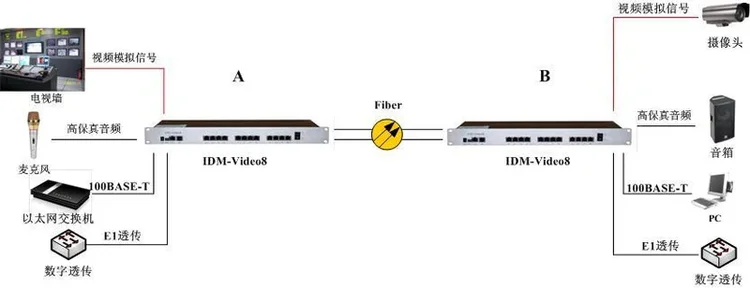
Figure 2: Networking diagram of point-to-point optical fiber transmission between the surveillance sites and the equipment room for the IDM-Video16 video optical multiplexer
Model Selection: How to Choose Between IDM-Video16 and IDM-Video8/4/2/1
The IDM-Video16 16-channel video optical multiplexer has exactly the same functions as the other models in the series, and the only difference is the number of video channels a single device can carry, so during selection it is only necessary to match the model to the number of video sites on site. As a professional optical multiplexer manufacturer, Ruiguang Jiyuan (Raytrans) provides multi-service optical multiplexers in a variety of specifications for selection in this series.
| Model | Video Service Transmission Capability | Other Functions |
|---|---|---|
| IDM-Video16 | 16 video channels | Same functions as the rest of the series |
| IDM-Video8 | 8 video channels | Same as IDM-Video16 |
| IDM-Video4 | 4 video channels | Same as IDM-Video16 |
| IDM-Video2 | 2 video channels | Same as IDM-Video16 |
| IDM-Video1 | 1 video channel | Same as IDM-Video16 |
Selection recommendations: when the sites are concentrated in the same cabinet and the total number of video channels does not exceed 16, one IDM-Video16 video optical multiplexer is sufficient to complete the aggregation, reducing the number of devices and the space they occupy in the cabinet; when the sites are distributed across several zones and independent optical cables have already been laid between the zones, IDM-Video8 or IDM-Video4 units can be deployed by zone, avoiding pulling a large number of video cables back to the same equipment room over a long distance. For specific optical port configurations, transmission distances and interface customization requirements, it is advisable to confirm with the optical multiplexer manufacturer according to the actual optical fiber conditions on site.
Typical Application Scenarios
The IDM-Video16 video optical multiplexer is suitable for all kinds of image transmission projects in which the video signal must cross a relatively long distance or must avoid electromagnetic interference; by industry, the typical scenarios can be divided into the following four categories.
Security Surveillance Video Aggregation
In the security surveillance systems of industrial parks, plants and large public buildings, the IDM-Video16 video optical multiplexer is deployed between the equipment rooms of each zone and the surveillance center: the front-end cameras of each zone are connected to the zone equipment room nearby using coaxial cable, and the IDM-Video16 video optical multiplexer then returns the 16 video channels together with the PTZ control data and the intercom audio to the surveillance center in a single transmission, replacing multiple long-distance video coaxial cables, so that the number of cables and the wiring difficulty in the equipment room are reduced accordingly.
Power and Industrial Plant Surveillance
Substations, distribution rooms and industrial plants are strong electromagnetic environments, and coaxial cable over a long distance is easily affected by interference. The IDM-Video16 video optical multiplexer uses optical fiber as its medium and is immune to electromagnetic interference (EMI), radio frequency (RF) interference (RFI) and common-ground loop interference, so it can deliver 16 channels of equipment status monitoring video and 4 audio channels stably to the control room; its data port uses a lightning protection design which, together with on-site grounding and lightning protection measures, makes it suitable for operation at outdoor sites in areas with frequent rain and lightning.
Expressway and Urban Road Surveillance
Expressway and urban road surveillance sites are scattered and far apart, and multiple video channels need to be concentrated at the road section center or the command center. The IDM-Video16 video optical multiplexer can carry 16 video channels in a single optical direction, with 4-channel transparent E1 superimposed to carry existing data channels; when a road section is newly built or upgraded, a single device can complete the synchronous return of the video and E1 services, reducing optical cable usage and the number of repeater nodes.
Video Conferencing and Remote Teaching
Scenarios such as video conferencing, remote teaching and multimedia classrooms require a picture with no compression loss and controllable latency. The IDM-Video16 video optical multiplexer uses all-digital uncompressed transmission, is compatible with PAL, NTSC and SECAM video formats and supports the transmission of high-resolution moving and still images; it also provides 4-channel high-fidelity audio, so the bidirectional transmission of audio and video can be organized between the main venue and the branch venues over a point-to-point optical fiber link, making it suitable for venues and classrooms with high requirements for picture detail and lip synchronization.
Conclusion
The IDM-Video16 video optical multiplexer integrates 16 video channels with 4-channel transparent E1, 4-channel high-fidelity audio and user-configurable RS232/RS422/RS485 data interfaces for transmission over one optical fiber. It uses all-digital uncompressed technology, is compatible with PAL, NTSC and SECAM formats, and provides a lightning protection design for the data port, making it suitable for image transmission projects such as security surveillance, power and industrial plant surveillance, road surveillance, and video conferencing and remote teaching. In addition to the 16-channel video optical multiplexer, the IDM-Video8, IDM-Video4, IDM-Video2 and IDM-Video1 of the same series can be flexibly combined according to the number of video channels, and the specific configuration can be confirmed with the manufacturer in the light of the actual optical fiber conditions on site.
Substations, distribution rooms and industrial plants are strong electromagnetic environments, and coaxial cable is easily affected by interference when transmitted over a long distance. The IDM-Video16 video optical multiplexer uses optical fiber as its medium and is immune to electromagnetic interference (EMI), radio frequency (RF) interference (RFI) and common-ground loop interference, so it can deliver 16 channels of equipment status monitoring video and 4 audio channels stably to the control room; its data port adopts a lightning protection design which, together with on-site grounding and lightning protection measures, makes it suitable for operation at outdoor sites in areas with frequent rain and lightning.
Expressway and Urban Road Surveillance
Surveillance sites along expressways and urban roads are scattered and far apart, and multiple video channels need to be concentrated at the road section center or the command center. The IDM-Video16 video optical multiplexer can carry 16 video channels unidirectionally over one optical fiber, with 4-channel E1 transparent transmission superimposed to carry existing data channels; when a road section is newly built or upgraded, a single device can complete the synchronous return of the video and E1 services, reducing optical cable usage and the number of repeater nodes.
Video Conferencing and Distance Learning
Scenarios such as video conferencing, distance learning and multimedia classrooms require a picture free of compression loss and with controllable latency. The IDM-Video16 video optical multiplexer uses all-digital uncompressed transmission, is compatible with PAL, NTSC and SECAM video formats and supports the transmission of high-resolution moving and still images; it also provides 4-channel high-fidelity audio, so that the bidirectional transmission of audio and video can be organized between the main venue and the branch venues over a point-to-point optical fiber link, making it suitable for venues and classrooms with high requirements for picture detail and lip synchronization.
Conclusion
The IDM-Video16 video optical multiplexer integrates 16 video channels, 4-channel E1 transparent transmission, 4-channel high-fidelity audio and user-configurable RS232/RS422/RS485 data interfaces for transmission over one optical fiber. It uses all-digital uncompressed technology, is compatible with PAL, NTSC and SECAM formats, and provides a lightning protection design for the data port, making it suitable for image transmission projects such as security surveillance, power and industrial plant surveillance, road surveillance, and video conferencing and distance learning. In addition to the 16-channel video optical multiplexer, the IDM-Video8, IDM-Video4, IDM-Video2 and IDM-Video1 of the same series can be flexibly combined according to the number of video channels, and the specific configuration can be confirmed with the manufacturer in the light of the actual optical fiber conditions on site.
