IP
IP
The IP Multimedia Audio/Video Dispatch System supports up to 16 split-screen displays, with additional screens available via polling mode, providing users with great convenience in conference scheduling, control, and management.
- System Functions
The adMUX private network HD video conference system consists of a control center, a main venue, and branch venues, forming the entire video conference system, which is built on an Ethernet switching network.
The functional requirements of each subsystem are as follows:
- Control Center: It can be deployed in the central communication equipment room, where the video conference control unit or video conference server is deployed. The main venue and branch venues access the control center via the network to achieve interactive video conferencing functions.
- Main Venue: The system modules of this venue mainly include the HD video conference client, conference audio system, HD image acquisition system, conference table, and seating arrangement. The main venue is equipped with desktop video conference terminal devices, which are required to have multiple audio, video, and data interfaces to meet various conference functions. A large-screen display system and video display and control system are installed. Audio systems and HD image acquisition and processing systems are also installed.
- Branch Venues: The system modules of these venues mainly include the HD video conference client, conference audio system, HD image acquisition system, conference table, and seating arrangement. Branch venues are equipped with desktop video conference terminal devices, which are required to have multiple audio, video, and data interfaces to meet various conference functions. Audio systems and HD image acquisition and processing systems are installed.
The video conference server system supports up to 16 split-screen displays, with additional screens available via polling mode, providing users with great convenience in conference scheduling, control, and management.
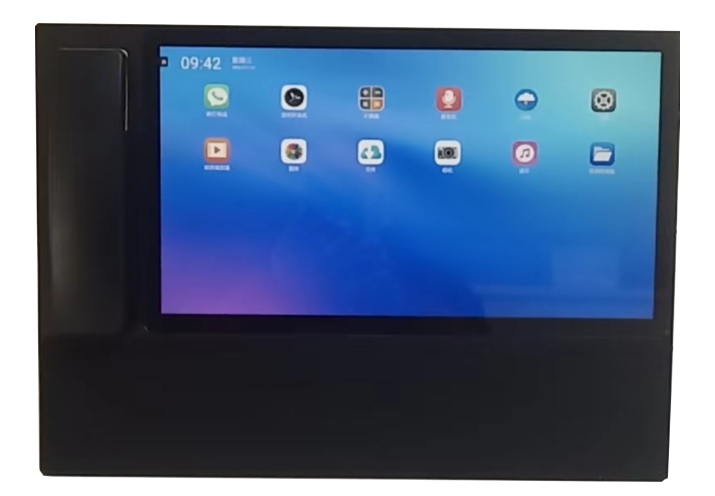
Touchscreen computers are deployed at the main venue and branch venues, with corresponding video conference system clients installed, along with appropriate audio and image acquisition devices. Each client accesses the video conference server at the control center via web to participate in conferences, enabling real-time video conference switching functions.
- System Solution
The overall topology of the network video conference system design is shown in Figure 1 below.
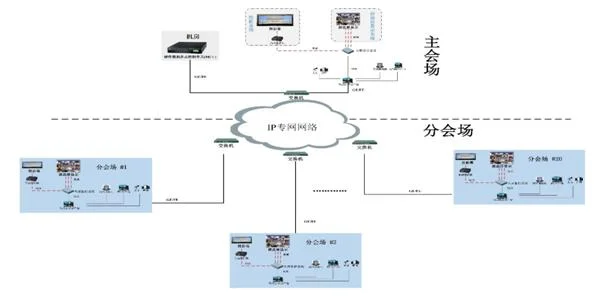
Figure 1 Overall Topology of the Video Conference System
As shown in the figure above, in this video conference system, an HD video conference server and supporting server systems are installed in the equipment room. The main venue and branch venues are deployed with touchscreen computer platforms with corresponding clients installed.
All main and branch venues access the video conference server via wired networks to achieve interactive functions across the entire video conference. In this solution, the number of participating conference points is theoretically unlimited, mainly constrained by the server's processing capability.
Venue Configuration Overview
- Display System: The display system can use ultra-narrow-bezel LCD screens for video wall splicing or an HD projection system. It works with an image processor and video matrix to enable viewing of command information and video conference images on the spliced screen; it can also be integrated into an existing large-screen display system. Alternatively, HD projection equipment can be used to display video conference images.
- Video Conference Terminal: The venue is equipped with an HD video conference terminal that directly interfaces with video and audio input/output devices to implement the software-based video conference layout. Video from the built-in conference camera or via a video capture card is routed to the video matrix, allowing conference images to be displayed on the spliced screen.
- HD Image Cameras: Integrated PTZ HD cameras (model D70) are configured and directly connected to the video conference terminal. The captured HD conference video from the main venue feeds directly into the video conference system.
- Audio System: Includes wireless conference microphones and speakers directly connected to the HD software video conference computer terminal to capture the speech of meeting participants and provide sound playback.
- System Features
- Easy Installation and Maintenance: One-click installation is adopted; the database, web services, and central management platform are all automatically deployed during program installation.
- B/S Architecture for System Management: System administrators can manage the system via IE from any location with internet access, offering simple operation and powerful functionality.
- Multi-level Hierarchical Management: Supports super administrators, organization administrators, department administrators, etc., each with different permission levels. Meeting roles can be designated as host, participant, or observer, with additional roles such as chairperson and speaker as needed. The host holds the highest authority and can authorize participants to control at any time, enabling consistent control and mutual assistance in an interactive environment.
- Virtual Conference Center Technology: Multiple independent virtual conference room centers can be created on the system platform, each with separate access, independent control, and no mutual interference.
- Powerful Video Browsing and HD Display: The system provides over 100 video templates, supports 16:9 widescreen LCD mode, and allows free dragging between template windows for flexible operation. Desktop resolution supports up to 4096x2048 HD resolution, with real-time synchronization of templates between all participants and the host during conferences.
- Multiple Video Formats: Video compression uses multiple encoding methods such as MPEG4, H.263, H.263+, and H.264, with adjustable frame rates and bitrates for strong network adaptability. Video input supports multiple input methods, including AV terminals, S-Video terminals, TV signals, and USB camera input. Each conference terminal supports up to 8 video input channels to meet various application scenarios.
- Multiple Audio Formats: Audio compression uses multiple encoding methods such as G.723.1, GSM, G.722, G.711 (A/U), and MP3, with support for Voice Activity Detection (VAD), Noise Suppression (NS), Acoustic Echo Cancellation (AEC), Automatic Gain Control (AGC), and Jitter Buffer technology, ensuring no image freezing under lower bandwidth requirements. It supports up to 32-channel audio mixing, with individual volume adjustment for each channel.
- Superior Network Audio/Video Streaming Technology: Uses the RTP transmission protocol with proprietary transmission algorithms including automatic packet loss retransmission, out-of-order recovery, jitter buffer prevention, and automatic error correction. Under low bandwidth conditions of approximately 100 kbps, it ensures real-time, smooth, and never-broken images. Audio and video can transmit normally over network bandwidths ranging from 50 kbps to 100 Mbps. It supports user transmission of audio and video through tunnel mode (HTTP Tunnel), proxy (HTTP Proxy, SOCKS5 Proxy), firewalls, VPN, and NAT.
- Powerful Conference Data Control: Supports multi-party collaborative whiteboard drawing, screen sharing of computer documents such as PPT, Excel, Word, web pages, courseware, and software interfaces for real-time synchronized viewing by all participants, commonly used in remote training scenarios. Supports communication via private messaging and conference chat without disrupting the ongoing meeting. Supports peer-to-peer file transfer. Supports conference announcements, notifying all participants of important content via scrolling text at the bottom of the screen. Supports playing VCD and DVD format video files during conferences to meet multimedia meeting requirements.
- Instant Messaging Support: The video conference system integrates an instant messaging system with features such as text chat, file transfer, whiteboard collaboration, screen sharing, remote control, audio/video conversations, multi-party conversations, contact search, joining conferences, and conference invitations. It can be deployed within an enterprise to facilitate communication among employees, while also playing an important role in network security and enterprise management.
- Conference Recording Support: The entire meeting process—audio, video, whiteboard, and screen data—can be recorded into a single file for storage, enabling future playback, review, or training, with support for remote on-demand playback.
- Auto-hide Control Panel and Pop-up Notifications: The conference control panel auto-hides and automatically reappears when the mouse moves to the far left or right edge, providing convenient use. Additionally, when participants enter or exit a conference, the system automatically pops up a message notification for clear visibility.
- Bandwidth Test Support: The system provides a bandwidth test tool that can measure the uplink and downlink bandwidth between any location connected to the server and the server itself. This allows users to accurately determine the network bandwidth at that location and decide how many smooth video streams can be opened simultaneously.
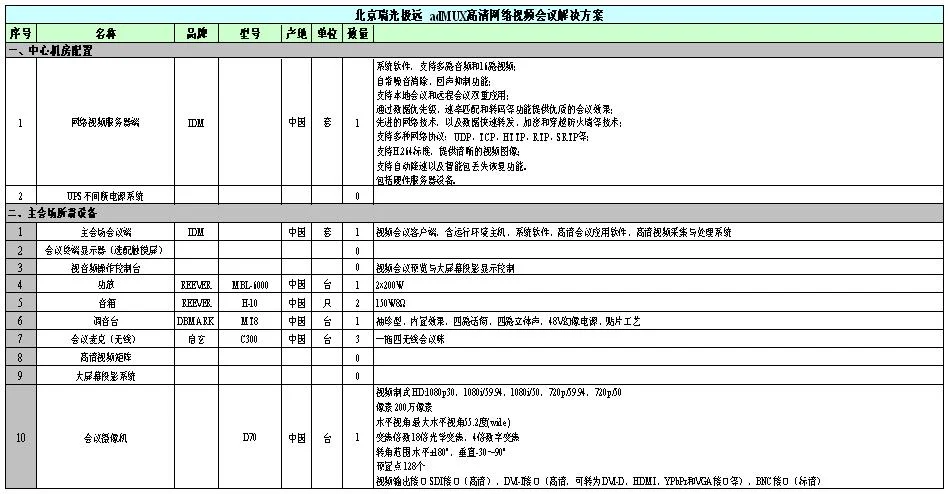
- Typical Configuration List
FAQs
What Are the Functions and Advantages of Video Optical Terminals?
The function of a video optical terminal is to convert one or multiple channels of analog video signals into optical…
View answerWhat is the difference between a Video Optical Terminal and a Network Video Server?
Composition and Function of Video Optical Terminal and Network Video Server An optical terminal is a device used to…
View answer