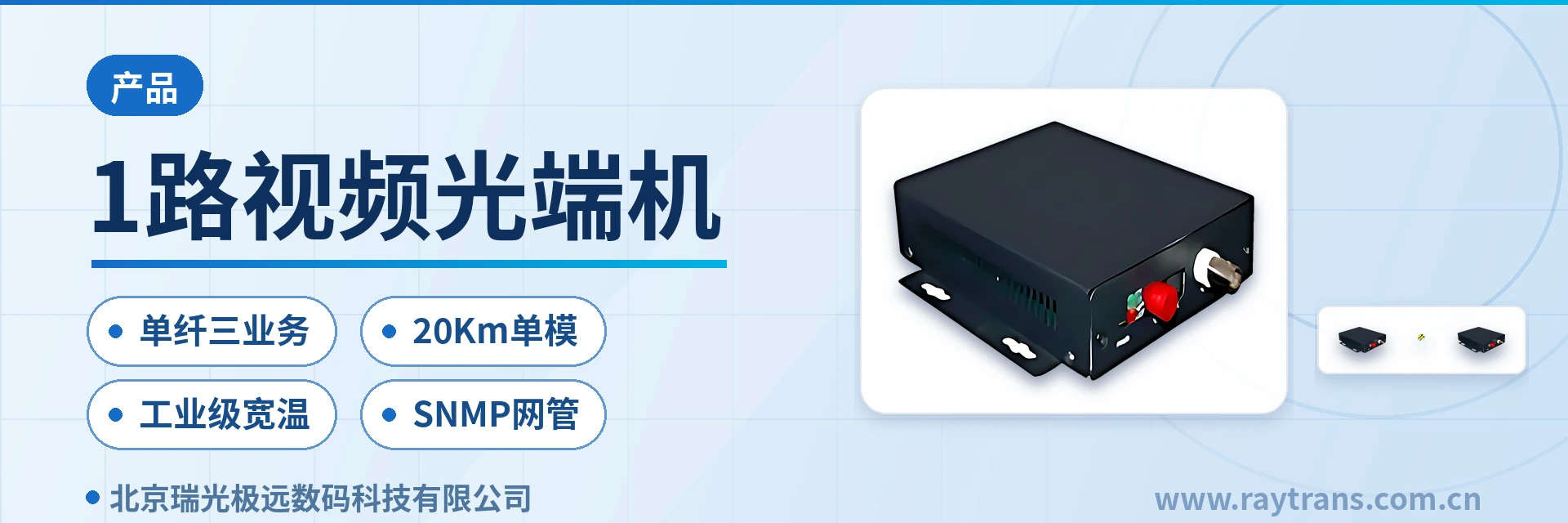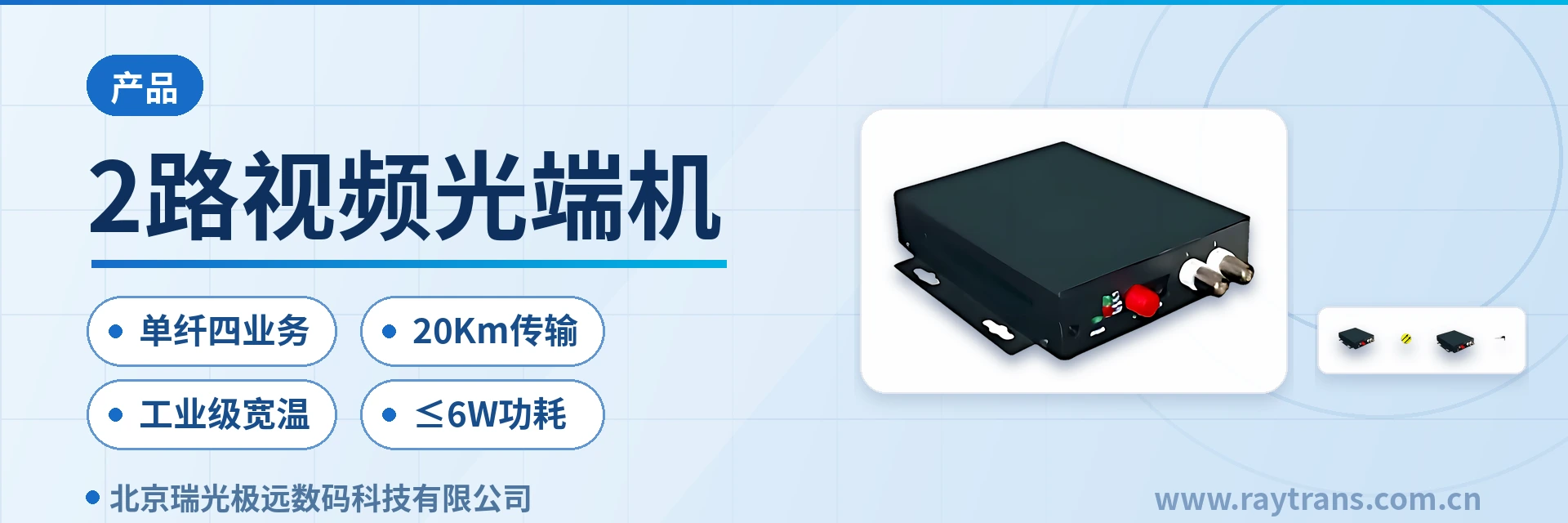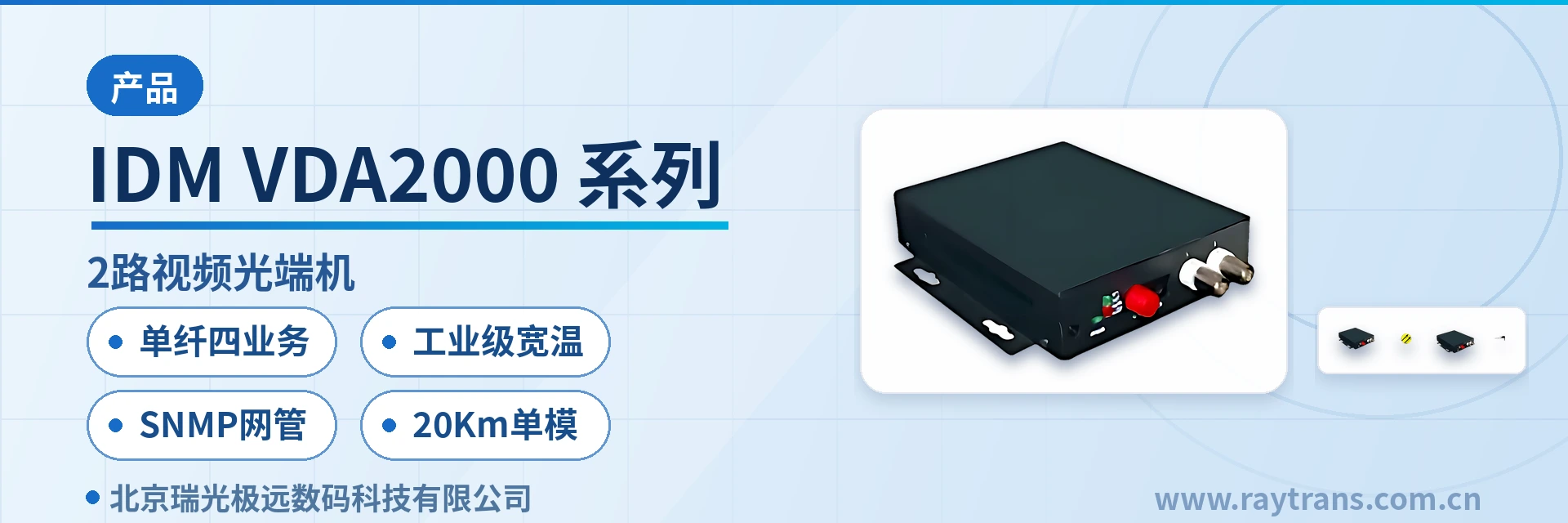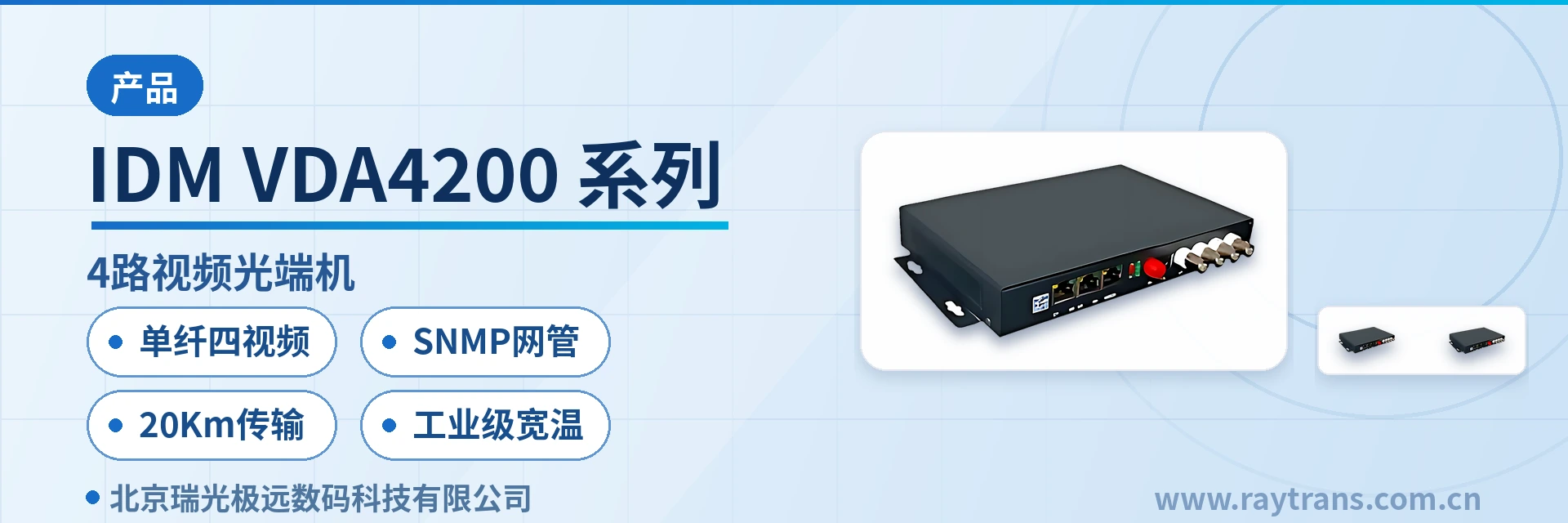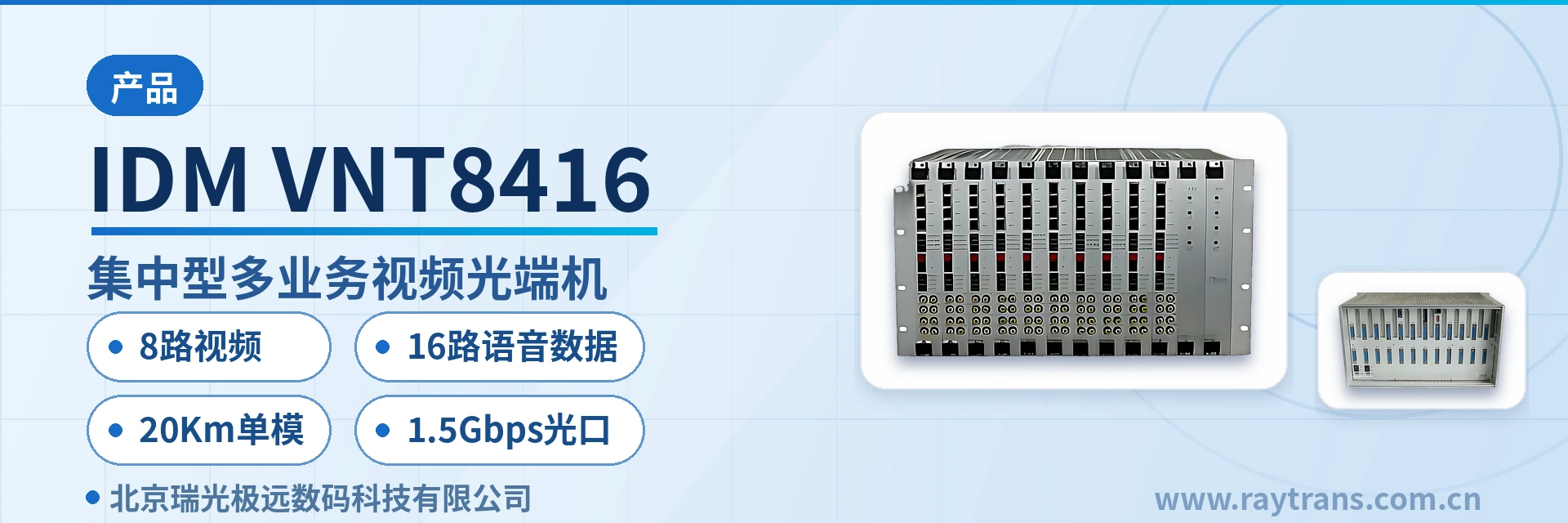
IDM-VNT8416 Centralized Multi-Service Video Optical Multiplexer
8-channel video
The IDM-VNT8416 centralized multi-service video optical multiplexer is developed by our company using advanced digital video optical fiber transmission technology, multiplexing 8-channel video signals, 16-channel voice or data, 4 groups of E1 transparent transmission services, 4 groups of high-fidelity audio services, and 4-channel shared 100M Ethernet
IDM-VNT8416 single-fiber aggregation multi-service optical multiplexer is a centralized multi-service video optical multiplexer developed by Beijing Ruiguang Jiyuan Digital Technology Co., Ltd. (Raytrans) using digital video optical fiber transmission technology. As a professional optical multiplexer manufacturer, it multiplexes 8-channel video, 16-channel voice or data, 4 groups of transparent E1, 4 groups of high-fidelity audio, and 4-channel shared 100M Ethernet over a single optical fiber for high-quality transmission. The site side and central side are deployed as a pair, requiring no on-site adjustment after connection. This multi-service optical multiplexer stands out in the video optical multiplexer product showcase. The core value of the single-fiber aggregation multi-service optical multiplexer is to converge four types of services—video surveillance, dispatch voice, E1 leased line, and network backhaul—onto a single single-mode fiber and a single device, reducing the number of site devices, optical cable cores, and associated construction investment. Raytrans's telephone optical multiplexer and video optical multiplexer series also support this type of multi-service converged access, providing users with a complete product showcase and selection reference.
Key Specifications at a Glance: 8-channel video · 16-channel voice/data · 4 groups of transparent E1 · 4-channel shared 100M Ethernet · 4 groups of high-fidelity audio · 1.5Gbps optical port · 20Km single-mode · industrial grade -40℃~+85℃ · overall power consumption ≤150W
What Is a Single-Fiber Aggregation Multi-Service Optical Multiplexer
A single-fiber aggregation multi-service optical multiplexer is a centralized access device that multiplexes multiple types of services such as video, voice/data, E1 leased line, and Ethernet onto a single optical fiber for transmission. The two ends are used in pairs, and the optical and electrical interfaces are designed in accordance with international standards. As part of the product showcase of Raytrans, a professional optical multiplexer manufacturer, this device adopts all-digital video optical fiber transmission. The video signal enters the optical channel without analog frequency modulation, phase modulation, or amplitude modulation, so it has none of the intermodulation interference common to analog optical multiplexers, nor electromagnetic interference (EMI) or radio frequency interference (RFI), resulting in clean images and stable services.
The IDM-VNT8416 single-fiber aggregation multi-service optical multiplexer is designed with a centralized chassis structure, with the main board and service sub-cards separated. A single device at the central side can aggregate and multiplex 8-channel video, 16-channel voice or data, 4 groups of transparent E1, 4 groups of high-fidelity audio, and 4-channel shared 100M Ethernet. The chassis can correspond to 10 remote stations, with unidirectional or bidirectional video configured according to on-site requirements, and is compatible with video formats such as PAL, NTSC, and SECAM. Service boards are selected per project, including voice interface cards (FXS, FXO, hotline telephone card, magneto telephone card, EM2/4 card) and data service cards (V.24, V.35). The centralized chassis can also be equipped with 2 PRU cards to achieve 1+1 mutual backup. This multi-service optical multiplexer can be flexibly deployed in both telephone optical multiplexer and video optical multiplexer application scenarios.
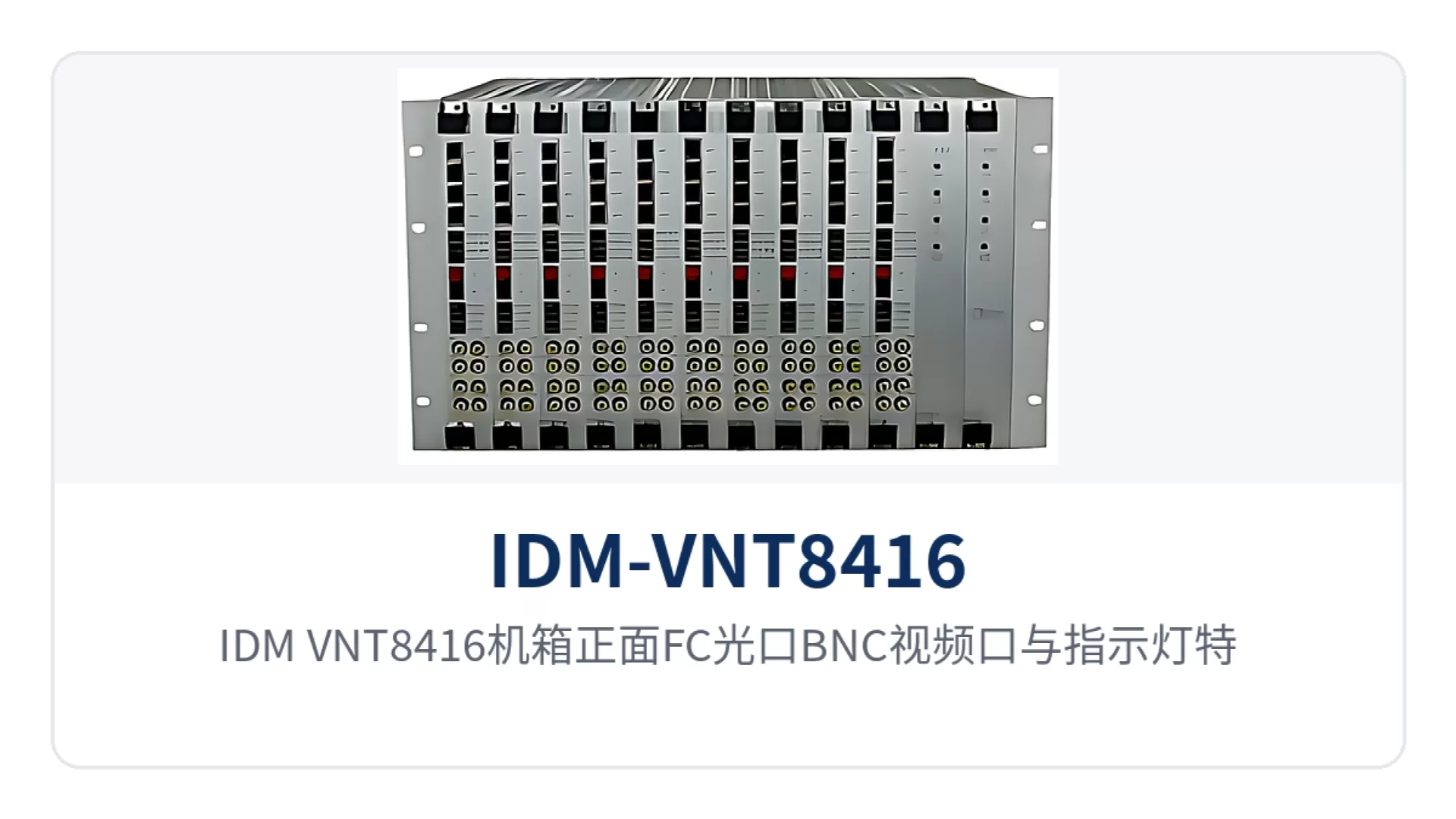
Figure 1: Close-up of the IDM-VNT8416 chassis front panel showing FC optical ports, BNC video ports, and indicator LEDs
Core Functions: One Device Multiplexes Video, Voice/Data, E1, and Ethernet into a Single Optical Fiber
The IDM-VNT8416 single-fiber aggregation multi-service optical multiplexer performs multiplexing and transmission of video, voice/data, E1, Ethernet, and high-fidelity audio on a single device. The core functions are shown in the table below.
| Function | Description |
|---|---|
| 8-channel video input | Provides 8-channel video input, unidirectional or bidirectional configurable per on-site requirements, compatible with video formats such as PAL, NTSC, and SECAM |
| 16-channel voice or data input | Provides 16-channel voice or data services. Voice can be configured with interface cards such as FXS, FXO, hotline telephone card, and magneto telephone card; data can be configured with interfaces such as RS-232, RS-422, RS-485, V.24, and V.35 |
| 4 groups of transparent E1 channels | Provides 4 groups of transparent E1 channels, carrying existing leased-line services such as substation telecontrol and rail signals, with transparent transmission that does not alter existing equipment |
| 4-channel shared 100M Ethernet | Provides 4-channel shared 100M Ethernet, RJ-45 interface, 10M/100M adaptive, compliant with IEEE802.3, carrying network cameras and office data |
| 4 groups of high-fidelity audio | Provides 4 groups of high-fidelity audio services, with an audio bandwidth of 20Hz~20KHz and an audio SNR ≥90dB, used for broadcast and intercom backhaul |
| Single-fiber multiplexing | Video, voice/data, E1, Ethernet, and high-fidelity audio share a single optical fiber, reducing optical cable cores and the number of site devices |
| Alarm and network management | Provides alarm functions and network management functions, enabling online real-time monitoring of link and service operating status |
| Centralized chassis structure | Main board and service sub-cards are separated. The chassis aggregates multiple services and can correspond to 10 remote stations, with service boards expandable per project |
| Wide-temperature industrial design | Industrial-grade operating temperature -40℃~+85℃, relative humidity 0~95% (non-condensing), suitable for unattended sites in the field |
Technical Specifications: Optical Interface, Video, Voice/Data, Ethernet, and Environmental Conditions
The interfaces and specifications of the IDM-VNT8416 single-fiber aggregation multi-service optical multiplexer are listed by service category. The two ends are used in pairs. For specific configurations, please refer to the technical documentation and commercial confirmation of the optical multiplexer manufacturer Raytrans.
Optical Interface and Transmission Distance
| Item | Parameter/Specification | Description/Applicable Conditions |
|---|---|---|
| Interface type | FC (SC and others can be customized) | Optical patch cord interface selected according to on-site optical cable termination method |
| Fiber mode | Single-mode (multi-mode optional) | 20Km single-mode transmission configuration |
| Receiver receive/transmit rate | 1.5Gbps/1.5Gbps | 1.5Gbps optical port |
| Receiver receive/transmit wavelength | 1310nm/1550nm | Bidirectional transmission over a single optical fiber, wavelengths paired at both ends |
| Transmitter receive/transmit rate | 1.5Gbps/1.5Gbps | 1.5Gbps optical port |
| Transmitter receive/transmit wavelength | 1550nm/1310nm | Cross-paired with the opposite end wavelength |
| Transmit optical power | -9~-1dBm | Available optical power at the transmit side |
| Receiver sensitivity | Better than -21dBm | Available optical power at the receive side |
| Transmission distance | 20Km | Long-distance optical modules can be optionally installed for longer optical fiber transmission |
Video Interface
| Item | Parameter/Specification | Description/Applicable Conditions |
|---|---|---|
| Interface type | BNC | 75Ω unbalanced video interface |
| Video sampling bit width | 8bit | All-digital sampling, without compression encoding |
| Video bandwidth | 0Hz~6.5MHz | Covers standard-definition video signal bandwidth |
| Luminance non-linearity | <3% | Image luminance distortion specification |
| Differential phase (DP) | <0.7° | Color signal phase distortion specification |
| Differential gain (DG) | <0.7% | Color signal amplitude distortion specification |
| Input overload voltage | 1.5VP-P (typical) | Input-side protection margin |
| Input/output voltage | 1VP-P (typical) | Standard video level |
| Input/output impedance | 75Ω (unbalanced) | Consistent with cameras and display devices |
| Video SNR | ≥70dB (weighted) | Reflects image noise level |
Voice and Data Interface
| Item | Parameter/Specification | Description/Applicable Conditions |
|---|---|---|
| Voice interface (FXO/FXS) | Audio range 300Hz~3400Hz, compression ITU G.711 A-law | Three-element complex impedance 200Ω+560Ω//0.1μF, loop current 25mA per channel |
| Data interface | RJ-45, RS-232, RS422 (4-wire), RS485 (2-wire) | Connects to on-site control and acquisition terminals |
Ethernet and High-Fidelity Audio Interface
| Item | Parameter/Specification | Description/Applicable Conditions |
|---|---|---|
| Ethernet interface | RJ-45, 10M/100M adaptive | Supports IEEE802.3, full/half duplex/adaptive |
| High-fidelity audio interface | RJ45, sampling bit width 24bit, sampling frequency 32KHz | Audio SNR ≥90dB, audio bandwidth 20Hz~20KHz, total harmonic distortion <1% |
| High-fidelity audio impedance | ADC:100KΩ/DAC:10KΩ, input/output voltage 1.5VP-P (typical) | Connects to broadcast and intercom equipment |
Power Supply, Power Consumption, and Environmental Conditions
| Item | Parameter/Specification | Description/Applicable Conditions |
|---|---|---|
| Power supply mode | AC220V/DC-48V/DC 9V | Powered from equipment rooms, private network cabinets, and field storage batteries |
| Overall power consumption | ≤150W | Overall power consumption of the centralized chassis with multiple services running in parallel |
| Operating temperature | -15℃~+65℃ | Conventional equipment room and equipment box environments |
| Industrial-grade operating temperature | -40℃~+85℃ | Wide-temperature configuration, suitable for field and harsh environments |
| Storage temperature | -25℃~+75℃ | Warehousing and transportation environments |
| Relative humidity | 0~95% (non-condensing) | Applicable condition for high-humidity environments is non-condensing |
| Product dimensions | 440×230×270 (mm, Length×Depth×Height) | Rack-mounted chassis, easy for cabinet installation |
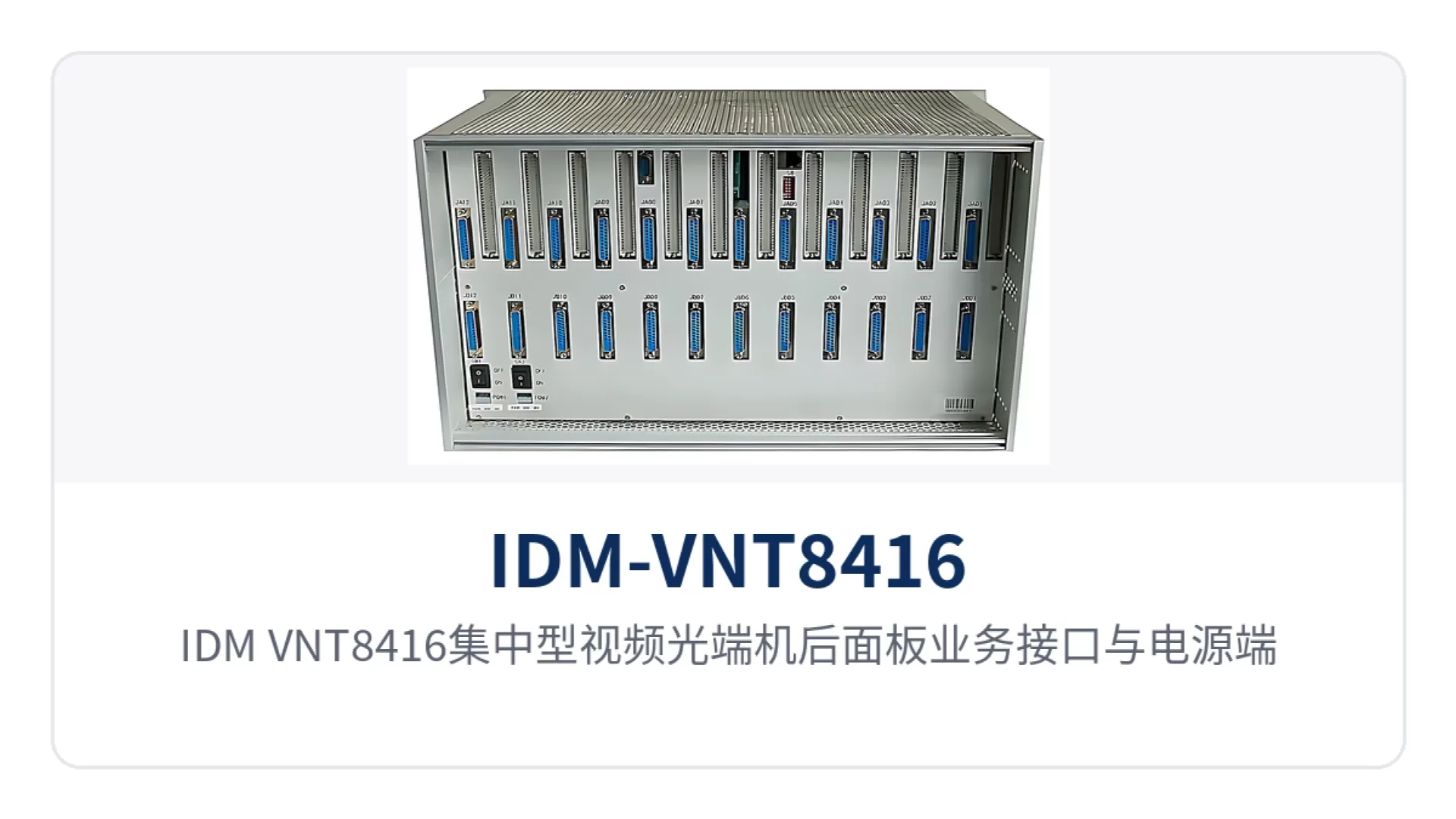
Figure 2: Layout of service interfaces and power supply terminals on the rear panel of the IDM-VNT8416 centralized video optical multiplexer
Differentiated Value: Single-Fiber Aggregation, 16-Channel Voice/Data, 20Km Single-Mode, and 1.5Gbps Optical Port
The differentiated value of the Raytrans IDM-VNT8416 single-fiber aggregation multi-service optical multiplexer centers on four aspects: single-fiber aggregation capability, voice/data capacity, transmission distance, and optical port rate. The corresponding capabilities and specifications for each are shown in the table below. As a professional optical multiplexer manufacturer, Raytrans fully presents the core advantages of this multi-service optical multiplexer in its product showcase.
| Differentiation Point | Corresponding Capability and Specifications | Description/Applicable Conditions |
|---|---|---|
| 8-channel video | Single-fiber aggregation of 8-channel video + 16-channel voice/data + 4 groups of E1, 1.5Gbps optical rate, multi-service over a single fiber for private networks | 8-channel video input via BNC, video SNR ≥70dB (weighted), for on-duty personnel to view on-site images |
| 16-channel voice/data | 16-channel voice or data services transmitted in parallel with video and E1 over the same optical fiber | Voice configured with FXO/FXS interface cards, data configured with RS-232, RS-422, RS-485 interfaces, configured per on-site service list |
| 20Km single-mode | 20Km single-mode transmission, receiver sensitivity better than -21dBm, sufficient link margin for long-distance field links | Transmit optical power -9~-1dBm, single-mode 20Km repeaterless; long-distance optical modules optional for longer distances |
| 1.5Gbps optical port | 1.5Gbps optical port, FC interface (SC and others can be customized), single-mode (multi-mode optional) | Bidirectional transmission over a single optical fiber, receiver and transmitter wavelengths cross-paired at 1310nm/1550nm |
How Far Can a Multi-Service Optical Multiplexer Transmit over a Single Fiber
How far a multi-service optical multiplexer can transmit over a single fiber depends on the margin among three factors: the optical module grade, the fiber type, and the link loss. The standard configuration of the Raytrans IDM-VNT8416 single-fiber aggregation multi-service optical multiplexer is single-mode fiber and FC interface, with a default transmission distance of 20Km, corresponding to a transmit optical power of -9~-1dBm and receiver sensitivity better than -21dBm. The optical power margin reserved at both ends is the usable portion of the link budget. The transmission distance performance of this optical multiplexer is also one of the key parameters in the optical multiplexer manufacturer's product showcase.
When the distance exceeds 20 Km, long-distance optical modules can be optionally installed to achieve longer optical fiber transmission; the actual reachable distance must also be calculated section by section based on optical cable loss, the number of fiber adapters and splice points, and termination quality. In engineering practice, it is recommended to reserve a certain optical power margin at both ends of the link to avoid insufficient margin after optical cable aging or connector contamination.
How to Connect 16-Channel Voice and Data on an Optical Multiplexer
How to connect 16-channel voice and data on an optical multiplexer depends on whether the on-site terminals are telephones or data devices: voice is connected to telephone lines via FXO/FXS interface cards, and data is connected to control and acquisition terminals via RS-232, RS-422, and RS-485 interfaces. Both types of interfaces are provided on service sub-cards and selected according to the project. Raytrans telephone optical multiplexers and multi-service optical multiplexers both use this wiring method.
- Voice interfaces use standard FXO/FXS cards, with an audio range of 300 Hz to 3400 Hz and ITU G.711 A-law compression, requiring no modification to the opposite end when interfacing with existing SPC exchanges and dispatch consoles;
- The voice interface impedance is three-element complex impedance 200 Ω + 560 Ω//0.1 μF, with a loop current of 25 mA per channel. When wiring, connect the two telephone line wires according to the interface card silkscreen to avoid mixing with data ports;
- Data services are selected as RS-232, RS-422 (4-wire) or RS-485 (2-wire) according to the terminal type. All interfaces are RJ-45; verify the wiring sequence and signal direction before insertion;
- Voice and data share the 16 voice or data channels over the same optical fiber. Services can be enabled once the service ports at both ends correspond one-to-one, with no on-site adjustment required.
What Is the Industrial-Grade Wide Temperature Range of a Centralized Video Optical Multiplexer
What is the industrial-grade wide temperature range of a centralized video optical multiplexer? The answer is an industrial-grade operating temperature of -40℃ to +85℃ and a relative humidity of 0 to 95% (non-condensing). The standard operating temperature of the Raytrans IDM-VNT8416 single-fiber converged multi-service optical multiplexer is -15℃ to +65℃, with a storage temperature of -25℃ to +75℃. The wide-temperature configuration enables the device to start and operate normally in severe cold plateaus and high-temperature deserts, unaffected by on-site day-night temperature differences and wind, sand, rain, or snow. The performance of this video optical multiplexer in terms of industrial-grade wide temperature is a hard metric that cannot be overlooked in an optical multiplexer manufacturer's product showcase.
When selecting a wide-temperature configuration, also verify the picture quality specifications: video SNR ≥70 dB and differential gain (DG) <0.7%, with industrial-grade -40℃ to +85℃ wide temperature operation. Together, these determine the long-term operation performance of field sites. The power supply mode is compatible with AC 220 V, DC -48 V, and DC 9 V, with an overall power consumption of ≤150 W. Communications equipment rooms and private network cabinets can directly draw DC -48 V power, while field sites without mains power can use storage battery supply. For optical cable routes that are aerial or laid along poles, equipotential grounding is recommended inside the equipment boxes at both ends.
How to Select a Multi-Service Optical Multiplexer
How to select a multi-service optical multiplexer: first verify the number and type of services to be connected according to the on-site service list, then determine the optical module and model grade based on transmission distance and environmental conditions, and finally verify the power supply mode and installation space. As a professional optical multiplexer manufacturer deeply engaged in the optical multiplexer field, Raytrans recommends that users confirm item by item based on actual requirements.
- The service list determines the interface configuration: how many channels of video are on site, whether bidirectional transmission is needed, whether an E1 dedicated line should be reserved, and whether terminals are voice or data. Map each item to video ports, E1 channels, voice/data ports, and Ethernet ports;
- Capacity calculation determines the enclosure configuration: the Raytrans IDM-VNT8416 single-fiber converged multi-service optical multiplexer comes standard with 8-channel video, 16-channel voice or data, 4 groups of E1 transparent transmission, 4 groups of high-fidelity audio, and 4-channel shared 100M Ethernet. The centralized enclosure can correspond to 10 remote stations; when services are insufficient, interface cards can be optionally selected as required;
- Distance and environment determine the optical module and model: for lines with large section spacing and distributed sites, calculate the optical power budget based on 20 Km single-mode; for longer distances, install long-distance optical modules; for outdoor equipment boxes, mounting poles, and tunnel sites, select the industrial-grade wide-temperature configuration (-40℃ to +85℃);
- Power supply and installation conditions determine placement: confirm whether on-site power supply access is AC 220 V or DC -48 V, verify whether the 440×230×270 mm enclosure dimensions match the cabinet space, and then determine the quantity to purchase in pairs.
Typical Applications
Smart Grid Substation Communications Private Network
Substations, switching stations, and distribution rooms are mostly far from the dispatch center. On site, there is often only a pair of optical fibers and limited rack positions, yet surveillance images, dispatch telephones, and telecontrol data must all be backhauled simultaneously. The Raytrans IDM-VNT8416 single-fiber converged multi-service optical multiplexer uses one optical fiber to send 8-channel video, 16-channel voice or data, 4 groups of E1 transparent transmission, and 4-channel shared 100M Ethernet back to the dispatch end together. Existing E1 dedicated lines are transparently transmitted as-is, eliminating the need to lay separate lines for each type of signal. The industrial-grade -40℃ to +85℃ wide temperature and AC 220 V/DC -48 V dual power supply access adapt to the actual conditions of substation equipment rooms and outdoor terminal boxes.
Rail Transit Line Video Surveillance Private Network
Rail transit line stations are distributed in a belt along the line. The distance from section equipment boxes to the central equipment room often exceeds the usable range of coaxial cable and twisted pair, while duct resources are extremely tight. The Raytrans IDM-VNT8416 single-fiber converged multi-service optical multiplexer covers the typical distance between adjacent stations, sections, and depots with single-fiber 20 Km transmission. Front-end images reach the center directly over a single optical fiber, with no repeater or routing/switching equipment in between. Video and 100M Ethernet are multiplexed over one optical cable, reducing duct occupation. A video SNR of ≥70 dB ensures image legibility under nighttime and backlight conditions.
Oil and Gas Pipeline and Mining Area Unattended Sites
Unattended sites such as oil and gas pipeline valve chambers, mining area well sites, and pumping stations are far from the center and require low maintenance frequency. Once the communication link is interrupted, manual attendance on site for troubleshooting is time-consuming. The Raytrans IDM-VNT8416 single-fiber converged multi-service optical multiplexer directly connects the site to the central equipment room, reducing one level of repeater and routing/switching links, thereby reducing points of failure. The overall power consumption of ≤150 W facilitates long-term power supply via storage battery or solar power. The industrial-grade -40℃ to +85℃ wide temperature and 0 to 95% non-condensing humidity adapt to field cabinet environments, with video, voice/data, E1, and Ethernet services uniformly connected within the same device.
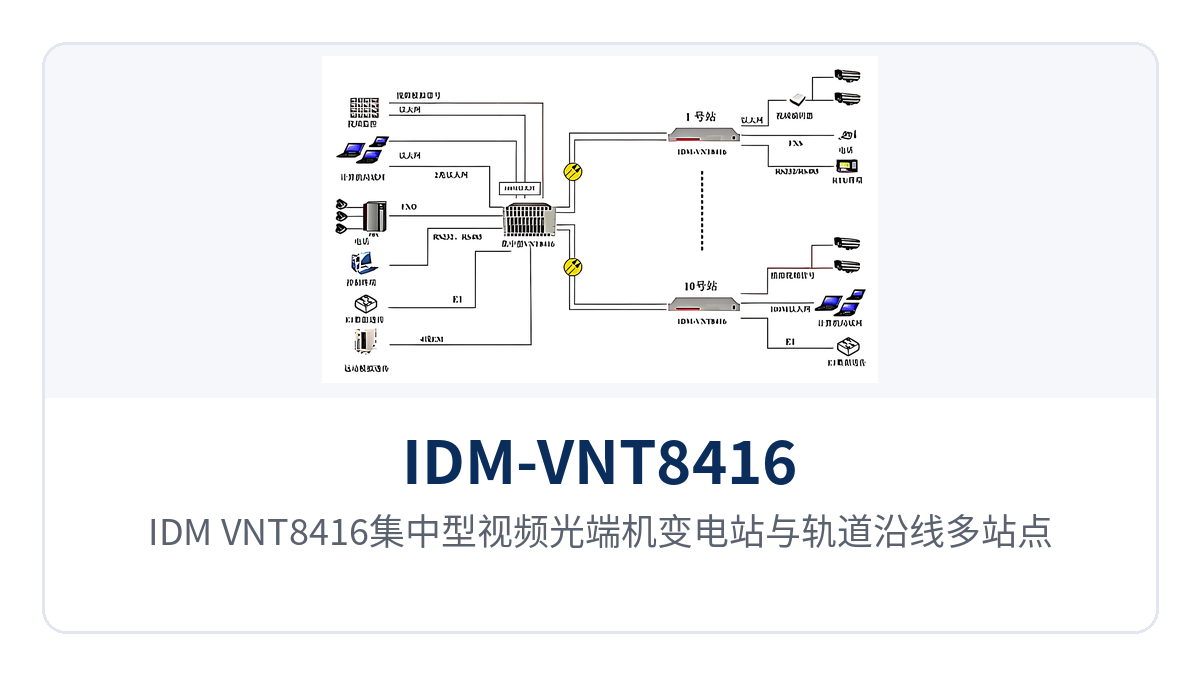
Figure 3: IDM-VNT8416 centralized video optical multiplexer single-fiber networking diagram for multiple sites at substations and along rail lines