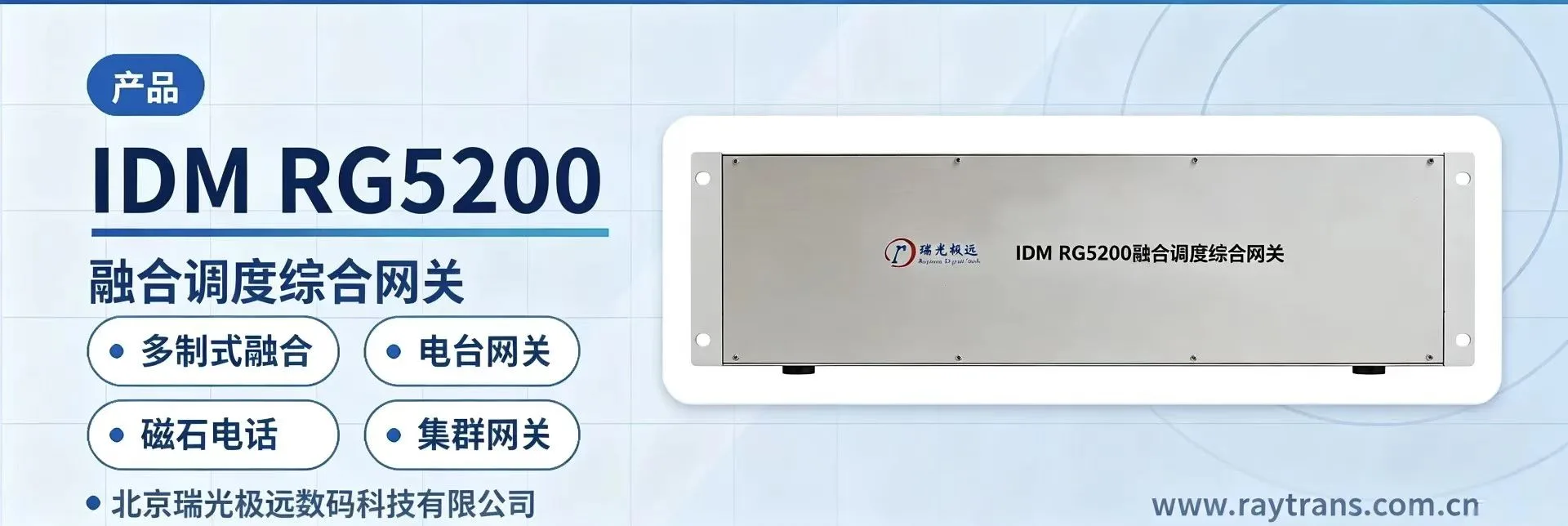
IDM RG5200 Converged Dispatching Integrated Gateway
One Chassis with 17 Slots, Converging Magneto Telephones, Radio Sets and Trunking into One SIP Dispatch Network
The IDM RG5200 converged dispatching integrated gateway is used in the field of converged dispatching gateways, and is communication/transmission/dispatch equipment for industry customers (to be detailed according to the documentation)
The IDM RG5200 IP access gateway is a modular converged dispatching integrated gateway product developed by Beijing Ruiguang Jiyuan Digital Technology Co., Ltd., and is made up of the main chassis and various service boards. It is used to connect communication terminals of different standards such as program-controlled telephones, magneto telephones, HF/VHF/UHF radio sets and trunking intercom into the SIP softswitch and the converged communication command and dispatch system in a unified way. The IDM RG5200 IP access gateway has complete signaling and media processing capability and integrates various communication interfaces in one unit; it supports E1, FXO/FXS, 4G LTE, trunking interfaces/vehicle-mounted radios/handheld radios, audio/HF/VHF/UHF, E&M interfaces, magneto interfaces and the SIP protocol, supports dual power supply, and is mainly used in specific industries such as IPCC, SIP dispatching and unified communications (UC), making it an ideal product showcase in the field of converged communication and command and dispatch.
Key specifications at a glance: 19-inch 3U modular chassis · 17 service slots · 170 channels of 64K time slots · SIP protocol and G.711/G.729 encoding · 7 gigabit Ethernet ports (2 support link aggregation) · dual power supply
Where an industrial private network dispatching project needs to integrate several mutually independent communication systems — telephones, magneto telephones, radio sets and trunking — into one IP dispatch network, the IDM RG5200 IP access gateway can be selected as the core access device. As a professional converged dispatching product, the IDM RG5200 IP access gateway adopts a 19-inch 3U modular chassis and provides 17 service slots, so that smooth capacity expansion is achieved simply by inserting expansion function boards for E1, analog telephone, magneto, audio, radio, trunking, LTE and so on according to the services required; the FXO central office interface, the FXS telephone interface, the radio interface/PTT hand microphone interface, the LTE mobile phone interface, the magneto telephone interface, the public address (PA) broadcasting interface and the mixer interface can all be dispatched in a unified way by the dispatch console. As an experienced command and dispatch system manufacturer, Raytrans provides a converged communication command and dispatch system that is widely applicable to scenarios such as military emergency communications vehicle solutions and smart mining communication solutions.
What Is the IDM RG5200 Converged Dispatching Integrated Gateway?
The IDM RG5200 converged dispatching integrated gateway is an integrated access and conversion device located between various voice terminals and the SIP dispatch network. As an IP access gateway, its role is to aggregate communication terminals whose interface formats differ from one another, convert them uniformly into SIP signaling and media streams, and hand them over to the dispatch console, the dispatch server and the unified communications platform. One side of the IDM RG5200 converged dispatching integrated gateway connects to the dispatching local area network (LAN) and the SIP softswitch/dispatch server, while the other side provides access, as required by the services, to E1 trunks, analog telephones, magneto telephones, LTE terminals, E&M audio, HF/VHF/UHF radio sets and trunking radio sets; signaling conversion between different formats is performed by the plug-in boards inside the enclosure.
The typical value of the converged dispatching integrated gateway lies in integrating heterogeneous communication networks into a single dispatching system under unified command, and it is an important part of building a converged communication command and dispatch system. Dispatchers do not need to care about protocol differences on the terminal side: on the dispatch console they can initiate calls to any port, organize conferences and apply centralized management, without having to deploy a separate gateway or maintain a separate operating interface for each type of terminal.
What Functions Can the Converged Dispatching Integrated Gateway Provide?
The five capabilities of the IDM RG5200 converged dispatching integrated gateway divided by functional role are shown in the table below; the five capabilities are carried by different service boards in the same chassis and can be enabled on one device at the same time.
Function | Description |
|---|---|
Converged communication | Takes SIP as the core so that terminals such as telephones, magneto telephones, radio sets, trunking and LTE are incorporated into a unified dispatching system; the FXO/FXS/PTT/LTE/magneto/PA broadcasting/mixer interfaces are dispatched in a unified way by the dispatch console |
Integrated services | Provides integrated access for E1, Ethernet, FXO/FXS, E&M, magneto and so on; after service multiplexing the services can be transmitted over links such as DDN, microwave and satellite, and audio, data and Ethernet channels support physically isolated transparent transmission |
Radio gateway | Connects HF/VHF/UHF radio sets to the SIP softswitch system, and supports PTT control, listen inhibit/mute/recording as well as remote management of the channel, squelch and so on |
Magneto telephone gateway | Connects magneto telephones and magneto exchanges to the IP dispatch network, performs mutual conversion between magneto signaling and SIP signaling, and supports ordinary magneto and 2100 Hz carrier magneto interfaces |
Trunking gateway | Connects trunking radio sets and vehicle-mounted/handheld radios to the SIP softswitch, supports PTT intercom signaling and can join the conference room of the softswitch server |
In terms of main unit network processing capacity, the IDM RG5200 converged dispatching integrated gateway provides 7 gigabit Ethernet (GE) interfaces, of which 2 ports support link aggregation (LACP), and these are used for signaling and media processing; the system clock supports modes such as the local clock and the line-recovered clock; the device supports a network management system (NMS) based on the SNMP protocol, which can monitor the gateway and each service board in a centralized way.
Device Structure: Which Function Boards Can Be Inserted into the 17 Service Slots?
The IDM RG5200 converged dispatching integrated gateway adopts a 19-inch 3U standard chassis, with overall dimensions of 485 mm wide, 310 mm deep and 135 mm high; the front panel concentrates the Ethernet interface, the Ethernet network management interface, the CPU console interface, the power terminals, the power switch and various indicator LEDs. The front panel provides 17 universal slots from left to right, and the service boards are inserted from the panel side, which is convenient for users to operate and maintain.
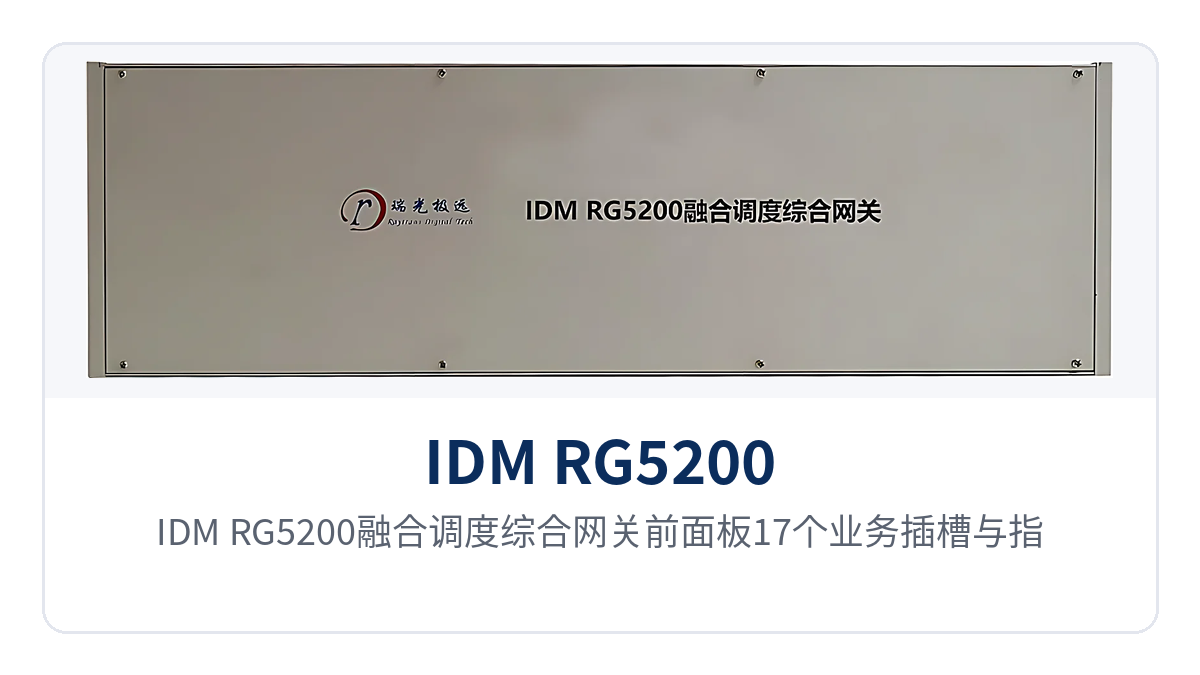
Figure 1: Layout of the 17 service slots and indicator LEDs on the front panel of the IDM RG5200 converged dispatching integrated gateway
Inside the IDM RG5200 converged dispatching integrated gateway the structure is card-based and modular: the main unit handles signaling and media processing, while subscriber interfaces of different formats are provided by the corresponding function boards. Service boards can be combined and expanded as required inside the same chassis, supporting mixed insertion of various boards such as voice, data, radio and trunking, and the whole device does not have to be replaced when the capacity is expanded.
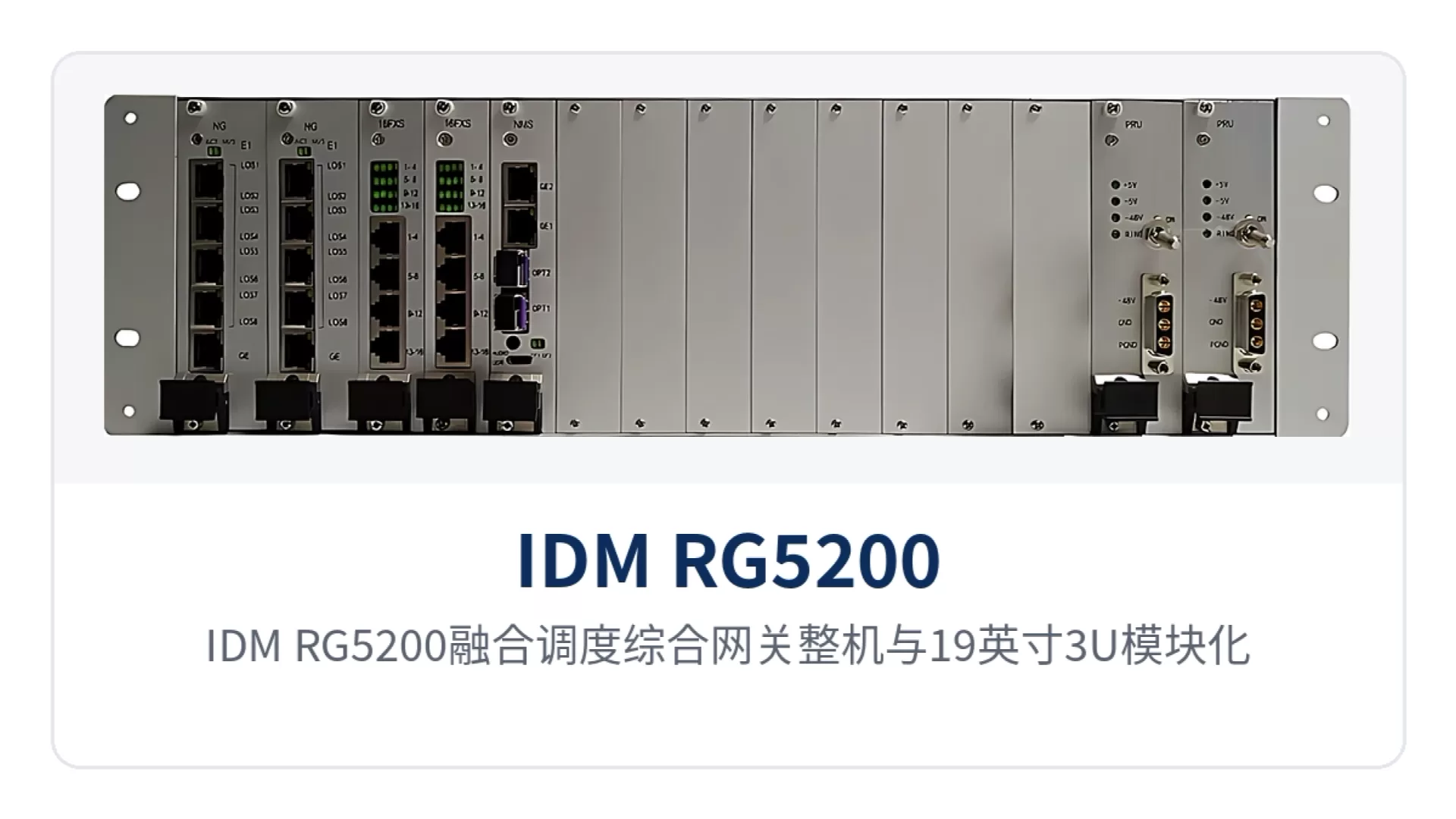
Figure 2: The complete unit of the IDM RG5200 converged dispatching integrated gateway and its 19-inch 3U modular chassis structure
The main service boards that can be inserted into the IDM RG5200 converged dispatching integrated gateway and their capabilities are shown in the table below:
Service board | Interfaces and capabilities provided |
|---|---|
E1 service access board | Provides 8 E1 interfaces, of which 6 are G.703 E1 interfaces, 1 is an E1 transparent transmission interface and 1 is an E1 transmission interface |
Analog telephone access board | Provides 10 analog telephone (FXO/FXS) interfaces |
Magneto access board | Provides 4-channel magneto telephone access and supports ordinary magneto or 2100 Hz carrier magneto interfaces |
Audio service access board | Provides 4-channel E&M 2-wire/4-wire interfaces, and performs mutual conversion between E&M signaling and SIP signaling as well as audio over IP transmission |
Radio access board | Provides 4-channel radio service interfaces, enabling HF/VHF/UHF radio sets to access the SIP softswitch system |
Trunking access board | Provides 4-channel trunking service interfaces, enabling trunking radio sets to access the SIP softswitch system |
LTE access board | Supports 1-channel 4G LTE access |
Universal service board | Provides 4 slots for 64 kbit/s services and supports mixed insertion of service sub-cards such as FXO/FXS, magneto, E&M 2-wire/4-wire and radio |
Echo cancellation function board | Supports echo cancellation for a delay of 600 ms, and can be used in high-latency scenarios such as satellite transmission |
The universal service board concentrates the interfaces of multiple sub-cards on the same board, which suits station types with a small number of channels of a single type but many service types; when a new interface format has to be added or the capacity has to be expanded, it is enough to insert the corresponding function board into the remaining slots, and the board combination can be confirmed with the command and dispatch system manufacturer according to the actual project.
How Do the Radio Gateway and the Trunking Gateway Access the SIP Softswitch Dispatching System?
HF/VHF/UHF radio sets and trunking intercom can be connected to the SIP softswitch dispatching system. The access mode is to configure a radio access board and a trunking access board for the IDM RG5200 converged dispatching integrated gateway, and the gateway performs the conversion between audio, PTT signaling and SIP signaling, after which the dispatch console can carry out unified calling and control over the radio and trunking terminals, realizing converged dispatching.
The radio gateway function is carried by the radio access board. The radio access board supports 4-channel radio service interfaces and provides 2-channel audio and PTT interfaces, and can carry out voice calls and control with HF radio sets, VHF/UHF radio sets, data links, satellite communications and trunking; the operation and control end can perform operations such as listen inhibit, mute and recording on any radio, and the way the console voice is fed to the radio supports the PTT control mode, the VAD voice activation mode and the PAD console operation mode. Through the SIP converged dispatching system, PTT commands can be delivered to the radio gateway and transparently transmitted to the radio, and the current channel, squelch and other status of the radio can also be queried and modified; the device provides WEB interface configuration management, and technical specifications such as SIP data configuration, volume control, noise control and radio control can be modified.
The trunking gateway function is carried by the trunking access board. The trunking access board supports 4-channel trunking service interfaces, enabling trunking radio sets to access the SIP softswitch system; it supports the SIP protocol and can join the conference room of the SIP softswitch server; it supports PTT intercom signaling, can define the validity of the E and M signals, and supports selective access of PTT handles and trunking intercom radios, which suits bringing the vehicle-mounted radios and handheld radios of analog trunking and digital trunking into unified dispatching.
How Does the Magneto Telephone Gateway Connect Magneto Telephones to the IP Dispatch Network?
Magneto telephones can be connected to the IP dispatch network, and the access mode is to insert a magneto access board into the IDM RG5200 converged dispatching integrated gateway. The magneto access board supports 4-channel magneto telephone access and performs the mutual conversion between magneto telephone signaling and SIP signaling, after which the magneto telephone can be called by the dispatch console as a SIP terminal; the magneto access board provides two modes, the ordinary magneto interface and the 2100 Hz carrier magneto interface, which can be selected according to the type of the equipment at the opposite end.
The ordinary magneto mode converts the user voice signal and the main device signal into each other, and also completes the conversion between digital signaling and line states, so it can be used as the connection interface between magneto telephones, between magneto exchanges and between the two. The 2100 Hz carrier magneto mode completes the conversion between the 2100 Hz carrier signaling and ringing current or 16-time-slot digital signaling: it can convert the 2100 Hz in-band signaling coming from the audio trunk card of a remote PCM equipment into a ringing current signal for output, and can also convert the ringing signal at the local end into 2100 Hz in-band signaling for the remote end, which suits scenarios where remote PCM trunk telephones are connected to the converged dispatching system.
How Many Time Slots Do the Integrated Services Support for Access, and over Which Links Can They Be Networked?
The converged communication integrated service access capacity of the IDM RG5200 IP access gateway is 170 channels of 64K time slots (TS); communication services such as voice, audio and video and the local area network (LAN) can be multiplexed into one high-speed data stream for bidirectional transmission over communication links such as DDN leased lines, microwave and satellite. In terms of networking and transmission, the IDM RG5200 IP access gateway supports transparent transmission of audio services and data services as well as physically isolated transparent transmission of Ethernet channels, meeting the private network requirements of simultaneous voice and data transmission and channel isolation.
In terms of E1 trunks and long-distance extension, the E1 service access board provides 8 E1 interfaces, of which 6 are E1 interfaces compliant with the G.703 standard, 1 is an E1 transparent transmission interface and 1 is an E1 transmission interface; the audio service access board supports transmission through the E1 transmission interface and supports party-line voice services, and E1 lines can be used for cascading transmission to extend voice services to remote nodes.
Key Specifications and Performance Indicators
The interface and performance specifications of the IDM RG5200 IP access gateway are subject to the product documentation of the command and dispatch system manufacturer; the table below summarizes the parameters specified in the product documentation, for reference in product showcase, selection and networking design.
Item | Parameter/Specification | Description/Applicable Conditions |
|---|---|---|
Product form | Modular converged dispatching integrated gateway | For industry scenarios such as IPCC, SIP dispatching and unified communications |
Chassis and dimensions | 19-inch 3U standard chassis, 485 mm wide × 310 mm deep × 135 mm high | Standard cabinet installation |
Service slots | 17 universal slots | Supports boards such as E1, analog telephone, magneto, E/M audio, radio, trunking, LTE, universal and echo cancellation boards |
Time slot access capacity | 170 channels of 64K time slots | Access for voice and data services; the board combination is subject to the manufacturer's configuration |
VoIP protocols and encoding | SIP; G.711 A-law/μ-law, G.711 Appendix 1, G.723.1 and Annex A, G.729 Annex A/B | Voice codec format |
Voice processing technologies | Voice activity detection (VAD), CNG comfort noise generation, echo cancellation G.168 (≤128 ms delay) | Echo cancellation complies with G.168 |
Main unit network interfaces | 7 gigabit Ethernet interfaces, of which 2 ports support link aggregation | Used for signaling and media processing |
Service Ethernet channels | 10/100 Mbps, end-to-end (E2E) bridging, compliant with IEEE 802.3 | RJ45 connector |
Network protocols | IP, NAT, ICMP, ARP, HTTP, BOOTP, FTP, TFTP, DHCP, SNMP, Diff-Serv | Main unit protocol stack |
E1 interfaces | 8 E1 per board: 6× G.703 E1, 1× E1 transparent transmission, 1× E1 transmission | Interface standard G.703/G.704, rate 2.048 Mbps; DB37 connector, with a DB37-to-micro-coaxial converter provided |
Analog telephone interfaces | FXO/FXS, 10 per board | Encoding G.711 (64k) A-law, audio range 300 Hz-3400 Hz, balanced 600 Ω, RJ45 |
Magneto interfaces | 4 per board | Ordinary magneto or 2100 Hz carrier magneto, with mutual conversion between magneto signaling and SIP signaling |
E/M audio interfaces | 4 2-wire/4-wire per board | Mutual conversion between E&M signaling and SIP, supports 2-wire/4-wire modes, and supports transmission over E1 and party-line voice |
Radio interfaces | 4 per board, with 2 audio channels and PTT provided per channel | Supports intercommunication with HF/VHF/UHF radio sets, data links, satellite communications and trunking; supports PTT/VAD/PAD control modes and WEB configuration |
Trunking interfaces | 4 per board | Supports joining the softswitch conference room over SIP, and supports PTT intercom signaling as well as access of PTT handles and trunking intercom radios |
LTE interfaces | 1 4G per board | LTE mobile phones access the dispatching system |
Serial interfaces | EIA-422/EIA-232, 4 RJ45 physical interfaces, with a DB25 conversion cable provided | Asynchronous rate 300 bps-115200 bps, synchronous rate 1200 bps-115200 bps |
System clock | Local clock, line-recovered clock | Clock modes are configurable |
Network management | Based on the SNMP protocol | Centralized monitoring of the gateway and the service boards |
Power supply | Dual power supply | The voltage specification is subject to the manufacturer's technical documentation and commercial confirmation |
Operating environment | Temperature 0 °C-40 °C, humidity 90% (non-condensing) | For use in equipment room and station building environments |
Overall power consumption | 230 W ± 10% | Related to the board configuration; the actual value is subject to the unit configuration |
Differentiated Value: Why Can the Convergence of Different Standards Eliminate the Protocol Conversion Middleware?
The differentiated value of the IDM RG5200 IP access gateway is concentrated in three aspects: access for terminals of different standards, industrial private network adaptation and unified dispatching management. One device can replace multiple single-format gateways and the protocol conversion step between them; the three selling points and the corresponding capabilities are shown in the table below.
Differentiated selling points | Corresponding capability | Customer Value |
|---|---|---|
Converged access for radio sets, magneto telephones, trunking and other terminals of different standards | The radio access board, trunking access board, magneto access board, analog telephone access board, audio service access board, LTE access board and universal service board can be mixed in the same chassis | One gateway opens up heterogeneous communication islands, and gateway equipment and protocol conversion middleware do not have to be purchased separately for each format |
A converged dispatching integrated gateway for industrial private networks, suited to field and unattended scenarios | 19-inch 3U modular chassis, dual power supply, centralized monitoring by SNMP network management, echo cancellation function board with 600 ms delay for high-latency satellite links, card-based capacity expansion | Remote station buildings and lightly staffed sites support centralized monitoring and remote maintenance, reducing the need for personnel to travel to the site |
Integrated service gateway architecture supporting unified access and dispatching management of multiple types of terminals | 17 service slots, integrated access for 170 channels of 64K time slots, and unified dispatching of the FXO/FXS/PTT/LTE/magneto/PA broadcasting/mixer interfaces by the dispatch console | Multiple types of terminals are accessed and managed at the same dispatch console, and the communication system is integrated into one operating interface |
In terms of project implementation, the IDM RG5200 IP access gateway adopts a 19-inch 3U chassis and supports dual power supply, so it can be installed in a standard cabinet; when a new interface format is added, it is enough to insert a function board into the remaining slots, without changing the existing terminals and cabling, which suits the phased construction and upgrading of private network communication systems. As a professional command and dispatch system manufacturer, Raytrans provides a converged communication command and dispatch system that has been widely used in scenarios such as military emergency communications vehicle solutions and smart mining communication solutions; the deep integration of the IP access gateway with converged dispatching, command and dispatch and the converged communication command and dispatch system provides industry users with integrated product showcase and solutions.
Typical Application Scenarios
The typical networking of the IDM RG5200 IP access gateway is to connect the telephones, magneto telephones, radio sets and trunking terminals of the dispatch equipment room to the SIP dispatching system in a unified way; services can be tandemed over E1, the LAN or DDN/microwave/satellite links, and the networking relationship of the product showcase is shown in the figure below.
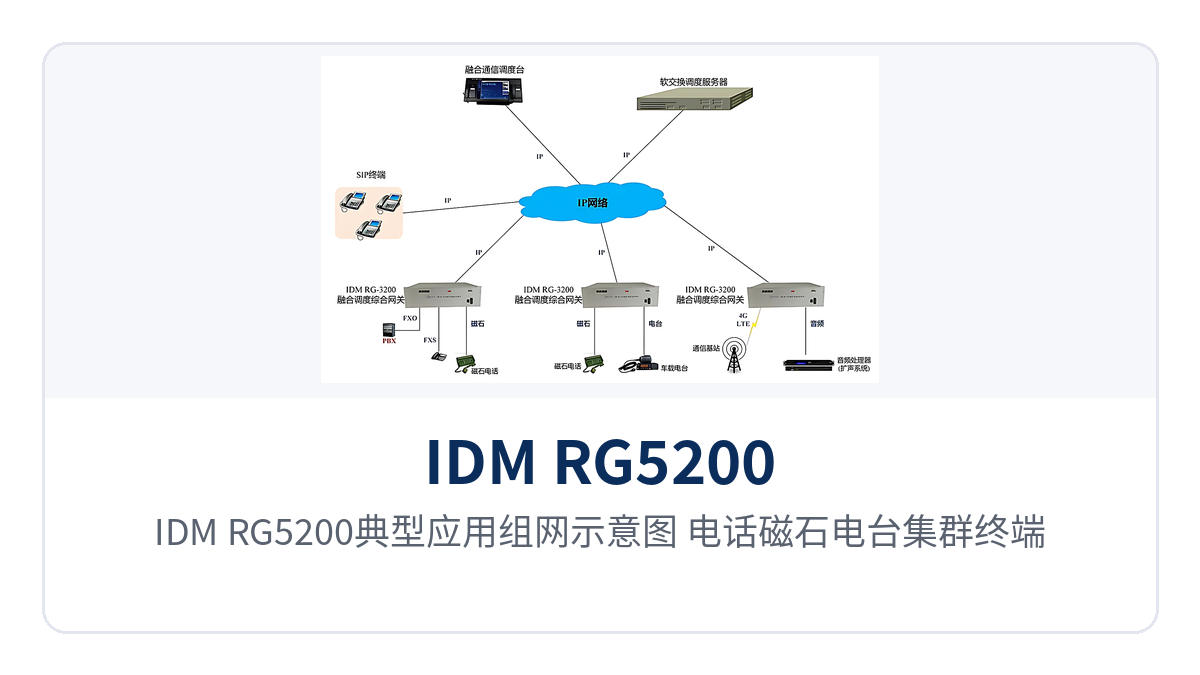
Figure 3: Typical application networking diagram of the IDM RG5200 — telephones, magneto telephones, radio sets and trunking terminals access SIP dispatching
Power and Energy Industry Private Network Dispatching
In the private networks of the electric power and energy industries, the dispatch telephones, magneto telephones, HF/VHF/UHF radio sets used for inspection and trunking intercom of substations and power plants often belong to different systems. The IDM RG5200 IP access gateway is deployed in the dispatch equipment room: dispatch telephones and analog telephones are connected through FXO/FXS boards, the existing magneto telephones are retained through the magneto access board, wireless terminals are brought into the dispatch network through the radio access board and the trunking access board, and the E1 board can interconnect with existing stored program control (SPC) switching or transmission equipment as a trunk according to the G.703 standard (2.048 Mbps). When a remote station has few on-duty personnel, the SNMP network management can centrally monitor the status of the gateway and the boards, reducing the frequency of on-site inspection.
Rail Transit and Railway Dispatching
In rail transit and railway dispatching scenarios, the official telephones, section telephones and dedicated wireless intercom of stations, sections and depots need to be merged into the same converged communication command and dispatch system. The IDM RG5200 IP access gateway can interconnect with the existing transmission system over an E1 trunk (compliant with the G.703/G.704 standard, at a rate of 2.048 Mbps), connect station telephones through FXO/FXS boards, and connect station radio sets and handheld terminals through the radio access board and the trunking access board; audio, data and Ethernet channels can be carried in parallel on the same link through physically isolated transparent transmission, which makes it easy to aggregate the voice services of dispersed sites along the line to the dispatch center for unified command and dispatch.
Emergency Command and Public Safety
In emergency command and public safety scenarios, the HF/VHF/UHF radio sets, trunking intercom and mobile telephones commonly used on site need intercommunication with the telephone network of the rear command center. The IDM RG5200 IP access gateway connects HF/VHF/UHF base station radios to the SIP dispatching system through the radio access board, brings the vehicle-mounted radios and handheld radios of analog trunking and digital trunking into the dispatch network through the trunking access board, and connects 4G terminals to dispatching through the LTE access board; dispatchers can perform PTT calls, listen inhibit, mute, recording and channel status queries, and when satellite link extension is required an echo cancellation function board is optional, whose 600 ms delay capability addresses high-latency scenarios such as satellite transmission.
Selection and Deployment Recommendations
Before deploying the IDM RG5200 converged dispatching integrated gateway, it is recommended to first take stock of the terminal formats and the number of channels to be connected: for trunks and telephones choose FXO/FXS boards or E1 boards, for magneto telephones choose the magneto access board, for HF/VHF/UHF radio sets choose the radio access board, for trunking intercom choose the trunking access board, and for mobile backhaul requirements the LTE access board can be selected; then plan the reserved capacity expansion margin according to the total slots. The IDM RG5200 converged dispatching integrated gateway adopts a 19-inch 3U chassis and supports dual power supply, so it can be installed in a standard cabinet; it is ready for use once the network side is connected to the LAN where the SIP softswitch and the dispatching system reside.
If a project needs to connect program-controlled telephones, magneto telephones, HF/VHF/UHF radio sets and trunking intercom to one SIP dispatch network in a unified way, the IDM RG5200 converged dispatching integrated gateway can be selected as the core access device. As a professional command and dispatch system manufacturer, Raytrans can provide product showcase and technical support for military emergency communications vehicle solutions and smart mining communication solutions. Engineering parameters such as the voltage specification of the dual power supply are not yet recorded in the knowledge base here; please refer to the manufacturer's technical documentation and commercial confirmation.
The radio gateway function is carried by the radio access board. The radio access board supports 4-channel radio service interfaces and provides 2-channel audio and PTT interfaces, and can carry out voice calls and control with HF radio sets, VHF/UHF radio sets, data links, satellite communications and trunking; the operation and control end can perform operations such as listen inhibit, mute and recording on any radio, and the way the console voice is fed to the radio supports the PTT control mode, the VAD voice activation mode and the PAD console operation mode. Through the SIP converged dispatching system, PTT commands can be delivered to the radio gateway and transparently transmitted to the radio, and the current channel, squelch and other status of the radio can also be queried and modified; the device provides WEB interface configuration management, and technical specifications such as SIP data configuration, volume control, noise control and radio control can be modified.
The trunking gateway function is carried by the trunking access board. The trunking access board supports 4-channel trunking service interfaces, enabling trunking radio sets to access the SIP softswitch system; it supports the SIP protocol and can join the conference room of the SIP softswitch server; it supports PTT intercom signaling, can define the validity of the E and M signals, and supports selective access of PTT handles and trunking intercom radios, which suits bringing the vehicle-mounted radios and handheld radios of analog trunking and digital trunking into unified dispatching.
How Does the Magneto Telephone Gateway Connect Magneto Telephones to the IP Dispatch Network?
Magneto telephones can be connected to the IP dispatch network, and the access mode is to insert a magneto access board into the IDM RG5200 converged dispatching integrated gateway. The magneto access board supports 4-channel magneto telephone access and performs the mutual conversion between magneto telephone signaling and SIP signaling, after which the magneto telephone can be called by the dispatch console as a SIP terminal; the magneto access board provides two modes, the ordinary magneto interface and the 2100 Hz carrier magneto interface, which can be selected according to the type of the equipment at the opposite end.
The ordinary magneto mode converts the user voice signal and the main device signal into each other, and also completes the conversion between digital signaling and line states, so it can be used as the connection interface between magneto telephones, between magneto exchanges and between the two. The 2100 Hz carrier magneto mode completes the conversion between the 2100 Hz carrier signaling and ringing current or 16-time-slot digital signaling: it can convert the 2100 Hz in-band signaling coming from the audio trunk card of a remote PCM equipment into a ringing current signal for output, and can also convert the ringing signal at the local end into 2100 Hz in-band signaling for the remote end, which suits scenarios where remote PCM trunk telephones are connected to the converged dispatching system.
How Many Time Slots Do the Integrated Services Support for Access, and over Which Links Can They Be Networked?
The converged communication integrated service access capacity of the IDM RG5200 IP access gateway is 170 channels of 64K time slots (TS); communication services such as voice, audio and video and the local area network (LAN) can be multiplexed into one high-speed data stream for bidirectional transmission over communication links such as DDN leased lines, microwave and satellite. In terms of networking and transmission, the IDM RG5200 IP access gateway supports transparent transmission of audio services and data services as well as physically isolated transparent transmission of Ethernet channels, meeting the private network requirements of simultaneous voice and data transmission and channel isolation.
In terms of E1 trunks and long-distance extension, the E1 service access board provides 8 E1 interfaces, of which 6 are E1 interfaces compliant with the G.703 standard, 1 is an E1 transparent transmission interface and 1 is an E1 transmission interface; the audio service access board supports transmission through the E1 transmission interface and supports party-line voice services, and E1 lines can be used for cascading transmission to extend voice services to remote nodes.
Key Specifications and Performance Indicators
The interface and performance specifications of the IDM RG5200 IP access gateway are subject to the product documentation of the command and dispatch system manufacturer; the table below summarizes the parameters specified in the product documentation, for reference in product showcase, selection and networking design.
Item | Parameter/Specification | Description/Applicable Conditions |
|---|---|---|
Product form | Modular converged dispatching integrated gateway | For industry scenarios such as IPCC, SIP dispatching and unified communications |
Chassis and dimensions | 19-inch 3U standard chassis, 485 mm wide × 310 mm deep × 135 mm high | Standard cabinet installation |
Service slots | 17 universal slots | Supports boards such as E1, analog telephone, magneto, E/M audio, radio, trunking, LTE, universal and echo cancellation boards |
Time slot access capacity | 170 channels of 64K time slots | Access for voice and data services; the board combination is subject to the manufacturer's configuration |
VoIP protocols and encoding | SIP; G.711 A-law/μ-law, G.711 Appendix 1, G.723.1 and Annex A, G.729 Annex A/B | Voice codec format |
Voice processing technologies | Voice activity detection (VAD), CNG comfort noise generation, echo cancellation G.168 (≤128 ms delay) | Echo cancellation complies with G.168 |
Main unit network interfaces | 7 gigabit Ethernet interfaces, of which 2 ports support link aggregation | Used for signaling and media processing |
Service Ethernet channels | 10/100 Mbps, end-to-end (E2E) bridging, compliant with IEEE 802.3 | RJ45 connector |
Network protocols | IP, NAT, ICMP, ARP, HTTP, BOOTP, FTP, TFTP, DHCP, SNMP, Diff-Serv | Main unit protocol stack |
E1 interfaces | 8 E1 per board: 6× G.703 E1, 1× E1 transparent transmission, 1× E1 transmission | Interface standard G.703/G.704, rate 2.048 Mbps; DB37 connector, with a DB37-to-micro-coaxial converter provided |
Analog telephone interfaces | FXO/FXS, 10 per board | Encoding G.711 (64k) A-law, audio range 300 Hz-3400 Hz, balanced 600 Ω, RJ45 |
Magneto interfaces | 4 per board | Ordinary magneto or 2100 Hz carrier magneto, with mutual conversion between magneto signaling and SIP signaling |
E/M audio interfaces | 4 2-wire/4-wire per board | Mutual conversion between E&M signaling and SIP, supports 2-wire/4-wire modes, and supports transmission over E1 and party-line voice |
Radio interfaces | 4 per board, with 2 audio channels and PTT provided per channel | Supports intercommunication with HF/VHF/UHF radio sets, data links, satellite communications and trunking; supports PTT/VAD/PAD control modes and WEB configuration |
Trunking interfaces | 4 per board | Supports joining the softswitch conference room over SIP, and supports PTT intercom signaling as well as access of PTT handles and trunking intercom radios |
LTE interfaces | 1 4G per board | LTE mobile phones access the dispatching system |
Serial interfaces | EIA-422/EIA-232, 4 RJ45 physical interfaces, with a DB25 conversion cable provided | Asynchronous rate 300 bps-115200 bps, synchronous rate 1200 bps-115200 bps |
System clock | Local clock, line-recovered clock | Clock modes are configurable |
Network management | Based on the SNMP protocol | Centralized monitoring of the gateway and the service boards |
Power supply | Dual power supply | The voltage specification is subject to the manufacturer's technical documentation and commercial confirmation |
Operating environment | Temperature 0 °C-40 °C, humidity 90% (non-condensing) | For use in equipment room and station building environments |
Overall power consumption | 230 W ± 10% | Related to the board configuration; the actual value is subject to the unit configuration |
Differentiated Value: Why Can the Convergence of Different Standards Eliminate the Protocol Conversion Middleware?
The differentiated value of the IDM RG5200 IP access gateway is concentrated in three aspects: access for terminals of different standards, industrial private network adaptation and unified dispatching management. One device can replace multiple single-format gateways and the protocol conversion step between them; the three selling points and the corresponding capabilities are shown in the table below.
Differentiated selling points | Corresponding capability | Customer Value |
|---|---|---|
Converged access for radio sets, magneto telephones, trunking and other terminals of different standards | The radio access board, trunking access board, magneto access board, analog telephone access board, audio service access board, LTE access board and universal service board can be mixed in the same chassis | One gateway opens up heterogeneous communication islands, and gateway equipment and protocol conversion middleware do not have to be purchased separately for each format |
A converged dispatching integrated gateway for industrial private networks, suited to field and unattended scenarios | 19-inch 3U modular chassis, dual power supply, centralized monitoring by SNMP network management, echo cancellation function board with 600 ms delay for high-latency satellite links, capacity expansion by plug-in boards | Remote station buildings and lightly staffed sites support centralized monitoring and remote maintenance, reducing the need for personnel to travel to the site |
Integrated service gateway architecture supporting unified access and dispatching management of multiple types of terminals | 17 service slots, integrated access for 170 channels of 64K time slots, and unified dispatching of the FXO/FXS/PTT/LTE/magneto/PA broadcasting/mixer interfaces by the dispatch console | Multiple types of terminals are accessed and managed at the same dispatch console, and the communication system is integrated into one operating interface |
In terms of project implementation, the IDM RG5200 IP access gateway adopts a 19-inch 3U chassis and supports dual power supply, so it can be installed in a standard cabinet; when a new interface format is added, it is enough to insert a function board into the remaining slots, without changing the existing terminals and cabling, which suits the phased construction and upgrading of private network communication systems. As a professional command and dispatch system manufacturer, Raytrans provides a converged communication command and dispatch system that has been widely used in scenarios such as military emergency communications vehicle solutions and smart mining communication solutions; the deep integration of the IP access gateway with converged dispatching, command and dispatch and the converged communication command and dispatch system provides industry users with integrated product showcase and solutions.
Typical Application Scenarios
The typical networking of the IDM RG5200 IP access gateway is to connect the telephones, magneto telephones, radio sets and trunking terminals of the dispatch equipment room to the SIP dispatching system in a unified way; services can be tandemed over E1, the LAN or DDN/microwave/satellite links, and the networking relationship of the product showcase is shown in the figure below.
Figure 3: Typical application networking diagram of the IDM RG5200 — telephones, magneto telephones, radio sets and trunking terminals access SIP dispatching
Power and Energy Industry Private Network Dispatching
In the private networks of the electric power and energy industries, the dispatch telephones, magneto telephones, HF/VHF/UHF radio sets used for inspection, and trunking intercom of substations and power plants often belong to different systems. The IDM RG5200 IP access gateway is deployed in the dispatch equipment room: dispatch telephones and telephone sets are connected through FXO/FXS plug-in boards, the existing magneto telephones are retained through the magneto access board, wireless terminals are incorporated into the dispatch network through the radio access board and the trunking access board, and the E1 plug-in board allows interfacing with existing stored program control (SPC) switching or transmission equipment as a trunk according to the G.703 standard (2.048 Mbps). When remote stations have few on-duty personnel, the SNMP network management can centrally monitor the status of the gateway and the plug-in boards, reducing the frequency of on-site inspection.
Rail Transit and Railway Dispatching
In rail transit and railway dispatching scenarios, the official telephones, section telephones and dedicated wireless intercom of stations, sections and depots need to be merged into the same converged communication command and dispatch system. The IDM RG5200 IP access gateway can support interfacing with the existing transmission system over an E1 trunk (compliant with the G.703/G.704 standard, at a rate of 2.048 Mbps), connect station telephones through FXO/FXS plug-in boards, and connect station radio sets and handheld terminals through the radio access board and the trunking access board; audio, data and Ethernet channels can be carried in parallel on the same link through physically isolated transparent transmission, which makes it easy to aggregate the voice services of dispersed sites along the line to the dispatch center for unified command and dispatch.
Emergency Command and Public Safety
In emergency command and public safety scenarios, the HF/VHF/UHF radio sets, trunking intercom and mobile telephones commonly used on site need intercommunication with the telephone network of the rear command center. The IDM RG5200 IP access gateway connects HF/VHF/UHF base station radios to the SIP dispatching system through the radio access board, brings the vehicle-mounted radios and handheld radios of analog trunking and digital trunking into the dispatch network through the trunking access board, and connects 4G terminals to dispatching through the LTE access board; dispatchers can perform PTT calls, listen inhibit, mute, recording and channel status queries, and when satellite link extension is required an echo cancellation function board is optional, whose 600 ms delay capability addresses high-latency scenarios such as satellite transmission.
Selection and Deployment Recommendations
Before deploying the IDM RG5200 converged dispatching integrated gateway, it is recommended to first take stock of the terminal formats and the number of channels to be connected: for trunks and telephones choose FXO/FXS plug-in boards or E1 plug-in boards, for magneto telephones choose the magneto access board, for HF/VHF/UHF radio sets choose the radio access board, for trunking intercom choose the trunking access board, and for mobile backhaul requirements the LTE access board can be selected; then plan the reserved capacity expansion margin according to the total slots. The IDM RG5200 converged dispatching integrated gateway adopts a 19-inch 3U chassis and supports dual power supply, so it can be installed in a standard cabinet; it is ready for use once the network side is connected to the LAN where the SIP softswitch and the dispatching system reside.
If a project needs to connect program-controlled telephones, magneto telephones, HF/VHF/UHF radio sets and trunking intercom to one SIP dispatch network in a unified way, the IDM RG5200 converged dispatching integrated gateway can be selected as the core access device. As a professional command and dispatch system manufacturer, Raytrans can provide product showcase and technical support for military emergency communications vehicle solutions and smart mining communication solutions. Engineering parameters such as the voltage specification of the dual power supply are not yet recorded in the knowledge base here; they are subject to the manufacturer's technical documentation and commercial confirmation.