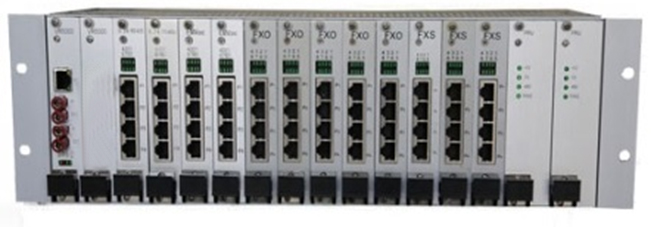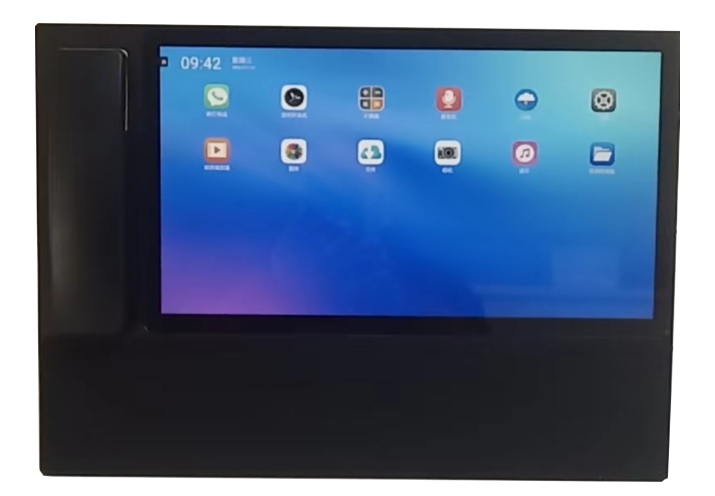
IDM RG
IDM RG
The IDM RG3200 Audio Converged Dispatch Switch is a PBX/IPPBX-based converged communication device developed by Beijing Ruiguang Jiyuan Digital Technology Co., Ltd. It is widely used by telecom operators, government agencies, industries, and large/medium-sized enterprises, delivering powerful performance. The product is designed with advanced digital integrated circuits, highly integrated optimized structures, and PBX/IPPBX communication technologies. It can be deployed on the enterprise side or in operator equipment rooms, providing users with an integrated audio/video converged comprehensive solution. The system adopts a modular design with board-level assembly, supporting PRI, NO.1, NO.7, and SIP/H.323 signaling methods. It can connect to traditional PSTN networks and operator VoIP softswitch platforms, enabling voice, fax, and data transmission over TDM and IP networks, achieving secure and efficient enterprise internal audio/video converged communication.
I. Overview
The IDM RG3200 Audio Converged Dispatch Switch is a PBX/IPPBX-based converged communication device developed by Beijing Ruiguang Jiyuan Digital Technology Co., Ltd. It is widely used by telecom operators, government agencies, industries, and large/medium-sized enterprises, delivering powerful performance. The product is designed with advanced digital integrated circuits, highly integrated optimized structures, and PBX/IPPBX communication technologies. It can be deployed on the enterprise side or in operator equipment rooms, providing users with an integrated audio/video converged comprehensive solution.
The system adopts a modular design with board-level assembly, supporting PRI, NO.1, NO.7, and SIP/H.323 signaling methods. It can connect to traditional PSTN networks and operator VoIP softswitch platforms, enabling voice, fax, and data transmission over TDM and IP networks, achieving secure and efficient enterprise internal audio/video converged communication.
II. Structure Description
IDM MCC Device Panel:
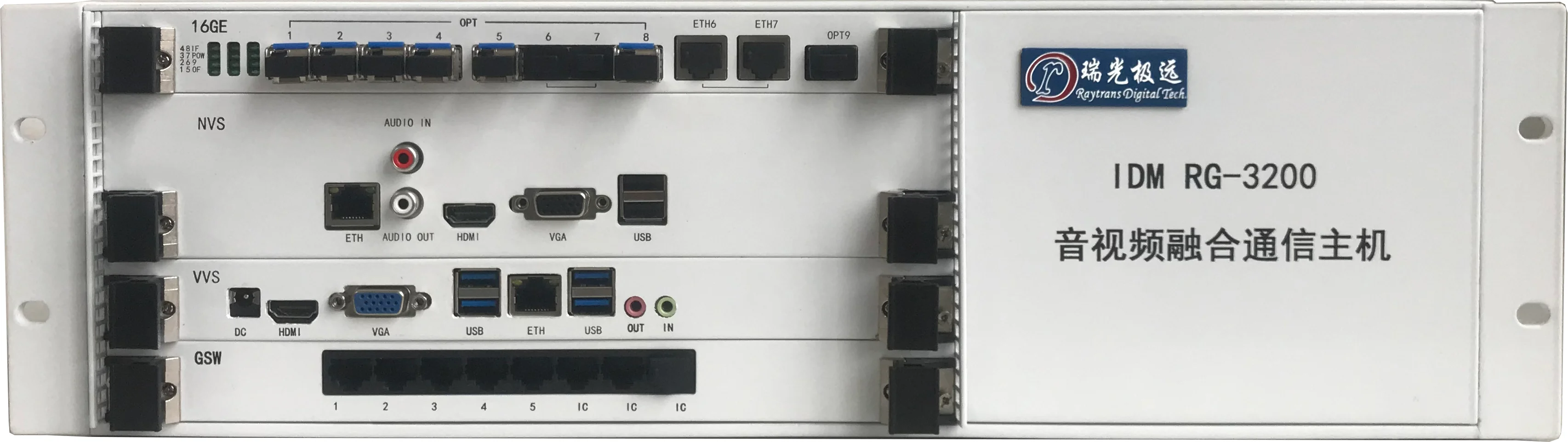
Figure 1. Front Panel Schematic Diagram
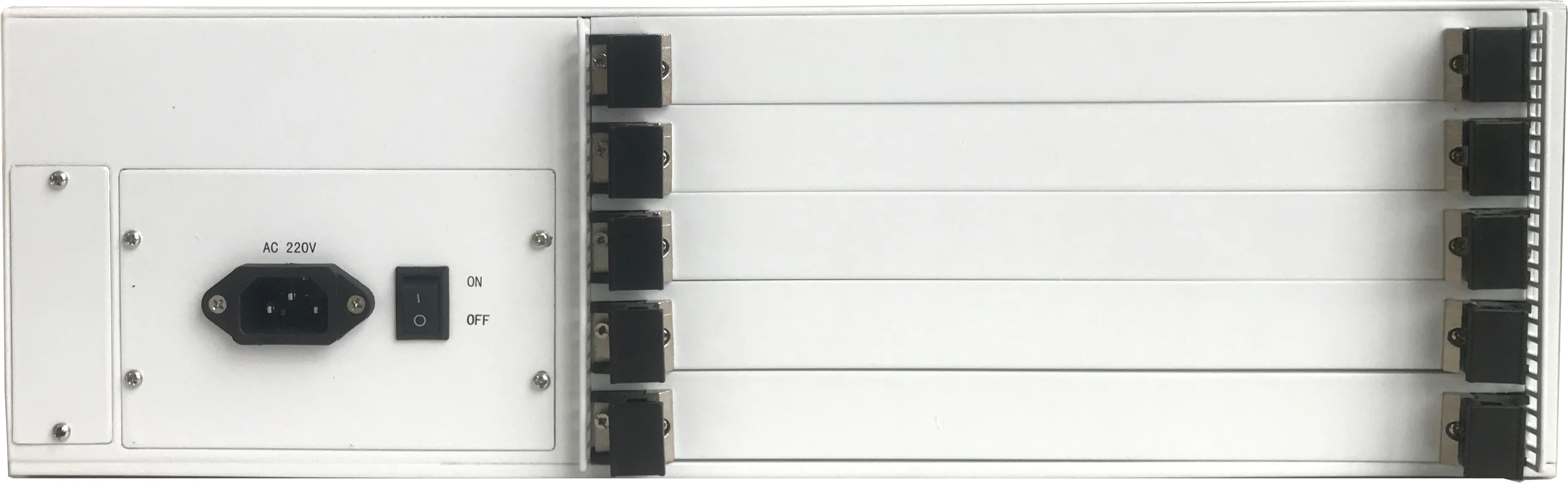
Figure 2. Rear Panel Schematic Diagram
III. Device Functions
(1). Rack-mount design, ≥ Xeon quad-core processor, ≥ 4G DDR3, ≥ 1T storage, 220V single power supply, Gigabit Ethernet ports;
(2). Protocol support: SIP2.0/TFTP/FTP/SNMP/TELNET/HTTP/IEEE802.1Q/IEEE802.1X/RTSP;
(3). The HFT software platform architecture must comply with the "Cloud, Pipe, End" architecture, facilitating future migration from server to cloud; the switching system software adopts the LINUX operating system; it includes converged Command & Dispatch software, converged communication service software, broadcast service software, and consultation service software modules; the system software supports up to 100 concurrent communication channels and up to 500 user registrations; supports multi-unit cascading; concurrent channel count and user registration count can be configured based on user requirements.
(4). Supports interfaces with voice dispatch subsystems, broadband trunking subsystem interfaces, video conference system interfaces, video surveillance system interfaces, individual soldier system interfaces, emergency plan system interfaces, GIS system interfaces, LED display systems, and other system linkage interfaces; enabling centralized unified management and control of all subsystems;
(5). Customized development can be performed based on interfaces provided by subsystems; supports dual-machine backup capability;
(6). Possesses converged communication functions, broadband trunking functions, broadcast service functions, electronic fax functions, SMS service functions, video service functions, voice consultation service functions, video consultation service functions, and converged Command & Dispatch functions (i.e., providing access and centralized management of information resources from various voice terminals, broadband trunking terminals, information broadcast systems, video surveillance, video conferencing, GIS systems, etc., with unified invocation, realizing converged Command & Dispatch services for voice, video, and data media streams).
(7). Supports converged voice dispatch functions, basic intercom functions, conference call functions, video dispatch functions, and other dispatch functions; supports SIP trunking to interface with third-party systems; supports GIS dispatch functions: direct click-to-call, direct click-to-view video, area selection calling, movement trajectory recording/querying, etc.
(8). The Dispatch Console interface provides basic conference functions including create/modify/cancel conference rooms, add members to conference rooms, enable/disable speaking permissions, remove members from conference rooms, lock conference rooms, end conferences, conference broadcast/broadcast termination, conference recording, etc.;
(9). Supports interconnection with video conference systems; dispatch conferences can serve as an extension and backup of existing video conferences. When video conferences cannot be held due to objective constraints, ordinary fixed telephones and mobile phones of users can be added to audio conferences.
IV. Key Business Boards of the Device
4.1 Dispatch Service Main Control Board (MAIN)
(1). Protocol support: SIP2.0/HTTP/IEEE802.1Q/IEEE802.1X/RTSP;
(2). The HFT software platform architecture must comply with the "Cloud, Pipe, End" architecture, facilitating future migration from server to cloud; the switching system software adopts the LINUX operating system; it includes converged Command & Dispatch software, converged communication service software, broadcast service software, and consultation service software modules; the system software supports up to 100 concurrent communication channels and up to 500 user registrations; supports multi-unit cascading; concurrent channel count and user registration count can be configured based on user requirements.
4.2 Loop Trunk Board (8FXO)
(1). Each board provides up to 8 loop trunk interfaces, supporting 8 FXO interfaces;
(2). Supports caller ID detection: FSK, DTMF;
(3). Supports G.711, G.726, G.729a/b, G.723, iLBC and other audio codecs.
4.3 Loop Trunk Board (8FXS)
(1). Each board provides up to 8 loop trunk interfaces, supporting 8 FXS interfaces;
(2). Supports caller ID detection: FSK, DTMF;
(3). Supports G.711, G.726, G.729a/b, G.723, iLBC and other audio codecs.
4.4 Trunking Access Board (4AU)
(1). Supports 4 trunking interfaces, supporting access to trunking systems such as 350M, 300M, 800M, shortwave/ultra-shortwave, enabling voice interworking between trunking systems and public network mobile phones, IP phones, wireless trunking, and mobile APPs;
(2). Supports voice activity detection technology.
4.5 Audio Access Board (4EM)
(1). Supports 4 audio interfaces, each corresponding to a speaker system (mixing console), microphone, conference terminal, or other voice interfaces. The voice from these speaker systems (mixing consoles) can be connected to the IP communication system, enabling voice interworking between speaker systems (mixing consoles) and public network mobile phones, IP phones, wireless trunking, and mobile APPs;
(2). Supports voice activity detection technology.
4.6 16GE Gigabit Ethernet Aggregation Switch Board
4.6.1 Function Description
(1). The board provides 16 Gigabit Ethernet switching ports;
(2). The front panel provides 7 SFP Gigabit optical ports + 2 optical/electrical combo interfaces;
(3). Provides 8 Gigabit ports toward the backplane direction; aggregates Gigabit Ethernet networks from various plug-in boards;
(4). Provides 1 Gigabit Ethernet port toward the 3U plug-in board backplane direction;
4.6.2 Panel Description
No. | Item | Description |
1 | OPT1-5,OPT8,OPT9 | 1000Base-X interfaceSFP |
2 | OPT6,ETH6 | EthernetCOMBO interface |
3 | OPT7,ETH7 | EthernetCOMBO interface |
4 | LED indicator 1-9 | Corresponding toOPT1-9 optical interfaceLINK status On: fiber connection of the corresponding port is normal Off: fiber of the corresponding port is disconnected |
5 | POW | On: power supply is normal Off: power supply failure |
6 | IF | Indicates the total Gigabit port connection on the backplane |
7 | OF | Indicates the total switching connection of external optical ports |
4.7 GSW Gigabit Ethernet Switching Card
4.7.1 Function Description
(1). The card provides 8 Gigabit Ethernet switching ports in total;
(2). The front panel provides 5 10M/100M/1000M electrical interfaces;
(3). It provides 1 Gigabit port toward the backplane direction for access to the 16GE aggregation card;
4.7.2 Panel Description
No. | Item | Description |
1 | 1-5 | 10M100M/1000M electrical interface |
2 | IC | IC port for internal use |
4.8 NVS Video Processing Board
4.8.1 Function Description
(1). Compatible with network cameras from major mainstream manufacturers conforming to ONVIF and RTSP standards;
(2). Supports H.265 high-efficiency video encoding streams, and supports mixed access of H.265 and H.264 IP devices;
(3). Supports preview, storage, and playback of up to 6-megapixel HD network video;
(4). Supports simultaneous HDMI and VGA output, with HDMI supporting 4K ultra-HD output and VGA supporting HD 1080p display output;
n HDMI resolutions: 3840x2160/30Hz (4K), 2560x1440/60Hz (2K), 1920×1080/60Hz, 1600×1200/60Hz, 1280×1024/60Hz, 1280×720/60Hz;
n VGA resolutions: 1920*1080/60Hz, 1600×1200/60Hz, 1280*1024/60Hz, 1280*720/60Hz.
(5). Supports fully automatic configuration and one-click IPC addition for rapid device initialization;
4.8.2 Panel Description
No. | Item | Description |
1 | AUDIO IN | Audio input |
2 | AUDIO OUT | Audio output |
3 | HDMI | HDMI video output, |
4 | VGA | VGA video output |
5 | USB | USB2.0 |
4.9 VVS Audio-Video Processing and Switching Card
4.9.1 Function Description
(1). Protocol support: SIP2.0/TFTP/FTP/SNMP/TELNET/HTTP/IEEE802.1Q/IEEE802.1X/RTSP;
(2). The HFT software platform architecture shall comply with the "cloud, pipe, terminal" architecture to facilitate future migration from servers to the cloud; the switching system software adopts the LINUX operating system; it incorporates modules such as converged command dispatching software, converged communication service software, publishing service software, and consultation service software; the system software supports up to 100 concurrent communication sessions and up to 500 registered users; supports multi-unit cascading; the number of concurrent sessions and registered users can be optionally configured according to user requirements.
(3). Supports interfaces with the voice command subsystem, broadband trunking subsystem, video conferencing system, video surveillance system, individual soldier system, emergency plan system, GIS system, LED display system, and linkage interfaces with other systems; enables centralized unified management and control of all subsystems;
(4). Supports customized development based on interfaces provided by subsystems; possesses dual-machine backup capability;
(5). Possesses converged communication functions, broadband trunking functions, publishing service functions, electronic fax functions, SMS service functions, video service functions, voice consultation service functions, video consultation service functions, and converged command dispatching functions (i.e., the capability to access and centrally manage information resources from various voice terminals, broadband trunking terminals, information publishing, video surveillance, video conferencing, GIS and other systems, with unified invocation to realize converged command dispatching services for voice, video, and data media streams).
(6). Supports converged voice dispatching functions, basic push-to-talk functions, teleconferencing functions, video dispatching functions, and other dispatching functions; supports SIP trunking to enable interconnection with third-party systems; supports GIS dispatching functions: direct click-to-call, direct click-to-view video, area selection calling, movement trajectory recording/query, etc.
(7). The dispatching console interface provides basic conference functions including creating/modifying/canceling conference sites, adding members to conference sites, enabling/prohibiting speech, removing members from conference sites, conference locking, ending conferences, conference broadcasting/ending broadcasting, and conference recording;
(8). Supports interconnection with video conferencing systems; dispatching conferences can serve as an extension and backup of existing video conferences. When video conferences cannot be held due to objective constraints, it supports adding users' ordinary fixed-line telephones and mobile phones into audio conferences.
4.9.2 Panel Description
No. | Item | Description |
1 | IN | Audio input |
2 | OUT | Audio output |
3 | HDMI | HDMI video output, |
4 | VGA | VGA video output |
5 | USB | USB2.0 |
6 | ETH | 100M Ethernet port |
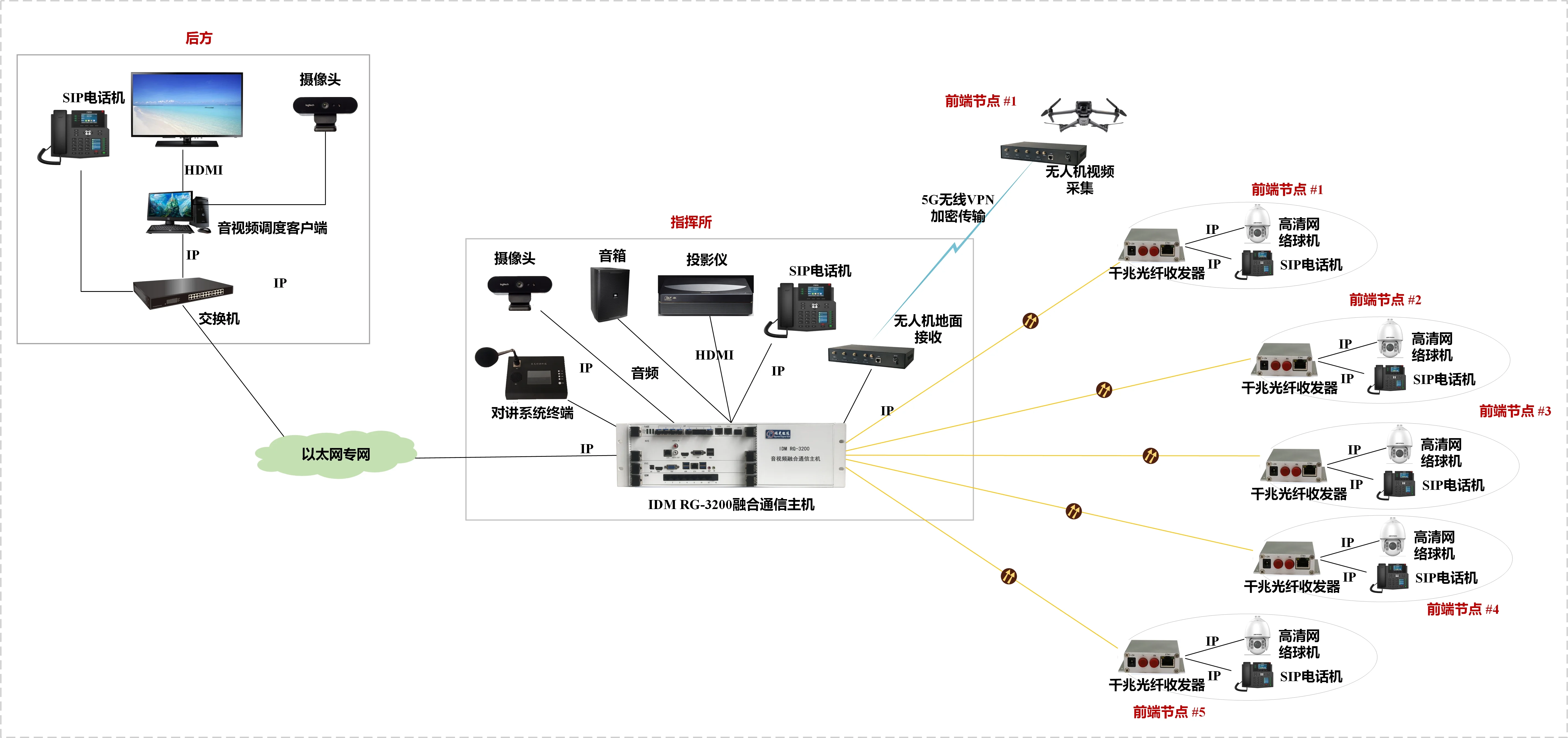
- Typical Equipment Applications
- Equipment Installation
FAQs
What Are the Functions and Advantages of Video Optical Terminals?
The function of a video optical terminal is to convert one or multiple channels of analog video signals into optical…
View answerWhat is the difference between a Video Optical Terminal and a Network Video Server?
Composition and Function of Video Optical Terminal and Network Video Server An optical terminal is a device used to…
View answer