IDM-RFlabel
IDM-RFlabel
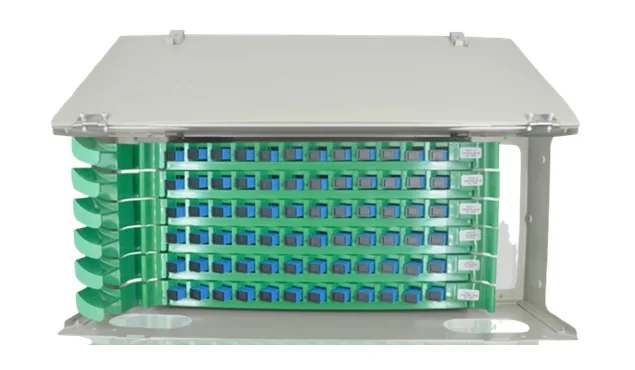
The IDM-RFlabel Intelligent Optical Fiber Distribution Frame is typically used for the management of ODF optical fiber distribution frames in equipment rooms. It is generally managed in conjunction with the equipment room's cable database. RFID tags are affixed to the ends of optical cable distribution frames within the equipment room, and the devices and port numbers connected by each cable and optical cable are recorded in the database. RFID monitoring antennas are affixed to each port on the ODF distribution frame. If a fiber optic cable or cable head insertion is detected, the database is consulted to verify whether it is the required circuit. If not, an alarm is triggered. Each port is equipped with a corresponding indicator light: red indicates an error, green indicates normal, and no light indicates no insertion.
I. Overview
The IDM-RFlabel Intelligent Optical Fiber Distribution Frame is typically used for the management of ODF optical fiber distribution frames in equipment rooms. It is generally managed in conjunction with the equipment room's cable database. RFID tags are affixed to the ends of optical cable distribution frames within the equipment room, and the devices and port numbers connected by each cable and optical cable are recorded in the database. RFID monitoring antennas are affixed to each port on the ODF distribution frame. If a fiber optic cable or cable head insertion is detected, the database is consulted to verify whether it is the required circuit. If not, an alarm is triggered. Each port is equipped with a corresponding indicator light: red indicates an error, green indicates normal, and no light indicates no insertion.
II. Device Structure
III. Product Features
(1). Addresses the blind spot issue in traditional ODF resource monitoring, enabling real-time monitoring and security alarms for ODF resources. It can automatically collect fiber port information and monitor fiber port connection status in real time;
(2). The current status of each port can be queried through the network management system;
(3). Utilizes passive RFID tags, IoT technology, and databases to replace manual identification management methods using paper labels or electronic spreadsheets, solving issues such as label damage, illegible handwriting, easy detachment, difficulty in updating information, susceptibility to contamination, and inconvenient reading;
(4). Employs passive RFID tags with periodic scanning. Scanning is halted when the equipment room is unattended to avoid wireless signal interference;
(5). Utilizes ultra-low-power antenna radiation, capable of distinguishing signal tags within a relatively small range;
(6). When combined with AI recognition from equipment room cameras, RFID monitoring is activated when personnel are working in front of the distribution frame;
(7). The tags are RFID 13.56MHz tags, compliant with the ISO-14443A standard and NFC-compatible;
(8). The tags utilize passive, active RFID contactless technology;
(9). The thickness of the adhesive tape used to attach tags to equipment must be less than or equal to 0.35mm. If the frame is metallic, anti-metal tags must be used;
(10). The tags are made of fire-resistant materials;
(11). The tags can store information such as the rack number, device number, port number, and remarks of the connected equipment, supporting offline management and inventory management;
(12). The asset information within the tags is protected by an information security mechanism; unauthorized terminals cannot read the asset information;
(13). The electronic tags adopt a passive design, requiring no battery replacement, offering high reliability throughout the entire lifecycle and being maintenance-free;
(14). The rack features an Ethernet management interface, and multiple racks can be cascaded for management via Ethernet;
(15). The software includes a self-test function;
(16). Information collection supports both online and offline methods; offline management can be performed using an RFID reader;
(17). The device communication mode adopts the MQTT protocol, which is more suitable for IoT products, improving communication stability and efficiency. Through the MCP protocol of the network management system, it can interconnect with the equipment room's operations and maintenance intelligent agent;
(18). The device's network management system supports connection to the equipment room's operations and maintenance intelligent agent via the MCP protocol. Operational data can be displayed arbitrarily through chat BI. Line analysis and summarization can be performed using the equipment room and line database, and future line conditions can be predicted based on historical trends and physical characteristics;
(19). Interface: 48 ports, with flexible configuration of FC or SC quantities;
(20). Number of collector interfaces: ≥4;
(21). Number of splice trays: ≥4.
FAQs
What is the difference between optical fiber and optical cable? What are the common optical fiber connectors?
Optical fiber is a medium that transmits information from one end to another. It is a glass or plastic fiber that…
View answer