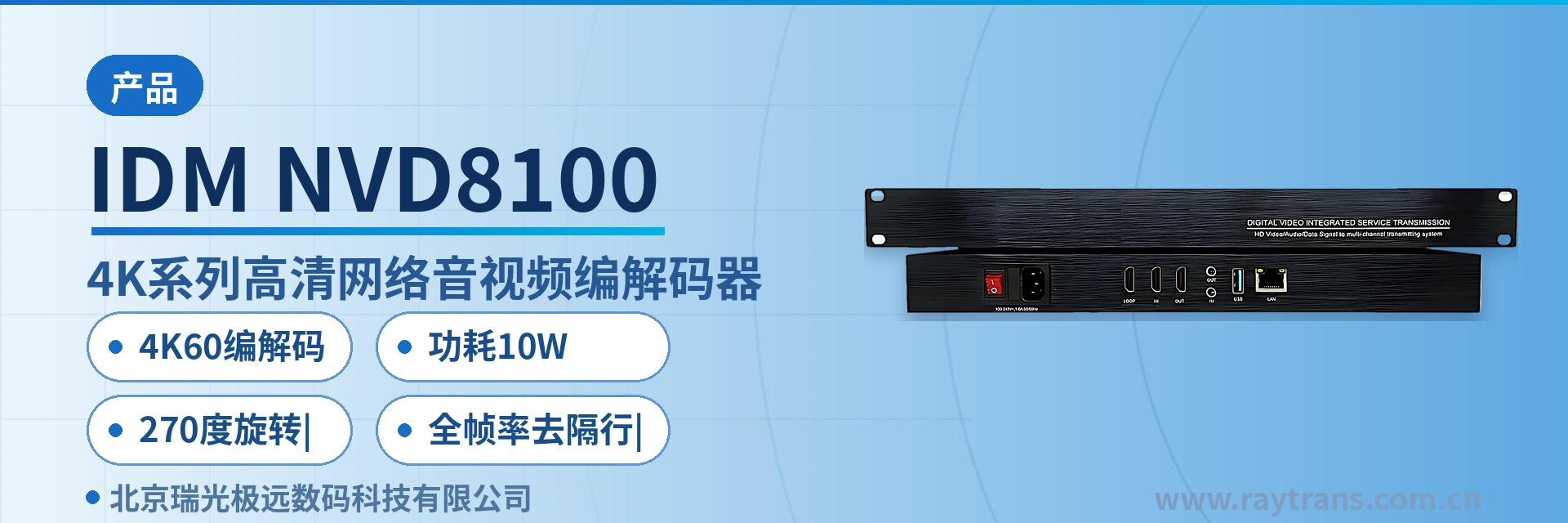
IDM-NVD8100/4K Codec
Single unit integrates live production and recording, 4K60 encoding and decoding, power consumption <10W, 1080P60
The IDM-NVD8100/4K series HD network audio and video codec is a high-quality, broadcast-grade HD audio and video real-time encoding and decoding product. It supports video encoding and decoding standards such as H.265/HEVC and H.264/AVC, and audio decoding standards such as AAC, MP3, MPEG2, and PCMA. It supports 1-channel HDMI video signal input, 1-channel HDMI video loop-out, and 1-channel HDMI video signal output; it supports 3.5mm audio signal input and output, as well as HDMI embedded digital audio. IDM-NVD8100/4K high
What kind of device is the IDM-NVD8100/4K Low-Power 4K60 Network Audio and Video Codec?
The IDM-NVD8100/4K low-power 4K60 network audio and video codec is a broadcast-grade HD audio and video real-time encoding and decoding device developed by Beijing Ruiguang Jiyuan Digital Technology Co., Ltd. (Raytrans). It encodes HDMI input video and audio into IP streams for backhaul to private network platforms, and can also decode network streams back into HDMI for on-screen display. As a professional optical multiplexer manufacturer, Raytrans positions this device as a key node device in government private network optical fiber communication solutions and military emergency communications vehicle solutions. It is designed on domestic embedded chips with low encoding and decoding latency, making it suitable for latency-sensitive private network backhaul and command consultation scenarios, and it can also serve as a front-end encoding and decoding unit for system integrators selecting equipment for command and dispatch systems.
The device comes standard with 1 HDMI2.0 input, 1 HDMI loop-out, and 1 HDMI output. The input supports 4K@60fps and the output supports 4K60; the loop-out port can connect directly to a local monitor. Input resolution is compatible with common formats such as 4K60, 4K30, 1080P, 1080i, and 1600×1200, so existing standard definition and high definition signals do not require additional conversion equipment. In government private network optical fiber communication solutions, the device can work with video optical multiplexers to enable local decoding and on-screen display and product showcase of remote video after optical fiber backhaul.
Key specifications at a glance: 4K60 encoding and decoding · Power consumption <10W · 1080P60×4 concurrent · SRT/GB28181 · H.264/H.265 · AC 220V power supply
On the network side, it provides a 10/100M/1000M adaptive RJ45 connector and supports HTTP, HLS, RTSP, RTMP push and pull streaming, UDP, and multicast, as well as SRT transmission, GB28181 sending, and ONVIF receive/transmit. Encoded streams can connect directly to existing video platforms without an additional protocol conversion gateway, making it easy to interface quickly with command platforms at all levels in military emergency communications vehicle solutions.
On the audio side, it supports HDMI embedded stereo and 3.5mm Line input and output, with sampling rates from 8k to 48K and encoding formats of AAC, PCMA, MP3, and MPEG2. Gain is adjustable from -24dB to +24dB, and on-site microphone and mixer signals can be connected directly.
The device provides live production and secondary production capabilities: video mixing supports arbitrary switching between 9-grid, 4-picture, 1+2, picture-in-picture, and custom layouts, and can overlay Logo, watermark, subtitle, scrolling subtitle, mosaic, and timestamp. USB and built-in storage can record MP4, TS, FLV, MOV, and MKV files, and files on a FAT32-format USB drive can also be streamed as a live stream. Multiple encoders on the local area network (LAN) can be configured centrally through the WEB interface. For showroom and command center scenarios that require product showcase, a single device can complete multi-view composition and recording output.
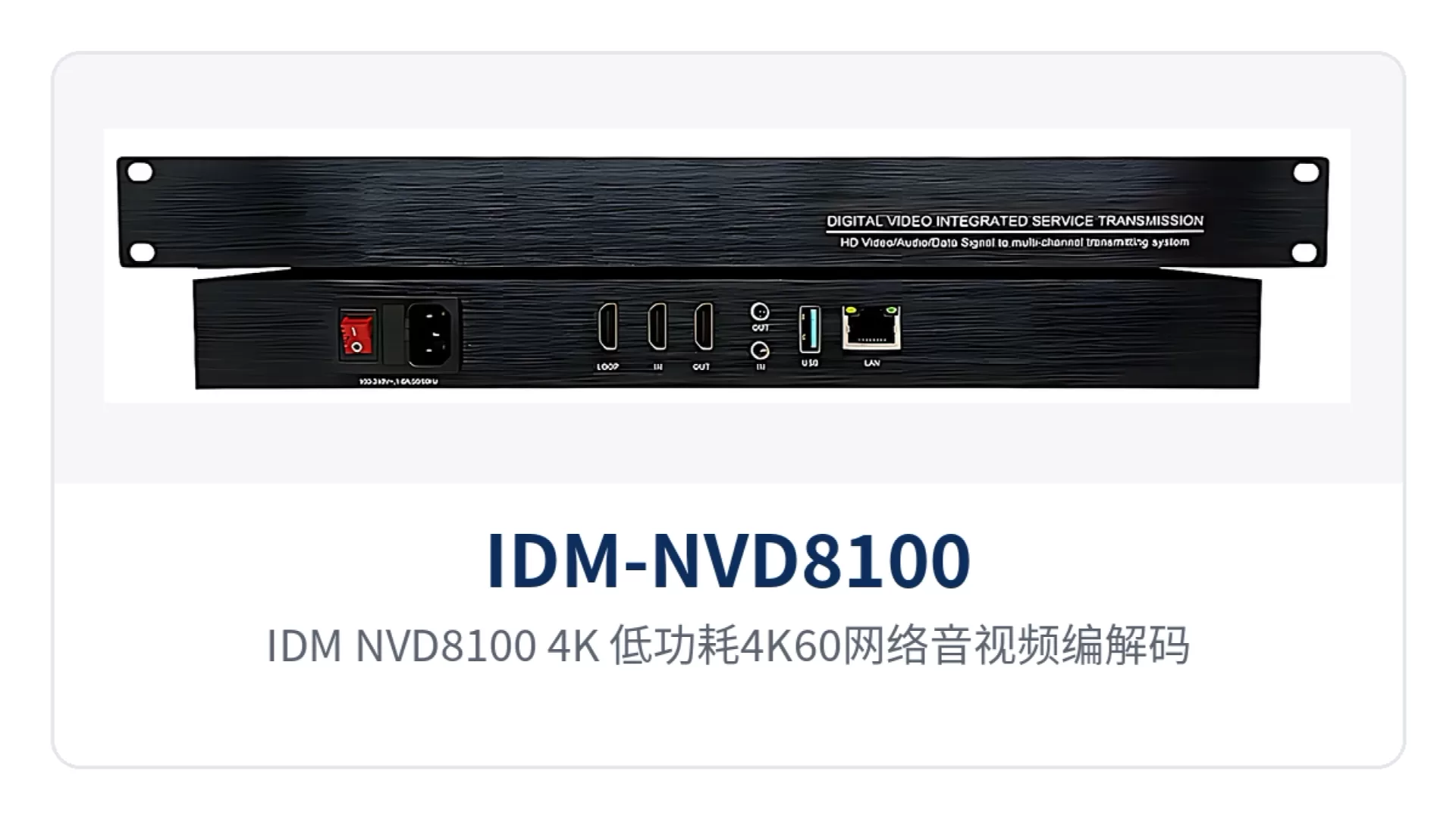
Figure 1: Front panel and interface layout of the IDM-NVD8100/4K low-power 4K60 network audio and video codec
Core Functions and Performance Specifications
The functions cover four categories: video processing, encoding and transmission, live production, and platform interconnection. Common on-site requirements such as interface adaptation, video composition, and video recording can be completed within a single device, without additional standalone video compositors and recording hosts. As an encoding and decoding product from an optical multiplexer manufacturer, Raytrans deploys this device together with video optical multiplexers and the optical multiplexer product line. The table below lists the corresponding capabilities and applicable conditions item by item.
Function List
| Function | Description |
|---|---|
| HDMI input and loop-out | HDMI2.0 input supports 4K@60fps; 1 HDMI loop-out is for local monitoring, with encoding and local display running in parallel |
| HDMI output | Supports 4K60, restoring decoded network streams to HDMI signals for display terminals |
| Multi-resolution adaptation | Input is compatible with 4K60, 4K30, 1080P, 1080i, 1600×1200, 1440×900, 1280×1024, 1024×768, 800×600, 640×480, etc. |
| Audio encoding and decoding | HDMI embedded stereo and 3.5mm Line input and output, sampling rates 8k/16K/32K/44.1K/48K, formats AAC, PCMA, MP3, MPEG2 |
| Video encoding | H.264 and H.265 dual formats, frame rate 1~60 fps, rate control supports CBR, VBR, AVBR, FIXQP |
| Smart encoding | SmartP, DualP, and ROI modes, which can shift bit rate toward regions of interest |
| Video processing | Supports 90, 180, and 270-degree rotation, top/bottom/left/right cropping, standard de-interlacing, and full-frame-rate de-interlacing |
| Video mixing | Supports arbitrary switching between 9-grid, 4-picture, 1+2, picture-in-picture, and custom layouts |
| Effect overlay | Supports overlay of Logo, watermark, subtitle, scrolling subtitle, mosaic, and timestamp |
| Multi-platform live streaming | Supports simultaneous live streaming push to multiple platforms |
| File loop playback and recording | Streams files from a FAT32-format USB drive as a live stream; supports recording to USB and built-in storage in MP4, TS, FLV, MOV, and MKV formats |
| Network stream input and live production | Supports decoding, re-encoding, and live production of network stream input in formats such as rtsp and rtmp |
| Platform protocol interconnection | GB28181 supports sending; ONVIF supports sending and receiving; network transmission supports SRT |
| Group management | Can centrally configure all encoders on the LAN and aggregate program schedules |
Technical Specifications
Parameters are listed across four dimensions: interfaces, encoding, network, and power supply. Values are subject to the product documentation for this model; the performance figures in the table correspond to a standalone unit in full configuration. During engineering calculations, verify each item against the actual link bandwidth on site and the platform concurrency requirements, and do not directly use the maximum configuration. In government private network optical fiber communication solutions and military emergency communications vehicle solutions, the device is often paired with video optical multiplexers: the optical multiplexer handles optical fiber link transmission, while the unit handles encoding and decoding and product showcase output.
| Item | Parameter/Specification | Description/Applicable Conditions |
|---|---|---|
| HDMI input | HDMI2.0, supports 4K@60fps | Input resolutions include 4K60, 4K30, 1080P, 1080i, etc. |
| HDMI loop-out | 1 channel, for on-site monitoring | Runs in parallel with the encoded output and does not occupy an encoding channel |
| HDMI output | Supports 4K60 | Drives a 4K display terminal after decoding and restoration |
| Audio interface | HDMI embedded stereo up to 48K; 3.5mm Line input and Line output are both stereo | Analog audio and embedded digital audio can be connected separately |
| Audio encoding | Sampling rates 8k, 16K, 32K, 44.1K, 48K; bit rate can be set arbitrarily, 64k~256kbps recommended | Formats AAC, PCMA, MP3, MPEG2; gain -24dB ~ +24dB, default 0 |
| Video bit rate | Maximum 40Mbps | Rate control CBR, VBR, AVBR, FIXQP |
| Encoding protocol | H.265 Main Profile Level 5.0; H.264 Baseline/Main/High Profile Level 5.1 | Encoding frame rate 1~60 fps |
| Encoding and decoding performance | Encoding 4K60×1 / 4K30×2 / 1080P60×4 / 1080P30×8, with the same decoding capability | A single unit can handle both encoding and decoding |
| Basic protocols | HTTP, HLS, RTSP, RTMP push streaming, RTMP pull streaming, UDP, multicast, plus SRT | Choose the encapsulation method according to platform capabilities |
| Wired network port | 10/100M/1000M RJ45 adaptive | The Gigabit port is used for multi-channel concurrent uplink |
| Platform interconnection | GB28181 supports sending; ONVIF supports sending and receiving | Can interconnect with multi-level video platforms |
| Recording and loop playback | Supports recording to USB and built-in storage in MP4, TS, FLV, MOV, and MKV formats | Files on a FAT32-format USB drive can be streamed as a live stream |
| Power supply and power consumption | AC 220V; power consumption <10W | Suitable for long-term online operation |
| Operating temperature | 0 ~ 70°C | Covers equipment room and most station site environments |
| Dimensions and net weight | 440×190×34mm (L×W×H), net weight 1.2KG | 1U form factor, can be installed in a standard cabinet |
Typical Application Scenarios
The following three types of sites differ considerably in power supply conditions, concurrency channels, and platform protocol requirements. The scenario descriptions only explain the role the device plays at each type of site and the implementation conditions; specific channel counts, bit rates, and bandwidth are still determined based on on-site survey results, and platform interconnection configuration items are included in the checklist.
Electric power and energy private network: 4K video backhaul at substations and along power lines
Video inspection at substations, converter stations, and along transmission lines requires HD camera video to be reliably sent back to the regional dispatch center. The IDM-NVD8100/4K captures 4K video from on-site cameras or inspection robots via HDMI and backhauls it over the private network after H.265 encoding. When there is only one HDMI signal in the station, the loop-out port can connect to a local monitor, so the video seen by on-duty personnel at the station site matches the content sent upstream. As a manufacturer focused on government private network optical fiber communication solutions and command and dispatch systems, Raytrans can incorporate such encoding and decoding devices together with video optical multiplexers and optical multiplexer products into the product showcase and selection list for electric power and energy private network projects, making it easy for customers to check items one by one according to site conditions.
Cabinet space and power supply capacity at power sites are usually calculated based on existing secondary equipment. The device uses a direct AC 220V supply with overall power consumption below 10W, so after installation in a standard cabinet it places limited pressure on station power and heat dissipation; the upstream stream is registered to the regional platform via GB28181, and dispatch at the same level and superior management platforms can each view the same stream without configuring a separate encoder for each platform level.
Rail transit line monitoring: centralized encoding of multiple 1080P60 channels
At station entrances and exits, platforms, and section equipment rooms in rail transit, many video channels are sent upstream and per-channel clarity requirements are high. The IDM-NVD8100/4K has an encoding performance of 1080P60×4, so a single device can simultaneously handle 4 channels of 1080P60 encoding, consolidating work that previously required multiple single-channel encoders into one 1U device and reducing equipment room rack positions and cabling.
Transmission channels from stations along the line to the line center are mostly existing resources, and bandwidth is not generous. The device provides SmartP, DualP, and ROI smart encoding and multiple rate control modes, which can shift bit rate toward key areas such as personnel and switches, improving the clarity of effective video while channel bandwidth remains unchanged; the frame rate can be set from 1 to 60 fps and can be lowered as required during low passenger flow periods.
Border and coastal defense/remote unattended sites: low-power encoding and decoding and weak-signal network backhaul
At border and coastal defense posts, remote unattended sites in the field, and temporary observation points, power is mostly supplied by solar panels and storage batteries, and device power consumption directly determines site endurance and the scale of photovoltaic panel configuration. The IDM-NVD8100/4K has overall power consumption below 10W, completing 4K60 encoding and decoding at this power level; sites can connect it by configuring inverters and lightning protection units according to the on-site power supply mode, and storage battery capacity and total station load must be verified before implementation.
When border and coastal defense sites are scattered and optical fiber is difficult to lay, links often use wireless microwave or satellite, and packet loss and jitter are more pronounced than on wired links. The device supports SRT transmission, which can trade retransmission and cache for picture continuity on links with packet loss, and with H.265 encoding it can transmit 4K video within limited bandwidth; the upstream stream is registered per GB28181, and multi-level command platforms can view it according to permissions. In the military emergency communications vehicle solution, the optical multiplexer manufacturer Raytrans can likewise deploy such low-power codec devices together with video optical multiplexers and optical multiplexers, meeting the interfacing requirements of command and dispatch system manufacturers for multi-level platform viewing and weak-signal network backhaul.
How to Configure SRT Audio and Video Backhaul
SRT is an encapsulation protocol for reliable transmission over unreliable networks. Configuration is divided into two steps: the device side and the platform side. The mode and encryption parameters at both ends must be consistent; if parameters at either end do not match, a connection may be established but no picture will appear. On-site troubleshooting should check these two items first.
- On the WEB interface of the IDM-NVD8100/4K, go to the encoding and push streaming settings, select SRT as the output protocol, and enter the opposite-end address and port.
- The negotiation modes at both ends are configured as a pair: when one end is set to Listener, the other end must be set to Caller; if both ends are Listener, the connection cannot be established.
- Set the latency buffer and encryption password; for links with high jitter such as satellite and wireless microwave, the buffer can be appropriately increased.
- Select H.265 for video encoding, and set the bitrate to about 70% of the actual measured link bandwidth. First verify the path with 1080P60, then switch to 4K60.
- After saving, check the push streaming bitrate and packet loss count on the status page, and confirm that the picture on the platform side is displayed normally before delivering the configuration in batches.
The device also supports RTMP push and pull streaming, RTSP, HLS, UDP, and multicast, so the encapsulation method can be selected according to platform capabilities; the same HDMI input can push streams to multiple platforms separately, and the command center and business departments each take their own streams without occupying additional encoding channels. For sites in the government private network optical fiber communication solution where video optical multiplexers and optical multiplexers have already been deployed, this SRT configuration can be used in parallel with existing optical fiber links. As an optical multiplexer manufacturer, Raytrans can provide interfacing instructions for the corresponding models in the product showcase.
Differentiated Value
The three capabilities directly address the selection pain points of private network sites: power supply and endurance, the number of devices for multi-channel backhaul, and protocol compatibility with multi-level platforms. The table below lists the implementation method and customer value of each capability side by side, making it easy to compare item by item with requirements and to cite directly during selection reviews.
| Differentiated Capability | Implementation | Customer Value |
|---|---|---|
| 4K60 encoding and decoding at only <10W power consumption | Fully domestic embedded chip solution, AC 220V input, power consumption <10W, operating temperature 0~70°C | 4K60 encoding and decoding at only <10W power consumption, suitable for low-power supply at private network field sites; endurance pressure at solar and storage battery sites and cabinet heat dissipation requirements are reduced simultaneously |
| Standalone unit with concurrent 4-channel 1080P60 encoding and decoding | Encoding and decoding performance both 1080P60×4, also configurable as 4K60×1, 4K30×2, 1080P30×8 | Standalone unit with concurrent 4-channel 1080P60 encoding and decoding saves devices for multi-channel backhaul in private networks; one unit replaces multiple single-channel encoders, reducing rack positions and wiring |
| GB28181+ONVIF+SRT full-protocol receive/transmit | GB28181 transmit, ONVIF receive/transmit, SRT transmission, coexisting with RTSP, RTMP, HLS, and multicast | Compatible with multi-level private network platforms; provincial and municipal platforms and existing manufacturer platforms can each view the stream, reducing additional gateways and commissioning steps |
Conclusion
Selected according to the three capabilities of 4K60 encoding and decoding, 1080P60×4 concurrency, and GB28181/ONVIF/SRT full-protocol interfacing, the IDM-NVD8100/4K low-power 4K60 network audio and video codec is suitable for three types of sites: electric power and energy private networks, rail transit line-side surveillance, and border and coastal defense field sites, completing image acquisition, encoding, backhaul, and restoration with one device.
Overall power consumption below 10W, a direct AC 220V supply, an operating temperature of 0~70°C, and a 1U form factor bring deployment conditions close to existing industrial cabinets and unattended equipment rooms; before on-site termination, link bandwidth, platform registration method, and site power supply mode still need to be verified, and then the channel count and bitrate configuration can be determined. As an optical multiplexer manufacturer, Raytrans can incorporate this codec device together with video optical multiplexer and optical multiplexer products into the product showcase in the government private network optical fiber communication solution and the military emergency communications vehicle solution, for reference by command and dispatch system manufacturers and users during selection reviews.