
Fiber Factory All-Fiber Ring Network Protected Telephone Communication Switching and Access Solution
This article compares various fiber networking solutions when a factory transitions from cable communication to…
Abstract: This article compares various fiber networking solutions when a factory transitions from cable communication to all-fiber communication, and concludes that the integrated communication equipment based on telephone trunking, switching, and SDH transmission in Solution 4 is not only low-cost and ring-network protected, but also expandable with more functions. The system delivers high voice communication quality and is widely used in private network communications. As VoIP voice communication currently demands high IP bandwidth and cannot provide satisfactory voice quality in many locations, and with communication cable prices rising while fiber costs continue to decline, this is also an excellent solution for fiber-to-office and high-quality fiber-to-the-home applications.
I. User Requirements
A factory has one old office building, one new office building, and 10 factory plants. The communication equipment room is located in the old office building. The new office building requires 100 office telephone lines, and each plant requires 30 telephone lines. The 30 telephone lines in the old office building serve as the trunk lines for the entire factory area, and 30 new telephone numbers need to be provisioned for the old office building.
II. Solution Analysis
Solution 1: PBX + Optical Terminal + PCM Solution
The original approach is to add a 500-port PBX switch in the old office building, providing 1 pair of 100-channel Telephone Optical Terminals and 10 pairs of 30-channel Telephone Optical Terminals for the new office building.

Solution Quotation:

Note: The above prices do not include service cables or engineering installation costs.
Disadvantages of this solution: 1. The equipment performance limit has already been reached;
The connection between the PBX and PCM uses twisted pair cables, which is difficult to maintain;
Equipment functions are dispersed, making unified network management difficult;
Too many devices result in multiple points of failure;
Occupies excessive rack space;
Due to point-to-point connections, excessive fiber is consumed;
No fiber line protection function; the system is relatively vulnerable.
Advantages of this solution: 1. PCM has strong functionality and can transmit multiple signal types.
Solution 2: PDH+PCM Integrated Unit (PDH Telephone Optical Terminal)
This solution can use a slightly improved PDH Telephone Optical Terminal, significantly reducing costs, but it can only transmit telephone signals; other PCM signals cannot be transmitted.

Solution Quotation:

Note: The above prices do not include service cables or engineering installation costs.
Solution 3: PBX Telephone Switch with PCM Optical Port Transmission at the Central End
The central end uses a PBX switch with 30 FXO trunk interfaces, 30 FXS telephone interfaces, and PCM optical port signaling support, providing 11 PDH fiber interfaces (3 PDH cards suffice) for the plants and the new office building. Due to the large switching capacity of this equipment, a single PBX card can achieve 1892-channel telephone switching capacity, offering strong future expansion capability.
The PBX card also supports 8 E1 SS7 signaling or 8 PRI signaling, and can support Command & Dispatch functions.
Dispatch communication system with transmission and access functions:

Solution Quotation:

Note: The above prices do not include service cables or engineering installation costs.
Advantages of this solution:
With integrated equipment, the central end is consolidated into a single device, saving rack space, reducing failure nodes, and unifying the network management system;
Simultaneously provides Ethernet switching and transmission services;
Can be expanded to carrier E1 digital signaling (SS7 and PRI) access;
The G3CP is powerful and can provide more functions.
Disadvantages of this solution:
PDH interfaces cannot form loop protection;
PDH interfaces are not universally compatible across vendors, potentially causing waste later;
PDH interfaces are not conducive to providing multiple physically isolated Ethernet networks.
Solution 4: SDH+PCM Integrated Unit with Ring Network Protection
Raytrans offers the G3CP platform with telephone access, telephone switching, telephone transmission, and digital signaling access. Its PBX switching card can provide 1892-channel telephone switching, and the equipment also supports telephone port access as well as PDH, SDH, and IP optical port access.
Unlike Solution 3, the transmission card uses SDH interfaces, and the ETH-USER card can provide 4 SDH interfaces and EOS Ethernet services.

Solution Quotation:

Note: The above prices do not include service cables or engineering installation costs.
Features:
The G3CP is a multi-service platform with powerful functionality;
Remote end uses equipment with SDH interfaces;
The G3CP can simultaneously provide telephone interface cards.
Solution 5: Price-Optimized SDH Integrated Unit Ring Network Protection Solution
In the above system (Solution 4), multiple cards are used, requiring the G3CP multi-slot chassis. If SDH ring network functionality is required, a single SDH card (ETH-USER) suffices, and a 3U miniCP chassis can be used.

Solution Quotation:

Note: The above prices do not include service cables or engineering installation costs.
Note 1: Central End
At the central end, since the G3CP is relatively expensive (the G3CP is recommended if conditions permit, as it offers more future expansion functions), a miniCP622M device is used here, providing 4 155M SDH interfaces. These 4 optical ports can be upgraded to 622M SDH, primarily used to transmit PBX telephone switch signals through the SDH fiber ring network to remote ends.
The 8EOS card can provide 16 physically isolated Ethernet networks to remote ends simultaneously, for transmitting network and HD video information (not used in this project).
The PBX card selected here can provide over 600 channels of telephone switching output. After software upgrade, audio/video Command & Dispatch functions can be implemented.
The MSAP155-24 can provide dual optical port SDH 155M interfaces with 6 user service slots, each slot accommodating a 10-channel telephone card.
At the central end, the IDM MSTP155-24 is equipped with 30 FXO ports as trunk interfaces and 30 FXS interfaces for local telephone termination.
Note 2: Remote End
The IDM MUX300 is an SDH+PCM integrated unit with 2 sets of SDH interfaces, providing up to 300 telephone interfaces, delivering 100 telephone lines for the new office building;
The IDM MSAP155-24 can provide 30 telephone lines for the other 10 nodes. The remaining 3 slots can accommodate 8-port Ethernet switch cards, or NVR cards with 8 video inputs and 1 HD video output, etc.
Advantages of this solution:
SDH can be upgraded to 622M;
SDH can form a ring network, enabling ring network connectivity;
The entire system provides not only telephone access, switching, and transmission, but also Ethernet switching and transmission, with physical isolation of Ethernet interfaces, HD video access, IP encoding/decoding, recording and retrieval, etc.;
The PBX card supports E1 digital signaling (SS7, PRI) modes, with multiple capacity options for telephone access equipment models.
Solution 6: Upgradable to Audio/Video Command & Dispatch System

Advantages: 1. Integrated telephone access, switching, and transmission;
Can form an audio/video dispatch system with synchronized telephone and video, compatible with video surveillance systems;
Supports interconnection with multiple trunked radio systems;
GIS map display;
Strong system expansion capability;
The PBX card can operate in dispatch switch mode, providing audio/video Dispatch Consoles for each plant.
III. Comparative Analysis of Solutions

From the above table analysis, Solution 4 has stronger functionality. The central end equipment is powerful, critical components can be duplicated, capacity is large with ample upgrade margin, and it offers not only FXO loop trunk interfaces but also E1-based digital signaling (SS7, PRI, etc.), resulting in large trunk capacity and fast call setup speed.
Remote end equipment uses SDH technology, providing large fiber transmission capacity and loop protection capability; integrated remote end equipment is easy to install and maintain; all integrated equipment provides not only telephone interfaces but also Ethernet interfaces, HD video interfaces, and control data interfaces.
This solution is a comprehensive scheme integrating telephone trunk access, telephone switching, SDH multi-service fiber transmission, and multimedia Command & Dispatch systems, optimizing both the transmission system and the access system. It is an integrated, distributed telephone switching and transmission system.
If the central end does not plan to use extensive expansion functions, Solution 5 can be used to save initial system investment costs.
Solution 6 is a case of future expansion into an audio/video command system!
Comparison of Cable vs. Fiber Networking:
500-pair cable costs 180,000 RMB/KM, while the 500-line telephone SDH integrated unit ring network protection solution costs 220,000 RMB. This shows that: cable has short transmission distance, poor anti-interference capability, short service life, and high cost. Fiber has long transmission distance, strong anti-interference capability, long service life, and lower cost.
Appendix 1: IDM-G3CP Introduction
IDM MSAP-G3CP Multi-Service Access Platform
Overview
The IDM MSAP-G3CP is a new generation centralized device based on SDH transmission/access, launched by Beijing Ruiguang Jiyuan Digital Technology Co., Ltd. It is optimized for large user access and provides access and transmission of multiple services. The IDM MSAP-G3CP is designed according to the functional modules defined in ITU-T G.783 recommendations, providing comprehensive service monitoring, access, protection, and network management functions inherent to SDH equipment, as well as Ethernet access functions required by MSTP equipment.
The IDM MSAP-G3CP Multi-Service Access Platform features a centralized chassis structure with multiple protection functions for optical ports, service cards, tributaries, and routes. The equipment can form ring, chain, star, and other topology communication networks as required, and is widely used in military, firefighting, power, banking, and other fields.


Figure 1 IDM MSAP-G3CP Device Schematic Diagram
Product Features
u 19-inch 7U standard chassis structure, easy to install;
u Adopts plug-in card structure design, flexible configuration, with ample room for upgrades;
u Integrates SDH, PDH, PCM, IP, IPPBX, and TDM OVER IP functions into one platform;
u Provides 16 slots, supporting a variety of service cards based on service requirements:
E1-USER card, ETH-USER card, STM-4 aggregation card, GEEOS card, CP-PD card, Gigabit optical switching card, STM1-WG card, MSCP-21/42E1 card, EOSEOP card, 64K-USER card, etc. Remote devices can provide E1 interfaces, Ethernet interfaces, V.35/V.24 interfaces, FXS/FXO interfaces, and hotline telephone interfaces;
u For SDH/MSTP optical transmission services, the IDM MSAP-G3CP supports the insertion of 2 STM-16 (2.5G) SDH transmission cards, which can operate in mutual backup mode or independently. It can also accommodate 4 STM-4 cards with full-service access to the central cross-connect card, where pairs can serve as mutual backups and function as aggregation cards. When used as tributary cards, STM-4 optical transmission cards can be inserted into any of the 12 user slots. PDH cards and optical modem cards can also be installed in these slots;
u Each GEEOS card provides 3 GE interfaces, each offering both optical and electrical forms, enabling Gigabit Ethernet transmission over STM-1/STM-4 lines;
u The VC4 cross-connect card (G3ODXC) of the IDM MSAP-G3CP provides cross-connection for 64 VC4s, and supports mutual backup switching between dual G3ODXC cards;
u The IDM MSAP-G3CP supports the insertion of PCM service access cards, with over 20 types of PCM plug-in modules available for installation on PCM user cards, providing voice and data services;
u The IDM MSAP-G3CP can interface with digital trunk ports/analog trunk ports of PBX systems, supporting V5.2, SS7 signaling, R1 signaling, and PRI signaling;
u Each CP-PD card provides 4 groups of PDH optical interfaces, each optical interface handling 1 Fast Ethernet interface and 5 groups of E1 interfaces. The E1 interfaces can be dropped locally or cross-connected to the E1-USER on the aggregation card;
u Supports Synchronous Equipment Timing Source (SETS), with optional tracking of optical line timing sources or external synchronization input, provides external synchronization output, and supports automatic timing source switching based on faults or SSM; clock sources can be selected from line clock, external clock, or free-running oscillation;
u When used as the central office end, it can form redundant ring networks, tangent ring networks, etc., with other devices (MSTP/MSAP);
u Provides F and f network management interfaces with comprehensive NMS functions, enabling real-time online monitoring;
u Provides RS-232 serial control interface for convenient network element management;
u Provides equipment ambient temperature monitoring, with real-time temperature-based fan on/off control. Environmental monitoring also helps reduce power consumption;
Application Example 1

Figure 2 Star Network Application Schematic Diagram
Appendix 2: Introduction to IDM-miniCP622M
IDM MiniCP-622M MSTP Multi-Service Optical Transmission Platform
Overview
The IDM MiniCP622M MSTP multi-service optical transmission platform is a new-generation transmission platform launched by our company, integrating MSTP technology, PCM technology, and IP technology. It provides STM-4 transmission, Gigabit EoS, Fast Ethernet EoS, E1 access, all-optical IP switching, portable dispatching, and HD video surveillance functions.
The IDM MiniCP622M MSTP multi-service optical transmission platform leverages SDH and IP transmission technologies to meet the requirements of various network topologies.
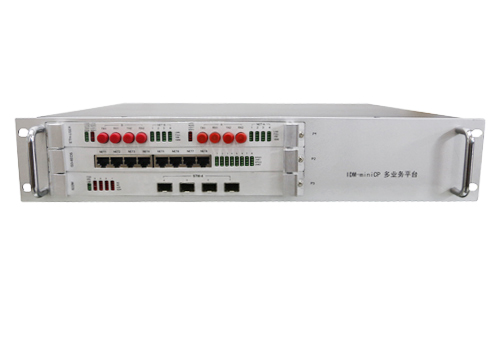
Figure 1 IDM MiniCP622M Multi-Service Optical Transmission Platform Front and Rear View
Features of STM-4-based MSTP Access Products
    19-inch standard 2U chassis, DC -48V and AC 220V, optional DC+DC, AC+AC, AC+DC dual backup power supplies;

    Supports 4 STM-4 optical access ports, enabling ring networks, chain networks, dual-fiber mutual backup, or dual-ring tangent networks;

    Provides up to 16 physically isolated 100M EoS Ethernet channels, with a total bandwidth of 2 STM-4s;

    Provides up to 4 Gigabit Ethernet EOS access ports, each supporting a maximum bandwidth of 63 VC12s;

    Provides up to 84 E1 access channels;

    Adopts plug-in card structure design, flexible configuration, and strong upgradeability;

    Provides SNMP protocol-based network management interface with comprehensive NMS functions;

    Provides 3 front plug-in slots and 3 rear plug-in slots, accommodating STM-4 cards, G3-8EOS cards, G3-2GE cards, G3-ETHUSER cards, G3-42E1 cards, G3-16E1DXC, G3-NMS-ETH cards, etc.;
Typical Configuration:

Technical Specifications
**
Optical Interface
Interface Type | SFP | Fiber Mode | Single-mode (Multi-mode optional) |
Tx/Rx Rate | 622.08Mbps/622.08Mbps | Tx/Rx Wavelength | 1310nm/1550nm (optional) |
Transmit Power | -12~-6dBm | Receiver Sensitivity | Better than-32dBm |
Transmission Distance | 40Km, with optional long-haul optical modules available for extended fiber transmission distances | ||
**
E1****Interface
Line Rate | 2.048Mbps | Line Code | HDB3 |
Standard Protocol | Supports ITU-T G.703 | Impedance | 75Ω/120Ω |
Frame Structure | pcm30/32 | Signaling | Channel-associated signaling |
Gigabit Ethernet
Interface Type | RJ-45 | Transmission Rate | N×VC12 (N≤63) |
Standard Protocol | Supports IEEE802.3 | Operating Mode | Full/Half Duplex/Auto-Negotiation |
Fast Ethernet
Interface Type | RJ-45 | Transmission Rate | N×VC12 (N≤50) |
Standard Protocol | SupportsIEEE802.3 | Operating Mode | Full/Half Duplex/Auto-Negotiation |
FXO**, **FXS Interfaces
Audio Range | 300Hz~3400Hz | Compression Rate | A-law per ITU G.711 |
Impedance | Triple compound impedance 200Ω+560Ω//0.1μF | Loop current | 20mA/channel |
EM2/4 line interface
Audio Range | 300Hz~3400Hz | Impedance | Balanced 600Ω |
Companding | A-law per ITU G.711 | Return Loss | ≥18dB |
Power Supply and Power Consumption
Power Supply Mode | AC220V/DC-48V | Total Power Consumption | ≤70W |
Environmental Conditions
Operating Temperature | -10oC ~+50oC | Relative Humidity | 0~95% (non-condensing) |
Product Dimensions
**
Length×Depth×Height | 440×230×90(mm) |
**
**
**Board Card Selection List
Card | G3-2GE | G3-8EOS | |
Physical View | 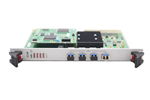 | 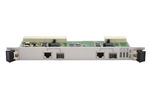 | 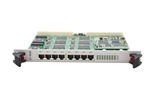 |
Functional Description | Provides 4 channels of STM-4 access, along with 10G space-division cross-connect and 5G time-division cross-connect capacity | Provides 2 sets of STM-1-to-1000M EoS Ethernet access | |
Card | G3-42E1 card | G3-ETHUSER card | G3-4pdh card |
Physical Image | 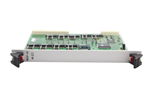 | 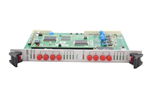 | 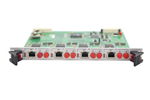 |
Functional Description | Provides 42 channels of E1 access, connected to the 622M board via the TelecomBUS bus | Provides 2 sets of STM-1 access, each set with two groups of optical ports and 4 100M EoS ports | Provides 4 groups of pdh interfaces, each group with 5 channels of E1+ line-rate Fast Ethernet |
Card | G3-16E1 DXC | G3-MUSER Card | G3-NMS-ETH |
Physical View | 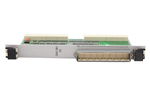 | 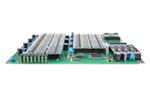 | 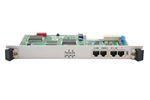 |
Function Description | Provides switched access for 64K services | Provides 64K service access | Provides SNMP management access for the system NMS |
**
Application Example 1


Figure 2 Star Network Application Diagram
The IDM MiniCP622M multi-service optical transmission platform can form a star network with other SDH devices to aggregate remote services, facilitating monitoring of remote services and solving the problem of dispersed remote units.
Application Example 2
**

**
Figure 3 Ring Network Application Diagram
The IDM MiniCP622M multi-service optical transmission platform can form a ring network. Multiple devices form the ring topology, and the 1+1 channel protection mechanism ensures real-time and accurate transmission of all data and voice services within the ring network.
FAQs
What Is the Definition of Communication?
Communication: the exchange and transmission of information between people, or between people and nature…
View answerWhat is the difference between optical fiber and optical cable? What are the common optical fiber connectors?
Optical fiber is a medium that transmits information from one end to another. It is a glass or plastic fiber that…
View answerWhat is the difference between single-fiber and dual-fiber?
The biggest difference between single-fiber and dual-fiber optical terminals lies in the optical modules on their…
View answerWhat is E1? How to Use E1
What is E1 The European 30-channel pulse code modulation PCM is abbreviated as E1, with a rate of 2.048Mbit/s.
View answerPCM30 Working Principle: What Is PCM30/32
PCM30 Equipment Working Principle The 30-channel PCM equipment refers to equipment that provides 30 user interfaces and…
View answer