
A Mine Emergency Converged Dispatch Communication System Construction Plan
Aiming at the current situation where systems such as underground production dispatch telephones (350 units)…
I. Project Background
A Mine currently has several relatively independent systems, including an underground emergency broadcast system, a production wired telephone dispatch system, and a 5G wireless communication system. These systems operate independently, failing to achieve communication convergence and unified dispatch management for underground production dispatch telephones (350 units), emergency broadcast telephones (over 100 units), and 5G wireless mobile terminals (over 700 units), which does not align with the development direction of smart coal mines.
The current status of A Mine's existing systems is as follows:
- The production dispatch telephone is based on a program-controlled dispatch system. The dispatch console occupies considerable space on the workstation, making it inconvenient for duty personnel to operate.
- The information integration and binding between the production dispatch telephone and the video surveillance system are insufficient, and information display is not intuitive.
- The existing industrial video surveillance, production dispatch telephone system, 5G wireless communication, emergency broadcast, and administrative telephone systems in the coal mine operate independently, each forming its own system. The dispatch positions in the command and dispatch center operate independently from each other, and there is no effective convergence in communication methods, making it impossible to uniformly operate underground production dispatch telephones, 5G wireless communication, and broadcast intercom services from the dispatch console.
To support the intelligent construction of the coal mine, A Mine utilizes the emergency converged dispatch communication system to achieve interconnection between various communication systems in the coal mine, realize unified dispatch of these systems, enable rapid linkage and disposal under abnormal monitoring conditions, achieve efficient surface-underground coordination in emergency scenarios, accelerate emergency response speed, and gradually achieve the goals of smart coal mine construction.
II. Construction Objectives
To support the intelligent transformation of the coal mine, this project aims to establish a fully converged, responsive, collaborative, and efficiently dispatched emergency converged dispatch communication system, creating a system for efficient daily communication, rapid abnormal disposal, and coordinated emergency rescue operations.
Specific construction objectives: One-network convergence, efficient daily communication — Through the emergency converged dispatch communication system, fully converge the coal mine's production dispatch telephone system, emergency broadcast telephones, 5G wireless mobile terminals, and coal mine alarm system, enabling multi-party voice, video, and short message communication between underground and surface areas, facilitating production plan adjustments, remote consultation and repair, and daily dispatch instruction issuance for underground personnel, achieving seamless communication anytime, anywhere.
III. Construction Content
- By building an emergency converged dispatch communication system, achieve the convergence and linkage of multiple systems including the production wired telephone dispatch system, emergency broadcast system, 5G wireless communication system, and coal mine alarm system, completing services such as voice, video, SMS, and consultation among terminals connected to each communication system, ensuring full visual command and traceability during emergency incident handling, achieving the unified command and dispatch combat effect of "audible, visible, commandable, and traceable."
- Integrate the command and dispatch center system, consolidating the relatively independent desktop dispatch of the original production wired telephone dispatch system, emergency broadcast system, and 5G wireless communication system into one, achieving unified dispatch through the converged communication console.
IV. Construction Reference Standards
- "Coal Mine Safety Regulations" 2022 Edition
- "Code for Design of Coal Mine Industry" GB50215-2015
- "Explosive Atmospheres – Part 1: Equipment – General Requirements" GB/T3836.1-2021
- "Mining General Purpose Electrical Equipment" GB/T12173-2008
- National Coal Mine Safety Administration Notice on Issuing the "Technical Plan for Upgrading and Transforming Coal Mine Safety Monitoring Systems" (Coal Mine Safety Supervision Letter [2016] No. 5)
- "General Technical Requirements for Coal Mine Safety Monitoring Systems" AQ6201-2019
- "Code for Use and Management of Coal Mine Safety Monitoring Systems and Detection Instruments" AQ1029-2019
- "Basic Requirements for Coal Mine Safety Equipment"
- "Code for Design of Intelligent Monitoring Systems for Coal Mine Safety Production" GB51024-2014
- "General Technical Conditions for Coal Mine Safety Production Monitoring System Software" MT/T1008-2006
- "General Technical Requirements for Electronic Products for Coal Mine Communication, Detection and Control" MT209-1990
- "Equipment Reliability Testing" GB/T5080.1~2
- "Equipment Standards and Use Management Regulations for Mine Ventilation Safety Monitoring Systems"
- "Technical Specifications for Coal Mine Safety Production Informatization – Part 1: Coal Mining Enterprises" DB14/T1727.1-2018
- "Technical Specifications for Coal Mine Safety Production Informatization – Part 2: Coal Mine Safety Production Regulatory Authorities" DB14/T1727.2-2018
- "Code for Design of Power Distribution for General Electrical Equipment" GB50055-2011
- "Standard for Mine Power Design" GB50070-2020
- "General Technical Conditions for Coal Mine Production Dispatch Communication Systems" MT/T401
- "Guiding Opinions on Accelerating the Intelligent Development of Coal Mines" (National Development and Reform Commission Energy [2020] No. 283)
- National Coal Mine Safety Inspection Bureau "Notice of the National Coal Mine Safety Administration on Issuing Guiding Opinions on Informatization Construction" (Coal Mine Safety Supervision Office [2019] No. 24)
V. Construction Principles
1. Advanced Principle
The emergency converged dispatch communication system solution is technologically forward-looking. Based on future technology development trends, considering the overall system architecture of hardware and software, selecting advanced hardware and software system platforms and application system designs based on best practices ensures the technological advancement of the entire system within a certain period.
2. Reliability Principle
The emergency converged dispatch communication system solution possesses the capability for long-term high stability and high reliability operation, with powerful processing capabilities and error-free transmission. It can meet the needs of peak business processing, adapt to the pressure brought by various special situations on the system, and ensure 7×24-hour uninterrupted system operation.
3. Security Principle
While ensuring information is shared with other applications, the system must guarantee information security.
4. Maintainability Principle
During system construction, the daily maintenance, information security, and unified management needs of a large number of devices must be considered. Ensure that after the platform is put into operation, only a small amount of manpower is required to complete comprehensive maintenance and unified management of the system. The system should be easy to maintain, provide a unified maintenance interface, and be capable of managing and maintaining remote devices through this interface, including real-time monitoring, remote restart, etc. It should be easy to analyze and test, easy to detect and locate faults, and ensure fault isolation through good system design.
5. Visualization Principle
Command and dispatch involves various aspects, and visualization of command is an important development direction for emergency response. The design of the emergency converged dispatch communication system must fully consider support for visual command, achieving audio/video dispatch and visual dispatch.
VI. Construction Plan
6.1 Upgrade and Transformation of the Command and Dispatch Center Hall for Converged Dispatch
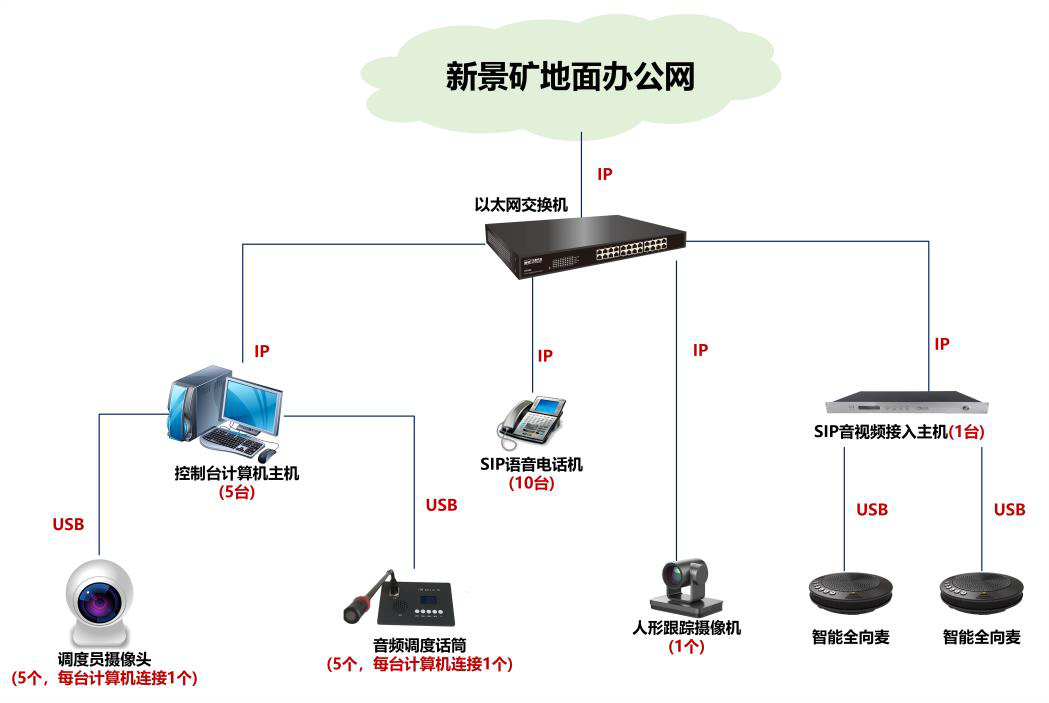
The original 20 seats in the command and dispatch center hall are upgraded and integrated into 5 converged dispatch seats. Each converged dispatch seat is deployed with 1 computer, 2 SIP dispatch phones, 1 dispatcher camera, and 1 audio dispatch microphone. A single seat can achieve unified audio/video dispatch and communication command functions for production wired telephone terminals, emergency broadcast terminals, and 5G wireless communication mobile terminals.
Additionally, 1 intelligent humanoid tracking camera and 2 intelligent omnidirectional microphones are deployed in the command and dispatch center hall. When command personnel speak in the command hall, the system can track the command personnel and capture omnidirectional sound in real time.
The system connection diagram of the command and dispatch center hall is shown below.
Interconnection Description:
- The dispatch computer hosts of the 5 dispatch seats, 10 SIP dispatch phones, 1 humanoid tracking camera, and 1 SIP audio/video access host are all connected to A Mine's surface office network via IP.
- Each dispatch seat is configured with 1 dispatcher camera and 1 audio dispatch microphone, both connected to the dispatch computer host via USB.
- The intelligent omnidirectional microphone is connected to 1 SIP audio/video access host via USB, and the SIP audio/video access host is connected to A Mine's surface office network via IP.
6.2 Construction of the Emergency Converged Dispatch Communication System
6.2.1 Analysis of Existing System Architecture
6.2.1.1 Production Telephone Dispatch System
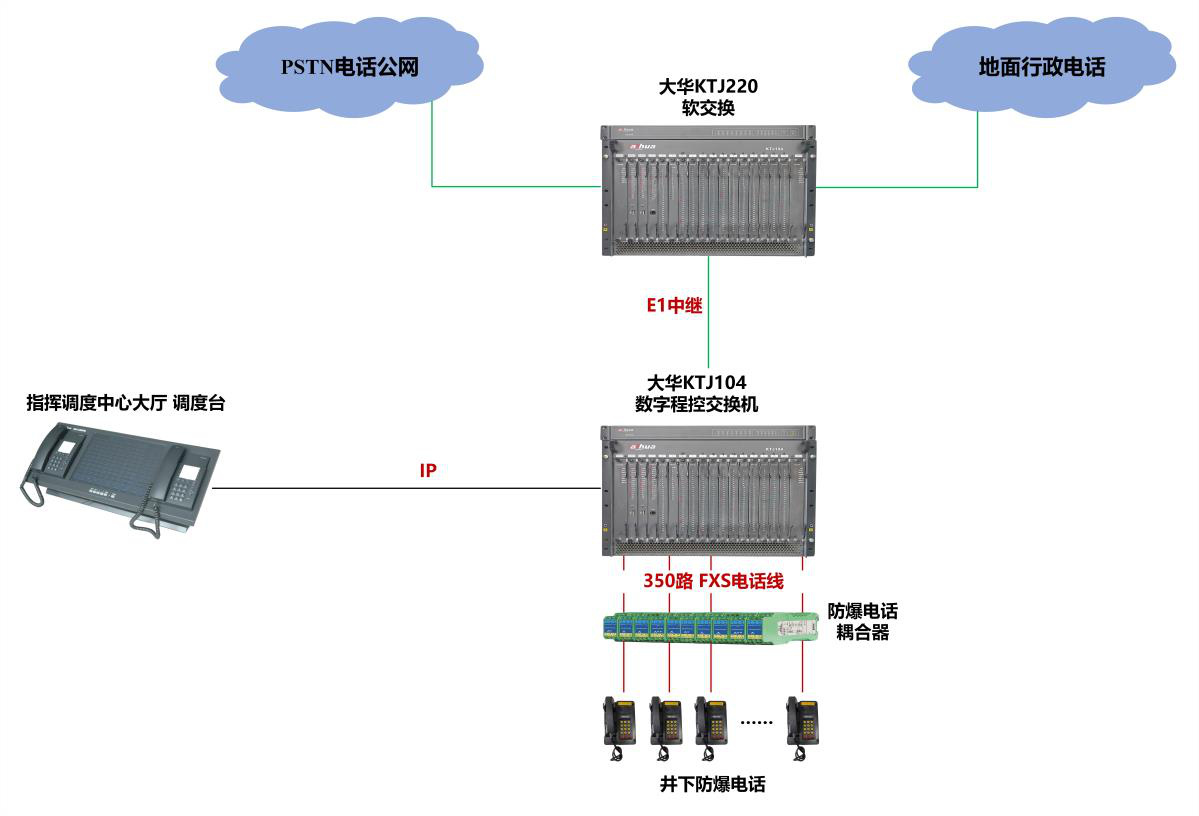
The existing production telephone dispatch system has 350 underground explosion-proof telephones connected via the machine room's explosion-proof isolation barrier to 1 set of Dahua KTJ104 digital program-controlled dispatch switch and 1 set of Dahua KTJ220 softswitch dispatch switch in the surface machine room. The Dahua command dispatch console in the command and dispatch center is connected to the KTJ104 digital program-controlled dispatch switch via IP, thereby enabling the command center to perform telephone dispatch command for underground explosion-proof telephones, and also supporting functions such as telephone calling by underground explosion-proof telephones during working hours and emergency calls during emergencies.
The networking diagram of the existing production telephone dispatch system is shown below.
6.2.1.2 Emergency Broadcast System
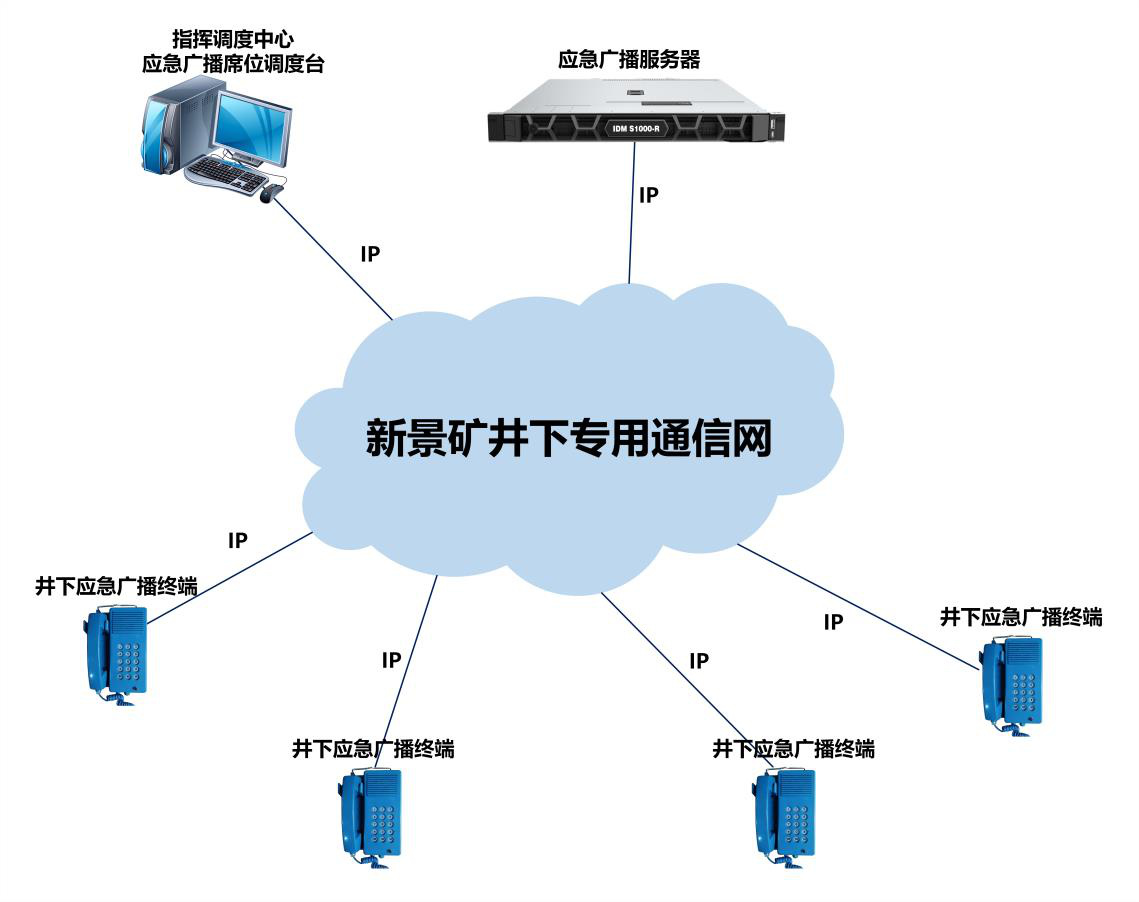
The existing emergency broadcast system has over 100 underground emergency broadcast terminals connected via A Mine's underground dedicated LAN to the emergency broadcast server in the surface machine room. Broadcast voice dispatch commands, hourly time signals, and other broadcast commands are performed through the emergency broadcast seat dispatch console in the command and dispatch center.
The networking diagram of the existing emergency broadcast system is shown below.
6.2.1.3 5G Wireless Communication System
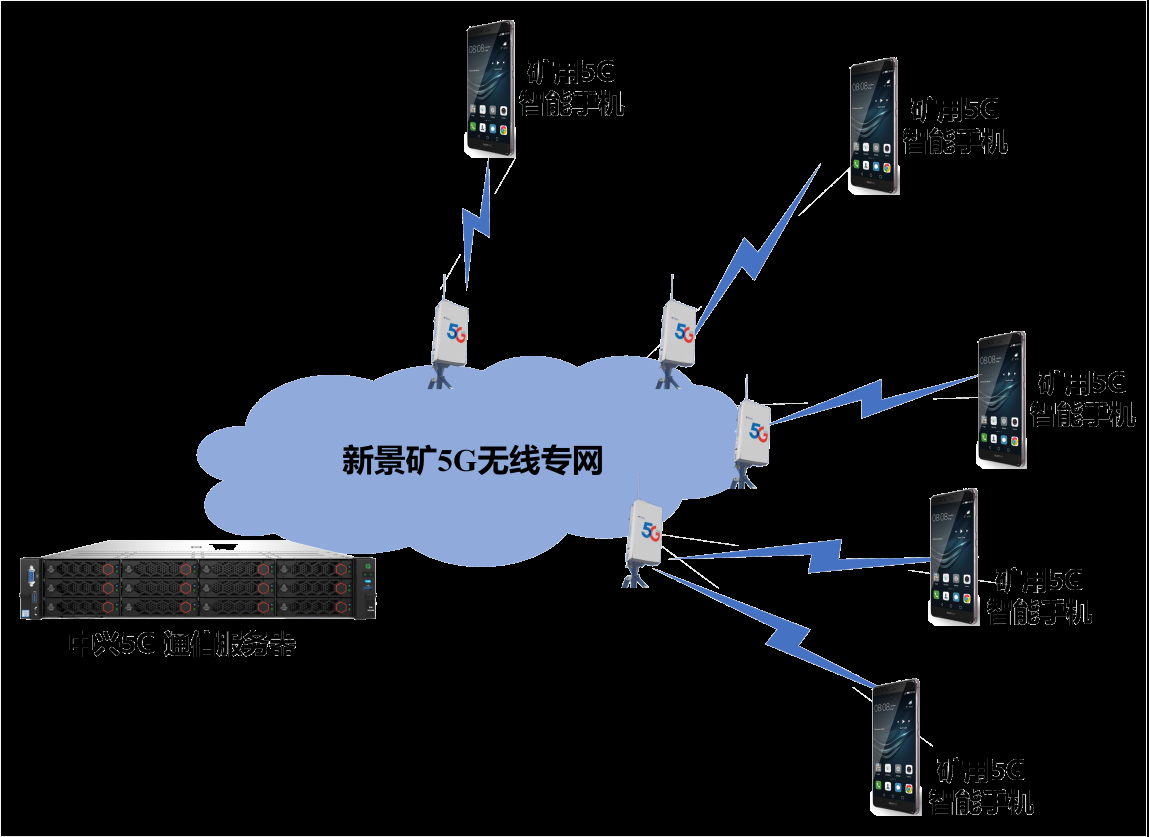
The coal mine's 5G wireless communication system consists of over 700 explosion-proof 5G mobile terminals, 5G underground base stations, and a 5G server, with the core communication server being the ZTE 5G server system.
The networking diagram of the existing 5G wireless communication system is shown below.
6.2.2 Emergency Converged Dispatch Communication System Plan
6.2.2.1 Networking Architecture
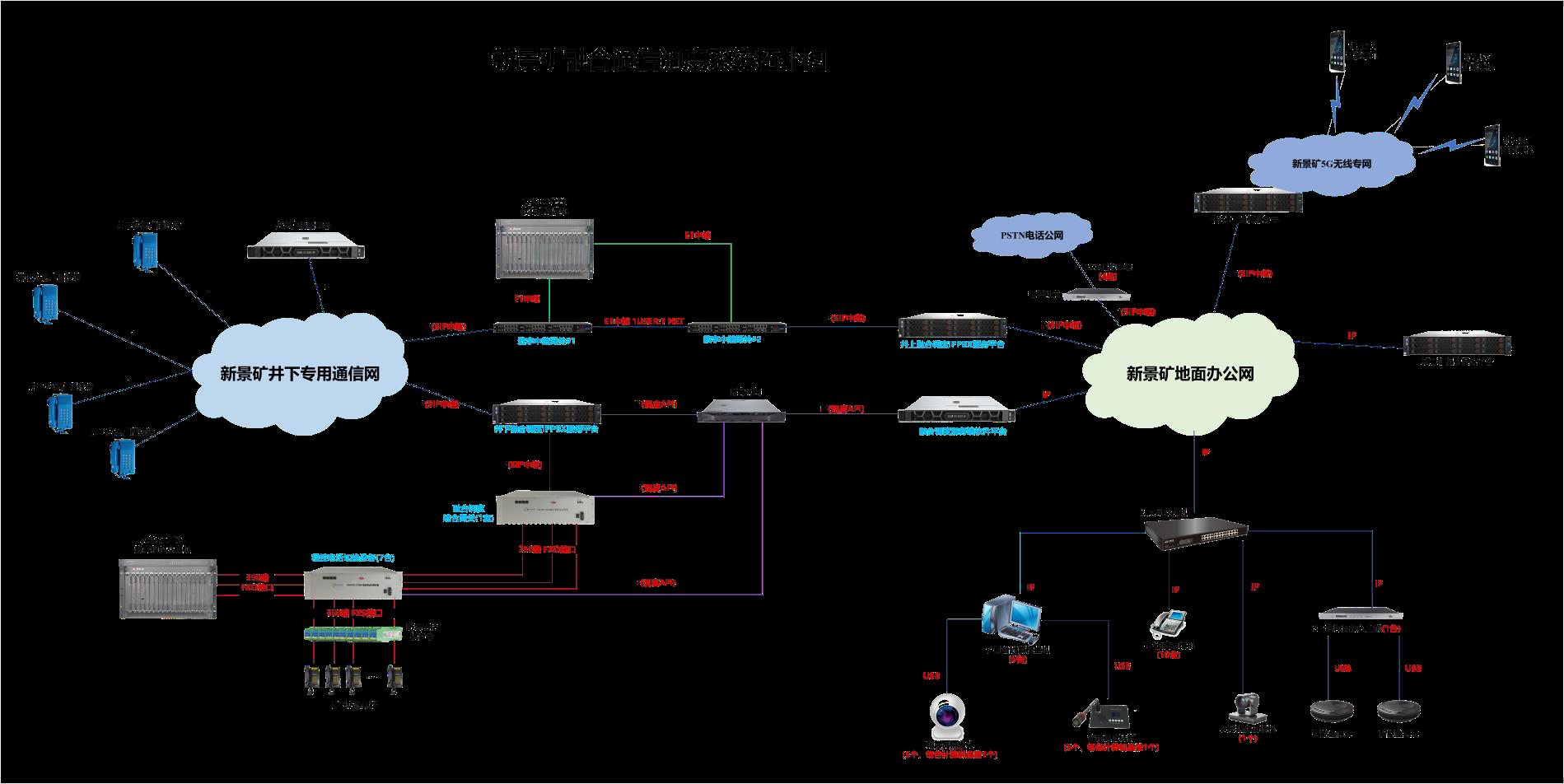
The networking architecture of the emergency converged dispatch communication system is shown in the figure below.
6.2.2.2 Networking Plan Description
The emergency converged dispatch communication system newly deploys a surface converged dispatch IPPBX service platform, an underground converged dispatch IPPBX service platform, a converged dispatch server software platform, a digital trunk gateway, a program-controlled telephone switching device, a converged dispatch integrated gateway, a command and dispatch center converged dispatch client system, and supporting equipment (including computer hosts, SIP voice telephones, humanoid tracking cameras, SIP audio/video access devices, and intelligent omnidirectional microphones). The newly deployed systems and equipment are interconnected with the original systems via digital trunks, SIP trunks, and IP networks, achieving communication convergence and unified dispatch.
Among them, the three service platforms—the surface converged dispatch IPPBX service platform, the underground converged dispatch IPPBX service platform, and the converged dispatch server software platform—are deployed on A Mine's own hyper-converged server.
The surface converged dispatch IPPBX service platform, the converged dispatch server software platform, and the command and dispatch center converged dispatch client system are deployed on the surface office network.
The underground converged dispatch IPPBX service platform is deployed on the underground dedicated communication network, which is the same network as the emergency broadcast system network.
IP communication between the surface office network and the underground dedicated communication network is securely interconnected via the coal mine's security gateway.
The following content specifically explains the integration plan for each system.
6.2.2.2.1 Integration with the Production Telephone Dispatch System
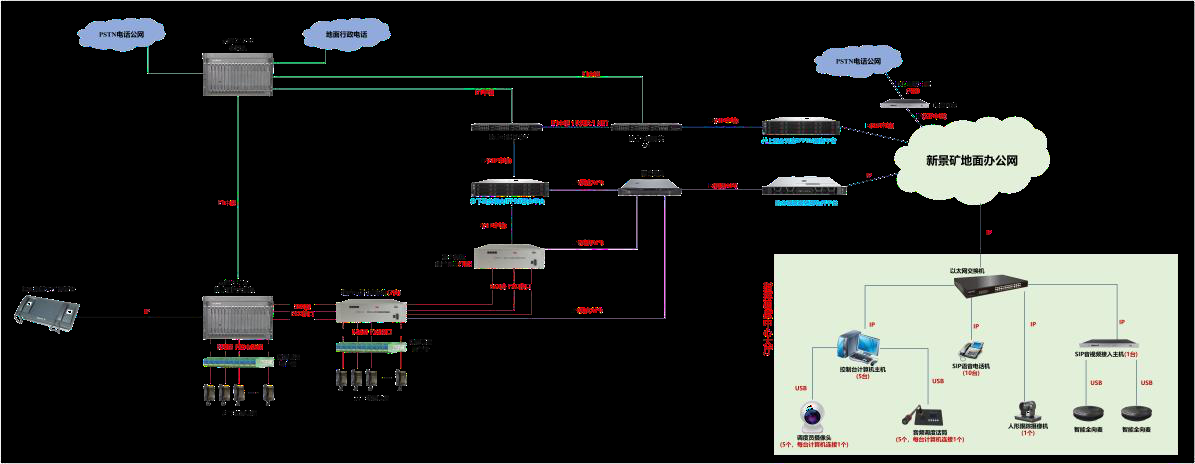
Integration with the production telephone dispatch system uses a program-controlled telephone switching device to achieve parallel connection of 350 underground telephones. Through this program-controlled telephone switching device, the underground telephones are split into two directions: one direction continues to connect to the original production telephone dispatch system, and the other direction connects to the emergency converged dispatch communication system, ensuring dual-system operation. In the future, full switching of production telephones to the emergency converged dispatch communication system can be considered.
The converged dispatch server software platform interconnects with the underground converged dispatch IPPBX service platform, the converged dispatch integrated gateway, and the program-controlled telephone switching device via the isolation security gateway, enabling the dispatch application service platform software to issue control commands and dispatch to underground equipment.
The underground converged dispatch IPPBX service platform interconnects with the Dahua KTJ220 softswitch server via a digital trunk gateway for voice trunk interconnection.
The surface converged dispatch IPPBX service platform interconnects with the Dahua KTJ220 softswitch server via a digital trunk gateway for voice trunk interconnection.
The system topology diagram is shown below.
6.2.2.2.2 Integration with the Emergency Broadcast System
The emergency converged dispatching communication system supports integration with the emergency broadcast system. The original underground emergency broadcast terminals in the coal mine register directly with the underground converged dispatching IPPBX service platform via the dedicated underground communication network, enabling voice intercommunication. The converged dispatching communication client provides broadcast dispatching functions for the original underground emergency broadcast terminals.
6.2.2.2.3 Integration with 5G Wireless Communication System
The emergency converged dispatching communication system supports integration with the 5G wireless communication system. It interconnects with the 5G communication server via a SIP trunk to achieve intercommunication, enabling audio and video calls with 5G mobile terminals.
6.2.2.2.4 Integration with Public Network External Telephone Lines
The emergency converged dispatching communication system achieves voice intercommunication between the public network loop trunk and the above-ground converged dispatching IPPBX service platform via a telephone gateway, enabling external telephone line access.
6.2.2.2.5 Integration with Coal Mine Alarm System
The emergency converged dispatching communication system supports integration with the coal mine alarm system. This is achieved through the server-side software platform to enable alarm linkage functionality.
VII. System Functions
7.1 Production Telephone Voice Dispatching Function
The voice dispatching functions of the converged emergency dispatching client mainly include all basic communication and supplementary service functions of softswitch communication, common dispatching functions, dispatching conference functions, recording, system management, dispatcher management, and other related functions. The console supports command and dispatching functions such as emergency call, dialing, monitoring, call pickup, hold, barge-in, forced release, transfer, conference, dial pad, editing, and broadcasting for various types of communication terminals.
7.2 5G Mobile Terminal Audio and Video Calls
The converged emergency dispatching client supports audio and video call functions for 5G mobile terminals. Audio and video calls can be initiated by the dispatching console or by the 5G mobile terminal.
7.3 Emergency Broadcast Function
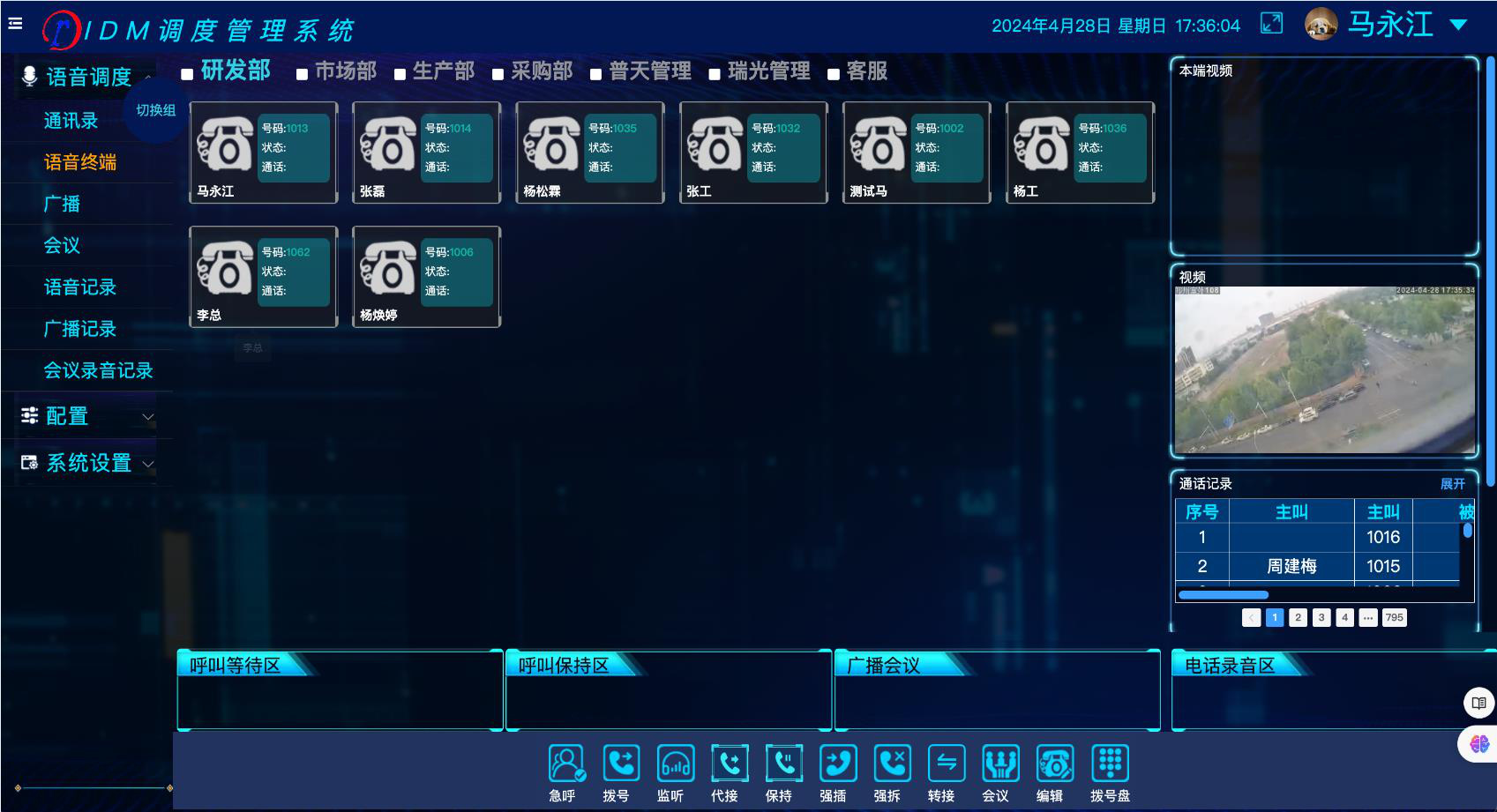
The converged emergency dispatching client supports emergency broadcast dispatching functions for underground emergency broadcast terminals, including intercom, voice insertion, file insertion, barge-in, monitoring, hold, transfer, forced release, hourly time signal, and task creation.
The emergency broadcast dispatching function interface is shown in the figure below.
7.4 Intelligent Command and Dispatching Center Functions
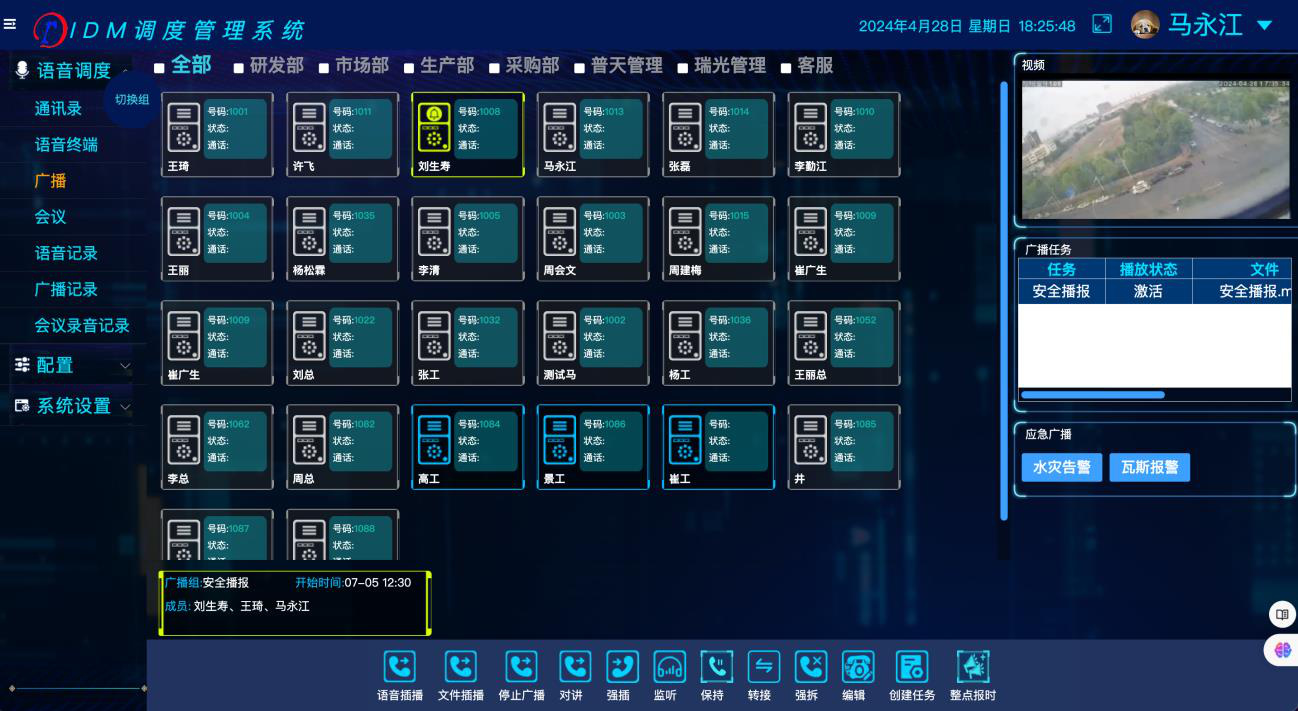
The original 20 seats in the command and dispatching center hall have been renovated and upgraded, consolidated into 5 converged dispatching seats. Each converged dispatching seat is deployed with 1 computer, 2 SIP dispatching phones, 1 dispatcher camera, and 1 audio dispatching microphone. A single seat can perform unified audio and video dispatching, communication, and command functions for production wired telephone terminals, emergency broadcast terminals, and 5G wireless communication mobile terminals.
Additionally, 1 intelligent humanoid tracking camera and 2 intelligent omnidirectional microphones are deployed in the command and dispatching center hall. When command personnel speak in the hall, the system can track the speaking personnel and perform omnidirectional sound capture.
The intelligent system structure of the command and dispatching center is shown in the figure below.
7.5 Linkage with Coal Mine Alarm System
The emergency converged dispatching communication system supports integration with the coal mine alarm system. This is achieved through the server-side software platform to enable alarm linkage functionality.
VIII. System Construction List
I. Communication Room Equipment
| No. | Name | Technical Parameters | Qty | Unit |
|---|---|---|---|---|
| 1 | Above-ground Converged Dispatching IPPBX Service Platform | (1) ★ Default supports 1000 extensions, 500 concurrent calls; (2) ★ Expandable to 2000 extensions, 700 concurrent calls; (3) ★ Supports 400 VOIP trunks, expandable to 1000 VOIP trunks; (4) ★ Supports automatic recording; (5) ★ Supports virtualization, supports VMware; (6) ★ Supports dual-system hot standby; (7) ★ Default supports 60-party telephone conference, maximum supports 200-party conference group invitation via conference panel; (8) ★ Default supports 128 IVR auto-attendant channels, expandable to 512 channels; (9) ★ Default supports 64 broadcast/intercom channels, expandable to 256 channels; (10) ★ Default supports 256 outbound routes, maximum expandable to 1000 routes; (11) ★ Default supports 512 inbound routes, maximum expandable to 1000 routes; (12) ★ Supports Android APP and PC softphone; (13) ★ Supports one number multiple devices, up to 5 different IP terminals can register with the same extension number; (14) ★ Supports importing and exporting extension lists and configuring the list. This platform is deployed on the user's own hyper-converged server, with server performance indicators not lower than: a) CPU: 2 CPUs, main frequency 3.10GHz, 16 cores, 32 threads; b) Memory: 32GB; c) Hard Disk: 1TB. | 1 | Set |
| 2 | Underground Converged Dispatching IPPBX Service Platform | (1) ★ Default supports 500 extensions, 300 concurrent calls; (2) ★ Expandable to 1000 extensions, 500 concurrent calls; (3) ★ Supports 400 VOIP trunks, expandable to 1000 VOIP trunks; (4) ★ Supports automatic recording; (5) ★ Supports virtualization, supports VMware; (6) ★ Supports dual-system hot standby; (7) ★ Default supports 60-party telephone conference, maximum supports 200-party conference group invitation via conference panel; (8) ★ Default supports 128 IVR auto-attendant channels, expandable to 512 channels; (9) ★ Default supports 64 broadcast/intercom channels, expandable to 200 channels; (10) ★ Default supports 256 outbound routes, maximum expandable to 1000 routes; (11) ★ Default supports 512 inbound routes, maximum expandable to 1000 routes; (12) ★ Supports Android APP and PC softphone; (13) ★ Supports one number multiple devices, up to 5 different IP terminals can register with the same extension number; (14) ★ Supports importing and exporting extension lists and configuring the list. This platform is deployed on the user's own hyper-converged server, with server performance indicators not lower than: a) CPU: 1 CPU, main frequency 3.50GHz, 6 cores, 12 threads; b) Memory: 16GB; c) Hard Disk: 1TB. | 1 | Set |
| 3 | Converged Dispatching Server-Side Software Platform | (1) Adopts B/S architecture, used to provide services for underground voice terminals; (2) Command and dispatching application server-side, providing dispatching interaction, management and other functions, including providing individual soldier APP service; (3) Voice dispatching: includes all basic communication and supplementary service functions of softswitch communication, common dispatching functions, dispatching conference functions, recording, system management, dispatcher management, and other related functions; (4) Supports user graphical operation interface; (5) Supports real-time display of user status and dispatching line usage; (6) Supports simultaneous multi-channel calls; (7) Supports integrated interface design for voice dispatching and video dispatching for convenient operation; (8) Maximum number of supported dispatching consoles expandable to no less than 10; (9) Supports monitoring and statistics of online terminal information, concurrent calls, call duration, etc.; (10) Supports functions including emergency call, dialing, monitoring, call pickup, hold, barge-in, forced release, transfer, conference, dial pad, broadcast, queue, etc., supports fully automatic recording; (11) Supports web configuration, software upgrade, status monitoring; (12) Supports G.711A/U, G.729A, iLBC codecs; (13) Supports RFC3261, RFC2367, RFC3262, RFC3264, RFC3581, RFC3515 and other specifications; (14) Supports RTP/RTCP protocol; supports TCP/IP, UDP, RTP/RTCP, ARP, PPPoE, DHCP, FTP/TFTP/SFTP, HTTP, HTTPS, Telnet, ICMP, DNS, SDP and other protocols; (15) Supports providing audio and video dispatching and interaction services for 4G/5G mining mobile terminals; (16) Actual configuration of 10 dispatcher licenses. This platform is deployed on the user's own hyper-converged server, with server performance indicators not lower than: a) CPU: 2 CPUs, main frequency 3.10GHz, 16 cores, 32 threads; b) Memory: 64GB; c) Hard Disk: 4TB. | 1 | Unit |
| 4 | Converged Dispatching Integrated Gateway | Converged Dispatching Integrated Gateway Host: (1) ★ Modular design, 19-inch 3U chassis, can accommodate up to 17 service plug-in cards; (2) ★ Host provides Gigabit Ethernet interface to complete service connection with the softswitch service platform, handling signaling and media processing, supports SIP protocol, supports G.711 U-Law and A-Law, G.711 Appendix 1, G.723.1 and G.723.1 Annex A, G.729 Annex A and Annex B voice coding protocols, supports IP, NAT, ICMP, ARP, HTTP, BOOTP, FTP, TFTP, DHCP, SNMP, Diff-Serv and other network protocols, supports G.168 protocol and maximum 128ms delay; Maximum supports 120 SIP concurrent calls; (3) This unit provides Fast Ethernet port for SNMP network management service, can detect port status and control port output mode; (4) Can accommodate various service interfaces, such as FXO, FXS, EM 2/4 wire audio, magneto telephone, and RS232/RS485, V.35 interfaces, can connect telephone, trunk, broadcast/intercom and other services; (5) ★ Can further expand interface capacity via E1 interface, optical fiber interface, optional optical transmission card can be inserted, connecting telephone access modules via optical fiber extension, realizing remote telephone transmission and access functions, especially can use optical fiber interface to place service interface terminals remotely, reducing copper cable installation difficulty and improving interface performance; (6) Equipment supports dual power supply mutual backup; (7) System clock supports local clock, line recovered clock and other clock modes; (8) ★ Analog telephone access card supports providing 10 analog telephone (FXO/FXS) interfaces, telephone interface uses thick film integrated circuit; (9) ★ Equipment supports network management system based on SNMP protocol; (10) ★ Supports remote power-off function, realizing remote telephone line power-off via software; (11) ★ Supports bidirectional emergency call function. Analog Telephone Access Module: (1) ★ Modular design, 19-inch 3U chassis, can accommodate up to 17 service plug-in cards; (2) Provides 4 E1 interfaces; (3) Single unit provides 120 analog telephone access; (4) ★ System clock supports local clock, line recovered clock and other clock modes; (5) ★ Equipment supports network management system based on SNMP protocol; (6) ★ Supports remote power-off function, realizing remote telephone line power-off via software; (7) ★ Telephone interface uses thick film integrated circuit. This project configures a total of 350 analog telephone interfaces, maximum supports 120 SIP concurrent calls. | 1 | Set |
| 5 | Telephone Line Bridging and Switching Device | (1) ★ Modular design, 19-inch 3U chassis, can accommodate up to 17 service plug-in cards; (2) Equipment supports dual power supply mutual backup; (3) ★ Analog telephone access card supports providing 10 analog telephone (FXO/FXS) interfaces, telephone interface uses thick film integrated circuit; (4) ★ Supports remote power-off function, realizing remote telephone line power-off via software. Single unit provides 50 underground telephone line bridging and switching access. | 7 | Unit |
| 6 | Switch | 24-port Gigabit electrical + 4 Gigabit optical enterprise-level fully managed Layer 3 switch | 1 | Unit |
| 7 | Digital Trunk Gateway | Provides 2 E1 trunks. (Reusing the user's existing digital trunk gateway equipment.) | 2 | Unit |
| 8 | Communication Cabinet | 42U, 2200×600×600 cabinet. | 2 | Unit |
II. Command Hall Equipment
| No. | Name | Technical Parameters | Qty | Unit |
|---|---|---|---|---|
| 1 | SIP Voice Telephone | (1) 2.8-inch color display, soft and clear interface; (2) Gigabit Ethernet port, high-speed and stable network access; (3) Built-in PoE power supply, supports unified deployment and PoE backup, no panic during power outages; (4) Uses noise reduction and echo cancellation technology; (5) Supports advanced voice codecs: G.722, G.711(A/u), G.729A/B, G.723, G.726. | 10 | pcs |
| 2 | SIP Audio/Video Access Host | Supports connection of 1 USB omnidirectional microphone in the command hall, and supports connection of 1 human-tracking network surveillance camera. | 1 | set |
| 3 | Smart Omnidirectional Microphone | (1) Number of mic capsules: 8; (2) Mic capsule type: MEMS MIC; (3) Sensitivity: -36dB±1dB; (4) Signal-to-noise ratio: 68dB(A); (5) Pickup range: radius ≤5m; (6) Pickup pattern: Omnidirectional; (7) Algorithm features: Automatic soft gain, intelligent AI noise reduction, intelligent AI de-reverberation, intelligent echo cancellation; (8) Cascading feature: Supports up to 8 units cascading (requires additional PoE power supply), supports connection to conference all-in-one large screens with built-in Tencent Tiantian Inside; (9) Interfaces: RJ45×2, DC×1, USB Type-C×1 (interfaces vary by model); (10) Power supply: DC48V/PoE/USB; (11) Dimensions: ∅120mm×70mm; (12) Weight: 420g; (13) Storage temperature: -20 |
2 | pcs |
| 4 | Smart Human-Tracking Camera | (1) Full HD image: Uses 1/2.8-inch 2.07-megapixel high-quality CMOS image sensor, max resolution up to 1920×1080, output frame rate up to 60fps; (2) Multiple optical zoom lenses: 12x optical zoom lens; (3) Auto-focus technology: Advanced auto-focus algorithm ensures fast, accurate, and stable auto-focus; (4) Low noise, high SNR: Low-noise CMOS effectively ensures ultra-high SNR of camera video, using advanced 2D and 3D noise reduction technology; (5) Multiple video output interfaces: Supports HDMI, SDI, USB3.0, LAN with simultaneous audio/video output; LAN interface supports PoE power supply; USB3.0 supports dual streams; SDI supports transmission up to 100 meters at 1080P60 format; (6) USB3.0 supports dual streams: Supports main stream and sub-stream, which can be output simultaneously; Supports YUY2, MJPEG, H.264, NV12, H.265 video encoding formats; (7) Built-in gravity sensor: Built-in gravity sensor, supports automatic pan/tilt flip function; (8) Multiple network protocols: Supports ONVIF, GB/T28181, RTSP, RTMP, VISCA OVER IP, IP VISCA, RTMPS, SRT protocols; Supports RTMP push mode; Supports RTP multicast mode; (9) Control interface: RS422 compatible with RS485, RS232-IN, RS232-OUT, RS232 interface supports cascading; (10) Multiple control protocols: Supports VISCA, PELCO-D, PELCO-P protocols, supports automatic protocol recognition; (11) Silent pan/tilt: Uses high-precision stepper motor and precision motor drive controller; (12) Multiple presets: Supports up to 255 presets (10 can be set/called via remote control); (13) Multiple remote controls: Optional infrared remote control or wireless remote control; 2.4G wireless remote control is not affected by angle, distance, or infrared interference; supports remote control signal pass-through function; (14) AI human tracking: Built-in high-speed processor and advanced image processing and analysis algorithms; users can choose real-time tracking or zone tracking based on usage environment. | 1 | pcs |
III. Console Desktop Equipment
| No. | Name | Technical Parameters | Qty | Unit |
|---|---|---|---|---|
| 1 | Integrated Dispatching Software | Integrated dispatching software, runs on the dispatcher computer in the command hall. (1) Voice dispatching functions mainly include all basic communication and supplementary service functions of softswitch communication, common dispatching functions, dispatching conference functions, recording, system management, dispatcher management, and other related functions; the console supports emergency call, dialing, monitoring, call pickup, hold, barge-in, forced release, transfer, conference, dial pad, broadcast, queue, and other command and dispatching functions for various communication terminals; (2) Supports USB camera connection for capturing dispatcher video. | 5 | sets |
| 2 | Dispatcher Camera | USB camera. | 5 | pcs |
| 3 | Audio Dispatching Microphone | Gooseneck desktop intercom terminal. Features mute and volume adjustment functions. | 5 | sets |
| 4 | Console Computer Host | I7-12700/16GB RAM/1TB SSD/Integrated Graphics/Win11. | 5 | units |
FAQs
What are common issues when using optical terminals in security surveillance?
Fiber optic technology is increasingly used in security surveillance projects to transmit images, audio, data…
View answerTop 10 Common FAQs About Optical Terminals
What is the main purpose of an optical terminal, and what is its current market price?
View answerWhat is the working principle and function of a telephone switch?
Telephone Switch Principle In fact, the basic principle of a telephone switch is quite simple…
View answer