IDM-VNT8416 Multi-Service Video Optical Multiplexer
8-channel video plus 4-channel E1 and Ethernet over the same fiber; one unit replaces multiple single-service devices
The IDM-VNT8416 multi-service video optical multiplexer adopts advanced international digital video optical fiber transmission technology. It is a high cost performance product that multiplexes video signals, 64 kbit/s services such as voice or data, E1 services, high-fidelity audio services, and 100M Ethernet over a single optical fiber for high-quality transmission. It supports high-quality transmission of any high-resolution moving and still images. The plug-and-play design makes installation simple and easy, with no on-site adjustment required. Its optical module and core circuits use standard components, ensuring high stability. All optical and electrical interfaces comply with international standards, making it suitable for different operating environments.
IDM-VNT8416 8-channel video industrial-grade wide-temperature optical multiplexer is a video optical multiplexer developed by Beijing Ruiguang Jiyuan. It is used in pairs consisting of a transmitter and a receiver to multiplex video signals, 64 kbit/s services such as voice or data, E1 services, high-fidelity audio services and 100M Ethernet over an optical fiber for high-quality transmission. It serves scenarios such as electric power and energy industrial private networks, rail transit and expressway private networks, and unattended sites of public security and military, and is one of the multi-service optical multiplexers that Raytrans, an optical multiplexer manufacturer, offers for industrial scenarios.
Key specifications at a glance: 8-channel video · 4-channel E1 transparent transmission · 4-channel shared 100M Ethernet · 4 groups of high-fidelity audio · 1.5Gbps single-mode FC optical port · transmission distance 20Km · industrial grade -40℃~+85℃ · overall power consumption ≤40W
IDM-VNT8416 8-channel video industrial-grade wide-temperature optical multiplexer carries 8-channel video, 4-channel E1 transparent transmission channels, 4-channel shared 100M Ethernet and 4 groups of high-fidelity audio services simultaneously over a single optical fiber, concentrating services that would otherwise require multiple single-function devices onto the same link. Only one optical fiber needs to be laid between the site and the center, reducing the number of optical cable cores occupied and the number of supporting devices, and accordingly lowering cable and construction investment. As a multi-service optical multiplexer, it can flexibly adapt to applications with high requirements for product showcase and reliability, such as government private network optical fiber communication solutions, military emergency communications vehicle solutions and smart mining communication solutions.
IDM-VNT8416 8-channel video industrial-grade wide-temperature optical multiplexer adopts digital video optical fiber transmission technology and supports high-quality transmission of any high-resolution moving and still images. The plug-and-play design makes installation simple and easy, with no on-site adjustment required; the optical module and core circuits all use standard components, providing high stability, and all optical and electrical interfaces comply with international standards, making the device suitable for different operating environments. Compared with single-service optical multiplexers such as telephone optical multiplexers, this industrial-grade wide-temperature optical multiplexer is better suited to harsh on-site conditions in terms of temperature adaptability and service integration.
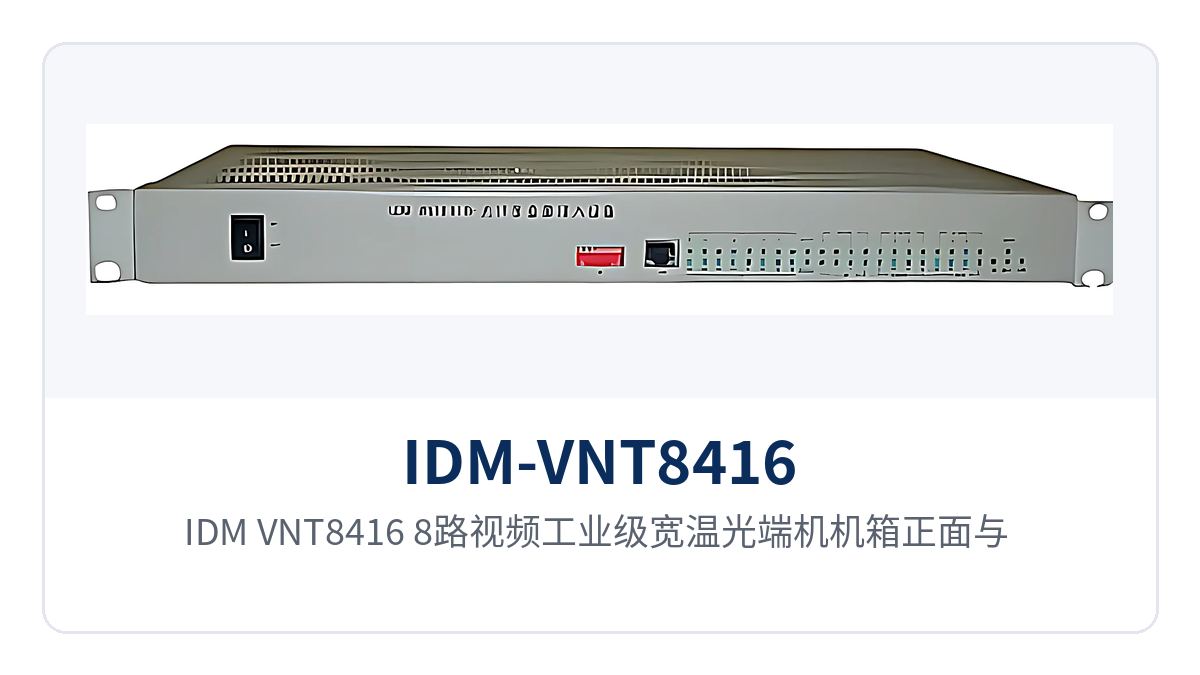
Figure 1: Front view of the IDM-VNT8416 8-channel video industrial-grade wide-temperature optical multiplexer enclosure and close-up of the FC optical port
What kind of device is the 8-channel video industrial-grade wide-temperature optical multiplexer?
IDM-VNT8416 8-channel video industrial-grade wide-temperature optical multiplexer is an optical fiber transmission access device deployed between the service site and the central equipment room. The transmitter multiplexes on-site video, E1, voice or data and Ethernet signals onto a single optical fiber, and the receiver at the opposite end restores the optical signals to the corresponding service interface outputs. A single device concurrently enables 8-channel video, 4-channel E1 transparent transmission channels, 4-channel shared 100M Ethernet and 4 groups of high-fidelity audio services, so the site side no longer needs to stack multiple single-function transmission devices. This is the main difference between the 8-channel video industrial-grade wide-temperature optical multiplexer and ordinary optical multiplexers that transmit only one type of service. As a multi-service optical multiplexer product of Raytrans, a professional optical multiplexer manufacturer, the device integrates more service interfaces on the basis of a video optical multiplexer and can be flexibly used in scenarios such as government private network optical fiber communication solutions, military emergency communications vehicle solutions and smart mining communication solutions.
IDM-VNT8416 8-channel video industrial-grade wide-temperature optical multiplexer does not use analog frequency modulation, phase modulation or amplitude modulation for transmission, so it has no intermodulation interference of analog frequency modulation (FM), phase modulation (PM) and amplitude modulation (AM) optical multiplexers, and no electromagnetic interference (EMI) or radio frequency interference (RFI); the video channels are compatible with video formats such as PAL, NTSC and SECAM and can be directly connected to existing on-site cameras, monitors and hard disk video recording devices without additional format conversion equipment. In its product showcase, Raytrans provides detailed descriptions of the anti-interference capability and format compatibility of this industrial-grade wide-temperature optical multiplexer.
IDM-VNT8416 8-channel video industrial-grade wide-temperature optical multiplexer can be networked jointly with centralized equipment to form a point-to-multipoint star network; where telephone or low-speed data access is required in addition to video, E1 and Ethernet, the device can be equipped with voice interface cards and data service cards, and the interface configuration expands with the service list without replacing the complete unit. For projects requiring the functions of a telephone optical multiplexer, this multi-service optical multiplexer can enable telephone service access by adding voice interface cards, meeting the needs for integrated voice and data transmission in government private network optical fiber communication solutions and smart mining communication solutions.
What functions does the 8-channel video industrial-grade wide-temperature optical multiplexer provide?
The functions of the IDM-VNT8416 8-channel video industrial-grade wide-temperature optical multiplexer are divided by service channel and O&M capability. The specific role of each function is shown in the table below.
Function | Description |
|---|---|
8-channel video input | A single device provides 8 video channels and supports high-quality transmission of any high-resolution moving and still images |
4-channel E1 transparent transmission channels | Provides 4 E1 transparent transmission channels for carrying E1 services or accessing 64 kbit/s services sent by devices such as PCM equipment |
4-channel shared 100M Ethernet | Provides 4 shared 100M Ethernet channels with a transmission rate of 10M/100M adaptive and support for IEEE802.3 |
4 groups of high-fidelity audio | Provides 4 groups of high-fidelity audio services with an audio sampling bit width of 24bit, a sampling frequency of 32KHz and an audio bandwidth of 20Hz~20KHz |
Online network management | Provides network management functions for online real-time monitoring of device and link operating status at the central side |
Multi-format compatibility | Compatible with video formats such as PAL, NTSC and SECAM, adapting to on-site cameras and monitors of different formats |
No intermodulation interference | No intermodulation interference of analog frequency modulation (FM), phase modulation (PM) and amplitude modulation (AM) optical multiplexers, and no electromagnetic interference (EMI) or radio frequency interference (RFI) |
Interface expansion | Can be configured with voice interface cards such as FXS, FXO, hotline telephone cards, magneto telephone cards and EM2/4 cards, as well as data service cards such as V.24 and V.35 |
Star networking | Can be networked jointly with centralized equipment to form a point-to-multipoint star network |
As an optical multiplexer manufacturer, Raytrans fully presents the functional specifications of this industrial-grade wide-temperature optical multiplexer in its product showcase. This multi-service optical multiplexer can meet the diverse needs for multi-service access of video optical multiplexers, telephone optical multiplexers and others in government private network optical fiber communication solutions, military emergency communications vehicle solutions and smart mining communication solutions.
Technical specifications of the 8-channel video industrial-grade wide-temperature optical multiplexer
The technical specifications of the IDM-VNT8416 8-channel video industrial-grade wide-temperature optical multiplexer (industrial-grade wide-temperature optical multiplexer) are listed below in groups by optical interface, video, Ethernet and data, voice and high-fidelity audio, and power supply and environment and structure, for convenient reference during project selection and product showcase.
Optical interface parameters
Item | Parameter/Specification | Description/Applicable Conditions |
|---|---|---|
Interface type | FC (SC and other interfaces can be customized) | Optical port connector type, selected according to the optical fiber patch cord configuration of the project |
Fiber mode | Single-mode (multi-mode optional) | Single-mode is the standard configuration; multi-mode is optional |
Receiver receive/transmit rate | 1.5Gbps / 1.5Gbps | Receive-direction and transmit-direction rates |
Receiver receive/transmit wavelength | 1310nm / 1550nm | Used in pair with the wavelength of the transmitter at the opposite end |
Transmitter receive/transmit rate | 1.5Gbps / 1.5Gbps | Transmit-direction and receive-direction rates |
Transmitter receive/transmit wavelength | 1550nm / 1310nm | Used in pair with the wavelength of the receiver at the opposite end |
Transmit optical power | -9~-1dBm | Output optical power range of the transmitter |
Receiver sensitivity | Better than -21dBm | Lower limit of optical power at which the receiver can receive normally |
Transmission distance | 20Km | Long-distance optical modules can be installed optionally for longer-distance optical fiber transmission |
Video Interface Parameters
Item | Parameter/Specification | Description/Applicable Conditions |
|---|---|---|
Interface type | BNC | Video port for connecting cameras and monitors |
Video sampling bit width | 8bit | Digital sampling precision of the video signal |
Video bandwidth | 0Hz~6.5MHz | Baseband bandwidth covering PAL, NTSC and SECAM formats |
Luminance non-linearity | <3% | Linearity specification of the video channel |
Differential phase (DP) | <0.7o | Phase distortion specification of the chrominance signal |
Differential gain (DG) | <0.7% | Amplitude distortion specification of the chrominance signal |
Input overload voltage | 1.5VP-P (typical value) | Overload level allowed at the video input |
Input/output voltage | 1VP-P (typical value) | Standard video signal level |
Input/output impedance | 75Ω (unbalanced) | Consistent with the impedance of conventional video coaxial cables |
Video SNR | ≥70dB (weighted) | Weighted signal-to-noise ratio specification |
Ethernet and Data Interface Parameters
Item | Parameter/Specification | Description/Applicable Conditions |
|---|---|---|
Ethernet interface type | RJ-45 | Ethernet port connector |
Transmission rate | 10M/100M adaptive | Auto-negotiation with the opposite-end network device |
Standard protocol | Supports IEEE 802.3 | Ethernet standard protocol |
Operating mode | Full/half duplex/adaptive | Automatically matched to the capability of the opposite-end port |
Data interface type | RJ-45 | Data port connector |
Data type | RS-232, RS422 (4-wire), RS485 (2-wire) | Select the wiring method according to the interface type of the on-site control and acquisition equipment |
Voice and High-Fidelity Audio Parameters
Item | Parameter/Specification | Description/Applicable Conditions |
|---|---|---|
FXO/FXS audio range | 300Hz~3400Hz | Voice channel frequency band |
Compression | ITU G.711 A-law | Voice compression method |
Impedance | Three-element complex impedance 200Ω+560Ω//0.1μF | Line-side impedance of the voice interface |
Loop current | 25mA/channel | Power feeding current of the voice interface |
High-fidelity interface type | RJ45 | High-fidelity audio channel interface |
Audio sampling bit width | 24bit | High-fidelity audio sampling precision |
Input/output impedance | ADC:100KΩ / DAC:10KΩ | Input and output impedance; connect cables according to the port markings |
Input/output voltage | 1.5VP-P (typical value) | Audio signal level |
Audio sampling frequency | 32KHz | High-fidelity audio sampling rate |
Audio SNR | ≥90dB | Signal-to-noise ratio of the high-fidelity audio channel |
Audio bandwidth | 20Hz~20KHz | Covers the frequency band of human voice and conventional audio services |
Total harmonic distortion | <1% | Distortion specification of the high-fidelity audio channel |
Power Supply, Environmental and Structural Parameters
Item | Parameter/Specification | Description/Applicable Conditions |
|---|---|---|
Power supply mode | AC220V / DC-48V / DC 9V | Selected according to the equipment room and on-site power supply conditions |
Overall power consumption | ≤40W | Overall operating power consumption |
Operating temperature | -15℃~+65℃ | Standard operating temperature range |
Storage temperature | -25℃~+75℃ | Storage temperature range in non-operating state |
Industrial grade | -40℃~+85℃ | Industrial-grade temperature range configuration |
Relative humidity | 0~95% (non-condensing) | Operating environment humidity conditions |
Product dimensions | 440×230×45 (mm) | Length × depth × height |
E1 transparent transmission channels are carried at the 2.048Mbps rate and HDB3 line code specified in ITU-T G.703; Ethernet channels follow the IEEE802.3 standard protocol; voice channels use the A-law compression specified in ITU-T G.711, with an audio range of 300Hz~3400Hz. In projects where only one -48V DC power supply is available on site, the DC-48V power supply configuration can be selected to share power with the DC power supply system of the communications equipment room. As a mature model from a professional optical multiplexer manufacturer, this video optical multiplexer from Raytrans can be flexibly configured as a multi-service optical multiplexer or a telephone optical multiplexer, and is widely suited to scenarios such as government private network optical fiber communication solutions, military emergency communications vehicle solutions and smart mining communication solutions.
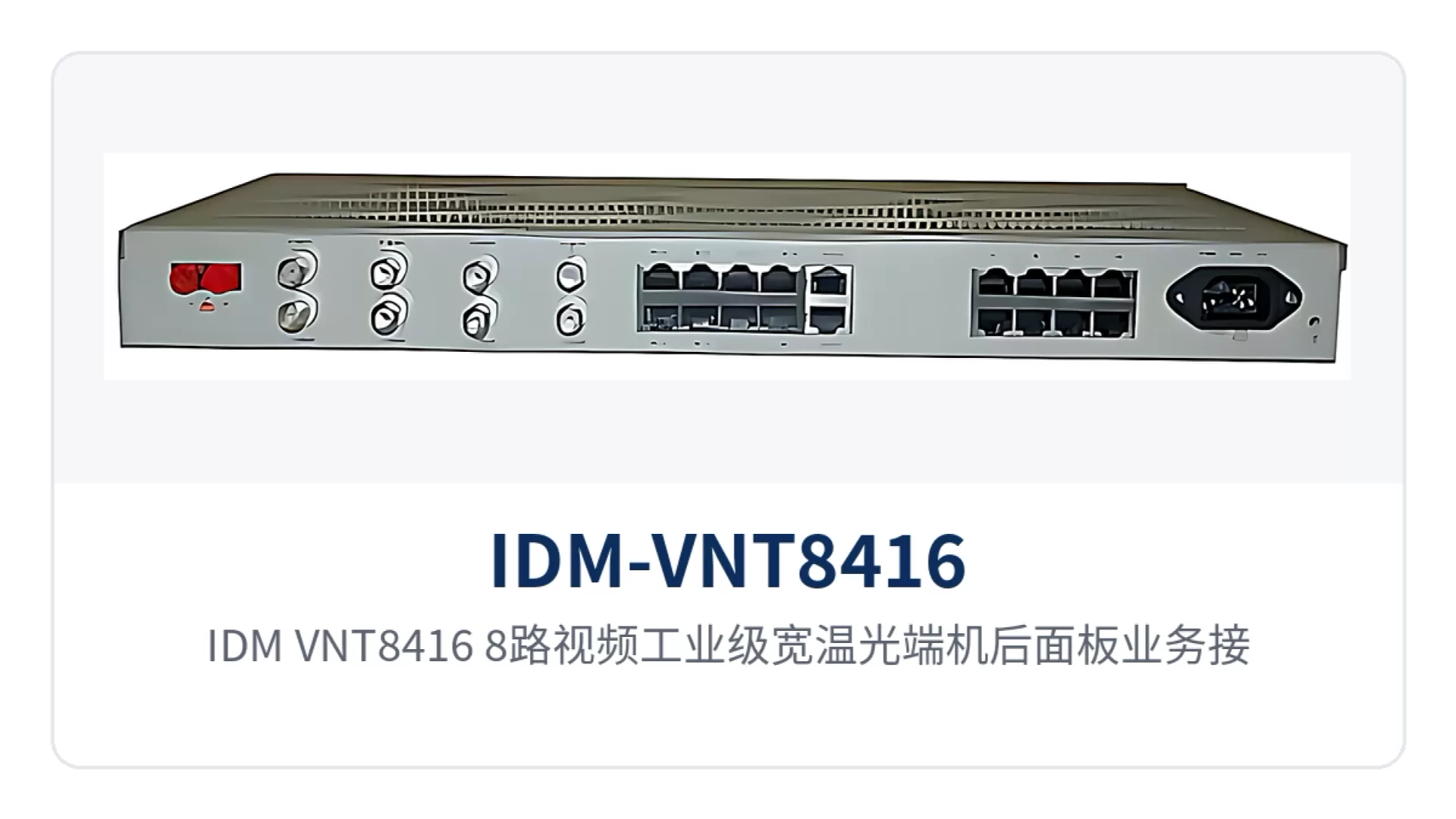
Figure 2: Rear panel service interfaces and power supply terminals of the IDM-VNT8416 8-channel video industrial-grade wide-temperature optical multiplexer
How is the 20Km transmission distance calculated?
The standard configuration transmission distance of the IDM-VNT8416 8-channel video industrial-grade wide-temperature optical multiplexer is 20Km, with single-mode fiber and FC optical ports as the configuration conditions. To check whether a link is usable, subtract the receiver sensitivity (better than -21dBm) from the transmit optical power at the transmitter (-9~-1dBm), and the result is the available optical power margin of the link; this margin is used to compensate for the attenuation of the optical fiber itself, splice point loss and mating connector loss.
When the on-site distance exceeds 20Km, long-distance optical modules can be optionally installed to achieve longer-distance optical fiber transmission. During project selection, the optical power should be calculated section by section according to the actual optical cable length, cable attenuation coefficient and number of splice points, with margin reserved for equipment aging and later maintenance; multimode fiber and single-mode fiber have different attenuation characteristics, so the final transmission distance must be determined after matching with the selected optical module type. As an optical multiplexer manufacturer, Raytrans recommends section-by-section calculation by the above method in government private network optical fiber communication solutions, military emergency communications vehicle solutions and smart mining communication solutions, and determining the final networking configuration in combination with the temperature adaptability of the industrial-grade wide-temperature optical multiplexer.
How is single-fiber composite video, E1 and Ethernet networked?
The networking approach for single-fiber composite video, E1 and Ethernet is as follows: deploy one IDM-VNT8416 8-channel video industrial-grade wide-temperature optical multiplexer at the site side and one at the central side, connect the two ends directly with a single optical fiber, and video, 4-channel E1 transparent transmission channels, 4-channel shared 100M Ethernet and high-fidelity audio services are transmitted bidirectionally over the same optical fiber and restored to the corresponding interfaces at the opposite end. This point-to-point approach provides a clear link and does not depend on other transmission devices in between, making it suitable for multi-service backhaul between a single site and the central equipment room, and it is also a typical application form commonly seen in optical multiplexer product showcases.
When sites are scattered and unified aggregation is required, the IDM-VNT8416 8-channel video industrial-grade wide-temperature optical multiplexer can be networked jointly with centralized equipment to form a point-to-multipoint star network, in which the video and services of multiple remote stations are aggregated at the central side. The central node of star networking covers multiple remote stations with a single investment, making it suitable for private network projects in electric power, energy and rail transit that have multiple sites distributed along lines or areas, and it also meets the multi-site aggregation requirements of government private network optical fiber communication solutions and smart mining communication solutions.
For the wiring sequence, first connect the cameras, E1 equipment, Ethernet equipment and audio equipment to the corresponding ports, then connect the optical fiber patch cords and confirm that the transmit and receive wavelengths at both ends are paired, then check the status of the equipment indicator LEDs, and finally switch on the power and incorporate the equipment into network management monitoring; this reduces the risk of end face contamination caused by repeatedly plugging or unplugging the optical ports.
Port | Connected to | Wiring key points |
|---|---|---|
BNC video port | Camera / monitor | 75Ω unbalanced, input/output voltage 1VP-P (typical value), use 75Ω video coaxial cable |
E1 channel | Switch / PCM equipment / trunk equipment | 4-channel E1 transparent transmission channels, interfacing at the 2.048Mbps interface of ITU-T G.703 |
RJ-45 Ethernet port | Switch / network camera / data terminal | 4-channel shared 100M Ethernet, 10M/100M adaptive, full/half duplex adaptive |
RJ-45 data port | Control device / data acquisition terminal | Select RS-232, RS422 (4-wire) or RS485 (2-wire) according to the device interface type |
RJ45 high-fidelity audio port | Speaker / audio terminal | Input impedance ADC:100KΩ, output impedance DAC:10KΩ, connect correspondingly according to the port markings |
FC optical port | Optical fiber patch cord / optical cable | Single-mode (multimode optional), SC and other interfaces can be customized, note that the transmit and receive wavelengths at both ends are paired |
Power port | AC220V / DC-48V / DC 9V | Selected according to the equipment room and on-site power supply conditions, overall power consumption ≤40W |
How to select an 8-channel video optical multiplexer?
To select an 8-channel video optical multiplexer, first count the channels according to the on-site service list: whether the number of video channels reaches 8, whether E1 transparent transmission channels are needed, whether the site side needs to backhaul Ethernet data, and whether telephone or hotline services need to be connected. In addition to 8-channel video, the IDM-VNT8416 8-channel video industrial-grade wide-temperature optical multiplexer provides 4-channel E1 transparent transmission channels, 4-channel shared 100M Ethernet and 4 groups of high-fidelity audio, making it suitable for sites where video and private network communication services need to be carried in parallel over a single optical fiber; if the site also needs to connect telephone services, it can also be used together with a telephone optical multiplexer or a multi-service optical multiplexer.
The second item to confirm is the link length and optical fiber resources. The IDM-VNT8416 8-channel video industrial-grade wide-temperature optical multiplexer has a standard transmission distance of 20Km; beyond this distance, long-distance optical modules are available as an option. When on-site optical cable cores are in short supply, choosing equipment that multiplexes video, E1 and Ethernet over a single optical fiber reduces the occupation of optical cable resources.
The third item is the operating environment. Outdoor cabinets, equipment rooms without air conditioning, and remote sites with large day-night temperature differences should use industrial-grade wide-temperature models. The IDM-VNT8416 8-channel video industrial-grade wide-temperature optical multiplexer has an industrial-grade temperature range of -40℃ to +85℃ and a standard operating temperature range of -15℃ to +65℃, so the configuration can be selected according to the site ambient temperature. Power supply modes include AC220V, DC-48V and DC 9V, which can match the existing on-site power supply conditions.
The fourth item is the O&M approach and subsequent capacity expansion. Projects that need to remotely monitor site device status should choose models with network management functions and online real-time monitoring. Sites that may later add telephone or low-speed data services can choose models that support voice interface cards (FXS, FXO, hotline telephone card, magneto telephone card, EM2/4 card, etc.) and data service cards (V.24, V.35, etc.), so interfaces expand with service growth. When selecting an optical multiplexer manufacturer, it is advisable to give priority to a manufacturer such as Raytrans that offers both multi-service optical multiplexer and telephone optical multiplexer product lines, which facilitates subsequent capacity expansion and unified O&M.
Selection Dimension | Points to Consider | Corresponding Capability of the IDM-VNT8416 8-Channel Video Industrial-Grade Wide-Temperature Optical Multiplexer |
|---|---|---|
Service channel | Number of video, E1, Ethernet, voice and audio channels | 8-channel video, 4-channel E1 transparent transmission, 4-channel shared 100M Ethernet, 4 groups of high-fidelity audio |
Link length | Distance between site and center, optical cable resources | Single-mode standard configuration 20Km, optional long-distance optical module |
Operating environment | Site temperature, humidity, power supply conditions | Industrial grade -40℃ to +85℃, humidity 0 to 95% (non-condensing), AC220V/DC-48V/DC 9V power supply |
O&M approach | Whether remote monitoring of device status is required | Network management functions, online real-time monitoring at the central side |
Capacity expansion needs | Whether telephone or low-speed data will be added later | Configurable FXS, FXO, hotline telephone card, magneto telephone card, EM2/4 card and V.24, V.35 service cards |
What Applications Are Industrial-Grade Wide-Temperature Optical Multiplexers Suitable For?
Industrial-grade wide-temperature optical multiplexers are suitable for sites where the ambient temperature exceeds standard equipment room conditions. The IDM-VNT8416 8-channel video industrial-grade wide-temperature optical multiplexer has an industrial-grade temperature range of -40℃ to +85℃ and a relative humidity of 0 to 95% (non-condensing), while its standard operating temperature range is -15℃ to +65℃; the two configurations can be selected to match the actual ambient temperature of the site.
Outdoor cabinets and pole-side equipment boxes are typical applications for industrial-grade wide-temperature optical multiplexers. Cabinets at locations such as substation perimeters, roadsides and pipeline valve chambers have no air conditioning; in summer the temperature inside the box can be significantly higher than the ambient temperature, and in winter it may fall below zero. Industrial-grade wide-temperature configuration reduces abnormal equipment shutdowns caused by temperature.
Equipment rooms without air conditioning and remote sites are also suitable for industrial-grade wide-temperature models. Unattended sites usually have no equipment room air conditioning, and the equipment operates under large temperature differences all year round. Industrial-grade wide-temperature configuration, combined with a plug-and-play design that requires no on-site adjustment, reduces on-site adjustment and maintenance workload.
Industrial sites with diverse power supply conditions are also suitable for industrial-grade wide-temperature optical multiplexers. The IDM-VNT8416 8-channel video industrial-grade wide-temperature optical multiplexer supports three power supply modes — AC220V, DC-48V and DC 9V — and can interconnect with substation direct current power supplies, communications equipment room direct current power supplies or on-site alternating current power supplies. Its overall power consumption is ≤40W and its dimensions are 440×230×45 (mm), making it easy to install in a standard cabinet or on-site equipment box. In scenarios such as smart mining communication solutions and military emergency communications vehicle solutions, which have high requirements for wide temperature and power supply adaptability, this type of industrial-grade wide-temperature optical multiplexer is particularly suitable.
What Can Online Network Management for Optical Multiplexers Monitor?
Online network management for optical multiplexers monitors the operating status of devices on the link. The IDM-VNT8416 8-channel video industrial-grade wide-temperature optical multiplexer has network management functions and can perform online real-time monitoring of devices at the central side. O&M personnel can grasp the current operating status of the equipment without traveling to each site, and the workload of routine inspection and fault diagnosis is reduced accordingly.
For unattended sites, the value of online network management lies in shortening the time to discover faults. When sites are distributed along oil pipelines, at substations, along expressways and other locations, on-site troubleshooting requires vehicles and personnel to travel back and forth. The IDM-VNT8416 8-channel video industrial-grade wide-temperature optical multiplexer reports operating status centrally to the central-side network management system, so abnormal conditions can be discovered earlier than user fault reports. Combined with its industrial-grade wide-temperature capability of -40℃ to +85℃, the frequency of on-site maintenance at sites can be kept at a low level.
It should be noted that the access mode, monitoring items and required interfaces of specific network management functions are subject to the manufacturer's technical documentation and commercial confirmation. Before project implementation, it is advisable to confirm the interfacing requirements of the network management platform with the technical department of the optical multiplexer manufacturer. Raytrans can provide corresponding technical support and product showcase materials.
Differentiated Value
Differentiated Selling Point | Corresponding Capability | Customer Value |
|---|---|---|
Single-fiber multiplexing, multiple services over one line | 8-channel video, 4-channel E1 transparent transmission, 4-channel shared 100M Ethernet and 4 groups of high-fidelity audio multiplexed over a single optical fiber | Fewer optical cables and fewer devices, saving optical fiber resources and cable construction investment |
Industrial-grade wide temperature operation | Industrial-grade -40℃ to +85℃ temperature range, relative humidity 0 to 95% (non-condensing) | Suitable for field cabinets and unattended equipment rooms, reducing temperature-induced downtime and on-site maintenance |
Online network management real-time monitoring | Network management functions, online real-time monitoring of device and link status at the central side | Remote O&M for private networks, early fault discovery, fewer on-site troubleshooting trips |
Typical Application Scenarios
Electric Power and Energy Industrial Private Network
Sites of electric power and energy industrial private networks are distributed along lines and plants. Locations such as substations, distribution rooms, pumping stations and valve chambers have strong electromagnetic environments, and the line distance between cameras and the main control room often exceeds the usable range of coaxial cable. The Raytrans IDM-VNT8416 8-channel video industrial-grade wide-temperature optical multiplexer uses optical fiber as the transmission medium, provides electrical isolation between the transmitter and the receiver, and is free from electromagnetic interference (EMI) and radio frequency interference (RFI). It can backhaul video, E1 services and Ethernet data from power sites to the main control room or dispatch center. As a professional optical multiplexer manufacturer, Raytrans offers this product with AC220V and DC-48V power supply, enabling interfacing with substation direct current power systems. Its industrial-grade wide-temperature configuration adapts to temperature differences in outdoor cabinets, providing reliable product showcase and multi-service optical multiplexer access capability for scenarios such as government private network optical fiber communication solutions.
Rail Transit and Expressway Private Network
The electromechanical systems of rail transit and expressway private networks are distributed in bands along the line. Toll plazas, tunnel portals, roadbed slopes, stations and section surveillance centers are far apart, and the power supply and cabling conditions of equipment boxes along the line are complex. The Raytrans IDM-VNT8416 8-channel video industrial-grade wide-temperature optical multiplexer multiplexes 8-channel video and 4-channel shared 100M Ethernet from sites along the line over a single optical fiber back to the section surveillance center, while using 4-channel E1 transparent transmission to carry private network E1 services, reducing the occupation of optical cable cores along the line. The digital video transmission method without intermodulation interference ensures stable images around interference sources such as vehicle ignition and variable-frequency equipment, while the industrial-grade wide-temperature capability adapts to the year-round temperature differences of tunnel portal and roadbed cabinets. This is a typical application of optical multiplexer products in transportation private networks.
Unattended Sites for Public Security and Military
Unattended sites for public security and military use are usually located in remote areas, with no permanent duty personnel on site, no air conditioning in the equipment room, and high requirements for device availability and remote O&M. At the site side, the Raytrans IDM-VNT8416 8-channel video industrial-grade wide-temperature optical multiplexer multiplexes 8-channel video, E1 services and Ethernet data onto a single optical fiber for transmission to the forward command post or surveillance center. At the central side, device status is monitored online in real time through network management functions, so abnormalities need not wait until personnel arrive on site to be discovered. The device can be networked jointly with centralized equipment to form a point-to-multipoint star network, aggregating services from multiple unattended sites into the same center and reducing the O&M pressure caused by an increasing number of sites. This solution is equally applicable to scenarios such as military emergency communications vehicle solutions and smart mining communication solutions that require integrated access for multi-service optical multiplexers and telephone optical multiplexers.
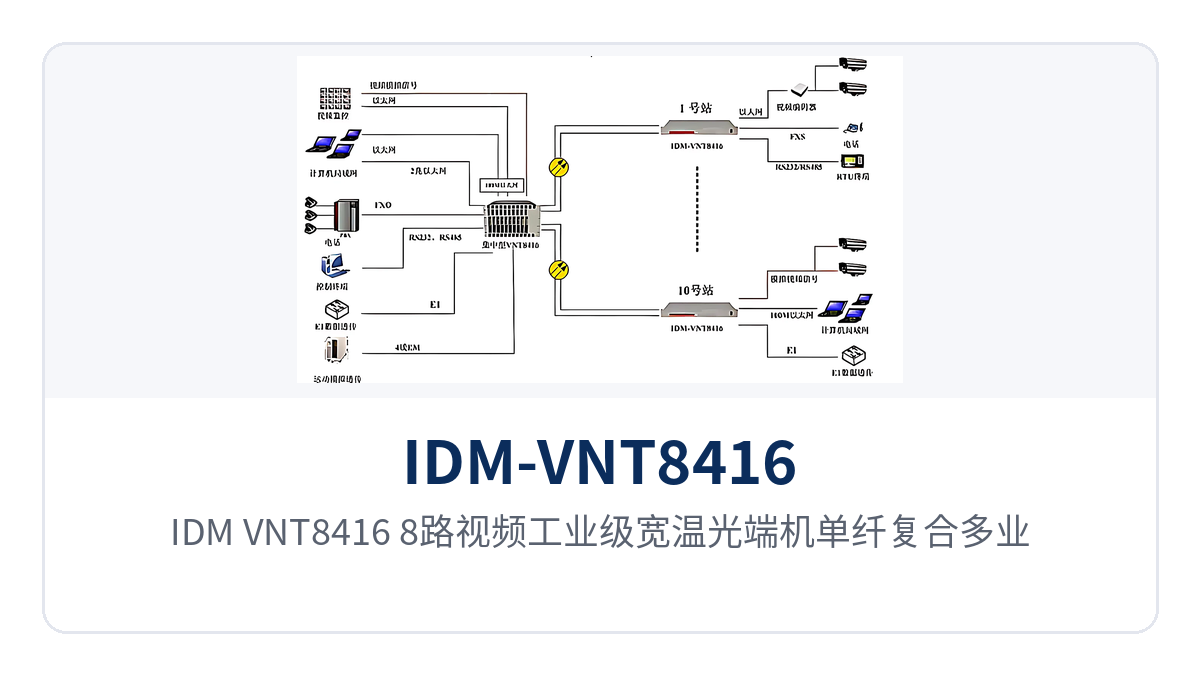
Figure 3: IDM-VNT8416 8-channel video industrial-grade wide-temperature optical multiplexer single-fiber multiplexing multi-service networking application diagram