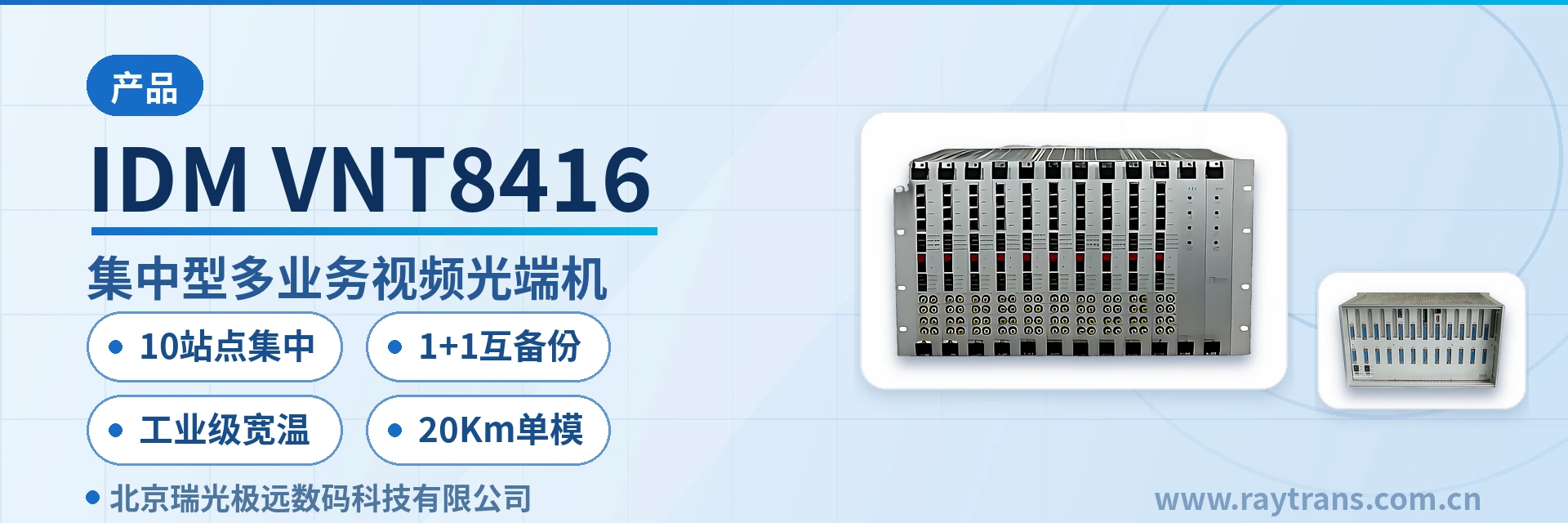
IDM-VNT8416 Centralized Multi-Service Video Optical Multiplexer
10-station centralized
The IDM-VNT8416 centralized multi-service video optical multiplexer is a product of our company that adopts advanced digital video optical fiber transmission technology to multiplex 8 video signals, 16 voice or data channels, 4 groups of E1 transparent transmission services, 4 groups of high-fidelity audio services and 4 channels of shared 100M Ethernet
IDM-VNT8416 10-station centralized multi-service optical multiplexer is a centralized multi-service video optical multiplexer developed by Beijing Ruiguang Jiyuan Digital Technology Co., Ltd. It belongs to the optical multiplexer product line of Raytrans and is used to multiplex 8-channel video, 16-channel voice or data, 4-channel E1 transparent transmission, 4 groups of high-fidelity audio and 4-channel shared 100M Ethernet onto a single optical fiber for high-quality transmission. As a professional optical multiplexer manufacturer, Raytrans fully demonstrates the technical advantages of video optical multiplexers in this product showcase. The IDM-VNT8416 10-station centralized multi-service optical multiplexer adopts digital video optical fiber transmission technology, supports high-quality transmission of any high-resolution moving and still images, and requires no on-site adjustment; the optical module and core circuits all use standard components, and all optical and electrical interfaces comply with international standards, making it suitable for different operating environments. This multi-service optical multiplexer can be flexibly applied to scenarios such as smart mining communication solutions, government private network optical fiber communication solutions and military emergency communications vehicle solutions, and telephone optical multiplexer functions can also be realized through voice interfaces.
Key Specifications at a Glance: 10-station centralized · 1+1 mutual backup · industrial-grade wide temperature · 20Km single-mode · online network management · 8-channel video · 16-channel voice or data · 4-channel E1 transparent transmission · 4-channel shared 100M Ethernet · 4 groups of high-fidelity audio
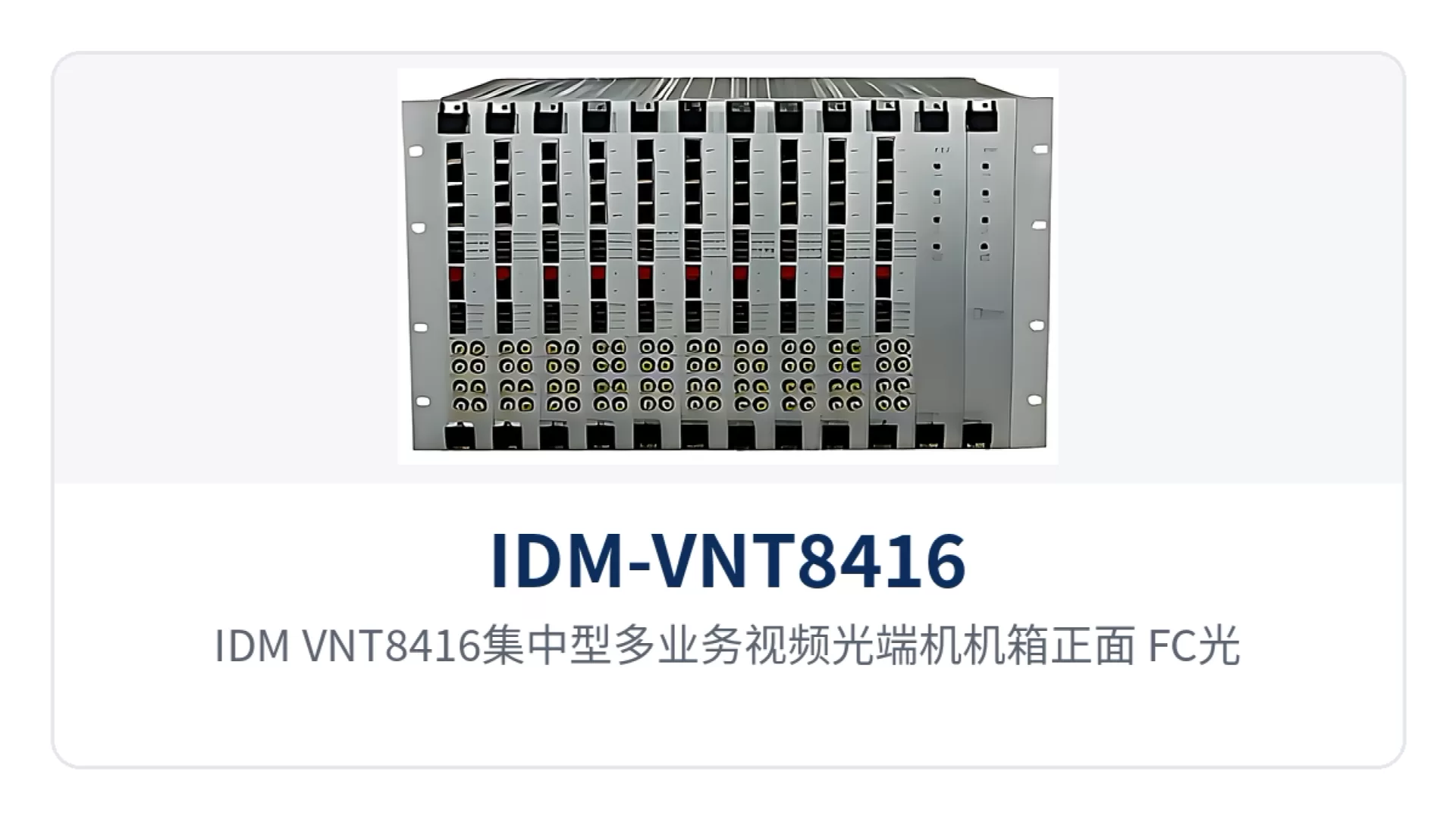
Figure 1: Close-up of the front panel, FC optical ports and BNC video ports of the IDM-VNT8416 centralized multi-service video optical multiplexer chassis
What kind of equipment is the 10-station centralized multi-service optical multiplexer?
The 10-station centralized multi-service optical multiplexer is a centralized optical multiplexer that multiplexes multiple types of services such as video, voice or data, E1 and Ethernet into the same optical fiber, and aggregates the services of multiple remote stations to one central-side device for restoration. The Raytrans IDM-VNT8416 10-station centralized multi-service optical multiplexer simultaneously carries 8-channel video, 16-channel voice or data, 4-channel E1 transparent transmission, 4 groups of high-fidelity audio and 4-channel shared 100M Ethernet over a single optical fiber line. As a representative product of a professional optical multiplexer manufacturer, this multi-service optical multiplexer eliminates the need to separately place independent transmission devices for surveillance images, telephone voice, E1 trunks and network data in the equipment box at a remote station; one product showcase covers all service access requirements.
The differences between the IDM-VNT8416 10-station centralized multi-service optical multiplexer and ordinary video optical multiplexers that only carry video channels lie in three aspects: service types, interface quantity and networking topology. In terms of service types, the IDM-VNT8416 10-station centralized multi-service optical multiplexer provides 16-channel voice or data, 4-channel E1 transparent transmission, 4-channel shared 100M Ethernet and 4 groups of high-fidelity audio in addition to 8-channel video; in terms of interface quantity, it can be configured with voice interface cards such as FXS, FXO, hotline telephone cards, magneto telephone cards and EM2/4 cards, as well as data service cards such as V.24 and V.35; in terms of networking topology, one central-side device can correspond to up to 10 remote stations, forming a point-to-multipoint star network.
The video channels of the IDM-VNT8416 10-station centralized multi-service optical multiplexer are input and output via BNC interfaces, with a video sampling bit width of 8bit, a video bandwidth of 0Hz to 6.5MHz, a video SNR of ≥70dB (weighted), luminance non-linearity <3%, differential phase (DP) <0.7°, differential gain (DG) <0.7%, and an input/output impedance of 75Ω (unbalanced). These specifications come from the all-digital video optical fiber transmission method: the video signal does not undergo analog frequency modulation, phase modulation or amplitude modulation, nor compression encoding, so it is compatible with video formats such as PAL, NTSC and SECAM, and is immune to electromagnetic interference (EMI) and radio frequency interference (RFI).
The IDM-VNT8416 10-station centralized multi-service optical multiplexer adopts a separated structure of mainboard and service sub-cards. The mainboard and service sub-cards are separated, and various voice and data service cards can be configured, so the unit does not need to be replaced entirely when the site service list changes. Each USER board provides 16 standard-defined subscriber interface positions, which can be arbitrarily configured with various interface cards and combined according to the type of telephone and the interface type of control devices at the site, offering strong scalability.
How many remote stations can a centralized optical multiplexer connect?
The number of remote stations that a centralized optical multiplexer can connect is determined by the card slots and service capacity of the central-side device. The upper limit of the IDM-VNT8416 10-station centralized multi-service optical multiplexer is 10 remote stations. One central-side device corresponds to up to 10 stations. Each station feeds video, voice or data, E1 and Ethernet services into the same optical fiber through its local USER board, and they are restored and dispatched at one central point. There is no need to configure a separate central device for each station in the equipment room, and cabinet space is thereby saved.
The central side is the node on the entire link that has no alternate route to bypass, so redundancy is implemented on the central side rather than the site side. The IDM-VNT8416 10-station centralized multi-service optical multiplexer is configured with 2 PRU boards for 1+1 mutual backup on the central device. When one of them becomes abnormal, services continue to be carried by the other, and the central side does not need to shut down for switching; services at each station continue to operate as usual. Remote stations still configure their local services according to the USER board. Redundancy is implemented only at the central point, with concentrated investment and a single O&M interface.
The IDM-VNT8416 10-station centralized multi-service optical multiplexer also features alarm functions and network management functions, enabling online real-time monitoring. On-duty personnel at the center can see the operating status of each station and board on the network management interface. For projects with distributed sites such as electric power, rail transit, public security forces and broadcasting and mining sites, the value of main control redundancy and online monitoring is particularly direct: most of these sites are unattended, and the single-visit cost and arrival cycle for maintenance personnel to reach the site are high, so most status judgments and alarm confirmations can be completed at the center. With its deep accumulation in the optical multiplexer field, Raytrans provides reliable multi-service optical multiplexer product support for scenarios such as smart mining communication solutions, government private network optical fiber communication solutions and military emergency communications vehicle solutions.
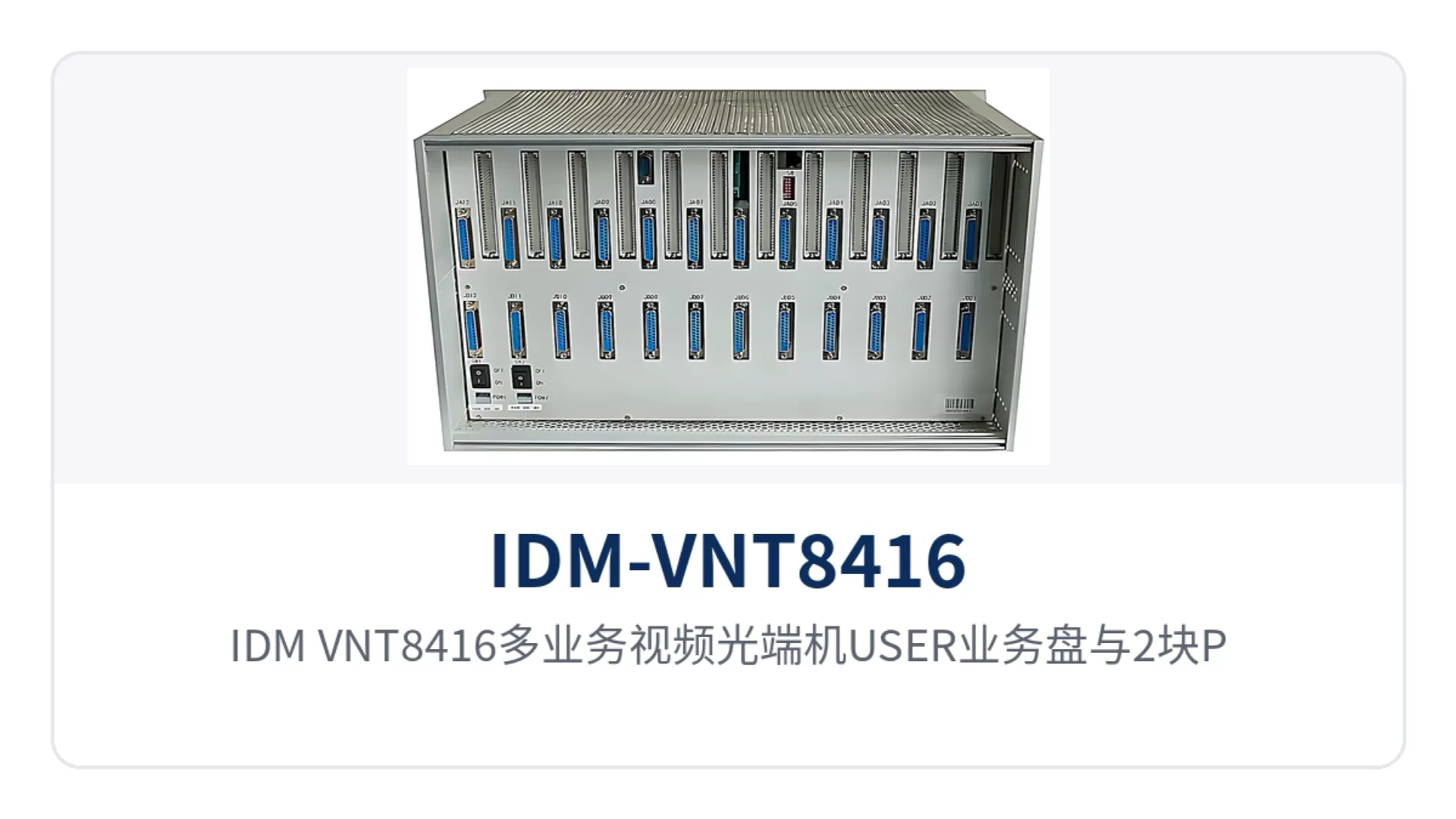
Figure 2: Layout of USER service cards and 2 PRU boards and rear panel interfaces of the IDM-VNT8416 multi-service video optical multiplexer
Core Functions: How 8-channel video, 16-channel voice or data, 4-channel E1 transparent transmission and 4-channel shared 100M Ethernet are multiplexed into a single optical fiber
The IDM-VNT8416 10-station centralized multi-service optical multiplexer completes the multiplexed transmission of video, voice, E1, Ethernet and audio services on one device. The core functions are shown in the table below.
| Function | Description |
|---|---|
| Centralized point-to-multipoint networking | Can correspond to up to 10 remote stations; one central-side device and the USER boards at each station form a star network, and station services are aggregated at one central point |
| 2 PRU boards with 1+1 mutual backup | The central device is configured with 2 PRU boards as mutual backup, avoiding central-side service interruption caused by a single main control board failure |
| 8-channel video access | Each USER board provides 8-channel unidirectional/4-channel bidirectional video, compatible with video formats such as PAL, NTSC and SECAM, and supports high-quality transmission of high-resolution moving and still images |
| 16-channel voice or data | Multiplexes 16-channel voice or data services into the optical fiber; can be configured with voice interface cards such as FXS, FXO, hotline telephone cards, magneto telephone cards and EM2/4 cards |
| 4-channel E1 transparent transmission channels | Each USER board provides 4-channel E1 transparent transmission channels; E1 services are transparently transmitted as-is over the optical path to the peer station |
| 4-channel shared 100M Ethernet | Each USER board provides 2-channel shared 100M Ethernet, and the complete unit provides 4-channel shared 100M; interface type RJ-45, rate 10M/100M adaptive, supporting IEEE802.3 |
| 4-channel high-fidelity audio | Each USER board provides 4-channel high-fidelity audio, interface type RJ45, audio sampling bit width 24bit, sampling frequency 32KHz, audio SNR ≥90dB |
| 1 group of 1.25G optical interfaces | Each USER board provides 1 group of 1.25G optical interfaces, used in pairs with the peer device; optical path rate and wavelength are paired according to the manufacturer's technical documentation |
| 16 subscriber interface positions | Each USER board provides 16 standard-defined subscriber interfaces, which can be arbitrarily configured with various interface cards and combined according to the on-site service list |
| Separated structure of mainboard and service sub-cards | The mainboard and service sub-cards are separated, and various voice and data service cards can be configured, offering strong scalability |
| Optional voice and data interface cards | Voice interface cards include FXS, FXO, hotline telephone cards, magneto telephone cards and EM2/4 cards; data service cards include V.24, V.35, etc. |
| Alarms and network management | Complete alarm functions and network management functions, enabling online real-time monitoring and supporting centralized O&M of multiple stations |
The value of multi-service over a single fiber first lies in saving optical fiber: the IDM-VNT8416 10-station centralized multi-service optical multiplexer packs 8-channel video, 16-channel voice or data, 4-channel E1 transparent transmission, 4 groups of high-fidelity audio and 4-channel shared 100M Ethernet into the same optical fiber, requiring only one fiber core between the station and the center. For sections with limited duct resources and private networks with optical cables in service for many years, there is no need to separately lay optical cables for surveillance images, telephone voice, E1 trunks and network data. The telephone optical multiplexer and video optical multiplexer product lines of Raytrans also continue this design approach, and this multi-service optical multiplexer has been fully verified in smart mining communication solutions, government private network optical fiber communication solutions and military emergency communications vehicle solutions. The one-stop product showcase of the optical multiplexer manufacturer makes user selection more intuitive and efficient.
Technical Specifications: Optical Interface, Video, Ethernet, Voice and High-Fidelity Audio Specifications
The interfaces and specifications of the IDM-VNT8416 10-station centralized multi-service optical multiplexer are listed by service category. The optical and electrical ends are used in pairs, and the following parameters are subject to the manufacturer's technical documentation. As a professional product showcase, this section presents the complete specifications of this multi-service optical multiplexer for services such as video optical multiplexer and telephone optical multiplexer.
Optical Interface Parameters
| Parameter | Specification | Description/Applicable Conditions |
|---|---|---|
| Interface type | FC (SC and others can be customized) | Optical patch cord interfaces are selected according to the on-site optical cable termination method |
| Fiber mode | Single-mode (multimode optional) | 20Km single-mode is the standard configuration; long-distance projects can be equipped with long-distance optical modules |
| Receiver receive/transmit rate | 1.5Gbps/1.5Gbps | Nominal rates in the receive and transmit directions, subject to the manufacturer's technical documentation |
| Receiver receive/transmit wavelength | 1310nm/1550nm | Used in pairs with the peer transmitter wavelength |
| Transmitter receive/transmit rate | 1.5Gbps/1.5Gbps | Nominal rates in the transmit and receive directions, consistent with the peer |
| Transmitter receive/transmit wavelength | 1550nm/1310nm | Used in pairs with the peer receiver wavelength |
| Transmit optical power | -9 to -1dBm | Available optical power range on the transmit side |
| Receiver sensitivity | Better than -21dBm | Lower limit of optical power at which the receive side can operate normally |
| Transmission distance | 20Km | Long-distance optical modules can be optionally installed for longer-distance optical fiber transmission |
Video Channel Parameters
| Parameter | Specification | Description/Applicable Conditions |
|---|---|---|
| Interface type | BNC | Video ports for connecting cameras and monitors |
| Video sampling bit width | 8bit | All-digital video sampling precision |
| Video bandwidth | 0Hz to 6.5MHz | Covers the baseband bandwidth of standard-definition video |
| Luminance non-linearity | <3% | Luminance distortion specification of the video channel |
| Differential phase (DP) | <0.7° | Phase distortion specification of the chrominance signal |
| Differential gain (DG) | <0.7% | Amplitude distortion specification of the chrominance signal |
| Input overload voltage | 1.5VP-P (typical) | Allowable overload level at the video input |
| Input/output voltage | 1VP-P (typical) | Standard video signal level |
| Input/output impedance | 75Ω (unbalanced) | Consistent with camera and monitor impedance |
| Video SNR | ≥70dB (weighted) | Picture noise level under the weighted specification |
Ethernet and Data Interface Parameters
| Item | Parameter/Specification | Description/Applicable Conditions |
|---|---|---|
| Ethernet interface type | RJ-45 | 4-channel shared 100M Ethernet ports |
| Ethernet transmission rate | 10M/100M adaptive | Auto-negotiation with the peer network device |
| Ethernet standard protocol | Supports IEEE802.3 | Compatible with general Ethernet devices |
| Ethernet operating mode | Adaptive half-duplex/full-duplex | Automatically matched to the peer port capability |
| Data interface type | RJ-45 | Data service ports |
| Data type | RS-232, RS422 (4-wire), RS485 (2-wire) | Selected according to the on-site control device interface type |
Voice Interface and High-Fidelity Audio Parameters
| Item | Parameter/Specification | Description/Applicable Conditions |
|---|---|---|
| Voice audio range | 300Hz~3400Hz | Telephone voice service bandwidth |
| Voice compression | ITU G.711 A-law | Voice encoding method |
| Voice interface impedance | Three-element complex impedance 200Ω+560Ω//0.1μF | Matched to SPC exchanges and the telephone side |
| Voice loop current | 25mA/channel | Power feeding current per telephone channel |
| High-fidelity interface type | RJ45 | 4-channel high-fidelity audio ports |
| Audio sampling bit width | 24bit | High-fidelity service sampling precision |
| Input/output impedance | ADC:100KΩ/DAC:10KΩ | Audio input and output impedance |
| Input/output voltage | 1.5VP-P (typical) | Audio signal level |
| Audio sampling frequency | 32KHz | High-fidelity service sampling rate |
| Audio SNR | ≥90dB | Reflects the noise level of audio channels |
| Audio bandwidth | 20Hz~20KHz | Covers the audible frequency range of the human ear |
| Total harmonic distortion | <1% | Nonlinear distortion of audio channels |
Power Supply, Environmental and Structural Parameters
| Item | Parameter/Specification | Description/Applicable Conditions |
|---|---|---|
| Power supply mode | AC220V/DC-48V/DC 9V | Selected according to equipment room and site power conditions |
| Overall power consumption | ≤150W | Overall operating power consumption |
| Operating temperature | -15℃~+65℃ | Operating temperature range of conventional models |
| Storage temperature | -25℃~+75℃ | Warehousing and transportation ambient temperature |
| Industrial grade | -40℃~+85℃ | Industrial-grade wide-temperature configuration for harsh on-site conditions |
| Relative humidity | 0~95% (non-condensing) | Applicable condition in high-humidity environments is non-condensing |
| Product dimensions | 440×230×270 (mm, Length×Depth×Height) | Rack-mounted form factor, easy to install in cabinets and equipment boxes |
The 4-channel E1 transparent transmission channels operate at the rate and interface characteristics specified in ITU-T G.703, with a bit rate of 2.048Mbps and HDB3 line coding; the channels are transparent to E1 frame content and do not alter the original services. The 16 voice channels are encoded in ITU G.711 A-law, with an audio range of 300Hz~3400Hz, and are matched by three-element complex impedance when connected to SPC exchanges and telephones. The 4-channel shared 100M Ethernet operates under the IEEE802.3 standard protocol with 10M/100M adaptive. Raytrans can perform targeted selection and adjustment of the above optical multiplexer configurations according to different scenarios such as smart mining communication solutions, government private network optical fiber communication solutions, and military emergency communications vehicle solutions.
How does 1+1 mutual backup of PRU boards in an optical multiplexer work?
The 1+1 mutual backup of PRU boards in an optical multiplexer works in a dual-board parallel, mutually backup manner: two PRU boards are inserted in the central-side chassis, and under normal conditions they jointly handle the central-side aggregation of video, voice, E1 and Ethernet services; when one board becomes abnormal, the services continue to be carried by the other board, and the central side does not need to stop for switchover. The IDM-VNT8416 10-station centralized multi-service optical multiplexer is configured in this way, placing redundancy at the central node where the entire link has no alternate route to bypass.
The choice of redundancy location comes from the link structure. Each remote station has its own independent optical fiber to the center, so a single-station failure affects only that station; the central side, however, aggregates the services of all stations, and once it fails, the services of all 10 stations are affected simultaneously, so the 1+1 mutual backup is placed on the central side. The 1+1 mutual backup of the two PRU boards in the IDM-VNT8416 10-station centralized multi-service optical multiplexer distributes this failure point across two boards, while the site side still configures its own services via USER boards, concentrating the redundancy investment at the central point for easier operation and spare parts management.
The 1+1 mutual backup can only form a closed loop when used together with alarms and network management. The IDM-VNT8416 10-station centralized multi-service optical multiplexer has complete alarm functions and network management functions, enabling online real-time monitoring; board status and alarm information can be viewed on the central-side network management interface, and on-duty personnel can grasp the central-side board operating status before services are affected. The specific switchover method and switching time are subject to the manufacturer's technical documentation and commercial confirmation.
What is the industrial-grade wide temperature range of an optical multiplexer?
The industrial-grade wide temperature range of an optical multiplexer is -40℃~+85℃, which is an operating temperature range specification, not a storage temperature. The industrial-grade configuration of the IDM-VNT8416 10-station centralized multi-service optical multiplexer has an operating temperature of -40℃~+85℃ and a relative humidity of 0~95% (non-condensing); the conventional commercial-temperature model has an operating temperature of -15℃~+65℃ and a storage temperature of -25℃~+75℃, and the two configurations are selected according to the on-site environment. As a professional optical multiplexer manufacturer, Raytrans clearly marks the wide-temperature specifications of various optical multiplexer products in its product showcase, facilitating project selection.
The wide-temperature specification corresponds to long-term online operation in harsh field environments. Outdoor equipment boxes, unattended equipment rooms and sites with large temperature fluctuations have large day-night temperature differences and no air conditioning, and the site-side equipment must continuously carry video, telephone and data services under such conditions. The IDM-VNT8416 10-station centralized multi-service optical multiplexer adopts the industrial-grade -40℃~+85℃ configuration, and with an overall power consumption of ≤150W and three power supply modes of AC220V, DC-48V and DC 9V, it can be configured according to site power conditions with heat dissipation and power capacity inside the equipment box calculated.
Structural conditions also affect installation in wide-temperature scenarios. The IDM-VNT8416 10-station centralized multi-service optical multiplexer has unit dimensions of 440×230×270mm, and the installation position should be checked against the actual space of the cabinet and equipment box; for sites with a large temperature span, it should be confirmed that the power supply and heat dissipation conditions allow the equipment to operate normally within the -40℃~+85℃ range, and for projects with many sites and high maintenance visit costs, online network management should also be listed as a selection condition to reduce the frequency of on-site inspection.
How to select a 20Km single-mode video optical multiplexer?
How to select a 20Km single-mode video optical multiplexer comes down to three questions: whether the sites are centralized, how many types of services are on the service list, and whether the on-site temperature and power supply conditions are harsh. The IDM-VNT8416 10-station centralized multi-service optical multiplexer is centralized equipment with a standard configuration of 20Km single-mode transmission, suitable for projects where multiple points converge to one center and the station spacing is within 20Km; it can be checked in the following three steps.
First check site distribution and networking approach
When sites are distributed around the center and the service volume of a single site is not large, using centralized equipment for point-to-multipoint networking saves more investment: one central-side unit of the IDM-VNT8416 10-station centralized multi-service optical multiplexer can correspond to up to 10 remote stations, each station occupying only one unit configured with USER boards, and the central equipment room does not need to place a separate unit for each station. When services need to be exchanged between only two stations, they can be deployed as a pair in point-to-point mode without enabling the centralized chassis.
Then check the service channel list
Listing site services item by item and comparing them with the equipment channels item by item can avoid a second round of construction. Video is checked at 8-channel unidirectional/4-channel bidirectional video per USER board; voice and data are checked at a capacity of 16 voice or data channels, and voice interface cards such as FXS, FXO, hotline telephone card, magneto telephone card and EM2/4 card are selected according to the type of telephone on site; existing E1 trunk services are checked at 4-channel E1 transparent transmission channels; the in-station network is checked at 4-channel shared 100M Ethernet; and broadcasting, intercom and sound reinforcement are checked at 4-channel high-fidelity audio.
Finally check distance, temperature and network management conditions
Distance is calculated according to optical interface specifications: the IDM-VNT8416 10-station centralized multi-service optical multiplexer has a standard configuration of 20Km single-mode, with a transmit optical power of -9~-1dBm and a receiver sensitivity better than -21dBm; on site, the receive-end optical power is calculated according to optical cable length, attenuation coefficient and number of connectors, and when the link exceeds 20Km, long-distance optical modules are installed to extend it. Temperature and power supply are checked against industrial-grade -40℃~+85℃ and three power supply modes for outdoor equipment boxes and unattended sites; for projects with many sites and high inspection costs, online network management is listed as a selection condition. Specific channel quantities, optical module distances and customized interface requirements are subject to the manufacturer's technical documentation and commercial confirmation.
What can online network management of an optical multiplexer monitor?
Online network management of an optical multiplexer can monitor equipment operating status and alarms, and its role is to bring site-side conditions to the central side for viewing. The IDM-VNT8416 10-station centralized multi-service optical multiplexer has complete alarm functions and network management functions, enabling online real-time monitoring; central on-duty personnel can view the operating status and alarm information of each site and board on the network management interface, without having to troubleshoot station by station after a service interruption, so private network projects with distributed sites can leave most status checks to be completed at the center.
Online network management, 1+1 mutual backup and industrial-grade wide temperature are three capabilities used together. The IDM-VNT8416 10-station centralized multi-service optical multiplexer uses 1+1 mutual backup of two PRU boards to address central-side single points of failure, uses industrial-grade -40℃~+85℃ wide temperature to address environmental adaptation at field sites, and uses online network management to address the problem of not being able to see or reach distributed sites, and the three together support long-term online operation of unattended field sites.
The network management access mode, manageable object list and alarm thresholds are subject to the manufacturer's technical documentation and commercial confirmation. One central-side unit of the IDM-VNT8416 10-station centralized multi-service optical multiplexer can correspond to up to 10 remote stations, and the site-side equipment requires no on-site adjustment; during project delivery, acceptance can be completed by wiring according to port markings and checking the online status of each site on the network management interface.
How to wire 16 voice channels and 4 E1 channels?
The wiring of 16 voice channels and 4 E1 channels can be matched item by item according to service type: video runs over BNC coaxial cable, voice runs through voice interface cards to telephones or exchanges, E1 runs to E1 service devices, Ethernet and data run over network cables, high-fidelity audio runs over RJ45 audio ports, and the optical path runs over optical fiber patch cords, with the optical and electrical ends used in pairs. The on-site wiring correspondences of the IDM-VNT8416 10-station centralized multi-service optical multiplexer are shown in the following table.
| Service | Equipment-side interface | On-site connection | Description |
|---|---|---|---|
| Video | BNC, 75Ω unbalanced | Camera, monitor, video matrix | Input/output voltage 1VP-P (typical), using 75Ω video coaxial cable |
| 16-channel voice | Voice interface card (FXS, FXO, hotline telephone card, magneto telephone card, EM2/4 card, etc.) | SPC exchange, ordinary telephone, magneto telephone | Audio range 300Hz~3400Hz, encoded in ITU G.711 A-law, loop current 25mA/channel |
| 4-channel E1 | 4-channel E1 transparent transmission channels | E1 trunk equipment, service device | Operates per ITU-T G.703, 2.048Mbps, HDB3 line coding, channels do not interpret E1 frame content |
| Ethernet | RJ-45, 4-channel shared 100M | Switch, network camera | 10M/100M adaptive, adaptive half-duplex/full-duplex |
| High-fidelity audio | RJ45, 4-channel | Audio terminal, broadcast equipment | Audio sampling frequency 32KHz, audio SNR ≥90dB |
| Data (optional) | Data service card (V.24, V.35, etc.) | Data terminal, control device | Data interface supports RS-232, RS422 (4-wire), RS485 (2-wire) |
| Optical path | FC (SC and other interfaces can be customized) | Optical fiber patch cord, optical cable | Single-mode 20Km, transmit and receive wavelengths 1310nm/1550nm paired |
| Power supply | AC220V/DC-48V/DC 9V | Equipment room and site power supply | Overall power consumption ≤150W |
The on-site work proceeds in sequence: first complete optical cable splicing and termination and check the pairing of transmit and receive wavelengths, then power on the equipment and confirm that the indicator LEDs show a normal status, after that use an optical power meter to obtain the measured received optical power and compare it with the indicator of receiver sensitivity better than -21 dBm, and finally enable item by item the video, voice, E1, Ethernet and audio services and record the test results. The equipment needs no on-site adjustment: the voice and data interface cards are configured before delivery according to the project, and on site the wiring only has to follow the port markings.
Typical Application Scenarios
The deployment position of the IDM-VNT8416 10-station centralized multi-service optical multiplexer is between the remote sites of a private network and the central station: on the site side it connects cameras, telephones and data terminals, E1 service devices and networks, while on the central side it restores video, voice, E1 and Ethernet services. The whole link occupies only a single fiber core, and one unit on the central side can correspond to up to 10 remote stations. As a representative product of a professional optical multiplexer manufacturer, this multi-service optical multiplexer launched by Raytrans fully demonstrates the advantages of centralized networking in product showcases.
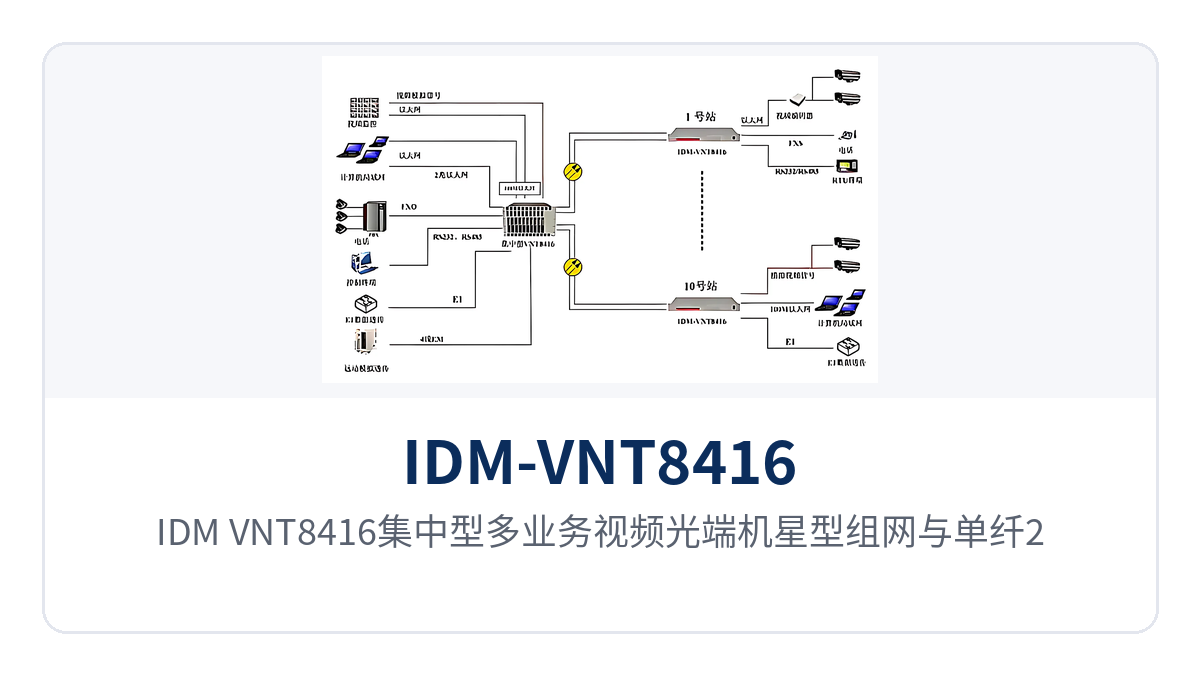
Figure 3: Star networking and single-fiber 20Km multi-service carrying of the IDM-VNT8416 centralized multi-service video optical multiplexer
Electric Power and Rail Transit: Less Worry with Unattended Sites
Substations, distribution rooms, new energy stations, stations along the line and equipment rooms at tunnel portals of the electric power and rail transit sectors are distributed along the route, with station spacing often exceeding several kilometers. Most points are unattended, and each station has both cameras and a monitoring terminal, and also telephones and an in-station network. The IDM-VNT8416 10-station centralized multi-service optical multiplexer multiplexes the station's 8 video channels, 16 channels of voice or data, 4-channel E1 transparent transmission, 4-channel shared 100M Ethernet and high-fidelity audio onto a single optical fiber to the centralized control center, and monitoring data and video images share one link; the 2 PRU boards in 1+1 mutual backup and the industrial-grade -40 °C to +85 °C wide-temperature configuration of the central unit address, respectively, the need to avoid a link interruption at substation main control and the environmental requirements of outdoor equipment boxes. One unit aggregates up to 10 stations, which makes the equipment room easier to manage. The solution also applies to site interconnection between underground and surface sites in a smart mining communication solution.
Public Security and the Military: Stable Operation of Field Private Networks
Camps, remote duty posts, checkpoints and temporary field outposts of public security and the military are usually connected by a self-built optical cable, which requires closed-loop transmission of services over their own lines with the link little affected by external factors, while air conditioning and permanent on-site attendance are unavailable in the field. The IDM-VNT8416 10-station centralized multi-service optical multiplexer multiplexes 8 video channels, 16 channels of voice or data, 4-channel E1 transparent transmission, 4 groups of high-fidelity audio and 4-channel shared 100M Ethernet onto a single fiber core of its own, and the link does not pass through the public network in between; the industrial-grade -40 °C to +85 °C range and the three power supply modes AC220V/DC-48V/DC 9V suit the installation conditions of camp cabinets and field sites, and the 2 PRU boards in 1+1 mutual backup on the central side ensure that the main control is not interrupted by a single board failure. This architecture is also an ideal choice for rapid deployment and service convergence in multi-service transmission in a military emergency communications vehicle solution.
Broadcasting and Mines: Worry-Free Long-Distance Video Backhaul
Transmitting stations, mine pitheads, belt conveyor corridors and material yards of broadcasting and mining operations are far apart, with heavy dust and large temperature differences, and the video surveillance sites are numerous and scattered, so the images need to be reliably backhauled to the dispatch center or surveillance center, while duct resources are often limited on site. The IDM-VNT8416 10-station centralized multi-service optical multiplexer has a standard configuration of 20Km single-mode transmission: a single fiber core backhauls 8 video channels together with 16 channels of voice or data, 4-channel E1 transparent transmission and 4-channel shared 100M Ethernet, and one unit on the central side can correspond to up to 10 remote stations; online network management lets the center view the operating status and alarms of the equipment at each station, reducing the inspection frequency for trips to the site. For mining area scenarios, the device can serve as the core transmission node of a smart mining communication solution, achieving stable interconnection between pitheads, corridors and the dispatch center.
Differentiated Value: 10-Station Aggregation, 1+1 Mutual Backup and Industrial-Grade Wide Temperature
The correspondence between the differentiated capability of the IDM-VNT8416 10-station centralized multi-service optical multiplexer and Customer Value is shown in the table below. As a representative product of Raytrans in the field of multi-service optical multiplexers, it presents a significant advantage of centralized networking in product showcases.
| Differentiation Point | Corresponding Capability and Specifications | Customer Value |
|---|---|---|
| 10-Station Aggregation | One unit on the central side can correspond to up to 10 remote stations and forms a star network with the USER boards at each station, so site services are restored and dispatched at one point on the central side | A single centralized unit can correspond to up to 10 remote stations and saves equipment room space: the equipment room does not need to dedicate a central unit and a cabinet slot to each station, and the 10 optical fiber services are managed at one point |
| 1+1 Mutual Backup | The central unit is configured with 2 PRU boards in 1+1 mutual backup, together with comprehensive alarm functions and network management functions for online real-time monitoring | 1+1 mutual backup of the PRU boards makes services uninterrupted, safer and more reliable: if a single main control board is abnormal, the services continue to be carried by the backup board, and the central side does not need to stop for switchover |
| Industrial-Grade Wide Temperature | Industrial-grade configuration with an operating temperature of -40 °C to +85 °C, a relative humidity of 0 to 95% (non-condensing) and an overall power consumption of ≤150 W | Industrial-grade -40 °C to +85 °C suits the harsh environment of field sites: outdoor equipment boxes and unattended sites can remain in long-term online operation without air conditioning, reducing how often a maintenance visit to the site is needed |
| 20Km Single-Mode | The optical interface has a standard configuration of 20Km single-mode and a receive/transmit rate of 1.5 Gbps, and long-distance optical modules can be optionally installed to extend the transmission distance | A single fiber core reaches 20Km from the site to the center, so laying optical cables separately for surveillance images, telephone voice, E1 trunks and network data is unnecessary, which is especially suitable for sections where duct resources are tight |
| Online Network Management | Complete alarm functions and network management functions allow online real-time monitoring, and the center can view the station and board status | For distributed sites, most status checks and alarm confirmations can be completed at the center, reducing the time spent on on-site inspection and fault location |
Summary
The IDM-VNT8416 10-station centralized multi-service optical multiplexer multiplexes 8 video channels, 16 channels of voice or data, 4-channel E1 transparent transmission, 4 groups of high-fidelity audio and 4-channel shared 100M Ethernet onto a single optical fiber for transmission. One unit on the central side can correspond to up to 10 remote stations, which saves equipment room space and fiber cores; the 2 PRU boards in 1+1 mutual backup, together with comprehensive alarm functions and online network management, keep the central side from interruption by an abnormal single main control board; the industrial-grade -40 °C to +85 °C wide temperature range, 20Km single-mode and the three power supply modes AC220V/DC-48V/DC 9V suit unattended sites in the field for long-term operation. For selection, check the site distribution, the service channel list, the transmission distance and the temperature and power supply conditions item by item, and the voice and data interface cards can be configured for the project as required.