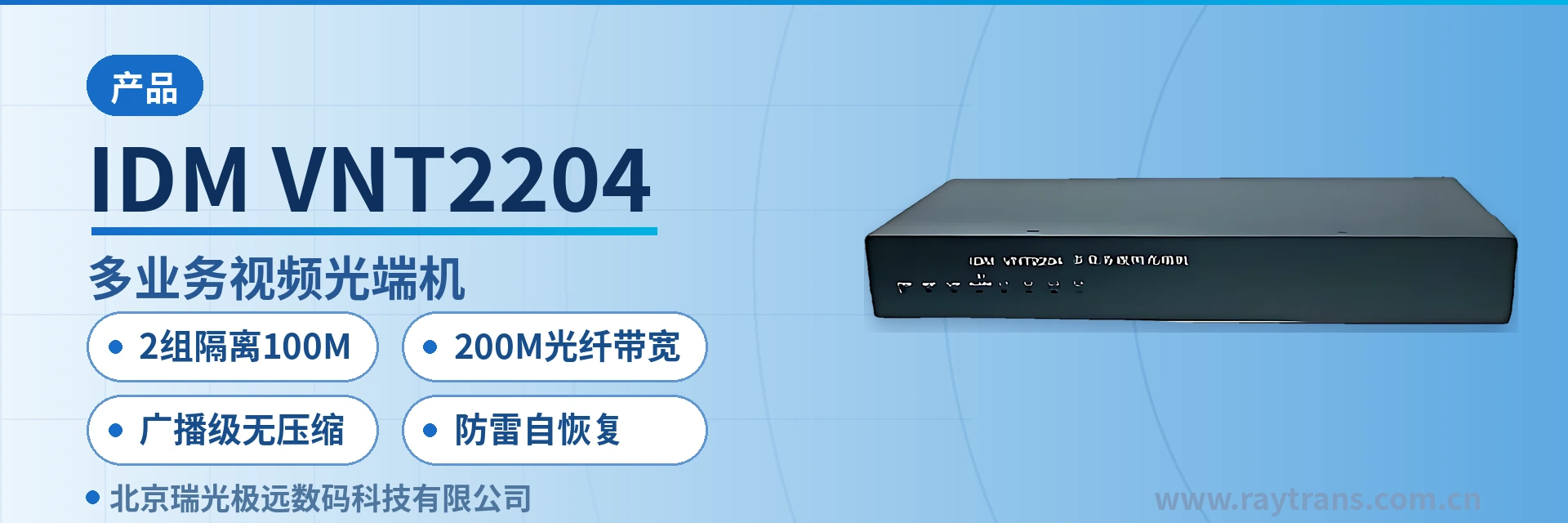
IDM-VNT2204 Multi-Service Video Optical Multiplexer
Two groups of 100M physically isolated interfaces, one fiber carrying video, voice, and data, eliminating one switch
The IDM-VNT2204 multi-service video optical multiplexer adopts advanced all-digital uncompressed video transmission technology for high-quality video transmission results. It transmits two unidirectional standard-definition video channels (or one bidirectional video channel) over an optical fiber line, with two groups separately sharing 1
The multi-service video optical multiplexer is a transmission device that multiplexes video, Ethernet, voice, and low-speed data into a single optical fiber and restores them into various service interfaces at the opposite end. It is a highly integrated product showcase type within the optical multiplexer product line. The IDM-VNT2204 multi-service video optical multiplexer is developed by Beijing Ruiguang Jiyuan Digital Technology Co., Ltd. (Raytrans). It adopts all-digital uncompressed video technology to transmit 2-channel unidirectional standard-definition video (or 1-channel bidirectional video) and 2 groups of physically isolated 100M Ethernet over a pair of optical fibers, while carrying voice and data services simultaneously. As a professional video optical multiplexer and multi-service optical multiplexer, the device can also be used to build access-layer transmission in a government private network optical fiber communication solution.
Key Specifications at a Glance: Video channel 2-channel unidirectional (or 1-channel bidirectional) · Video mode all-digital uncompressed · Ethernet 2 groups of isolated 100M, 200M optical fiber bandwidth · Voice 4-channel (telephone or EM 2/4-wire audio) · Data 2-channel RS232/RS485 · Video format NTSC/PAL/SECAM
What kind of device is the IDM-VNT2204 multi-service video optical multiplexer?
The IDM-VNT2204 multi-service video optical multiplexer has a total of 200M Ethernet bandwidth on the optical path, shared by 2 groups of 100M wire-speed Ethernet channels, each group providing 2 physical interfaces on the device. The two groups do not share bandwidth or exchange data, and devices connected to the two networks are isolated from each other at the link layer. This is where it differs from ordinary optical multiplexers that divide VLANs through configuration.
This structure targets departments that require "2 groups of physically isolated 100M bandwidth Ethernet": the office network and the production network each use one group, and a single optical fiber carries both networks simultaneously. The unit adopts a compact design with a small form factor, allowing flexible installation in narrow spaces such as cabinets and roadside equipment boxes, so the site side no longer needs to lay separate optical cables for each network.
The video side adopts all-digital uncompressed video transmission. Video signals are sent into the optical channel without compression encoding, and picture quality can reach broadcast-grade standards while audio quality can reach CD-grade standards, compatible with NTSC, PAL, and SECAM formats. The device features automatic gain control (AGC) and adopts a self-recovering fuse circuit design with lightning protection. It supports video lossless regenerative repeater, and its transparent data encoding makes it compatible with the products of major camera manufacturers.
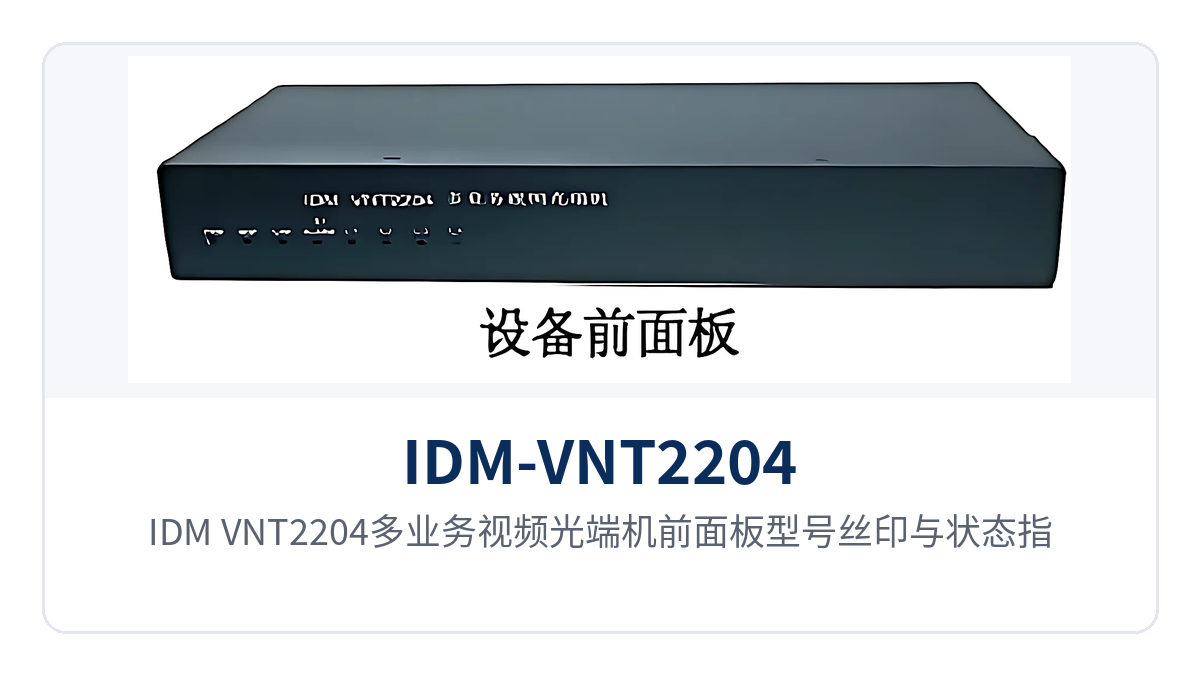
Figure 1: Model silkscreen and status indicator LEDs on the front panel of the IDM-VNT2204 multi-service video optical multiplexer
What services can one device carry?
The IDM-VNT2204 multi-service video optical multiplexer consolidates four types of services—video, Ethernet, voice, and data—into the same compact device, so the site side no longer needs to stack single-function devices for each service type. As a highly integrated multi-service optical multiplexer, its functional composition is listed item by item in the table below, and the number of interfaces should be checked against the project service list.
Function | Description |
|---|---|
All-digital uncompressed video | Video goes directly onto the optical fiber without compression encoding, free from the intermodulation interference of analog FM optical multiplexers, and picture details are not lost to encoding and decoding |
2-channel video input | Provides 2-channel unidirectional standard-definition video, configurable as 1-channel bidirectional video, supporting high-resolution still and motion image transmission |
2 groups of isolated 100M Ethernet | 2 groups of 100M wire-speed Ethernet channels are physically isolated, each group with 2 physical interfaces, totaling 200M bandwidth over the optical fiber |
Voice service access | 4 voice interfaces, connectable to telephones or EM 2/4-wire audio, of which 2 are automatic telephone services |
Data and control access | 2 RS232/RS485 interfaces and 1 control data channel, used to control devices such as PTZ at the opposite end |
Optional expansion | Optional 2-channel Ethernet and 2-channel high-fidelity audio access, configured according to project interface requirements |
Format compatibility | Compatible with NTSC, PAL, and SECAM video formats, adapting to front-end cameras of different formats |
Automatic gain control | Features automatic gain control (AGC), keeping video signals stable over long-distance links |
Lightning protection and self-recovery | Self-recovering fuse circuit design with lightning protection, automatically recovering after line abnormality and reducing the risk of lightning strike damage |
Video lossless regenerative repeater | Supports video lossless regenerative repeater, so picture quality does not degrade after segmented extension over long-distance links |
Compact structure | Compact design of the complete unit with a small form factor and flexible, convenient installation, suitable for installation in cabinets and equipment boxes |
IDM-VNT2204 multi-service video optical multiplexer technical specifications
Interface types, service capacity, and video specifications are listed according to the manufacturer's product documentation. The rear panel of the device centrally houses the video, Ethernet, voice, and data interfaces as well as the power supply terminals. During project selection, check each item against this table; the optical interface type and transmission distance not listed in the table are subject to the manufacturer's technical documentation and commercial confirmation.
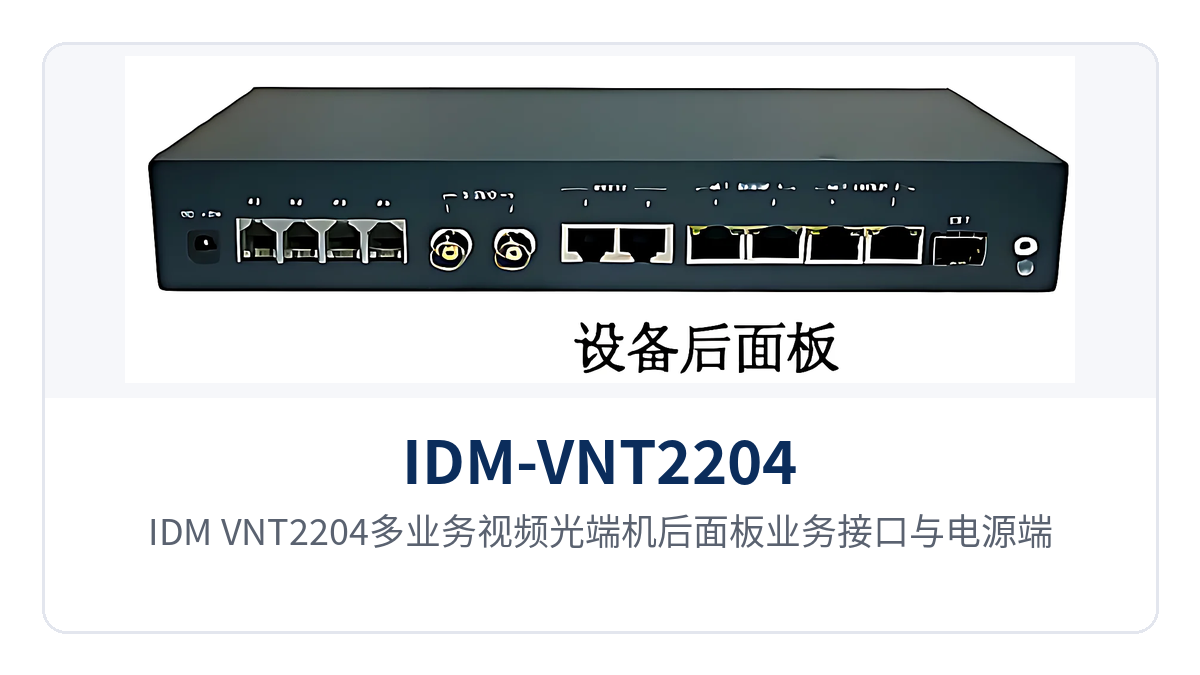
Figure 2: Layout of service interfaces and power supply terminals on the rear panel of the IDM-VNT2204 multi-service video optical multiplexer
Item | Parameter/Specification | Description/Applicable Conditions |
|---|---|---|
Video channel | 2-channel unidirectional video, or 1-channel bidirectional video | Standard definition (SD) video, used in pairs at the transmit and receive ends |
Video transmission mode | All-digital uncompressed video | Direct transmission without compression encoding |
Video quality | Broadcast-grade standard | Supports high-resolution still and moving image transmission |
Video format | NTSC, PAL, SECAM | Compatible with all three formats |
Audio quality | CD-grade standard | Restoration quality of voice and audio channels |
Ethernet capacity | 2 groups of isolated 100M, 200M optical fiber bandwidth | 2 physical interfaces per group, the two groups physically isolated, wire-speed 100M per group |
Optional services | 2-channel Ethernet, 2-channel high-fidelity audio | Optional according to project interface requirements |
Voice interface | 4-channel (telephone or EM 2/4-wire audio) | 2 of them are automatic telephone service; the specific interface configuration is subject to the manufacturer's documentation |
Data interface | 2-channel RS232/RS485 | For data acquisition and PTZ control at the opposite end |
Protection design | Self-recovering fuse circuit with lightning protection | Automatically recovers after line abnormality |
Gain control | Automatic gain control (AGC) | Stable video signal over long-distance links |
Transmission capability | Supports video lossless regenerative repeater | The specific transmission distance and optical interface type are subject to the manufacturer's technical documentation and commercial confirmation |
Structure and installation | Compact design, small structure | Flexible and convenient installation |
How Is Physically Isolated Ethernet Implemented in a Video Optical Multiplexer?
How physically isolated Ethernet is implemented in a video optical multiplexer: each Ethernet group is assigned an independent transmission channel between the two devices. The IDM-VNT2204 multi-service video optical multiplexer carries 2 groups of wire-speed 100M Ethernet on separate channels, with a total of 200M bandwidth over the optical fiber. The two groups do not share bandwidth or exchange data, and the two networks are isolated from each other at the link layer.
Compared with dividing VLANs on a switch, physical isolation does not depend on configuration and is not affected by misoperations on the management port. For public security, electric power and similar organizations that require the surveillance network and the service network to be transmitted separately, a single optical fiber carries both networks, so no separate optical cable needs to be laid for each network, and the wiring and points of failure in the equipment room are reduced accordingly. Such scenarios are common networking requirements in government private network optical fiber communication solutions, and Raytrans can provide the corresponding product showcase and selection support.
How Is Point-to-Point Direct Fiber Connection Networked?
Point-to-point networking requires no intermediate transmission device: deploy one IDM-VNT2204 multi-service video optical multiplexer at each end and connect them directly with a single optical fiber to achieve bidirectional transmission of video, voice and control signals. Cameras, telephones and PTZ control lines are connected at one end, while a large display and a dispatch keyboard are connected at the other end, and the two Ethernet groups are connected to the two networks that need to be isolated.
On-duty personnel can control the PTZ at the opposite end through the plug-in board or the joystick. The device supports video and voice binding, so the corresponding voice channel is invoked together when the image is switched. This networking does not rely on intermediate devices, features a clear link and few points of failure, and suits sites where the monitoring point is far from the duty room and a single optical fiber needs to send video, voice and network back together.
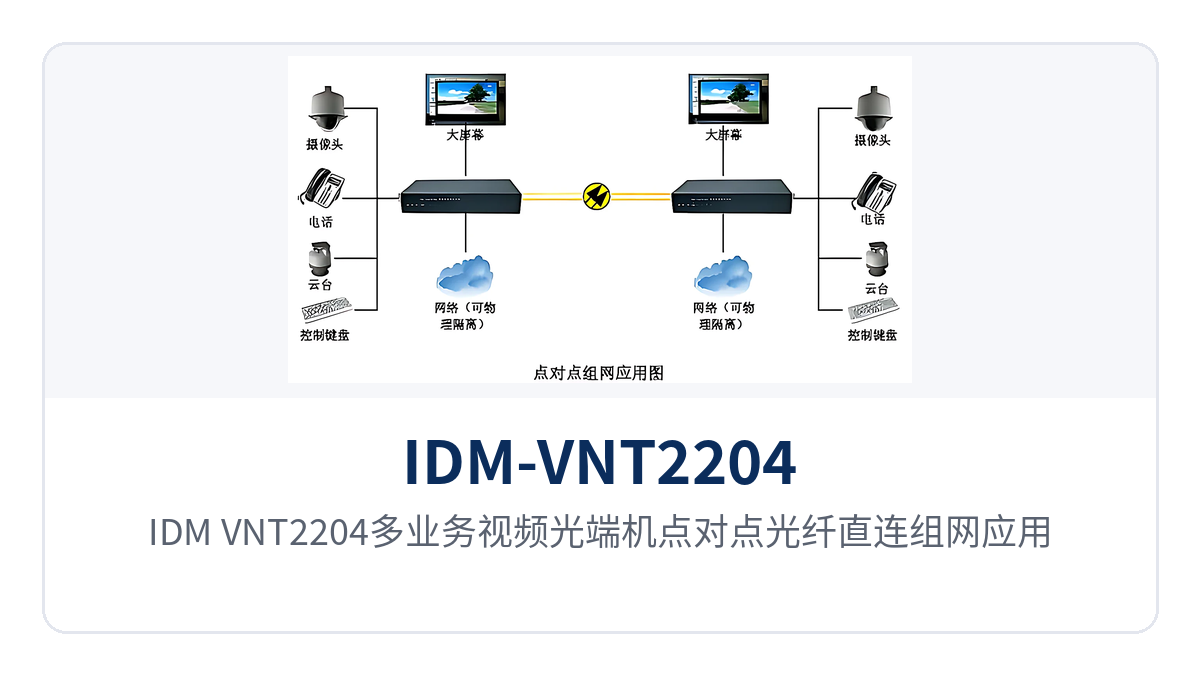
Figure 3: Point-to-point direct fiber connection networking application diagram of the IDM-VNT2204 multi-service video optical multiplexer
How Does a Video Optical Multiplexer Build a Point-to-Multipoint Star Network?
How a video optical multiplexer builds a point-to-multipoint star network: a centralized multi-service transmission device acts as the central node and multiple IDM-VNT2204 multi-service video optical multiplexers act as remote stations. The device can interoperate with the VNE board of the IDM MSAP-CP to form a point-to-multipoint star network, with multiple remote video and voice channels aggregated at the control center.
The control center can display multi-view video on a large display, and the dispatch console can control the PTZ at the opposite end through the keyboard or joystick, with the video and voice binding function also available. Remote voice can be accessed through the IDM MSAP-CP via the E1 interface to PCM equipment, or directly through 64 kbit/s service access, which suits projects with scattered front-end sites that need unified aggregation to the surveillance center. In government private network optical fiber communication solutions, such star networking together with telephone optical multiplexers and other equipment meets the construction requirements for unified aggregation of multi-level organizations, and Raytrans, as an optical multiplexer manufacturer, can provide a complete product showcase and technical consultation.
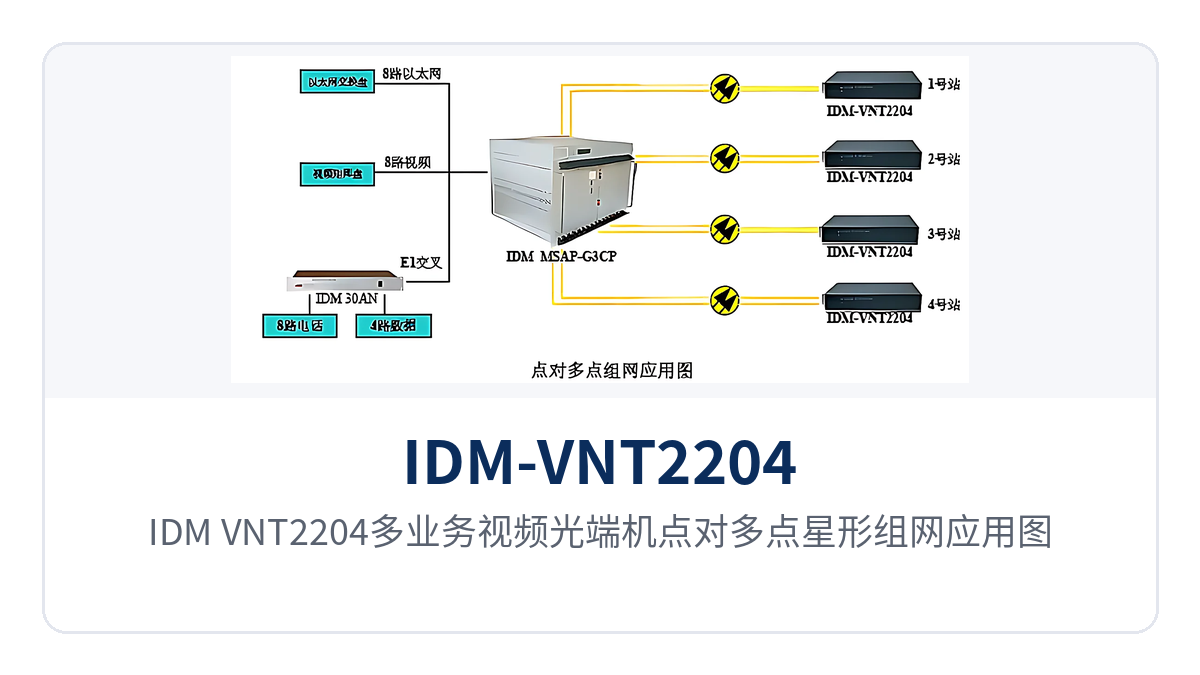
Figure 4: Point-to-multipoint star networking application diagram of the IDM-VNT2204 multi-service video optical multiplexer
Typical Application Scenarios
Public Security and Traffic Police Road Video Private Network
In the road video private network of public security and traffic police, the intersection cameras and checkpoint equipment are far from the command center, and the surveillance network and the public security service network must be carried separately. The IDM-VNT2204 multi-service video optical multiplexer sends 2-channel SD video and 2 groups of isolated 100M Ethernet over a single optical fiber at the same time, so only one optical cable is needed between the intersection equipment box and the command center. The requirements of such government private network optical fiber communication solutions for carrying isolation and long-distance backhaul are exactly covered by one multi-service optical multiplexer.
Video uses broadcast-grade uncompressed transmission, and the accident scene images are sent back without a compression stage, so the details can be used for evidence comparison; 2-channel RS232/RS485 and 1 control data channel are used for intersection device control, and the 4-channel voice interfaces can connect duty booth telephones. The device supports video lossless regenerative repeater, so image quality does not degrade after the long-distance link is extended in sections.
Electric Power and Energy Industrial Monitoring Private Network
The cameras, dispatch telephones and acquired data at substations, distribution rooms and energy station sites are distributed across different sites, where the electromagnetic environment is strong and the field cabinets are unattended all year round. The IDM-VNT2204 multi-service video optical multiplexer sends video onto the optical fiber in an all-digital manner, with no electromagnetic interference (EMI) or radio frequency interference (RFI) on the link, so the image is not disturbed by equipment in the station.
The self-recovering lightning protection fuse circuit and automatic gain control of the device target exactly such field lines: after a lightning strike or line abnormality, the protection circuit recovers automatically, reducing the trouble of on-site device replacement after every failure; the two isolated Ethernet groups carry the production monitoring network and the management network respectively without affecting each other. As a multi-service model in the video optical multiplexer product line, it aggregates video, voice and data together over the same pair of optical fibers.
Rail Transit and Expressway Line Monitoring
Rail transit sections and expressway lines have scattered sites and long distances, and the equipment at tunnel portals, toll stations and maintenance work areas often shares one already-laid optical cable. The IDM-VNT2204 multi-service video optical multiplexer concurrently provides 2-channel video, 2 groups of isolated 100M Ethernet, 4-channel voice and data services over one optical fiber, so no additional optical cable needs to be laid for new sites.
Long-distance links along the line can be extended in sections with video lossless regenerative repeater, and the 200M optical fiber bandwidth is allocated between the two service groups, with surveillance video in one group and the toll and office networks in the other. The compact structure makes it easy to install in roadside equipment boxes, and both installation and later replacement are relatively convenient.
What On-Site Problems Do the Four Capabilities Solve Respectively?
The correspondence between the short selling-point labels and the on-site problems is listed item by item in the table below, which can be used to compare against project pain points during selection. Each of the four capabilities has its own focus; checking them item by item makes it easier to finalize the configuration than a general comparison. The technical support in the table is taken from the equipment product documentation; for engineering details, the technical documentation and commercial confirmation of the optical multiplexer manufacturer shall prevail.
Differentiation Point | Technical Support | On-Site Value |
|---|---|---|
2 groups of isolated 100M | 2 groups of 100M wire-speed Ethernet channels, physically isolated, with 2 physical interfaces per group | The surveillance network and the service network each use one group, requiring less cabling and suffering less interference in networking, and the two networks do not interconnect |
200M optical fiber bandwidth | The 2 groups of channels total 200M bandwidth over the optical fiber, with 100M wire-speed per group | One optical fiber carries two networks, eliminating the need to lay a separate optical cable for each network |
Broadcast-grade uncompressed | All-digital uncompressed video transmission, with video quality reaching broadcast-grade standards | The picture does not undergo compression encoding and decoding, so both detail and latency are controllable, and long-distance backhaul does not degrade image quality |
Self-recovering lightning protection | Lightning protection with a self-recovering fuse circuit and automatic gain control (AGC) | After a lightning strike or line abnormality at an unattended equipment room in the field, the device can recover automatically, reducing on-site maintenance |
Selection and Deployment Recommendations
During selection, first determine the interfaces according to the on-site service list: when only 2 channels of video are needed, choose the unidirectional configuration; when bidirectional transmission is required, choose 1-channel bidirectional video. If there are two networks on site that need to be isolated, connect the 2 groups of isolated 100M channels to the corresponding networks respectively, and plan traffic at 100M wire-speed per group.
Voice is configured as telephone or EM 2/4-wire audio as needed, and data is calculated according to the number of RS232/RS485 interfaces; when the link exceeds the usable distance of a single segment of optical fiber, use the video lossless regenerative repeater to extend it in segments. For multi-site projects, point-to-multipoint star networking is recommended, with centralized equipment on the central side performing unified aggregation, which facilitates subsequent capacity expansion and centralized maintenance. If the project also involves pure voice access, a telephone optical multiplexer can be added to complete the voice channels, and the entire product showcase can be checked item by item against the service list.