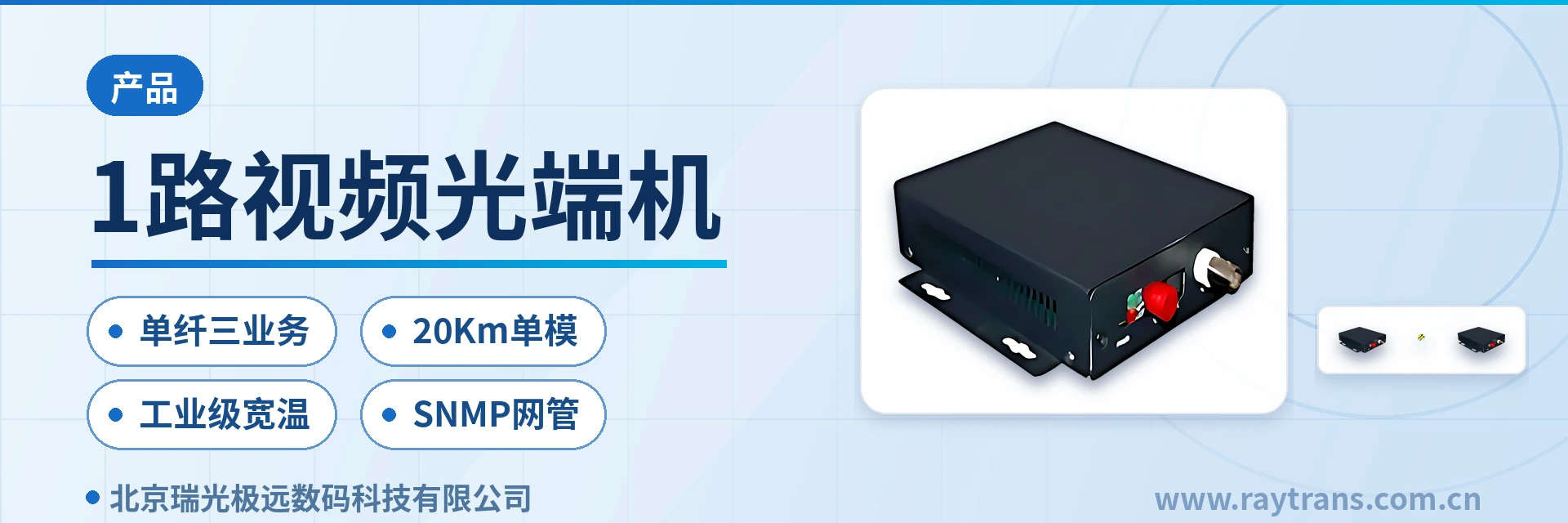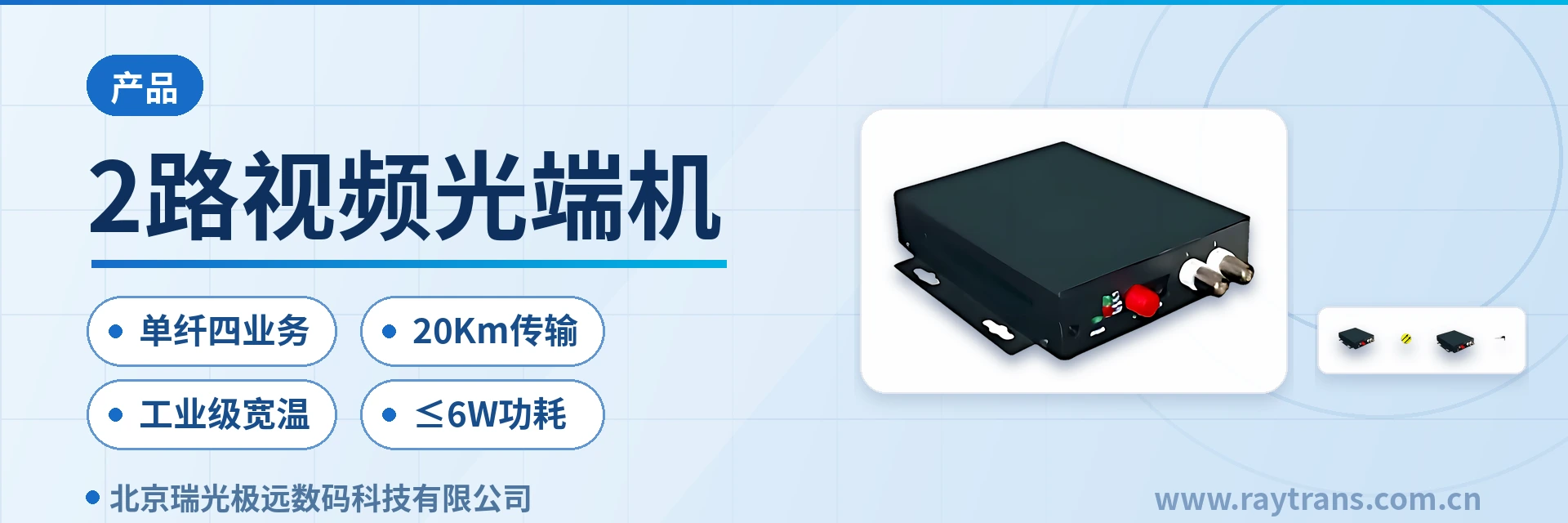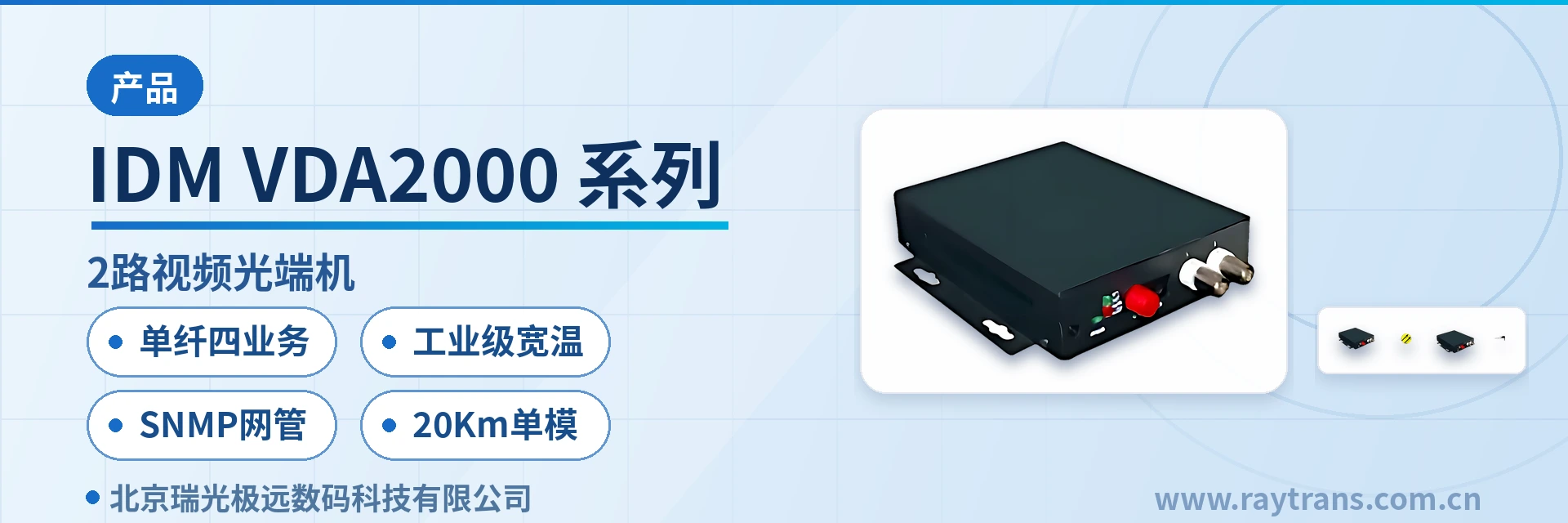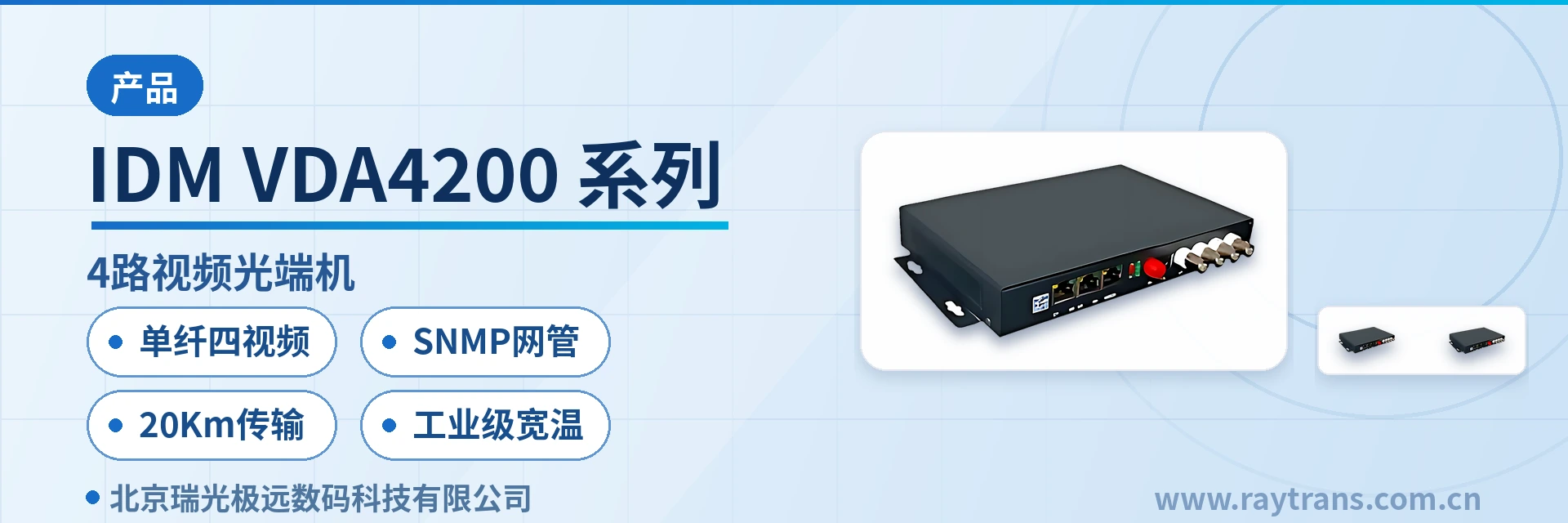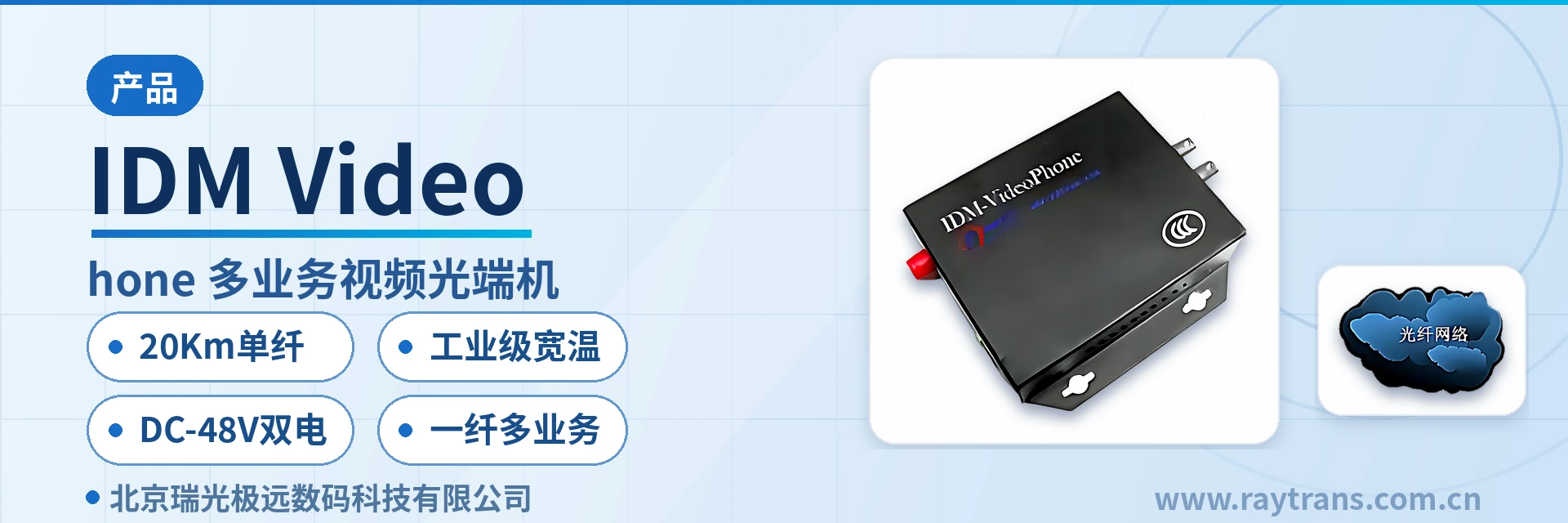
IDM-Video Phone Multi-Service Video Optical Multiplexer
Bidirectional video, 2 telephone channels, 2 data channels over a single fiber, saving three devices
The IDM-Video Phone multi-service video optical multiplexer adopts advanced all-digital uncompressed video transmission technology for high-quality video transmission results. It provides single/bidirectional video, data, telephone, Ethernet and single/dual high-fidelity services. It can support
IDM-Video Phone multi-service video optical multiplexer is a multi-service optical multiplexer product showcase that multiplexes video, telephone, data, and Ethernet services into a single optical fiber for transmission. It is also called a multi-service over a single fiber optical multiplexer based on its transmission characteristics, and is developed by the optical multiplexer manufacturer Beijing Ruiguang Jiyuan Digital Technology Co., Ltd. (Raytrans).
IDM-Video Phone multi-service video optical multiplexer is used in long-distance video transmission scenarios such as video surveillance private networks along power and rail transit lines, Safe City and expressway unattended sites, and military and public security field mobile command communications. Its coverage extends from unattended cabinets along the line to temporary setup mobile command points, making it a commonly used video optical multiplexer in government private network optical fiber communication solutions and military emergency communications vehicle solutions.
IDM-Video Phone multi-service video optical multiplexer adopts all-digital uncompressed video transmission technology, providing single/bidirectional video, data, telephone, Ethernet, and single/dual high-fidelity services. Video quality reaches broadcast-grade standards, audio quality reaches CD-grade standards, and it has a built-in telephone optical multiplexer functional module.
IDM-Video Phone multi-service video optical multiplexer supports high-quality transmission of still and moving images at any high resolution. It belongs to the Video series digital video optical multiplexer and is applicable to optical fiber CCTV network systems, traffic monitoring, industrial monitoring, building monitoring, video conferencing, high-quality video conferencing, and distance learning systems.
Key Specifications at a Glance: Video bidirectional single-channel uncompressed · Telephone 2 channels (FXO/FXS) · Data 2 channels RS-232/RS-422/RS-485 · Ethernet optional 2 channels 10M/100M adaptive · High-fidelity audio optional 2 channels · Optical interface 155M FC · Single-fiber transmission distance 20Km · Power supply AC220V/DC-48V · Power consumption ≤6W · Dimensions 110mm×168mm×28mm
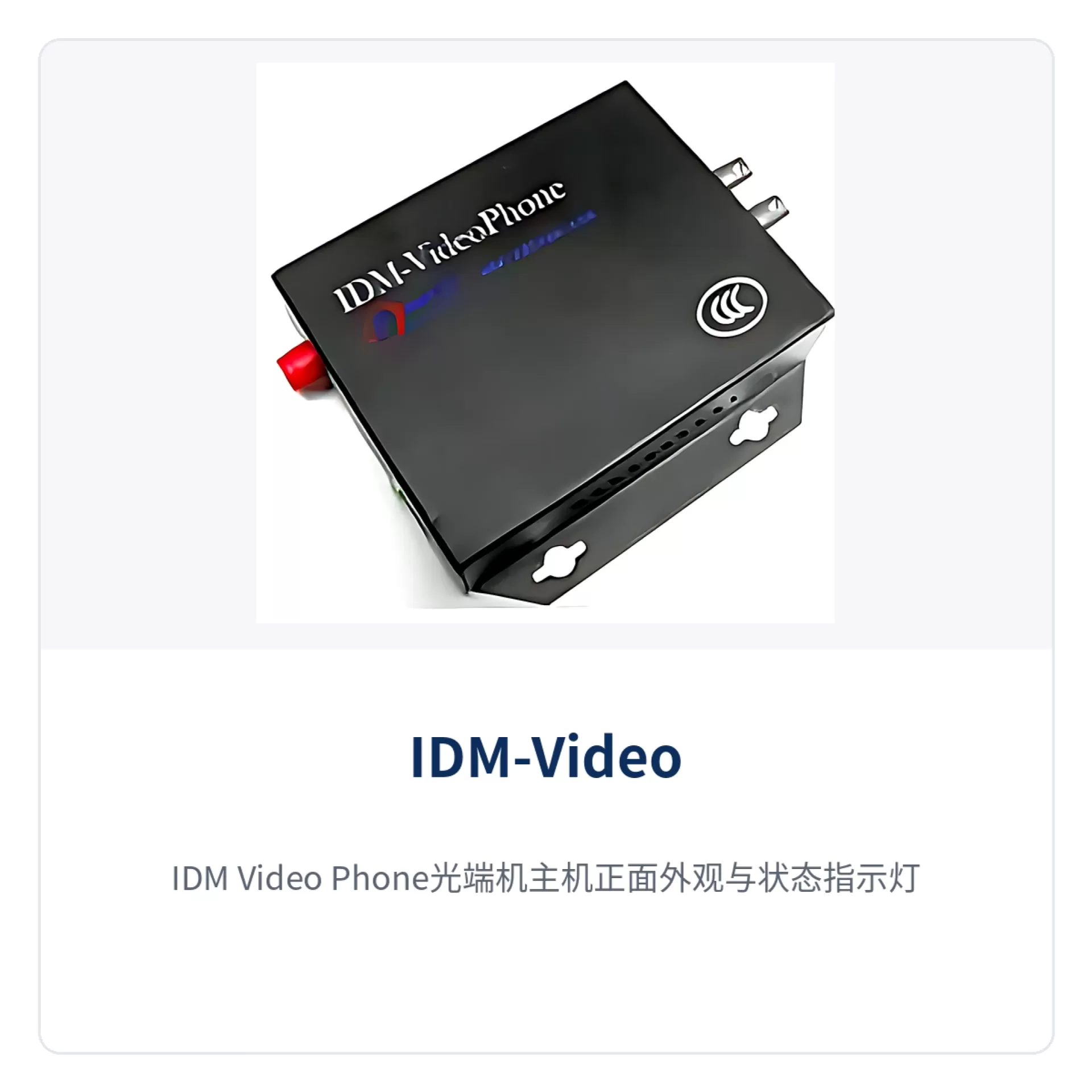
Figure 1: Front view and status indicator LED close-up of the IDM-Video Phone optical multiplexer host
What is a multi-service over a single fiber optical multiplexer?
A multi-service over a single fiber optical multiplexer is an optical multiplexer that packs four types of services—video, telephone, data, and Ethernet—into the same pair of optical fiber transmission channels. It replaces the previous practice of separately deploying video optical multiplexers, telephone optical multiplexers, and data multiplexing equipment, converging the transmission tasks previously accomplished by stacked devices into one device and one optical fiber.
IDM-Video Phone multi-service video optical multiplexer is designed exactly along these lines: the device carries bidirectional single-channel video signals, 2 telephone channels, and 2 data channels over the optical link, with optional 2 Ethernet channels and 2 high-fidelity audio inputs. The site side no longer needs separate transmission devices for video, telephone, and data, simplifying cabling and equipment box space in industrial private networks.
The difference between a multi-service over a single fiber optical multiplexer and an ordinary optical multiplexer that only transmits video lies in the variety of services and the number of interfaces. IDM-Video Phone multi-service video optical multiplexer provides bidirectional single-channel video signals, 2 telephone channels, and 2 data channels. The telephone section provides FXO and FXS interfaces, while the data section provides three types: RS-232, RS-422 (4-wire), and RS-485 (2-wire).
IDM-Video Phone multi-service video optical multiplexer also offers optional 2 Ethernet channels and 2 high-fidelity audio inputs, so video, calls, data acquisition, and network backhaul can be completed simultaneously over one optical fiber link. The interface types and quantities are determined by the on-site service list.
The way a multi-service over a single fiber optical multiplexer maintains high-quality images is through all-digital uncompressed video transmission. The video signal of IDM-Video Phone multi-service video optical multiplexer is sent into the optical channel without compression encoding, avoiding the loss of detail and encoding and decoding delay caused by compression.
IDM-Video Phone multi-service video optical multiplexer has a video sampling bit width of 8bit, a video bandwidth of 0Hz to 6.5MHz, and a video SNR ≥70dB (weighted), compatible with NTSC, PAL, and SECAM formats. Its transparent data encoding makes it compatible with the products of major camera manufacturers.
Core Functions: One Device Multiplexes Video, Telephone, Data, and Ethernet into a Single Fiber
IDM-Video Phone multi-service video optical multiplexer accomplishes the multiplexing and transmission of video, telephone, data, and Ethernet services on one device. The core functions are shown in the table below.
| Function | Description |
|---|---|
| All-digital uncompressed video transmission | Video signals are transmitted over optical fiber in an all-digital manner without compression, with no compression damage, avoiding the intermodulation interference of analog FM/PM optical multiplexers |
| Bidirectional single-channel video input | Provides bidirectional single-channel video signals; video quality reaches broadcast-grade standards and supports high-quality transmission of still and moving images at any high resolution |
| Telephone service access | Provides 2 telephone channels with FXO and FXS interfaces, an audio range of 300Hz to 3400Hz, ITU G.711 A-law compression, and a loop current of 25mA per channel |
| Data service access | Provides 2 data channels with RJ-45 interface type, supporting RS-232, RS-422 (4-wire), and RS-485 (2-wire), with transparent encoding compatible with mainstream cameras |
| Optional Ethernet access | Optional 2 Ethernet channels with RJ-45 interface type, 10M/100M adaptive transmission rate, IEEE802.3 support, and full/half duplex adaptive |
| Optional high-fidelity audio | Optional 2 high-fidelity audio inputs with 16bit audio sampling bit width and 32KHz sampling frequency; audio quality reaches CD-grade standards |
| Format compatibility | Compatible with NTSC, PAL, and SECAM video formats, adapting to front-end cameras of different formats |
| Automatic gain control | Features automatic gain control (AGC) to keep video signals stable over long-distance links |
| Lightning protection and self-recovery protection | Features a self-recovering fuse circuit design with lightning protection; automatically recovers after line abnormality, reducing damage risks from lightning strikes and line abnormalities |
| Video lossless regenerative repeater | Supports video lossless regenerative repeater to extend transmission distance without losing video quality |
| Compact structure | Compact design with small structure and flexible, convenient installation, suitable for deployment in narrow spaces such as equipment boxes and cabinets |
Technical Specifications: Optical Interface, Video, Telephone, Data, Ethernet, and High-Fidelity
The interfaces and specifications of IDM-Video Phone multi-service video optical multiplexer are listed by service category, with optical and electrical ends used in pairs. As a professional optical multiplexer manufacturer, Raytrans fully discloses all technical specifications in its product showcase, making it easy for users to select according to their needs.
Optical Interface Parameters
| Item | Parameter/Specification | Description/Applicable Conditions |
|---|---|---|
| Interface type | FC (SC and others can be customized) | Optical patch cord interfaces are selected according to the on-site optical cable termination method |
| Fiber mode | Single-mode (multimode optional) | 20Km single-mode transmission configuration |
| Receiver receive/transmit rate | 155M/155M | 155M optical interface |
| Receiver receive/transmit wavelength | 1310nm/1550nm | Single-fiber bidirectional dual-wavelength pairing for receive and transmit |
| Transmitter receive/transmit rate | 155M/155M | 155M optical interface |
| Transmitter receive/transmit wavelength | 1550nm/1310nm | Paired with the wavelength at the opposite end |
| Transmit optical power | -15 to -8dBm | Available optical power at the transmit side |
| Receiver sensitivity | Better than -32dBm | Available optical power at the receive side |
| Transmission distance | 20Km | Long-distance optical modules can be optionally installed for longer-distance optical fiber transmission |
Video Interface Parameters
| Item | Parameter/Specification | Description/Applicable Conditions |
|---|---|---|
| Interface type | BNC | 75Ω unbalanced video interface |
| Video sampling bit width | 8bit | All-digital uncompressed sampling |
| Video bandwidth | 0Hz to 6.5MHz | Covers standard-definition video signal bandwidth |
| Luminance non-linearity | <3% | Image luminance distortion specification |
| Differential phase (DP) | <0.7° | Color signal phase distortion specification |
| Differential gain (DG) | <0.7% | Color signal amplitude distortion specification |
| Input overload voltage | 1.5VP-P (typical) | Input-side protection margin |
| Input/output voltage | 1VP-P (typical) | Standard video level |
| Input/output impedance | 75Ω (unbalanced) | Consistent with cameras and display devices |
| Video SNR | ≥70dB (weighted) | Reflects image noise level |
Telephone (FXO/FXS) and High-Fidelity Audio Parameters
| Item | Parameter/Specification | Description/Applicable Conditions |
|---|---|---|
| Telephone interface audio range | 300Hz to 3400Hz | Telephone voice bandwidth |
| Telephone interface impedance | Three-element complex impedance 200Ω+560Ω//0.1μF | Matched with SPC exchanges and telephone side |
| Compression | ITU G.711 A-law | Voice encoding method |
| Loop current | 25mA per channel | Power feeding current per telephone channel |
| High-fidelity interface type | RJ45 | Audio input interface |
| Audio sampling bit width | 16bit | High-fidelity service sampling precision |
| Input/output impedance | ADC:100KΩ/DAC:10KΩ | Audio input/output impedance |
| Input/output voltage | 1.5VP-P (typical) | Audio level |
| Audio sampling frequency | 32KHz | High-fidelity service sampling rate |
| Audio SNR | ≥90dB | Audio quality reaches CD-grade standards |
| Audio bandwidth | 20Hz to 20KHz | Covers the audible frequency range of the human ear |
| Total harmonic distortion | <1% | Sound reproduction distortion |
Data and Ethernet Interface Parameters
| Item | Parameter/Specification | Description/Applicable Conditions |
|---|---|---|
| Data interface type | RJ-45 | Device-side data port |
| Data type | RS-232, RS-422 (4-wire), RS-485 (2-wire) | Selected according to on-site control device interface type |
| Ethernet interface type | RJ-45 | Optional 2 Ethernet channels |
| Ethernet transmission rate | 10M/100M adaptive | Adaptive to the connected network rate |
| Ethernet standard protocol | Supports IEEE802.3 | Compatible with general Ethernet devices |
| Ethernet operating mode | Full/half duplex/adaptive | Negotiated with the opposite-end switch |
Power Supply, Power Consumption, Environmental, and Structural Parameters
| Item | Parameter/Specification | Description/Applicable Conditions |
|---|---|---|
| Power supply mode | AC220V/DC-48V | AC 220V and DC -48V power supply options, convenient for power supply from communications equipment rooms and private network cabinets |
| Overall power consumption | ≤6W | Low power consumption, suitable for long-term online operation |
| Operating temperature | -15℃ to +65℃ | Conventional equipment room and equipment box environments |
| Storage temperature | -25℃ to +75℃ | Warehousing and transportation environments |
| Industrial grade | -40℃ to +85℃ | Industrial-grade wide-temperature configuration, adapting to harsh on-site conditions |
| Relative humidity | 0 to 95% (non-condensing) | Applicable condition for high-humidity environments is non-condensing |
| Product dimensions | 110mm×168mm×28mm (Length×Depth×Height) | Compact design with flexible, convenient installation |
Optional Configurations: Select Interface Combinations by On-Site Service List
IDM-Video Phone multi-service video optical multiplexer supports optional service combinations according to project interface requirements. The optional functions are shown in the table below. Specific configurations are subject to the manufacturer's technical documentation and commercial confirmation. Raytrans can flexibly configure telephone optical multiplexer and video optical multiplexer functional modules based on the actual service list of a government private network optical fiber communication solution or a military emergency communications vehicle solution.
| No. | Brief Description of Optional Functions |
|---|---|
| 1 | 2 Fast Ethernet, 2 telephone |
| 2 | 1 bidirectional video, 1 bidirectional data |
| 3 | 1 bidirectional video, 1 10M Ethernet, 1 telephone, 1 bidirectional data, 1 bidirectional audio |
| 4 | 1 bidirectional video, 1 10M Ethernet, 2 telephone, 1 bidirectional data, 1 unidirectional audio |
Differentiated Value: 20Km Single Fiber, Industrial-Grade Wide Temperature, DC-48V Dual Power and Multi-Service over a Single Fiber
The differentiated value of the IDM-Video Phone multi-service video optical multiplexer centers on four items: single-fiber transmission distance, environmental adaptability, power supply mode and service integration. The corresponding capability and specifications for each item are shown in the table below. Raytrans has long been deeply engaged in the fields of multi-service optical multiplexers and telephone optical multiplexers, and the following advantages are particularly prominent in government private network optical fiber communication solutions and military emergency communications vehicle solutions.
| Differentiated Selling Points | Corresponding Capability and Specifications | Description/Applicable Conditions |
|---|---|---|
| 20Km single fiber | Single-fiber 20Km transmission, receiver sensitivity better than -32dBm, 155M optical interface, transmit optical power -15 to -8dBm | Front-end camera images travel along a single fiber core directly to the surveillance center, with no repeater or routing/switching equipment between adjacent sites; for longer distances, long-distance optical modules can be optionally installed to extend coverage |
| Industrial-grade wide temperature | Industrial-grade -40℃ to +85℃ wide temperature operation, relative humidity 0 to 95% (non-condensing) | Suitable for field cabinets and unattended sites; also usable in outdoor equipment boxes, mounting poles and plants with large temperature fluctuations |
| DC-48V dual power | AC220V/DC-48V dual power supply selectable, overall power consumption ≤6W | Communications equipment rooms and private network cabinets can directly draw DC -48V power, with less pressure on power supply and heat dissipation for long-term online operation |
| Multi-service over a single fiber | Bidirectional single-channel video, 2 telephone, 2 data, optional 2 Ethernet and 2 high-fidelity audio | A single optical fiber replaces multiple single-function transmission devices, simultaneously reducing site wiring, equipment box space and fiber usage |
How to Select a Multi-Service over a Single Fiber Optical Multiplexer?
To select a multi-service over a single fiber optical multiplexer, first check the number and direction of services to be connected against the on-site service list, then determine the optical module configuration and model grade according to transmission distance and environmental conditions, and finally check the power supply mode and installation space. The selection of the Raytrans IDM-Video Phone multi-service video optical multiplexer can proceed along the following three dimensions, helping users quickly lock in the right optical multiplexer model.
Determine the Base Model by Number and Direction of Video Channels
The number and direction of video services determine the base configuration of the device. When images need to be transmitted in both directions between two points, choose the bidirectional single-channel video configuration; when only one image needs to be sent back in one direction, the unidirectional video configuration is sufficient; when the remote image must be sent back on site while the opposite end simultaneously sends back one image, choose the bidirectional video configuration.
The video interface of the IDM-Video Phone multi-service video optical multiplexer is BNC, 75Ω unbalanced, consistent with the video interface forms of common cameras, optical multiplexer transmit/receive ends and display devices; connect according to the input/output direction. As a professional optical multiplexer manufacturer, Raytrans provides complete interface descriptions and wiring diagrams in its product showcase, making it easy for engineering personnel to select models by comparison.
Equip Services by Telephone, Data and Ethernet Interfaces
The number of service interfaces must align with the actual needs of on-site telephones, control devices and the network. The IDM-Video Phone multi-service video optical multiplexer comes standard with 2 telephone and 2 data; telephones connect to an SPC exchange or telephone via FXO and FXS interfaces. For scenarios requiring multiple telephone access, the Raytrans telephone optical multiplexer series can also be selected for flexible expansion.
The data port of the IDM-Video Phone multi-service video optical multiplexer supports three types of interfaces: RS-232, RS-422 (4-wire) and RS-485 (2-wire), and can connect to PTZ control, access control and data acquisition terminals; when the network also needs to be sent back on site, add 2 Ethernet (10M/100M adaptive) and 2 high-fidelity audio connections per the optional configuration list, and a single optical fiber can simultaneously enable video, telephone, data and network services. This multi-service optical multiplexer design is particularly suited to the multi-service convergence transmission needs of government private network optical fiber communication solutions.
Determine the Optical Module and Model Grade by Transmission Distance and On-Site Environment
Transmission distance and environmental conditions determine the choice of optical module and unit grade. The IDM-Video Phone multi-service video optical multiplexer comes standard with 20Km single-mode transmission; for longer distances, long-distance optical modules can be optionally installed to achieve longer-distance optical fiber transmission, and when the link needs to be extended in the middle, a video lossless regenerative repeater can be used.
For outdoor equipment boxes, outdoor mounting poles or plants with large temperature fluctuations, an industrial-grade wide-temperature configuration (-40℃ to +85℃) is recommended, and confirm whether the power supply mode is AC220V or DC-48V. Before installation, also check whether the 110mm×168mm×28mm unit dimensions match the on-site installation position; the compact structure makes it easy to fit into narrow equipment boxes or cabinets. As an experienced optical multiplexer manufacturer, Raytrans provides detailed model specification comparisons on its product showcase pages, helping users quickly determine the configuration grade according to the actual environment.
How to Calculate a Single-Fiber 20Km Repeaterless Link, and How to Extend It When the Distance Is Insufficient?
The transmission distance of a multi-service over a single fiber optical multiplexer depends on the margin among the optical module's transmit optical power, receiver sensitivity and line loss. The IDM-Video Phone multi-service video optical multiplexer comes standard with single-fiber 20Km transmission, corresponding to a 155M optical interface, transmit optical power of -15 to -8dBm, and receiver sensitivity better than -32dBm.
The available optical power margin left between the two ends of the IDM-Video Phone multi-service video optical multiplexer is the margin portion of the link budget; the actual achievable distance must also be calculated in combination with factors such as optical cable loss, the number of fiber adapters and splice points, and termination quality.
A single-fiber 20Km link can extend its coverage in three ways: first, install long-distance optical modules to achieve longer-distance optical fiber transmission; second, use a video lossless regenerative repeater to segment the long link and amplify it through regeneration, so that video quality does not degrade due to regeneration; third, first measure the received optical power on site, then decide based on the measured value whether to add a repeater or replace the optical module.
In engineering practice, it is recommended to leave a certain optical power margin at both ends of the link to avoid insufficient link margin after optical cable aging or connector contamination. Transmission distance calculation should be considered together with service direction; the IDM-Video Phone multi-service video optical multiplexer simultaneously carries video, telephone, data and Ethernet services over a single optical fiber, and a link interruption affects all services, so the design phase should incorporate the optical cable route, the number of patch points and spare fiber cores into the solution. In government private network optical fiber communication solutions and military emergency communications vehicle solutions, accurate calculation of the link budget is particularly critical, and Raytrans can provide targeted technical support.
For lines with high reliability requirements, spare fiber cores and backup devices can be reserved in the solution to facilitate fast switchover when a failure occurs.
How Much Power Does a Multi-Service over a Single Fiber Optical Multiplexer Consume, and How to Choose Power Supply and Environmental Conditions?
The overall power consumption of a multi-service over a single fiber optical multiplexer is ≤6W, with power supply modes of AC220V/DC-48V. Operating temperature range, power supply mode and line protection together determine whether the device can operate online over the long term at unattended sites.
The industrial-grade configuration of the IDM-Video Phone multi-service video optical multiplexer covers an operating temperature of -40℃ to +85℃, with a standard operating temperature of -15℃ to +65℃, a storage temperature of -25℃ to +75℃, and a relative humidity of 0 to 95% (non-condensing). The device can be used in outdoor equipment boxes, plant mounting poles and equipment rooms with large temperature fluctuations.
Power supply modes support AC220V and DC-48V; communications equipment rooms and private network cabinets can directly draw DC -48V power, and an overall power consumption of ≤6W puts less pressure on cabinet power supply and heat dissipation. The IDM-Video Phone multi-service video optical multiplexer adopts a self-recovering fuse circuit design with lightning protection; after protection is triggered by a lightning strike or line abnormality, the circuit can recover automatically, reducing downtime caused by manual replacement of fuse components.
Wide-temperature and line protection conditions need to be determined at the design stage together with the optical cable laying method. Aerial optical cables or those laid along poles are more likely to be affected by induced lightning current; for such routes, equipotential grounding treatment is recommended inside the equipment boxes at both ends, and industrial-grade models should be selected according to the on-site environment. Point-to-point links inside equipment rooms usually meet requirements with a standard temperature grade, and the construction quality of power and ground lines also affects long-term operation performance of the device. Raytrans, as an optical multiplexer manufacturer, clearly marks the power consumption and environmental parameters of each model in its product showcase, making it easy for users to select models as needed.
How to Wire and Deploy a Multi-Service over a Single Fiber Optical Multiplexer?
The wiring of a multi-service over a single fiber optical multiplexer can be matched item by item according to service type: video over BNC coaxial, telephone over telephone cable, data over data cable, Ethernet over network cable, and the optical path over optical fiber patch cords, with both ends configured as a pair. The on-site wiring correspondences of the IDM-Video Phone multi-service video optical multiplexer are shown in the table below.
| Service | Equipment-Side Interface | On-Site Connection | Description |
|---|---|---|---|
| Video | BNC, 75Ω unbalanced | Camera, optical multiplexer, display device | Connect according to the on-site signal flow direction for input/output |
| Telephone | FXO, FXS | SPC exchange, telephone | Audio range 300Hz to 3400Hz, A-law companding in ITU G.711 |
| Data | RJ-45 | PTZ controller, access control and data acquisition terminal | Wire according to RS-232, RS-422 (4-wire), RS-485 (2-wire) |
| Ethernet (optional) | RJ-45 | Switch, network camera | 10M/100M adaptive, full/half duplex adaptive |
| High-fidelity audio (optional) | RJ45 | Audio terminal, broadcast equipment | Audio sampling frequency 32KHz, signal-to-noise ratio ≥90dB |
| Optical path | FC (SC and others can be customized) | Optical fiber patch cord, optical cable | Single-mode 20Km, transmit and receive wavelengths 1310nm/1550nm paired |
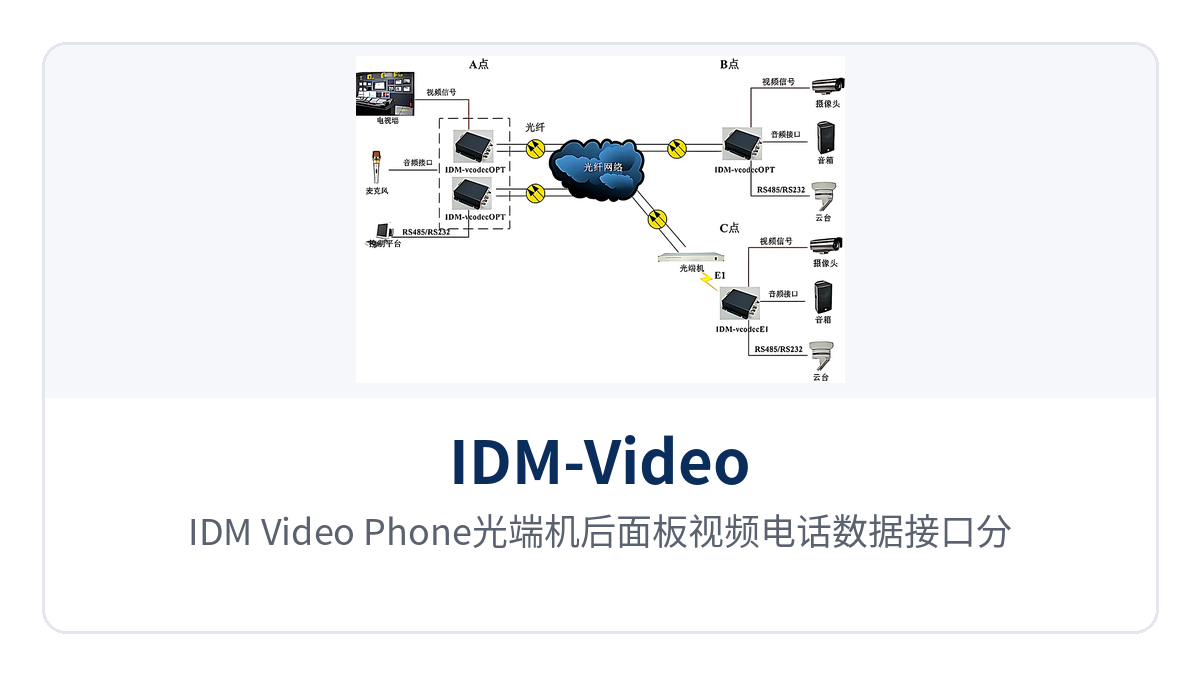
Figure 2: Close-up of the video, telephone and data interface layout on the rear panel of the IDM-Video Phone optical multiplexer
The deployment of the IDM-Video Phone multi-service video optical multiplexer is mainly point-to-point direct connection. Deploy one device at each end, connect them directly with a single optical fiber, connect a camera, telephone, control device and network at one end, and connect a display device, switch and telephone network at the other end, to complete end-to-end transmission of video, telephone, data and Ethernet.
Point-to-point direct connection offers clear networking and few points of failure, and is suitable for occasions where the distance between a monitoring point and a duty room is relatively long and multiple types of services need to be sent back together. During deployment, first complete the device power-on self-test and confirmation of the received optical power on the optical path, then enable video, telephone, data and network services item by item; when on-site capacity expansion is needed, simply add Ethernet and high-fidelity audio interfaces per the optional configuration list. In military emergency communications vehicle solutions, such a rapidly deployable multi-service optical multiplexer with complete interfaces is particularly important, and Raytrans can provide complete product showcases and solution support for video optical multiplexers and multi-service optical multiplexers.
Typical Application Scenarios
Video Surveillance Private Network Along Electric Power and Rail Transit Lines
The monitoring points of electric power and rail transit are distributed across substations, traction substations, pump stations and along the lines, with large spacing between stations and most being unattended; cabinets usually have no air conditioning or permanent staff. The IDM-Video Phone multi-service video optical multiplexer uses a single optical fiber to send back bidirectional single-channel video, 2 telephone, 2 data and optional 2 Ethernet to the dispatch end together; as a multi-service convergence product in the optical multiplexer family, a single device can achieve the composite access capability that previously required multiple product showcases.
On-site images, dispatching calls, device status data and network services share a single fiber core, eliminating the need to lay separate lines for each type of signal, and reducing duct occupation and excavation along the route accordingly. The device's industrial-grade operating temperature covers -40℃ to +85℃ and relative humidity 0 to 95% (non-condensing), and it can be deployed as an industrial-grade wide-temperature model in field cabinets and outdoor equipment boxes, adapting to environments with large temperature differences between winter and summer along the route.
Safe City and Expressway Unattended Sites
The monitoring points of Safe City and expressways are distributed in a belt along the route, and the distance from intersection equipment boxes to the surveillance center often exceeds the usable range of coaxial cable and twisted pair. The single-fiber 20Km repeaterless capability of the IDM-Video Phone multi-service video optical multiplexer can cover the typical distance between adjacent toll stations, tunnel portals and the surveillance center, with front-end camera images traveling along a single fiber core directly to the center without the need for repeaters and routing/switching equipment along the way.
Video, telephone, and data services are multiplexed over a single optical cable, reducing road excavation and duct occupation; broadcast intercom and emergency telephone between the tunnel and the toll station can be connected to the telephone optical multiplexer channel, while the data channel is used for backhaul of PTZ and device status at the opposite end. Cabinets along the line are mostly installed outdoors, and the industrial-grade wide-temperature and self-recovering lightning protection fuse circuit design adapt to long-term online operation under wind, frost, and thunderstorm conditions; when the link is longer, long-distance optical modules can be added or video lossless regenerative repeaters used to extend it in segments.
Field Mobile Command Communications for Military and Public Security
Field mobile command scenarios for military and public security involve temporary setup and quick deployment, and the site often has no fixed equipment room or mains power. The IDM-Video Phone multi-service optical multiplexer adopts a compact 110mm×168mm×28mm structure, making it easy to carry in a vehicle and deploy quickly. A single optical fiber can backhaul on-site video, command calls, data, and network services to the command vehicle or temporary command post, meeting the practical requirements of military emergency communications vehicle solutions for rapid deployment and multi-service convergence.
For power supply, AC220V/DC-48V dual power supply is optional, and the overall power consumption is ≤6W, making it easy to get power according to on-site power conditions and to deploy under vehicle-mounted direct current power or temporary generator conditions.
The IDM-Video Phone multi-service optical multiplexer is compatible with NTSC, PAL, and SECAM formats and can interface with camera equipment of different formats on site; its transparent data encoding makes it compatible with the products of major camera manufacturers, facilitating coordinated operation with existing communications equipment.
Summary
The IDM-Video Phone multi-service optical multiplexer is a multi-service-over-one-fiber optical multiplexer that aggregates video, telephone, data, and Ethernet services onto a single optical fiber. All-digital uncompressed video transmission brings picture quality up to broadcast-grade standards, and single-fiber 20Km transmission with video lossless regenerative repeaters supports long-distance coverage.
Industrial-grade wide temperature, self-recovering lightning protection circuits, and AC220V/DC-48V dual power supply address harsh on-site conditions such as video surveillance private networks along electric power and rail transit lines, unattended sites in Safe City and expressway projects, and field mobile command communications for military and public security. When interface configuration, power supply mode, and transmission distance need to be checked per project, they can be confirmed item by item based on the actual service list and the manufacturer's technical documentation.