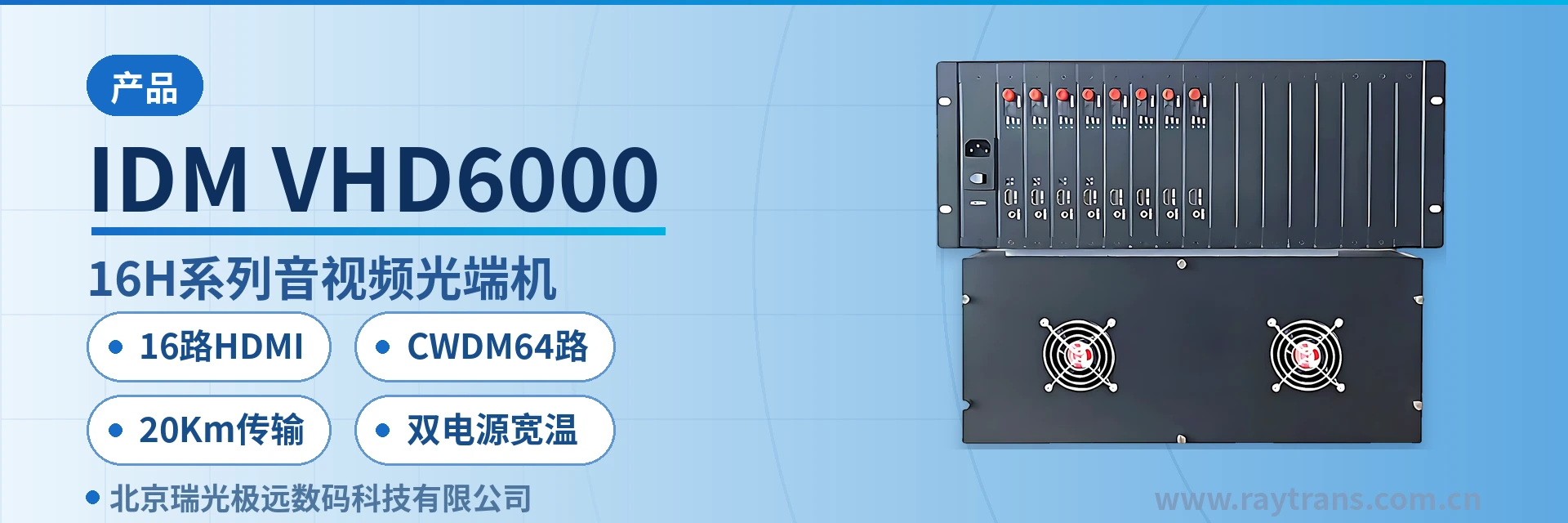
IDM VHD6000/16H Audio and Video Optical Multiplexer
16-channel HDMI, 16-channel audio, single-fiber transmission, point-to-multipoint, one transmitter with multiple receivers
The IDM VHD6000/16H series audio and video optical multiplexer supports real-time synchronous, distortion-free transmission of high-definition and ultra-HD high-quality images. The use of digital optical fiber transmission technology enables longer transmission distances for HD images, strong anti-interference capability, and larger transmission scale. This series is divided into two categories: the HD series supports 1080P@60Hz and provides HDMI, DVI, VGA, and SDI interfaces for interconnection. The IDM VHD6000/16H series audio and video optical multiplexer supports 16-channel HDMI HD video and 16-channel audio transmission, and can also support data
The IDM VHD6000/16H series audio and video optical multiplexer is a 16-channel HDMI audio and video optical multiplexer, developed by optical multiplexer manufacturer Beijing Ruiguang Jiyuan Digital Technology Co., Ltd. It delivers 16 channels of HDMI high-definition video and 16 channels of audio synchronously in real time to the opposite end over a single optical fiber, and is used in product showcase scenarios such as large display wall mounting in command centers, private network video conferencing, and broadcast television signal backhaul.
The series is built around JPEG2000 compression encoding, paired with a 225M pixel clock to process 1080P@60Hz images. The transmitter and receiver are provided in a paired configuration; services can be enabled by connecting cables according to the panel markings, and no separate video converter is required on site.
Sharing one optical fiber between 16 channels of HDMI and 16 channels of audio is the basic form of this optical multiplexer series. Video channels interconnect across four interface types: HDMI, DVI, VGA, and SDI. Audio channels support both unbalanced and balanced lead-out methods, and on site you simply select according to the interface type of the source device and mixer—there is no need to plan separate routes for picture and sound.
In addition to audio and video, the same optical fiber can also carry data, Ethernet, IO, IR, USB, telephone, E1, and other services, forming a multi-service optical multiplexer. The site side no longer needs to lay separate cables for each type of signal; a single optical cable entering the equipment room brings in picture, sound, and control signals together, and the cabling workload inside the cabinet decreases accordingly.
In terms of transmission mode, JPEG2000 encoding allows the link to be configured as point-to-point, point-to-multipoint, multipoint-to-multipoint, and one-to-many. The same signal can be sent simultaneously to multiple display terminals, making it suitable for command centers distributing front-end images to the main screen, duty room, and branch venues, and also for educational recording and broadcasting units sending a lesson to multiple classrooms. On this basis, Raytrans can provide government private network optical fiber communication solutions and military emergency communications vehicle solutions, and as a command and dispatch system manufacturer support multimedia video conferencing and broadcast television signal backhaul applications.
Key Specifications at a Glance: 16-channel HDMI · 16-channel audio · JPEG2000 compression · 225M pixel clock · 2.5Gbps · CWDM 64 channels · 20Km transmission · dual power supply, wide temperature
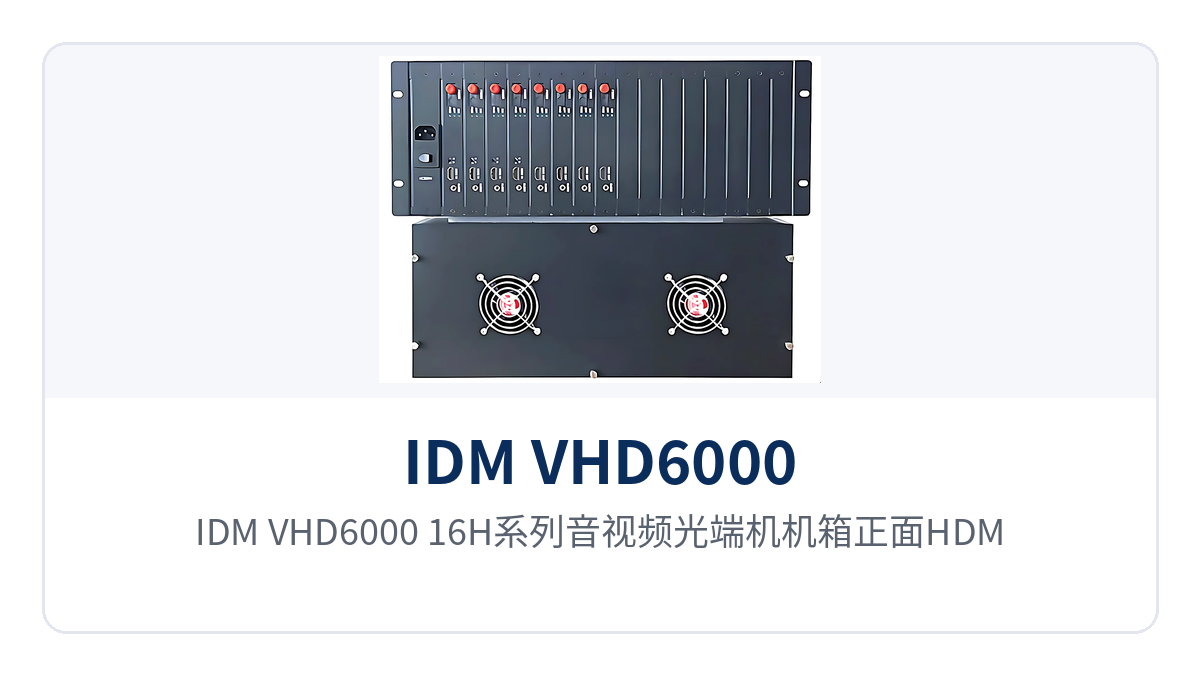
Figure 1: Close-up of the HDMI interfaces and optical port indicator LEDs on the front panel of the IDM VHD6000/16H series audio and video optical multiplexer chassis
Why the 16-Channel HDMI Audio and Video Optical Multiplexer Achieves Distortion-Free Images
JPEG2000 is an image compression standard based on wavelet transforms. It decomposes a frame into multiple resolution levels for encoding, and the receiver restores it layer by layer from the stream. In the 16-channel HDMI audio and video optical multiplexer, the encoded stream is sent directly onto the optical fiber, the link performs no secondary transcoding, and the image maintains synchronization and color gradation over long-distance links, with no blocking or ghosting in moving scenes. As a professional optical multiplexer manufacturer, Raytrans presents this encoding link as a core selling point in the product showcase for this series.
The processing capability on the video side determines whether the image can enter and leave the device intact. The HDMI port receives TMDS signals with a 225M pixel clock, selectable 8/10/12-bit color depth, and support for E-DDC2/EDID, so capability negotiation between the source device and the display terminal is completed automatically. On the audio side, the quantization level is 24 bit, aligned with the image on the same link.
When checking picture quality on site, you can verify three items one by one: resolution, color gradation, and audio-video synchronization. Each item corresponds to a specific verifiable step on the device, and the inspection order matches the actual commissioning order, making it easy to record results item by item and to recheck during shift handover.
Resolution matching: 1080p60/50, 1080p30/25, 1080i60/50, 720p60/50, 576i, and 480i are all within the supported range;
Color gradation: 8/10/12-bit color depth is set according to the source device output, with no banding in dark gradients;
Synchronization: video and 16 channels of audio are transmitted within the same clock domain, and lip sync does not drift with link length.
Another benefit of optical fiber transmission is anti-interference. Optical fiber itself does not conduct electricity, and the two ends of the link are electrically isolated, so it is immune to electromagnetic interference, radio frequency interference, and common-ground loop interference, and it does not suffer the intermodulation interference of analog frequency modulation (FM), phase modulation (PM), and amplitude modulation (AM) optical multiplexers. In strong electromagnetic environments such as substations, railway linesides, and intersection poles, the streaking and ground potential difference problems common with coaxial cable do not occur on optical fiber links.
Core Specifications Overview: Rate, Wavelength, and Transmission Distance
The optical interface and transmission capability determine how long the link can run and how many channels it can carry. The optical port of the IDM VHD6000/16H series is FC by default, with SC and ST optional according to on-site patch cords; the rate is tiered by channel count—1 channel is configured at 1.25Gbps, 28 channels at 2.5Gbps, and 1664 channels use CWDM wavelength division multiplexing, with each signal separated by wavelength over the same optical fiber.
Item | Parameter/Specification | Description/Applicable Conditions |
|---|---|---|
Optical interface type | FC (default), SC and ST optional | Selected according to equipment room patch cords and ODF interfaces |
Transmission rate | 1.25Gbps (1 channel), 2.5Gbps (2 | Tiered by the number of audio and video channels carried by a single device |
Transmission distance | 20Km (default); special distances must be stated in advance | Single-mode links are calculated against the optical power budget; distances longer than 20Km must be noted at ordering |
Wavelength | Multi-mode 850nm/1310nm; single-mode 1310nm/1550nm | Transmit and receive ends are matched in pairs by wavelength |
Applicable fiber | Multi-mode 50/125μm, 62.5/125μm; single-mode 9/125μm | Select optical modules according to the type of optical cable already laid on site |
20Km transmission is the default figure for single-mode links in this series. In engineering, the optical power budget is calculated section by section based on actual optical fiber attenuation, splice points, and mating connector loss; distances beyond 20Km must be stated in advance at ordering, and the manufacturer configures optical modules according to link conditions. Multi-mode links are suitable for short-distance interconnection within an equipment room or between buildings, with wavelengths at 850nm/1310nm configured in pairs with the opposite end.
How the CWDM Aggregation Optical Multiplexer Aggregates Multiple Sites onto One Optical Fiber
The CWDM aggregation optical multiplexer works by dividing multiple wavelength channels over the same optical fiber, with each site occupying one wavelength, and the central station using a wavelength division multiplexer to combine and separate the signals. Single-fiber CWDM can aggregate up to 64 channels, with wavelength modules added or removed according to the number of sites, so the central equipment room does not need to occupy a separate fiber core for each site.
The value of 64-channel aggregation is concentrated in optical fiber resources. Intersections, checkpoints, and yards often each have only one available fiber core; concentrating these 64 channels onto a single trunk back to the command center reduces the number of trunk cores required. Later capacity expansion only requires adding wavelength modules, with no need to re-excavate or lay additional optical cables. For scenarios such as government private network optical fiber communication solutions and military emergency communications vehicle solutions, where sites are scattered and optical fiber resources are tight, this feature of the CWDM aggregation optical multiplexer is particularly practical.
Which Services and Interfaces One Device Can Access
Service channels are configured at the factory according to the project configuration, and services can be enabled on site by connecting cables according to the port markings. The table below lists the main functions and their roles, making it easy to check the configuration list against on-site requirements and to determine which type of interface card to add during later capacity expansion. The list corresponds item by item to the physical ports, so it can be checked together during acceptance.
Function | Description |
|---|---|
16-channel HDMI video | A single unit carries 16 channels of HDMI high-definition (HD) video with real-time synchronous transmission at 1080P@60Hz |
16-channel audio | 16 channels of audio are transmitted over the same fiber as video, with unbalanced or balanced interfaces available |
JPEG2000 compression encoding | Video is sent over the fiber as a JPEG2000 stream and restored layer by layer at the receiver, achieving an uncompressed-grade picture |
Multi-format video interfaces | HDMI, DVI, VGA and SDI interfaces are interconnected and compatible with existing display and camera equipment |
Data channel | RS-485 by default; RS-232, RS-422, TTL and on/off signal optional; rate 115200bps |
Ethernet channel | RJ45 connector with LED, 100M, 10/100M adaptive, supporting Auto MDI/MDIX |
USB channel | USB2.0/USB1.1, high speed 480Mbps, type B upstream and type A downstream |
On/off signal channel | TTL or dry contact input, 5V/24V TTL or relay output, transmission latency 2ms |
E1 and telephone service | Carries existing services such as E1 and telephone over the same fiber as audio and video, reducing repeated laying |
IR and IO control | Infrared and on/off signals are backhauled over the same fiber as audio and video for site control |
The data port uses a 3.81mm standard Phoenix industrial terminal, with RS-485 by default, and can be changed to RS-232, RS-422, TTL or on/off signal according to the controlled equipment on site. Direction supports forward, reverse and bidirectional, the transmission rate is 115200bps, and both half-duplex and full-duplex operation are supported. During wiring, configure the data format of the equipment at both ends consistently before powering on.
The audio channel is configured for unbalanced or balanced output according to the project. The unbalanced interface uses a 3.81mm Phoenix terminal, with a bandwidth of 20Hz~20KHz, 24bit quantization, Line-in impedance of 47Ω and Line-out impedance of 10Ω, and a signal-to-noise ratio (SNR) of 85dB. The balanced interface can be an XLR connector or an RCA jack, with input and output level of 2Vp-p and input and output impedance of 600Ω or 100KΩ. This is exactly where the value of a multi-service optical multiplexer lies: one unit carries video, audio, data, Ethernet and telephone services at the same time, reducing repeated laying and equipment stacking.
Video Interfaces and Supported Resolution Range
The compatibility of the video interfaces determines whether existing equipment can be connected smoothly. As an HD audio and video optical multiplexer, the series places interface conversion and optical fiber transmission in the same unit, providing HDMI, DVI, VGA, SDI and CVBS interfaces according to configuration. Digital and analog signals each have their corresponding input specifications; on site, select them in pairs according to the source device and display terminal, and the interfaces can be converted to each other.
Interface | Key Specifications | Description/Applicable Conditions |
|---|---|---|
HDMI | HDMI 1.3b Type-A female socket; TMDS signal; pixel clock 225M; color depth 8/10/12bit; E-DDC2/EDID | Connects to HDMI sources such as conference terminals, recording and broadcasting main units and set-top boxes |
DVI | DVI 1.0; HDCP 1.2; 1x18+1 DVI-D male connector; pixel clock 225M | Connects to industrial PCs and legacy display devices with DVI output |
VGA | DB15/F female socket; 640x480@60Hz~1920x1080@60Hz; analog bandwidth 500MHz (3dB); 75Ω | Connects to computers, matrices and projector equipment with analog output |
SDI | SMPTE 424M/292M/259M, DVB-ASI; 270Mbit/s~2.97Gbit/s; BNC 75Ω | Connects to broadcast-grade cameras and switchers |
CVBS | PAL/NTSC; input 0.5~2Vpp, output 1Vp-p; 12bit; SNR ≥75dB | Connects to analog surveillance cameras and legacy video recording equipment |
The SDI channel supports 1080p60/50, 1080p30/25, 1080i60/50, 720p60/50, 576i and 480i, with a signal amplitude of 800mV±10%. Cable equalization reaches 250m at 270Mbit/s, 140m at 1.5Gbit/s and 80m at 2.97Gbit/s, so the coaxial segment from the front-end device to the optical multiplexer does not require an additional trunk equipment. With this interface compatibility, the video optical multiplexer can serve multimedia video conferencing, broadcast and television signal backhaul, and various audio and video links integrated by command and dispatch system manufacturers. Raytrans can also provide corresponding government private network optical fiber communication solution and military emergency communications vehicle solution configuration recommendations according to project requirements.
Power Supply, Enclosure and Operating Environment
Power supply and structural conditions determine which cabinet the equipment can be installed in and at what temperature it can operate over the long term. The wall-mounted and rack-mounted forms cover the two installation positions of site enclosure and central equipment room respectively. The main specifications are listed in the table below; during configuration, check them item by item according to the number of channels of the unit.
Item | Parameter/Specification | Description/Applicable Conditions |
|---|---|---|
Power supply mode | Wall-mounted: DC 5V/1A~1.5A; rack-mounted: AC220V or/and DC48V | Wall-mounted power supply terminals feature reverse-connection protection |
Power consumption | Wall-mounted <10W; rack-mounted depends on the specific configuration | Calculated according to the number of channels and interface card configuration of the unit |
Mean time between failures | Greater than 100,000 hours | Under normal temperature and humidity and standard installation conditions |
Operating temperature | -20℃~+75℃ | Wide-temperature design, suitable for cabinets outside equipment rooms and field sites |
Storage temperature | -40℃~+85℃ | Transportation and spare parts inventory conditions |
Relative humidity | 0~95% | For use in non-condensing environments |
Dimensions | 440x165x180mm, 4U, 19-inch standard chassis (16-channel) | Standard 19-inch rack installation |
The product documentation gives two markings for wall-mounted power supply, DC 5V/1A1.5A and DC 9V/0.5A1.5A. The power supply terminals use 5.08mm Phoenix terminals with reverse-connection protection, and can withstand a 35V input voltage, but the device will heat up noticeably. The actual configuration shall follow the nameplate of the supplied power adapter and the values confirmed with the optical multiplexer manufacturer; do not exceed the marked range for long-term operation.
Dual power supply and wide temperature are two on-site safeguards of the rack-mounted configuration. The rack-mounted power supply is connected through a three-pin power outlet, with AC220V and DC48V fed separately according to equipment room conditions, one feed each from the communication station and the equipment room. The operating temperature is -20℃~+75℃, so outdoor cabinets and unattended sites within the wide temperature range do not need additional constant-temperature equipment.
The installation environment requires no corrosive or solvent gases, no dust, and no strong magnetic field interference. The wall-mounted unit has an overall power consumption below 10W and can be powered directly from the on-site DC power supply; the rack-mounted unit's power consumption is calculated according to the interface card configuration, and the cabinet must reserve heat dissipation space and a grounding terminal. Grounding at both ends of a long-distance link shall be implemented according to engineering specifications.
Typical Application Scenarios
The three types of users have very different requirements for audio and video optical multiplexers. Command centers care about whether multiple video feeds can be displayed on the video wall at the same time, private networks care about the power supply and temperature margin of field links, and broadcast and media users care about whether the image quality can withstand secondary editing. The configuration approach for these three types of sites is described below.
Video Wall Display at a Public Security Traffic Command Center
Video from intersections, checkpoints and inspection booths must be sent simultaneously to the large display in the command center, while the sites are scattered and the number of available fiber cores at each site is limited. The Raytrans IDM VHD6000/16H series aggregates 16-channel HDMI video and 16-channel audio on a single device, and single-fiber CWDM brings 64 video feeds together to the central backbone, so the command hall does not need to occupy a separate fiber core for each screen.
On the video wall side, HDMI ports are assigned according to the arrangement order of the display terminals, and video and audio are aligned on the same link, so the duty operator does not need to adjust the audio matrix separately when switching signal sources. The central equipment room uses rack-mounted 4U equipment installed in a 19-inch rack, with AC220V and DC48V two power feeds connected separately; during mains power maintenance, DC power from the communication station maintains video backhaul.
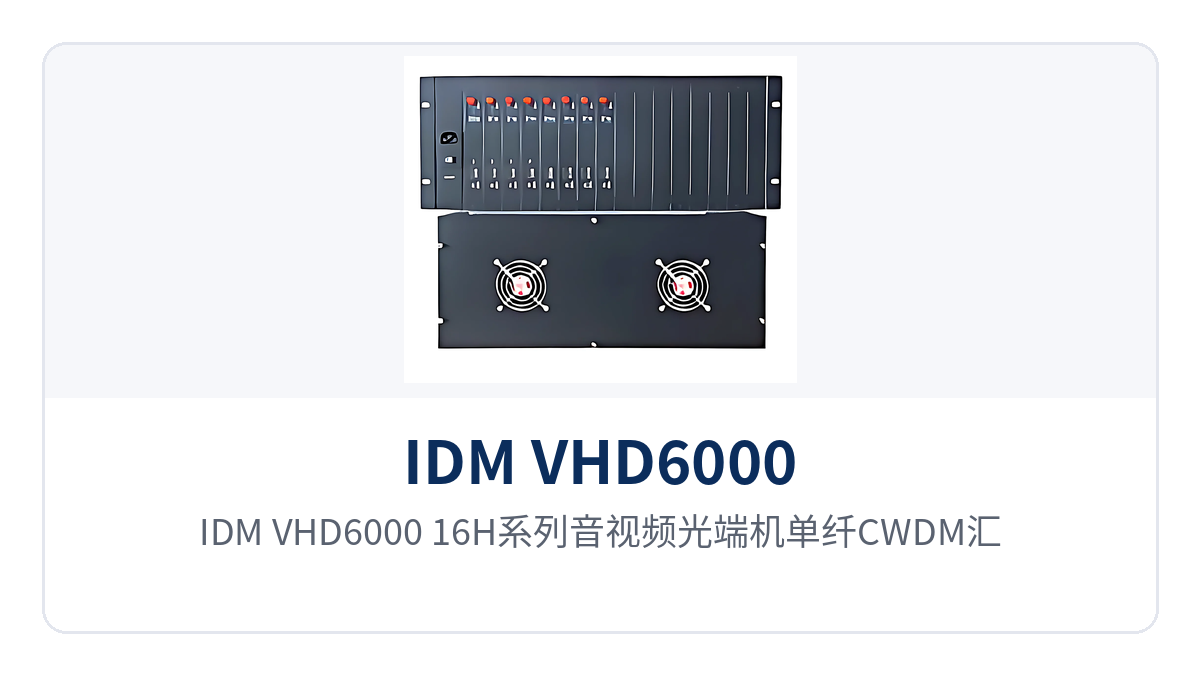
Figure 2: IDM VHD6000/16H Series Audio and Video Optical Multiplexer Single-Fiber CWDM Aggregation Networking and 19-Inch Rack Installation Diagram
Field Links of a Military Communications Private Network
Field private network sites are often set up in cabinets, shelters or temporary command posts, where power supply is unstable, the day-night temperature difference is large, and the links must also avoid strong electromagnetic environments. This series has an operating temperature of -20℃+75℃ and a storage temperature of -40℃+85℃, and a mean time between failures of more than 100,000 hours, making it suitable for long-term unattended field nodes.
The electrical isolation of the optical fiber link keeps signals immune to electromagnetic interference and common-ground loop interference, and the default 20Km transmission specification covers the distance from most nodes to the command post. The wall-mounted model uses DC power supply with power consumption below 10W and can be loaded directly from the shelter power supply, while the rack-mounted model connects to dual power feeds at a fixed command post.
Broadcast Television and Advertising Media
Materials for broadcast and advertising media must withstand post-production editing, and compression artifacts will be amplified during secondary processing. The series transmits JPEG2000 streams over fiber, supports 8/10/12bit color depth, and receives broadcast-grade camera signals on SDI channels according to SMPTE 424M/292M/259M, so the restored signal can still enter the switcher directly.
Outdoor large displays and advertising machines are distributed at various sites across the city, while the playback hosts are concentrated in the media equipment room. Single-fiber CWDM with 64 channels brings the playback signals of multiple large displays together to one point, and the equipment room allocates content by wavelength channel; SDI cable equalization supports 80m at 2.97Gbit/s, so the coaxial run from the front end to the optical multiplexer does not require an additional trunk device.