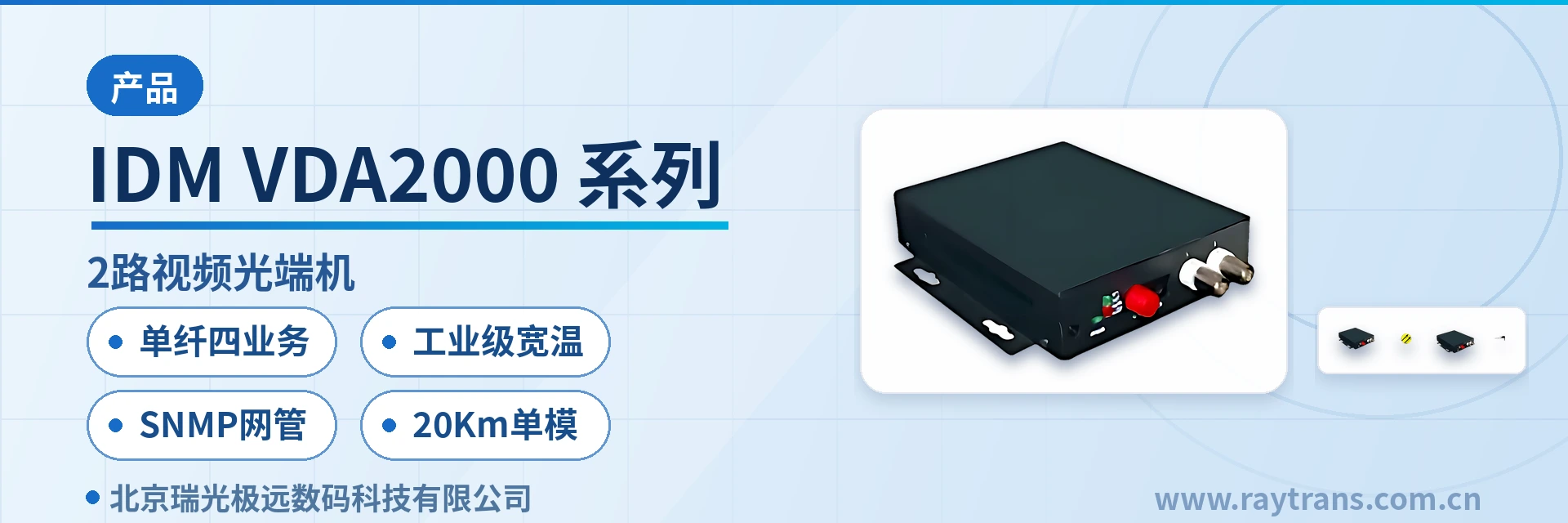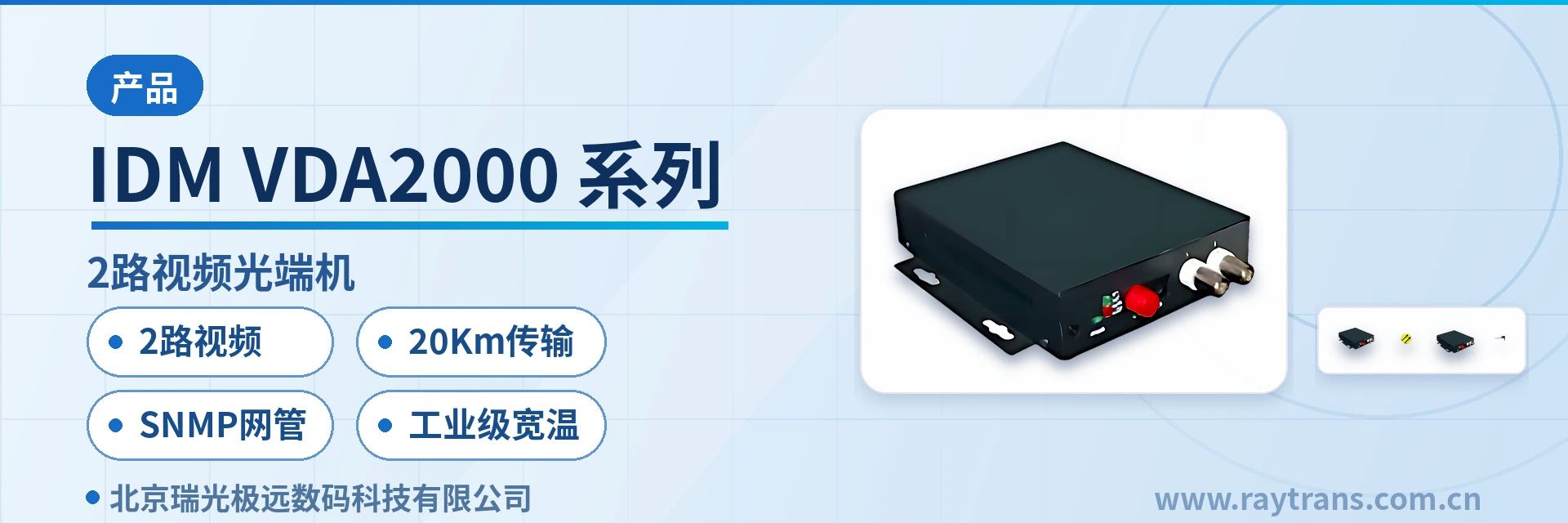
IDM-VDA2000 Series 2-Channel Video Optical Multiplexer
Transmits 2 channels of video, 2 channels of data, 1 channel of audio, and 2 Ethernet channels over a single optical fiber, eliminating one aggregation device
The 2-channel video series optical multiplexer is a compact multi-service signal optical fiber transmission product tailored by the company for the security surveillance market. It can transmit up to 2 channels of unidirectional video, 2 channels of data, 1 channel of bidirectional audio, and 2 Ethernet channels over a single optical fiber. Adopting the internationally advanced all-digital uncompressed video technology, it transmits two channels of video and multiple channels of data over the optical fiber in real-time synchronous, distortion-free, and high-quality manner. Plug-and-play, no on-site adjustment required. The optical module and core circuits all use standard components, ensuring high stability, and all optical and electrical interfaces comply with international standards.
The IDM-VDA2000 series (including IDM-VDA2000, IDM-VDA2100, and IDM-VDA2210) 2-channel video optical multiplexer is a compact multi-service signal optical fiber transmission device developed by Beijing Ruiguang Jiyuan Digital Technology Co., Ltd. (Raytrans) for the security surveillance market. It aggregates 2 channels of unidirectional video from front-end cameras together with data, audio, and Ethernet services onto a single optical fiber for real-time synchronous transmission, and is a practical product showcase within security surveillance optical fiber transmission solutions. As a professional optical multiplexer manufacturer, Raytrans adopts all-digital uncompressed video technology in this series: video signals are sampled into digital signals, transmitted directly over the optical fiber, and restored at the remote end without distortion, so the video quality meets the viewing and video recording requirements of a surveillance center. The plug-and-play design makes installation simple and easy, with no on-site adjustment required. The optical module and core circuits all use standard components, and all optical and electrical interfaces comply with international standards, making the device suitable for different operating environments. It also provides reliable multi-service optical multiplexer access capacity for government private network optical fiber communication solutions.
Key specifications at a glance: 2-channel unidirectional video · 2-channel data · 1-channel bidirectional audio · 2-channel Ethernet · single-mode fiber (multi-mode optional) · FC optical port (SC customizable) · transmission distance 20 Km · industrial-grade wide temperature -40℃~+85℃ · SNMP network management support · overall power consumption ≤6 W
What is a 2-channel video optical multiplexer?
The IDM-VDA2000 series 2-channel video optical multiplexer is an optical fiber transmission access device between surveillance sites and the surveillance center. It is used in pairs as a transmitter and a receiver, sending 2 channels of video signals from cameras together with on-site data and audio signals to the remote end for restoration and output. It is a compact service access device for point-to-point networking. As a product showcase model under the professional optical multiplexer manufacturer Raytrans, this series plays the role of front-end site access in the compact video optical multiplexer product line.
Traditional surveillance sites use coaxial cable to transmit video. Once the distance exceeds a few hundred meters, a repeater amplifier must be added, and the signal is also susceptible to electromagnetic interference and ground potential difference, with picture quality degrading with distance. The IDM-VDA2000 series 2-channel video optical multiplexer digitizes video signals and transmits them over optical fiber. The standard configuration achieves a transmission distance of 20 Km, and long-distance optical modules can be optionally installed for even longer optical fiber transmission. At the same time, it is free from electromagnetic interference (EMI) and radio frequency interference (RFI), making it suitable for security surveillance projects with scattered sites and long distances. It is also a common front-end access device in security surveillance optical fiber transmission solutions.
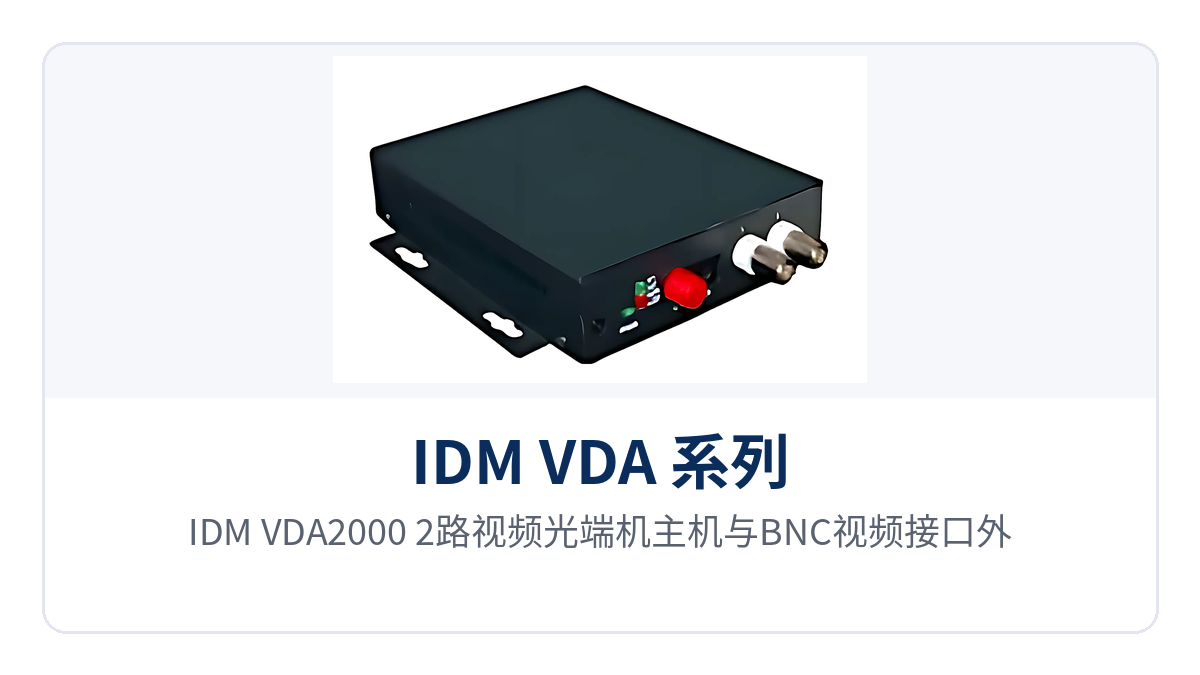
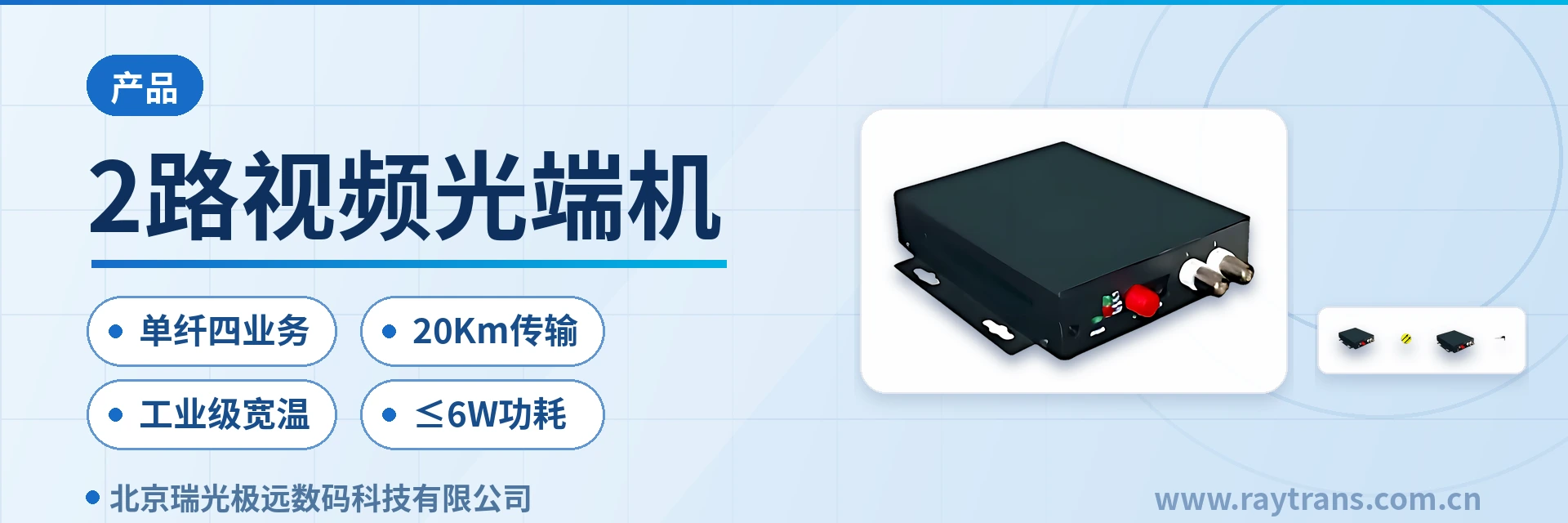
Figure 1: IDM-VDA2000 2-channel video optical multiplexer main unit and BNC video interface appearance
Where does carrying 2 channels of video, data, audio, and Ethernet over a single optical fiber save?
The IDM-VDA2000 series 2-channel video optical multiplexer can carry 2 channels of unidirectional video, 2 channels of data, 1 channel of bidirectional audio, and 2 channels of Ethernet over a single optical fiber, aggregating services that would otherwise require multiple optical fibers and multiple devices onto one optical fiber link, directly saving optical fiber resources and the number of supporting devices for a private network. This design approach of a multi-service optical multiplexer is exactly the access mode repeatedly verified by Raytrans in government private network optical fiber communication solutions and security surveillance optical fiber transmission solutions.
For security surveillance and industrial private network projects, optical fiber resource constraints usually appear in two places: first, the existing backbone optical cable cores between industrial parks and plants are limited, and new sites require re-splicing or leasing of fiber cores; second, the access section of an unattended site often has only one optical cable that can be laid. The IDM-VDA2000 series 2-channel video optical multiplexer multiplexes video, control data, voice, and Ethernet services over a single optical fiber for synchronous transmission. In engineering terms, the model can be selected according to the service volume of the site, with no need to lay separate cables for each type of service.
The 2 channels of Ethernet here are the description basis for the series service configuration; the specific channel configuration is subject to the manufacturer's technical documentation and commercial confirmation. The technical specifications table lists the parameters of the optical interface, video, audio, data, and power supply and environment.
Differentiation points of the IDM-VDA2000 series
Differentiation Point | Specific Capability | Value to the Project |
|---|---|---|
Multi-service over a single fiber | A single optical fiber carries 2-channel video + 2-channel data + 1-channel audio + 2-channel Ethernet | Saves private network optical fiber resources and reduces stacked devices and cable laying |
Industrial-grade wide temperature | Industrial-grade temperature range -40℃ | Suits installation environments with large temperature differences such as outdoor pole positions and unattended cabinets |
SNMP online network management | Supports SNMP network management for real-time online monitoring | Private network device status can be monitored remotely in real time, reducing on-site inspections |
20 Km single-mode direct transmission | Standard configuration transmission distance 20 Km, with optional long-distance optical modules | Covers conventional links between stations, plants, and the center without adding a repeater midway |
How does all-digital uncompressed video technology ensure picture quality?
The IDM-VDA2000 series 2-channel video optical multiplexer adopts all-digital uncompressed video technology: the transmitter samples video signals with an 8-bit sampling bit width and a 0 Hz~6.5 MHz video bandwidth, transmits them directly over the optical fiber without compression encoding, and the receiver restores them to analog video output without distortion. The device achieves a video SNR of ≥70 dB (weighted), luminance non-linearity <3%, differential phase (DP) <0.7°, and differential gain (DG) <0.7%. Video quality reaches broadcast-grade standards, and audio quality reaches CD-grade standards. For security surveillance optical fiber transmission solutions that pursue lossless picture quality, this all-digital optical multiplexer transmission method effectively avoids the picture quality loss caused by compression.
Because video signals do not go through an encoding and decoding stage, the link introduces no processing latency or stream jitter caused by compression algorithms, and the synchronization between video and data is maintained. This is critical in scenarios where the surveillance center simultaneously views the picture and operates on-site devices. The IDM-VDA2000 series 2-channel video optical multiplexer is compatible with video formats such as PAL, NTSC, and SECAM, and can transparently interface with the products of major camera manufacturers.
What functions does the IDM-VDA2000 series provide?
Function | Description |
|---|---|
SNMP network management | Supports SNMP network management for real-time online monitoring of device operating status |
Video quality | Video quality reaches broadcast-grade standards, with 2 channels of video transmitted synchronously without compression |
Audio quality | Audio quality reaches CD-grade standards, with an audio sampling bit width of 16 bit and a sampling frequency of 32 KHz |
Multi-format compatibility | Compatible with video formats such as PAL, NTSC, and SECAM |
Workmanship and protection | SMT surface mount technology, with multiple protection against lightning and surge on ports |
Regenerative repeater | Supports video lossless regenerative repeater, free from electromagnetic interference (EMI) and radio frequency interference (RFI) |
Transparent transmission of data | Transparent data encoding, compatible with the products of major camera manufacturers |
Adaptive, adjustment-free | Adaptive technology, requiring no on-site electrical or optical adjustment during use |
Structural design | Compact design, small structure, flexible and convenient installation |
Technical Specifications
Optical interface parameters
Item | Parameter/Specification | Description/Applicable Conditions |
|---|---|---|
Interface type | FC (SC and others can be customized) | Optical port connector type |
Fiber mode | Single-mode (multi-mode optional) | Optional according to the on-site optical cable type |
Receiver receive/transmit rate | 1.25G bps / 84M bps | Receive/transmit rate at the receiver |
Receiver receive/transmit wavelength | 1310nm / 1550nm | Receive/transmit wavelength at the receiver |
Transmitter receive/transmit rate | 84M bps / 1.25G bps | Receive/transmit rate at the transmitter |
Transmitter receive/transmit wavelength | 1550nm / 1310nm | Receive/transmit wavelength at the transmitter |
Transmit optical power | -12~-7dBm | Output optical power at the transmitter |
Receiver sensitivity | Better than -21dBm (1310nm) | Lower limit of optical power for normal reception at the receiver |
Transmission distance | 20Km | A long-distance optical module can be installed for longer-distance optical fiber transmission |
Video Interface Parameters
Item | Parameter/Specification | Description/Applicable Conditions |
|---|---|---|
Interface type | BNC | Analog video input/output |
Luminance non-linearity | <3% | Video channel linearity |
Video sampling bit width | 8bit | Digital sampling precision |
Video bandwidth | 0Hz~6.5MHz | Meets the baseband bandwidth of standard definition (SD) video |
Differential phase (DP) | <0.7° | Phase distortion specification of the chrominance signal |
Differential gain (DG) | <0.7% | Amplitude distortion specification of the chrominance signal |
Input overload voltage | 1.5VP-P (typical) | Non-saturation voltage at the input |
Input/output voltage | 1VP-P (typical) | Standard video signal level |
Input/output impedance | 75Ω (unbalanced) | Impedance matching with conventional video equipment |
Video SNR | ≥70dB (weighted) | Weighted measurement specification |
High-Fidelity Audio Parameters
Item | Parameter/Specification | Description/Applicable Conditions |
|---|---|---|
Interface type | RJ45 | Audio channel interface |
Audio sampling bit width | 16bit | Digital sampling precision |
Input/output impedance | ADC:100KΩ / DAC:10KΩ | Input/output impedance |
Input/output voltage | 1.5VP-P (typical value) | Audio signal level |
Audio sampling frequency | 32KHz | Sampling rate |
Audio SNR | ≥90dB | Audio channel SNR |
Audio bandwidth | 20Hz~20KHz | Covers the audible frequency band of the human ear |
Total harmonic distortion | <1% | Audio channel distortion specification |
Data Interface Type Description of the Video Optical Multiplexer
Item | Parameter/Specification | Description/Applicable Conditions |
|---|---|---|
Interface type | RJ-45 | Data channel interface |
Data type | RS-232, RS422 (4-wire), RS485 (2-wire) | Can interconnect with control and acquisition devices |
The data interface type of the video optical multiplexer is RJ-45, supporting three data types: RS-232, RS422 (4-wire) and RS485 (2-wire). It can interconnect with common industrial control devices such as PTZ control, alarm collection and sensor acquisition devices, and adopts a transparent data encoding method.
Power Supply, Power Consumption and Environmental Conditions
Item | Parameter/Specification | Description/Applicable Conditions |
|---|---|---|
Power supply mode | AC220V / DC-48V | Optional according to equipment room and on-site power conditions |
Overall power consumption | ≤6W | Power consumption during operation of the unit |
Operating temperature | -15℃ ~ +65℃ | Standard operating temperature range |
Storage temperature | -25℃ ~ +75℃ | Storage environment temperature range |
Industrial-grade temperature | -40℃ ~ +85℃ | Temperature range of industrial-grade models |
Relative humidity | 0~95% (non-condensing) | Operating environment humidity |
Product dimensions | 144×138×30(mm) | Length×Depth×Height |
Model Selection: How to Choose Between IDM-VDA2000, IDM-VDA2100 and IDM-VDA2210?
No. | Model | Service Configuration | Application Note |
|---|---|---|---|
1 | IDM-VDA2000 | 2-channel unidirectional video | Only two surveillance video channels need to be sent back to the surveillance center |
2 | IDM-VDA2100 | 2-channel unidirectional video, 1-channel data | One channel of control/acquisition data is required in addition to surveillance video |
3 | IDM-VDA2210 | 2-channel unidirectional video, 2-channel data, 1-channel bidirectional audio | Two data channels are required, together with on-site two-way voice intercom |
During selection, first count the services at the site: if only video is needed, choose IDM-VDA2000; if one channel of data such as PTZ control or alarm collection needs to be sent back, choose IDM-VDA2100; if two-way announcement and intercom between the surveillance center and the site is required, choose IDM-VDA2210 with 1-channel bidirectional audio. Selection of a 2-channel video optical multiplexer also requires confirming the optical fiber type (single-mode or multi-mode), transmission distance and optical port type. For long-distance links, it is recommended to calculate according to the optical power budget before deciding on the optical module. The specific configuration is subject to the optical multiplexer manufacturer's technical documentation and commercial confirmation.
Typical Application Scenarios
Surveillance of Unattended Sites in Transportation and Energy
Sites such as expressways, railway lines, pipeline valve chambers, substations and distribution rooms are usually unattended. The temperature inside pole-side cabinets and site enclosures varies greatly with seasons and sunlight, and the cost of a single O&M personnel visit is high. The IDM-VDA2000 series 2-channel video optical multiplexer provides an industrial-grade temperature range of -40℃+85℃ and humidity adaptability of 095% (non-condensing), and an industrial-grade model can be selected according to the site environment. It supports SNMP network management, so the operating status of site devices can be monitored remotely and in real time on the network management side; when an abnormality occurs, remote judgment is made first before arranging an on-site visit. From the site to the surveillance center, one single-mode fiber with the standard 20Km configuration covers the spacing between conventional stations, reducing the number of optical cables and devices along the line.
Industrial Automation Private Network
Cameras and control devices at production sites such as plants, mining areas and ports are often distributed in strong electromagnetic environments, where variable-frequency drives, high-power motors and welding equipment interfere with analog video signals. The IDM-VDA2000 series 2-channel video optical multiplexer uses optical fiber as the transmission medium, supports lossless regenerative video repeater, is free from electromagnetic interference (EMI) and radio frequency interference (RFI), and provides electrical isolation between the transmitter and the receiver. The RJ-45 data port supports RS-232, RS422 (4-wire) and RS485 (2-wire), and can interconnect with PLCs, PTZ controllers and acquisition terminals. Video and production data are transmitted over the same optical fiber, making it easy to expand sites within an existing industrial private network.
Project Delivery by Security Surveillance Integrators
During project delivery, integrators care more about commissioning workload and site adaptability. The IDM-VDA2000 series 2-channel video optical multiplexer adopts an adaptive, adjustment-free design. It is plug-and-play and requires no on-site electrical or optical adjustment; it works once the video cable, data cable, audio cable and optical fiber are connected and power is applied. The device is compatible with video formats such as PAL, NTSC and SECAM, and is compatible with the products of major camera manufacturers, so the optical multiplexer does not need to be replaced when the front-end camera brand changes. The unit dimensions are 144×138×30 (mm) and the power consumption is ≤6W, making it easy to install in a site enclosure. Power supply supports AC220V or DC-48V, adapting to both equipment room and on-site power supply access conditions.
Industrial Park, Building and Road Surveillance
Cameras at industrial park entrances and exits, perimeter walls, parking lots and road surveillance poles are often hundreds of meters to several kilometers away from the surveillance center, and it is difficult to lay new coaxial cables between buildings. The IDM-VDA2000 series 2-channel video optical multiplexer aggregates 2-channel video and data services onto one existing or newly laid single-mode fiber. The receiver directly outputs BNC video to a DVR, NVR or monitor, replacing the long-distance coaxial cable solution and avoiding picture streaking and distortion caused by ground potential difference and electromagnetic interference. The SMT surface-mount process, multiple port protections against lightning and surge, and the compact structure make it suitable for long-term operation in outdoor pole-side enclosures.
What Is the Transmission Distance of a Video Optical Multiplexer?
The standard configuration transmission distance of the IDM-VDA2000 series 2-channel video optical multiplexer is 20Km. The transmit optical power of the transmitter is -12~-7dBm, and the receiver sensitivity is better than -21dBm (1310nm). The difference between the two is the available optical power margin of the link, which is used to compensate for the attenuation of the optical fiber itself and the loss of splice points and connectors.
If the site is more than 20Km away, a long-distance optical module can be installed to achieve optical fiber transmission over a longer distance. During project selection, the optical power should be calculated section by section according to the actual optical cable length, cable attenuation coefficient, and splicing and connector loss, with aging and maintenance margin reserved. Multimode fiber and single-mode fiber have different attenuation characteristics, so the transmission distance should be determined after matching with the optical module type. As a professional optical multiplexer manufacturer, Raytrans provides complete transmission distance parameters in the product showcase of video optical multiplexers, optical multiplexers and multi-service optical multiplexers, making it easy for integrators to compare and select directly.
How Is a Video Optical Multiplexer Networked and Wired?
The IDM-VDA2000 series 2-channel video optical multiplexer adopts point-to-point networking: the site end is the transmitter and the surveillance center end is the receiver. The two ends are connected by one optical fiber, and video, data and audio services are transmitted synchronously over the same optical fiber.
Stage | Connection Method | Description |
|---|---|---|
Video input | Camera video output BNC → transmitter video input | Input impedance 75Ω (unbalanced), input voltage 1VP-P (typical value) |
Video output | Receiver video output BNC → DVR/NVR/monitor | The receiver restores the analog video signal |
Data port | Transmitter/receiver RJ-45 data port ↔ control or acquisition device | RS-232, RS422 (4-wire), RS485 (2-wire) |
Audio port | Transmitter/receiver RJ45 audio port ↔ intercom terminal | 1-channel bidirectional audio, supporting two-way call between the site and the center |
Optical port | Transmitter optical port ↔ receiver optical port, connected by single-mode fiber | FC interface (SC and other interfaces can be customized), transmission distance 20Km |
Power supply | AC220V or DC-48V | Overall power consumption ≤6W, no on-site electrical or optical adjustment required |
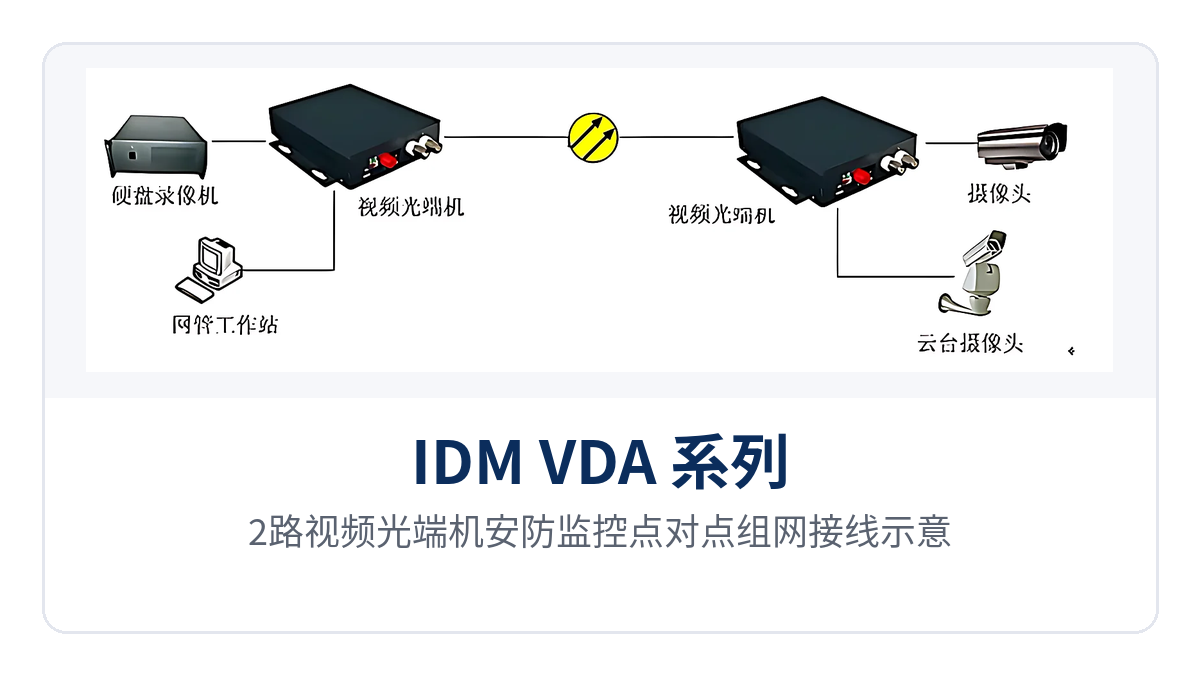
Figure 2: Wiring diagram of point-to-point networking for a 2-channel video optical multiplexer in security surveillance
The above point-to-point wiring method is a typical topology of a security surveillance optical fiber transmission solution, and is also suitable for edge access of a small government private network optical fiber communication solution. Raytrans provides a complete optical multiplexer wiring diagram and accessory list in the product showcase, making it easy for integrators to quickly complete on-site deployment.
Conclusion
The IDM-VDA2000 series 2-channel video optical multiplexer aggregates 2-channel unidirectional video with data and audio services onto a single optical fiber for transmission. It uses all-digital uncompressed video technology to guarantee broadcast-grade picture quality, and adapts to unattended sites and industrial private network sites with three capabilities: industrial-grade wide temperature from -40℃ to +85℃, SNMP online network management, and 20 km single-mode direct transmission. Its overall power consumption is ≤6W and its dimensions are 144×138×30 (mm), making it easy to install in a nearby site enclosure. When selecting a 2-channel video optical multiplexer for security surveillance and industrial private network projects, users can choose among the IDM-VDA2000, IDM-VDA2100, and IDM-VDA2210 models according to the number of service channels at the site, the optical cable type, and the transmission distance. As a professional optical multiplexer manufacturer deeply engaged in the optical multiplexer field, Raytrans provides users with one-stop product showcase and technical support, from video optical multiplexers and multi-service optical multiplexers to government private network optical fiber communication solutions and security surveillance optical fiber transmission solutions.