IDM-30FNV4 Multi-Service Video Optical Multiplexer
Video, E1, Ethernet, 30-channel PCM, single-fiber multiplexing, 1U card-based, replaces three types of standalone devices
The IDM-30FNV4 multi-service video optical multiplexer features high integration and a standard 19-inch 1U chassis design, supporting 4-channel all-digital uncompressed video transmission; 8-bit digital encoding, compatible with PAL, NTSC, and SECAM video formats; provides 8 groups of transparent transmission E1 channels
The 20 km single-fiber wide-temperature triple-power-supply video optical multiplexer is a site-side transmission device that multiplexes 4-channel video, 8 groups of E1 channels, Ethernet, and 30-channel PCM voice and data services onto a pair of optical fibers for transmission. It is a typical multi-service optical multiplexer product. The IDM-30FNV4 multi-service video optical multiplexer is developed by Beijing Ruiguang Jiyuan Digital Technology Co., Ltd. As a professional optical multiplexer manufacturer, Raytrans adopts a standard 19-inch 1U chassis and a modular card-based structure design, supports 4-channel all-digital uncompressed video transmission, and is compatible with PAL, NTSC, and SECAM video formats. While providing 8 groups of transparent transmission E1 channels, it supports 2 groups of shared line-rate 100M Ethernet access with VLAN partitioning. It also provides 30 channels of 64K or n×64K voice, data, image, and other services with more than 20 types of subscriber interfaces. The standard configuration offers a single-mode transmission distance of 20 km, and long-distance optical modules can be optionally installed for longer-distance optical fiber transmission. The IDM-30FNV4 multi-service video optical multiplexer provides integrated multi-service access for scenarios with distributed sites and limited optical fiber resources in electric power and energy private networks, rail transit and expressway communications, and military and government private networks. It is widely used in government private network optical fiber communication solutions, military emergency communications vehicle solutions, and smart mining communication solutions, fully meeting various product showcase requirements. This video optical multiplexer complements the PDH optical multiplexer product line, providing flexible optical multiplexer selection options for users in different industries.
Key Specifications at a Glance: 20 km single-fiber · 4-channel video · 30-channel PCM · wide temperature · triple power supply · 155M FC single-mode optical port · receiver sensitivity better than -21 dBm · 19-inch 1U chassis 440×230×45 mm · overall power consumption ≤40 W · supports AC220V/DC-48V/DC 9V power supply
What kind of device is the 20 km single-fiber wide-temperature triple-power-supply video optical multiplexer
The 20 km single-fiber wide-temperature triple-power-supply video optical multiplexer is a multi-service optical multiplexer that aggregates video, E1, Ethernet, and PCM services onto a pair of optical fibers. At the site side, it occupies only one 1U rack position to simultaneously provision all four types of services. The IDM-30FNV4 multi-service video optical multiplexer is designed according to this approach. The card-based service cards inside the chassis separately handle video backhaul, E1 transparent transmission, Ethernet access, and voice and data access tasks. The site side does not need to deploy independent transmission devices for each type of service, so cabinet space, cabling quantity, and points of failure are reduced accordingly. As a product showcase model under Raytrans, a professional optical multiplexer manufacturer, the IDM-30FNV4 balances compactness and service density in the video optical multiplexer and multi-service optical multiplexer categories.
Traditional private network sites usually select equipment separately by service: video over coaxial cable or video optical multiplexers, E1 trunks over PDH optical multiplexers, and voice and low-speed data over PCM multiplexers. The three types of equipment each occupy cabinet positions and optical fiber cores. The IDM-30FNV4 multi-service video optical multiplexer multiplexes video, E1, Ethernet, and 30-channel PCM services onto the same pair of optical fibers for transmission. Video is transmitted in an all-digital uncompressed manner, E1 channels are transparently transmitted without changing the original service content, Ethernet access supports VLAN partitioning, and 30 channels of 64K services can be gradually expanded in a card-based manner. The deployment approach of same-fiber transmission for video, E1, and PCM reduces the variety of equipment, cabling, and O&M complexity at the site side simultaneously, and also provides an integrated optical multiplexer access method for government private network optical fiber communication solutions, military emergency communications vehicle solutions, and smart mining communication solutions.
The video channels of the IDM-30FNV4 multi-service video optical multiplexer adopt 8-bit digital encoding, with a video sampling bit width of 8 bit and a video bandwidth of 0 Hz to 6.5 MHz, luminance non-linearity <3%, differential phase (DP) <0.7°, differential gain (DG) <0.7%, and video SNR ≥70 dB (weighted). After digital encoding, the video signal is transmitted directly over the optical fiber. There is no electromagnetic interference (EMI) or radio frequency interference (RFI) on the link, making it suitable for image backhaul in strong electromagnetic environments such as substations and traction substations.
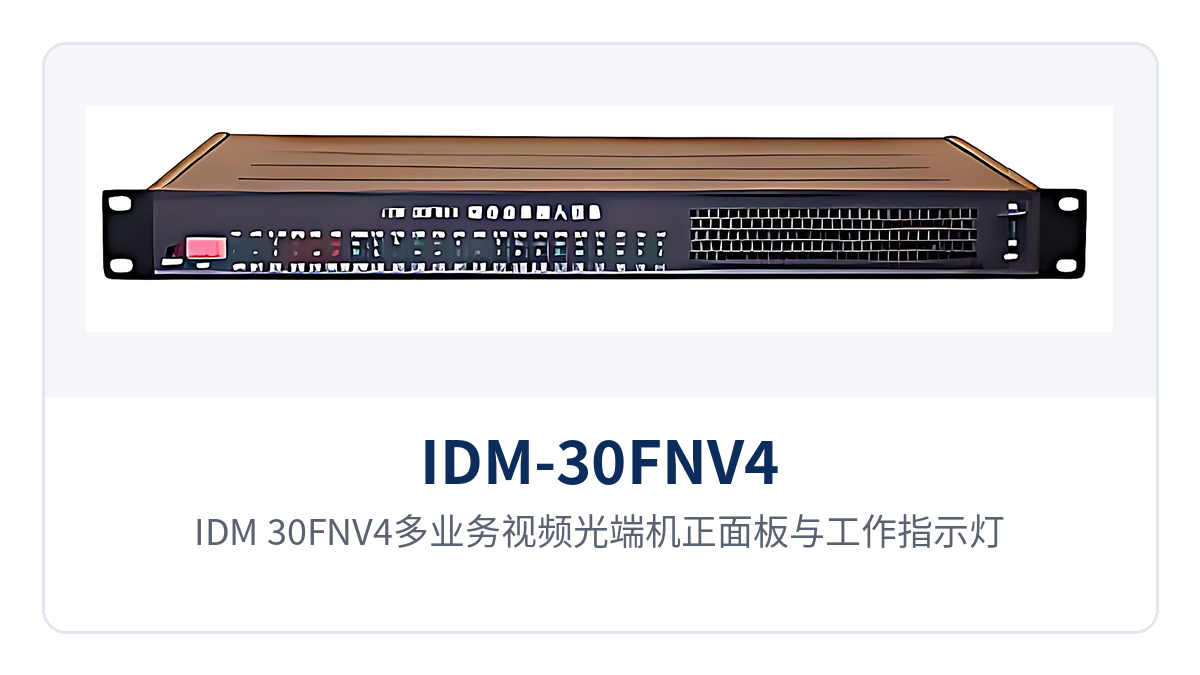
Figure 1: IDM-30FNV4 multi-service video optical multiplexer front panel and operating indicator LEDs
How does a single 1U device simultaneously carry video, E1, Ethernet, and PCM services
The IDM-30FNV4 multi-service video optical multiplexer performs multiplexing and transmission of video, E1, Ethernet, and PCM services within a 19-inch 1U chassis. The core functions are shown in the table below. The four types of services are divided by service card within the chassis, and the number of channels is configured according to the on-site service list.
| Function | Description |
|---|---|
| 4-channel all-digital uncompressed video | Supports 4-channel all-digital uncompressed video transmission. Video is digitally encoded at 8 bit onto the fiber without a compression encoding stage. Image details and synchronization among multiple services are not affected by encoding and decoding |
| Video format compatibility | Compatible with PAL, NTSC, and SECAM video formats. Front-end cameras do not require additional format conversion equipment |
| 8 groups of transparent transmission E1 channels | Provides 8 groups of transparent transmission E1 channels. E1 services are extended to the far end in transparent transmission mode, and the original frame structure and time slot division remain unchanged |
| 2 groups of VLAN-partitionable Ethernet | Provides 2 groups of shared line-rate 100M Ethernet interfaces with VLAN partitioning, interface type RJ-45, 10M/100M adaptive, supporting IEEE802.3 standard protocol, full/half duplex adaptive |
| 30-channel PCM multi-service access | Provides 30 channels of 64K or n×64K voice, data, image, and other service access, configurable with more than 20 types of subscriber interfaces |
| Interference-free transmission | Video and data services are transmitted over optical fiber with no electromagnetic interference (EMI) or radio frequency interference (RFI) |
| Card-based structure | Adopts a modular card-based structure design. More than 20 types of 64K data and voice services can be flexibly configured according to on-site requirements |
| Network management functions | Equipped with network management functions for online real-time monitoring of device operating status |
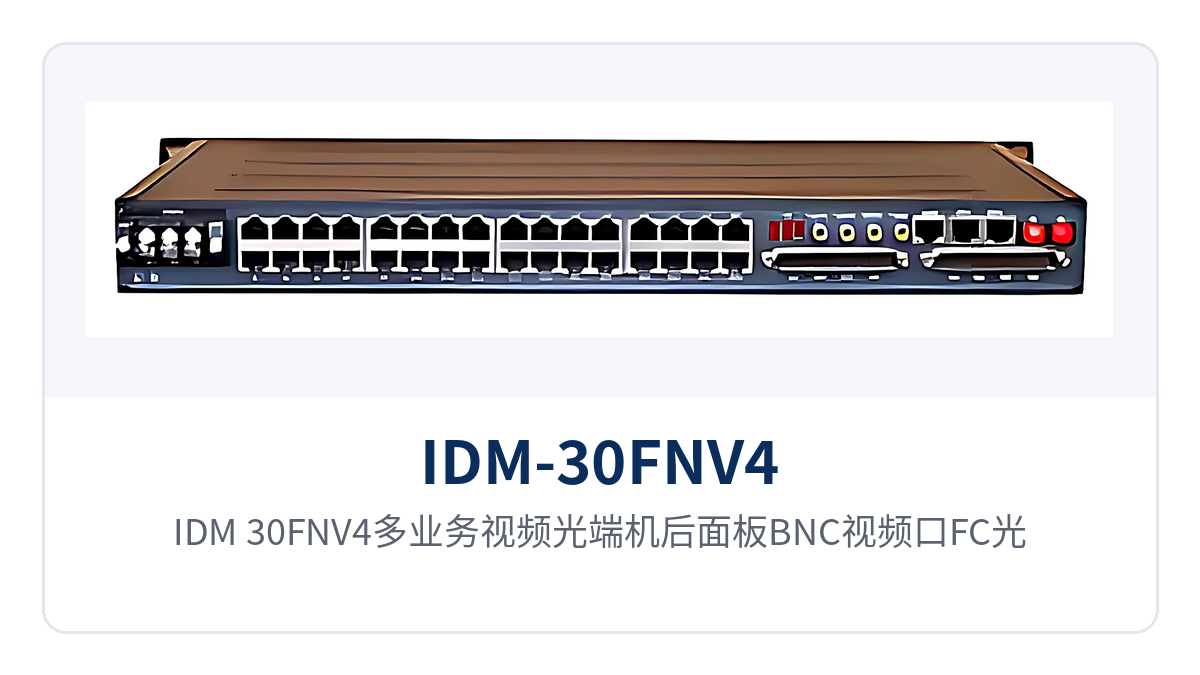
Figure 2: IDM-30FNV4 multi-service video optical multiplexer rear panel BNC video ports, FC optical ports, and E1/Ethernet interfaces
What are the optical interface, video, Ethernet, and PCM interface parameters
The interfaces and specifications of the IDM-30FNV4 multi-service video optical multiplexer are listed by service type. The optical interface is a standard FC type, and SC and other interface types can be customized according to project requirements. The optical and electrical ends are used in pairs.
Optical Interface Parameters
| Item | Parameter/Specification | Description/Applicable Conditions |
|---|---|---|
| Interface type | FC (SC and others can be customized) | Optical patch cord interfaces are selected according to the on-site optical cable termination method |
| Fiber mode | Single-mode (multimode optional) | 20 km single-mode transmission configuration |
| Receiver receive/transmit rate | 155 Mbps/155 Mbps | Nominal rate of the optical link |
| Receiver receive/transmit wavelength | 1310 nm/1550 nm | Dual-wavelength pairing for transmission and reception |
| Transmitter receive/transmit rate | 155 Mbps/155 Mbps | Nominal rate of the optical link |
| Transmitter receive/transmit wavelength | 1550 nm/1310 nm | Paired with the far-end wavelength |
| Transmit optical power | -15 to -8 dBm | Output optical power at the transmit side |
| Receiver sensitivity | Better than -21 dBm | Lower limit of optical power at which the receive side can operate normally |
| Transmission distance | 20 km | Long-distance optical modules can be optionally installed for longer-distance optical fiber transmission |
Video Interface Parameters
| Item | Parameter/Specification | Description/Applicable Conditions |
|---|---|---|
| Interface type | BNC | Video interface on the camera and monitor side |
| Video sampling bit width | 8 bit | All-digital uncompressed sampling precision |
| Video bandwidth | 0 Hz to 6.5 MHz | Covers standard-definition video baseband bandwidth |
| Luminance non-linearity | <3% | Image luminance distortion specification |
| Differential phase (DP) | <0.7° | Chrominance signal phase distortion specification |
| Differential gain (DG) | <0.7% | Chrominance signal amplitude distortion specification |
| Input overload voltage | 1.5 VP-P (typical) | Non-saturation voltage at the input |
| Input/output voltage | 1 VP-P (typical) | Standard video signal level |
| Input/output impedance | 75 Ω (unbalanced) | Impedance matching with conventional video equipment |
| Video SNR | ≥70 dB (weighted) | Weighted measurement basis, reflecting image noise level |
Ethernet Interface Parameters
| Item | Parameter/Specification | Description/Applicable Conditions |
|---|---|---|
| Number of channels | 2 groups | The two groups separately share line-rate 100M bandwidth and support VLAN partitioning |
| Interface type | RJ-45 | Connects to switches, network cameras, and other devices |
| Transmission rate | 10M/100M adaptive | Adapts to the access network rate |
| Standard protocol | Supports IEEE802.3 | Compatible with general Ethernet devices |
| Operating mode | Full/half duplex/adaptive | Negotiated with the far-end device |
Voice and Data Interface Parameters
| Item | Parameter/Specification | Description/Applicable Conditions |
|---|---|---|
| Voice service capacity | 30 channels of 64K or n×64K | A total of 30 channels for voice, data, image, and other services |
| Audio range | 300 Hz to 3400 Hz | Telephone voice bandwidth |
| Compression | ITU G.711 A-law | Voice encoding method |
| Impedance | Three-element complex impedance 200 Ω+560 Ω//0.1 μF | Matches SPC exchanges and the telephone side |
| Loop current | 25 mA/channel | Power feeding current per telephone channel |
| Data interface type | RJ-45 | Data port on the device side |
| Data type | RS-232, RS422 (4-wire), RS485 (2-wire) | Selected according to the interface types of on-site control and acquisition devices |
Power Supply, Power Consumption, Environmental, and Structural Parameters
| Item | Parameter/Specification | Description/Applicable Conditions |
|---|---|---|
| Power supply mode | AC220V/DC-48V/DC 9V | Selected according to equipment room and on-site power supply conditions |
| Overall power consumption | ≤40 W | Overall operating power consumption of one device simultaneously carrying four types of services |
| Operating temperature | -30℃ to +50℃ | Suitable for outdoor cabinets and equipment rooms with large temperature differences |
| Relative humidity | 0 to 95% (non-condensing) | Applicable condition in high-humidity environments is non-condensing |
| Product dimensions | 440×230×45 mm (Length×Depth×Height) | 19-inch 1U standard chassis, card-based structure |
How is 4-channel video and 8 groups of E1 same-fiber transmission implemented
The basis for implementing 4-channel video and 8 groups of E1 same-fiber transmission is that each type of service is first digitized and then multiplexed onto the same 155M optical link through its own fixed channel: 4-channel video occupies video channel bandwidth after 8-bit digital encoding, 8 groups of E1 are each mapped to independent transparent transmission time slots, 2 groups of Ethernet and 30-channel PCM services each occupy their own channel resources, and the four types of services are transmitted simultaneously over the optical fiber without interfering with one another. The IDM-30FNV4 multi-service video optical multiplexer is used in pairs. One end connects to on-site services, and the other end restores the same video, E1, Ethernet, and voice and data interfaces at the far end. This multi-service optical multiplexer performs multiplexing and transmission of video, E1, Ethernet, and PCM services over a single fiber, and is one of the main products offered by Raytrans, a professional optical multiplexer manufacturer, for multi-service access scenarios.
The public standard for the E1 interface is ITU-T G.703, with a nominal rate of 2.048 Mbps and line coding of HDB3. According to the PCM30/32 frame structure, each frame is divided into 32 64K time slots. The transparent transmission channels of the IDM-30FNV4 multi-service video optical multiplexer only perform optical-to-electrical and electrical-to-optical conversion and clock recovery, without parsing the voice channels and signaling inside E1. The frame structure, signaling method, and time slot division at the service side remain unchanged at the far end, and the E1 leased line, trunk, and clock synchronization relationships across sites are not affected. This transparent transmission method is equally applicable to PDH optical multiplexer application scenarios that need to carry E1 trunks and protection channels.
Eight groups of E1 channels, 4 channels of video, 2 groups of Ethernet, and 30 channels of PCM service share a 155M optical link. During the solution phase, the optical path capacity should be calculated by summing the actual bandwidth of each service type, with capacity expansion margin reserved. For on-site wiring, select the corresponding cables according to the equipment-side interface type; termination, shielding, and grounding shall follow communications equipment room construction practices. During commissioning, verify the bit error and alarm status of each E1 channel group by group.
How to Configure Service Cards for 30-Channel PCM Card Expansion
The approach to 30-channel PCM card expansion is to configure service cards according to the on-site service list. The per-channel rate is 64 kbit/s or n×64 kbit/s. The service types and quantities are determined by the service cards plugged into the enclosure. During capacity expansion, simply add or replace service cards without replacing the complete unit. The IDM-30FNV4 multi-service video optical multiplexer provides more than 20 types of subscriber interfaces for 30 channels of voice, data, and image services, making it a model with relatively high interface density in the optical multiplexer product showcase.
During configuration, first count the types and number of channels for voice, data, and image services according to the on-site service list, then allocate the corresponding service cards by slot, subsequently verify the power supply mode and cabinet space, and finally connect the optical path to enable and test each service item by item. Voice services are connected to the SPC exchange or telephone through FXO/FXS interfaces, with an audio range of 300 Hz to 3400 Hz, A-law companding per ITU G.711, a three-element complex impedance of 200Ω+560Ω//0.1μF, and a loop current of 25 mA per channel. Data services are connected through RJ-45 interfaces, supporting RS-232, RS-422 (4-wire), and RS-485 (2-wire) types, and can interface with collection terminals, control devices, and image service equipment.
The modular card-based structure keeps both the investment and downtime for service expansion controllable. During site upgrades, simply select service cards according to the type of newly added services, and the service configuration of existing channels remains unaffected. This modular design approach is also carried forward in other video optical multiplexer product series from Raytrans.
How to Implement VLAN Isolation on a Video Optical Multiplexer
The approach to VLAN isolation on a video optical multiplexer is to configure corresponding VLANs on the devices at both ends and on the switches, distributing traffic for different purposes onto two groups of Ethernet channels, thereby forming two logically independent network channels over the same pair of optical fibers. The 2 groups of Ethernet interfaces on the IDM-30FNV4 multi-service video optical multiplexer each share line-rate 100M bandwidth, both with RJ-45 interface type, 10M/100M adaptive transmission rate, support for the IEEE 802.3 standard protocol, and full/half duplex/adaptive operating mode, and can interface with the opposite-end switch through port negotiation.
A common practice is to have one group of Ethernet carry service traffic such as surveillance video and office traffic, and the other group carry production-type traffic such as device network management or protection and automation, so that the two groups of traffic do not interfere with each other. On site, there is no need to lay another optical fiber for the second network. The private network intranet and the production network can run in parallel over the same optical cable. This is also a common way in which the IDM-30FNV4 multi-service video optical multiplexer is used in electric power and energy private networks and government private network optical fiber communication solutions to separate production-type and management-type traffic services.
Typical Application Scenarios
The sites where the IDM-30FNV4 multi-service video optical multiplexer is applicable share a common characteristic: distributed sites, limited number of fiber cores, and limited cabinet space, while video, trunk, network, and voice services all need to be sent back together. Three indicators—operating temperature, power supply mode, and transmission distance—determine whether a device can operate stably at these sites over the long term.
Electric Power and Energy Private Network
Cameras, dispatch telephones, and protection channels at substations, distribution rooms, and new energy stations are distributed across different sites. The inter-station distance often exceeds the transmission range of cables, and the interior of the station is a strong electromagnetic environment. The IDM-30FNV4 multi-service video optical multiplexer uses a single optical fiber to send back 4 channels of video, 8 groups of E1 transparent transmission, 2 groups of VLAN Ethernet, and 30 channels of PCM voice and data services together to the centralized control station or dispatch center. The video channels carry uncompressed video backhaul from substations in 8-bit uncompressed mode, and the link is free from electromagnetic interference (EMI) and radio frequency interference (RFI). The E1 channels can be used for channel extension of protection and automation services, and the telephone channels are used for inter-station dispatching calls. The operating temperature of -30℃ to +50℃ and the DC-48V power supply mode adapt to outdoor substation cabinets and unattended sites.
Rail Transit and Expressways
Stations, section equipment rooms, toll stations, tunnels, and service areas along rail transit and expressways are separated by long distances with scattered sites, and communication services include video surveillance, dispatch telephones, public address, and device status data. The 20Km single-mode transmission and receiver sensitivity better than -21dBm of the IDM-30FNV4 multi-service video optical multiplexer cover the typical distance between adjacent stations. Unattended equipment rooms along the line can operate with the -30℃ to +50℃ operating temperature and DC-48V power supply. E1 channels are used for inter-station service trunking, 2 groups of Fast Ethernet with VLAN partitioning carry video and device data respectively, and 30 channels of PCM carry telephone and broadcast services. Laying a single optical cable along the line can meet the access requirements of multiple service types.
Military and Government Private Networks
Sites in military and government private networks are distributed and highly independent in their services, with high requirements for independently controllable links and service isolation. The IDM-30FNV4 multi-service video optical multiplexer multiplexes video, E1, Ethernet, and voice services onto its own optical fiber for transmission. The 2 groups of Ethernet achieve service isolation through VLAN partitioning, 30 channels of 64 kbit/s service are configured as required in card-based mode, and the network management functions support online real-time monitoring of device operating status, making it suitable for establishing unified multi-service transmission channels between camps, outposts, and dispersed office locations. In emergency communications vehicle scenarios, the IDM-30FNV4 multi-service video optical multiplexer can rapidly enable services with DC-48V and DC 9V power supply modes, and works with the military emergency communications vehicle solution to achieve rapid on-site deployment. For government private network optical fiber communication solutions and smart mining communication solutions, this device can likewise carry video surveillance, dispatch voice, and data channels in a multi-service over a single fiber manner.
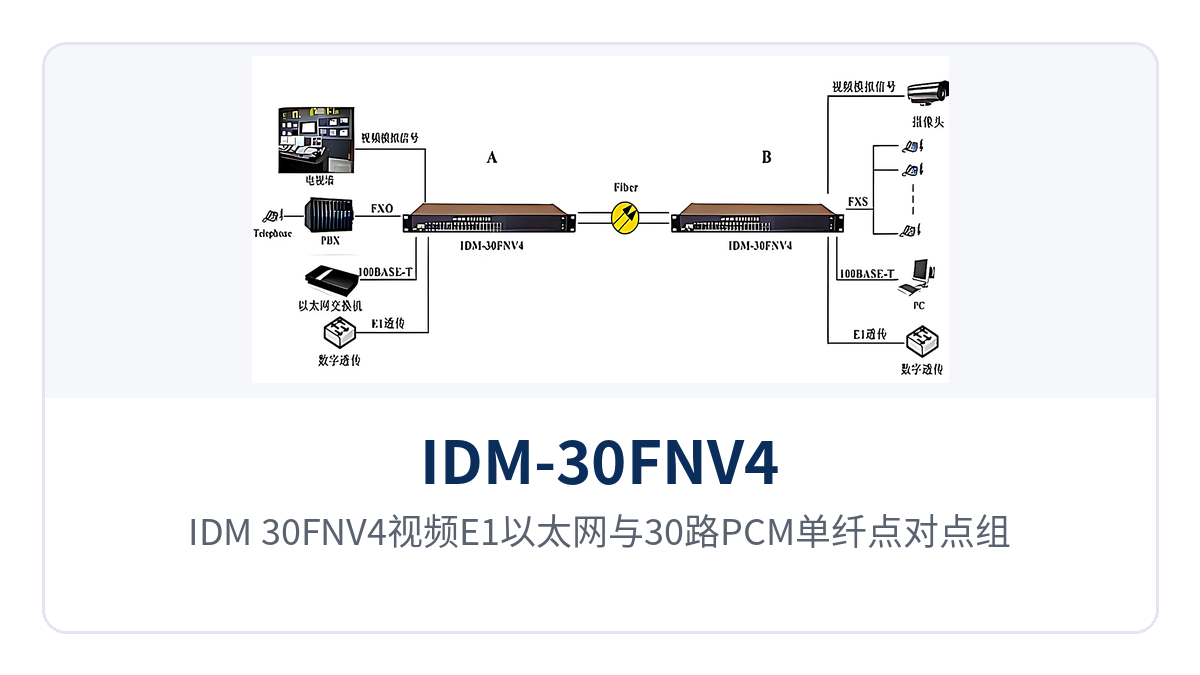
Figure 3: IDM-30FNV4 video, E1, Ethernet, and 30-channel PCM single-fiber point-to-point networking diagram
Differentiated Value
| Differentiated Capability | Technical Support | On-Site Value |
|---|---|---|
| Single-fiber 20Km transmission | 4 channels of uncompressed video, video encoded onto the fiber in 8-bit digital encoding, standard configuration with 20Km single-mode transmission distance, optional long-distance optical module for longer-distance optical fiber transmission | A pair of optical fibers spans the typical distance between adjacent sites; video pictures do not go through a compression encoding stage, and picture quality is not affected by encoding and decoding |
| Standalone integration of 30-channel PCM + 8 groups of E1 | One device simultaneously provides 30 channels of 64 kbit/s or n×64 kbit/s PCM service access, 8 groups of E1 transparent transmission channels, and 2 groups of shared line-rate 100M Ethernet with VLAN partitioning | Multi-service access over one line; the site side no longer needs to deploy separate transmission devices for video, trunk, and voice and data, saving both rack positions and the number of fiber cores |
| Supports -30℃~+50℃ wide temperature, three power supply options (AC/DC), suitable for the field | Operating temperature -30℃ to +50℃, relative humidity 0 to 95% (non-condensing), supports AC220V, DC-48V, and DC 9V power supply modes, overall power consumption ≤40W | Adapts to field cabinets and unattended sites; both in-station DC power and mains power conditions allow direct power supply access for operation |
Summary
The Raytrans IDM-30FNV4 multi-service video optical multiplexer is a 20Km single-fiber, wide-temperature, three-power-supply video optical multiplexer that multiplexes four types of services—video, E1, Ethernet, and PCM—onto a pair of optical fibers: 4 channels of uncompressed video are encoded onto the fiber in 8-bit digital encoding, with a video SNR ≥70dB (weighted) and resistance to EMI/RFI; 8 channels of E1 transparent transmission carry existing dedicated line and trunk services; 2 channels of VLAN Fast Ethernet achieve service isolation; and 30 channels of PCM card-based services carry voice and data access with on-demand capacity expansion. With 20Km single-mode transmission, -30℃ to +50℃ wide temperature operation, AC220V/DC-48V/DC 9V AC/DC three power supply options, and a 19-inch 1U modular card-based structure, the device adapts to distributed sites and unattended equipment rooms in electric power and energy private networks, rail transit and expressway communications, and military and government private networks, and can be flexibly incorporated into smart mining communication solutions, military emergency communications vehicle solutions, and government private network optical fiber communication solutions. During selection, verify the number of interface channels, power supply mode, and transmission distance according to the on-site service list. For specific configurations, refer to the optical multiplexer manufacturer's technical documentation and commercial confirmation.