
IDM DT02
IDM DT02
The IP-based elevator five-party intercom system is a serverless, IP-transmission-based five-party intercom system that not only supports traditional three-party or five-party intercom terminals, but also enables visual operation. Most importantly, it is compatible with multi-party intercom terminals using various protocol interfaces within the same system. It provides both IP transmission access and centralized dispatch functions (leveraging IoT servers and transmission protocols).
Currently, elevator intercoms are mainly divided into two categories: center-end dialing type elevator intercoms (Mitsubishi elevator intercom type) and center-end one-key call type elevator intercoms (Deling elevator intercom type).
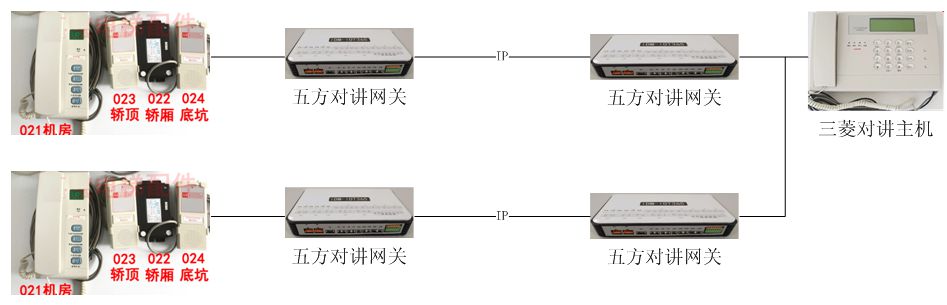
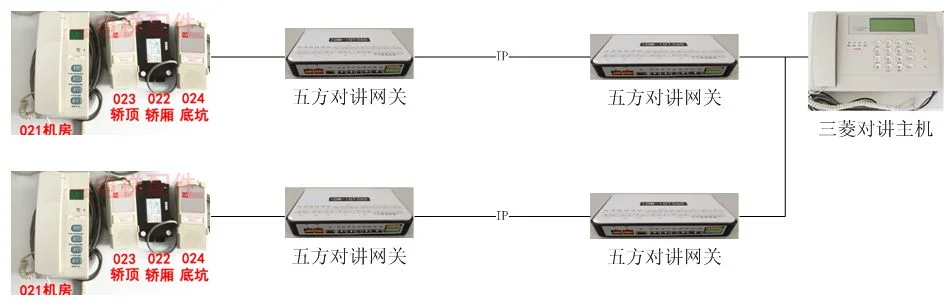
The Mitsubishi type uses two external line interfaces to connect to the elevator intercom's voice interface and signaling DTMF interface respectively, with the host providing dialing and number detection to the extensions.
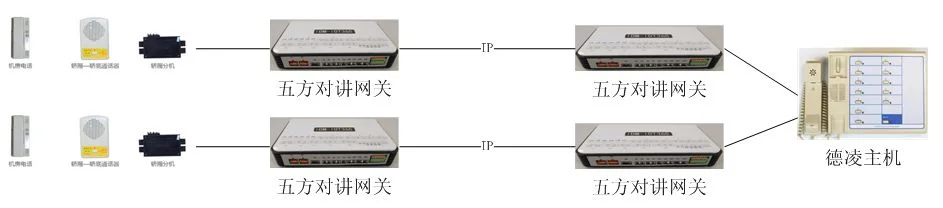
The Deling type uses a twisted-pair interface where one voice channel shares signaling.
Traditional five-party intercom systems use twisted-pair transmission. However, since fiber optic transmission is used between buildings, audio cables such as twisted-pair are rarely used due to high cost and limited transmission distance. Wireless transmission is subject to radio regulations and limited transmission distance, and signals including GSM suffer from unstable transmission quality. Therefore, elevator intercom optical terminals are now widely used to extend the transmission distance of traditional twisted-pair while keeping the traditional five-party intercom terminals unchanged, saving significant costs.
Some have also converted SIP-based IP phone systems into five-party intercoms, but some require terminal replacement, causing construction difficulties, and all require IP communication servers, making operation cumbersome.
A serverless, IP-transmission-based five-party intercom system not only supports traditional three-party or five-party intercom terminals, but also enables visual operation. Most importantly, it is compatible with multi-party intercom terminals using various protocol interfaces within the same system. It provides both IP transmission access and centralized dispatch functions (leveraging IoT servers and transmission protocols), with two usage modes:
- IP-transmission-based five-party intercom access function:
Both the center end and remote end use existing equipment, with the IOT365-DT02 only providing the five-party intercom access interface and IP transmission interface.
(1) For Mitsubishi elevator IP intercom type, the center-end Mitsubishi protocol is reconstructed, including center-end dialing to remote ends and remote-end calling to the center end, implementing intercom protocols with five-party intercom terminals;
(2) By transmitting telephone-like signaling protocols over the IP network and reconstructing level signaling at the other end, the center end can dispatch Deling-type two-wire or four-wire elevator IP intercoms
- Integrated dispatch system for IP-transmission-based five-party intercom
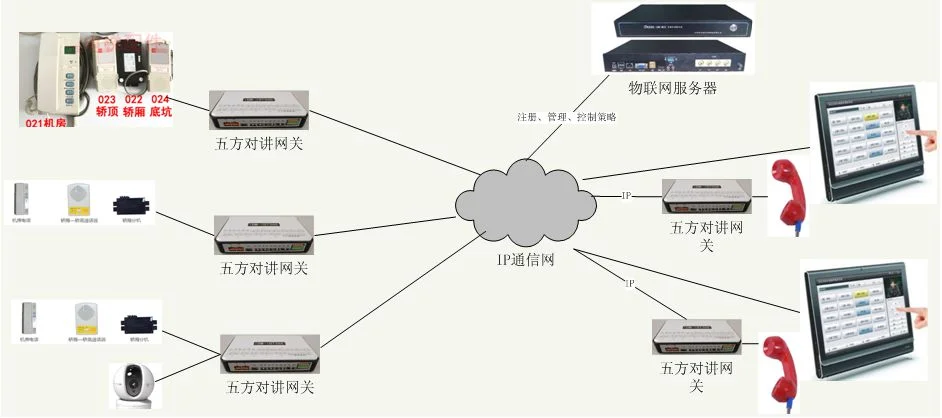
The remote end uses the original five-party intercom terminals, while the center end uses an integrated dispatch terminal, providing unified dispatch for all types of elevator intercoms.
(1) All five-party intercom terminals, five-party intercom center-end voice gateways, and display control terminals are registered on the IoT server.
(2) Through IoT protocols, Mitsubishi and Deling intercom terminals based on IP transmission are reconstructed. Terminals directly send status to the IoT server, which is responsible for establishing audio calls.
① When the Mitsubishi intercom elevator end calls the center end, the elevator end sends the calling number to the server. The server returns confirmation upon receipt, and simultaneously notifies the console of the status change via message, while establishing a voice channel between the center-end voice gateway and the elevator end;
② When the center end calls the elevator end, the console sends a request to the server. The server communicates with the elevator end via messages, while the center-end gateway and elevator end establish a voice channel;
③ To end the call, regardless of which side hangs up first, the server and elevator end confirm call termination through message exchange.
④ For Deling intercoms, the call status between the center end and elevator end is converted into messages to the center end.
(3) All devices send their status to the IoT server via IoT protocols.
(4) Based on the operation status on the dispatch console, audio calls are established between the center-end voice and five-party intercom terminal voice.
(5) Video linkage is performed simultaneously.
(6) Upon call termination, the IoT server restores the status of each terminal.
- Installation of IP elevator intercom access terminals
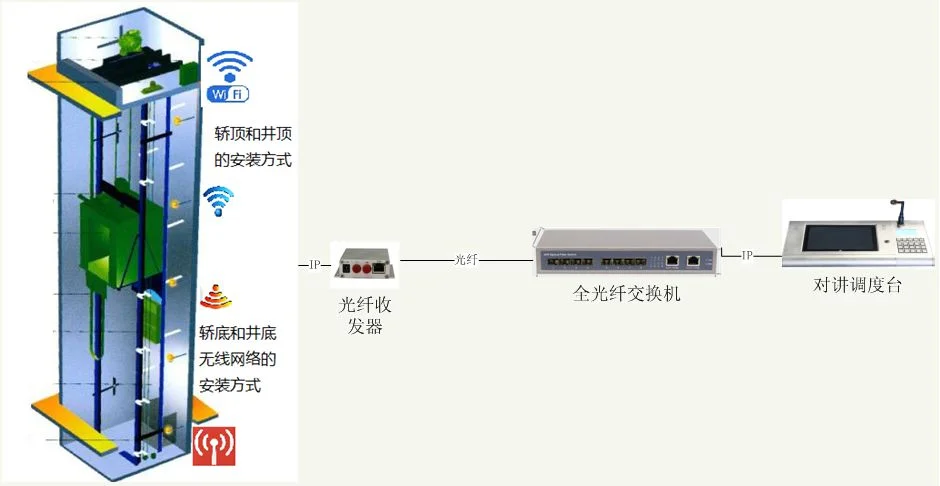
(1) Original twisted-pair cables can still be used between the elevator car, car top, and car bottom, while IP transmission is used between the machine room and management center.
Some car retrofits use wireless transmission. Due to the special monitoring environment inside elevators, where the elevator moves up and down continuously, if wired transmission is adopted, elevator-specific tensile-resistant network cables must be used. Ordinary network cables cannot be used, as they are easily pulled apart over time, affecting signal transmission. Five-party intercom and elevator surveillance can also use wireless transmission. The wireless bridge transmitter is fixed on the car top, and the receiver is fixed at the top of the elevator shaft. The elevator network surveillance camera can be powered directly by a 220V to DC12V power adapter plugged into the car top. The wireless bridge inside the elevator can be used for video transmission within the elevator shaft, and can also utilize multiple network ports to host in-elevator advertising machines for real-time content updates.
(2) IP network five-party intercom optical terminal
For ease of use, the remote IP five-party intercom terminal is typically integrated with a media converter to form an IP network five-party intercom optical terminal. The terminal can use an all-optical Ethernet switch with 8 or 24 100M Ethernet optical ports. After conversion to Gigabit Ethernet, it connects to the center-end integrated intercom dispatch console. This center system can simultaneously support dialing-type intercoms (such as Mitsubishi intercoms) and dedicated-line type intercoms (such as Deling intercoms). It can also support the integration of access control intercom systems.
4. Extended application scenarios for IP intercom
IP intercom systems feature simple networking, easy operation, and fast voice transmission, making them a fundamental tool for management and dispatch. Building intercom systems bring great convenience to security, business communication, equipment maintenance, property management, and other management tasks, enabling efficient and real-time handling of various events. In the hotel industry, hospital healthcare, utility tunnels, non-coal mines, large-scale manufacturing, large-scale warehousing, logistics parks, sports venues, etc., IP networks are already deployed, making IP intercoms suitable for widespread adoption.